

You’ve probably seen the word “empath” plastered across Pinterest boards and Instagram captions so many times it’s lost all meaning. But here’s the thing: if you’re genuinely asking what personality type is the empath, you’re likely not searching for a mood board. You’re searching because something real is happening to you. You’re exhausted in a way that sleep doesn’t fix. You absorb stress from a room the moment you walk into it. You cry at news stories your coworkers scroll past without blinking. That’s not weakness. That’s neurobiology.
And the advice you’ve been getting? “Just set better boundaries.” “Stop being so sensitive.” Completely useless, right? Because nobody’s actually explained why you work the way you do. That changes today.
What the Empath Actually Is (Beyond the Social Media Version)
Let’s get the definition on the table right away, because a lot of what’s floating around online is just wrong.
An empath is a person with high Sensory Processing Sensitivity (SPS), most commonly identified through INFJ or INFP personality profiles. Biologically, they carry a hyper-responsive Mirror Neuron System and elevated insula-cingulate activation, causing the involuntary absorption of others’ emotional and sometimes physical states. This is a neurobiological trait, not a spiritual gift or a personal flaw.
Table of Contents
That 55-word definition matters because it moves the conversation out of the metaphysical and into the measurable. Research published through the American Psychological Association has consistently shown that Sensory Processing Sensitivity affects roughly 20% of the population, cutting across every culture studied. You are not rare because you’re broken. You’re rare because your brain is wired for depth.
Here’s the biological picture in plain language:
- The Mirror Neuron System (MNS): Located in the inferior frontal gyrus, this network fires when you observe someone else’s actions or emotions. In high-SPS individuals, this system is essentially louder, more reactive, picking up signals the average person filters out entirely.
- The Insula-Cingulate Cortex: This is where empathy gets physical. When someone near you is in pain, your insula lights up as if you are in pain. This is why arguments in the next room give you a headache. Literally.
- The Thalamus Threshold: Your thalamus acts as a sensory gatekeeper. Empaths typically have a lower stimulus threshold, meaning more information gets through. Background noise, micro-expressions, the tension in someone’s voice when they say “I’m fine” — all of it lands.
Key Takeaway: Empathy, at its neurological core, is not a choice. It’s a feature of your brain’s architecture.
The MBTI Connection: Which Types Carry This Trait Most Often?
Here’s where it gets interesting. The Myers-Briggs framework, while imperfect, gives us useful shorthand for how empathy actually expresses itself across different personalities.
| Empath “Face” | MBTI Type | Empathy Style | Core Mechanism |
|---|---|---|---|
| The Mirror | INFP / ISFP | Feels with you through internal simulation | Introverted Feeling (Fi) |
| The Radar | INFJ / ENFJ | Scans and manages group emotional atmosphere | Extraverted Feeling (Fe) |
| The Logical Empath | INTP / ISTP | Intellectually processes emotional data first | Ti + Fe loop |
| The Empathic Activist | ENFP / ESFJ | Channels emotion into action and advocacy | Ne/Fe combination |
The INFJ “Radar” and INFP “Mirror” show up most frequently in clinical discussions of high empathy, largely because their dominant cognitive functions are built around feeling states. But it’s a mistake to assume all empaths are introverted. ENFJs, for example, are among the most empathically attuned personality types in the entire MBTI system.
What unites them? The 5-HTTLPR short (S) variant gene, which regulates serotonin transport and is linked to heightened emotional reactivity. People carrying this variant aren’t just perceiving more. They’re processing more, at a neurological level, with every social interaction.
Key Takeaway: The empath is not one MBTI type. It’s a cluster of types unified by a measurable neurobiological signature.
What Personality Type Is the Empath vs. HSP vs. Dark Empath

People confuse these three constantly, and the confusion has real consequences. Knowing which category fits you (or someone around you) shapes everything from career decisions to relationship boundaries.
| Profile | Core Driver | What Makes It Distinct | Watch Out For |
|---|---|---|---|
| Empath (Affective) | Emotional contagion | Actually feels others’ pain physically | Empathic distress and burnout |
| HSP (Highly Sensitive Person) | Deep sensory processing | Sensitive to ALL stimuli, not just emotions | Overstimulation in open offices, loud environments |
| Dark Empath | Cognitive empathy | Reads emotions perfectly but uses that info strategically | Appearing warm while being quietly manipulative |
| Trauma Response (Hyper-Vigilance) | Survival instinct | Scans moods to avoid threat, not to connect | Often mistaken for empathy; it’s a stress response |
This table is worth studying. The trauma-versus-trait distinction is one that comes up constantly in my work with clients, and getting it wrong leads people to either over-pathologize themselves or under-address real trauma. True empathy feels like an open door. Hyper-vigilance feels like a security camera scanning for danger.
As researcher Dr. Elaine Aron notes, “Sensitivity is not a flaw, but an evolutionary strategy.” She’s been studying this since the 1990s, and her work on SPS remains the most robust foundation we have for understanding the empath’s neurological reality. That framing matters because it repositions sensitivity from burden to biological advantage, which changes how you approach literally everything else.
The Science Behind the Empath Brain
Recent fMRI studies have confirmed something striking: high-SPS individuals don’t just respond more strongly to emotional stimuli overall. They respond selectively and more intensely to people they’re close to, compared to strangers. The empathic brain isn’t just an indiscriminate sponge. It’s a precision instrument calibrated for depth of connection over breadth.
A 2026 meta-analysis reviewed digital empathy interventions and found that, while apps and AI tools can simulate empathic responses, they consistently fall short of human-to-human interaction in generating what researchers call “attuned interaction,” the recursive, memory-dependent quality of genuine emotional connection. AI doesn’t remember your becoming. It doesn’t carry your history. It optimizes for engagement, not for truth.
This is relevant because many empaths are increasingly turning to AI companions for emotional support, precisely because those tools feel “safer” than unpredictable people. That pattern is worth examining honestly.
Key Takeaway: Your empathic brain is built for deep, selective connection. Digital substitutes can’t replicate that, no matter how convincing they sound.
A Real Story: How Marcus Finally Stopped Running on Empty

Marcus, 34, remote marketing manager, INFJ. He reached out to me on a Tuesday evening, which I remember because it was almost 9 PM and he’d been in back-to-back virtual meetings since 8 AM. His camera was off. He was, as he put it, “cooked.”
He described walking through his apartment after calls, feeling like he was wearing everyone else’s emotions as a second skin. He’d pick up his phone to decompress and spend an hour doomscrolling — absorbing more emotional content from strangers — and then wonder why he couldn’t sleep.
He didn’t understand why his colleagues looked energized at the end of the same meetings that left him hollowed out. He’d started doubting his fitness for leadership entirely.
What Marcus didn’t know was that his brain was doing something extraordinary during those calls: scanning for interpersonal signals, reading the tension between team members, registering the colleague who was one bad conversation away from quitting. His managers weren’t picking up any of that. He was.
The shift happened when Marcus started what I call “Neural Dark Time” — 20 minutes post-workday, low light, no screens, just stillness. He also restructured one relationship boundary using a direct conversation script (more on that below). Six months later, his team’s retention had improved markedly. He’d moved from passive absorber to what I call an “empathic architect.” Same brain. Different strategy.
He didn’t fix his sensitivity. He learned to work with his neurobiology instead of fighting it.
7 Steps to Functional Empathy Right Now
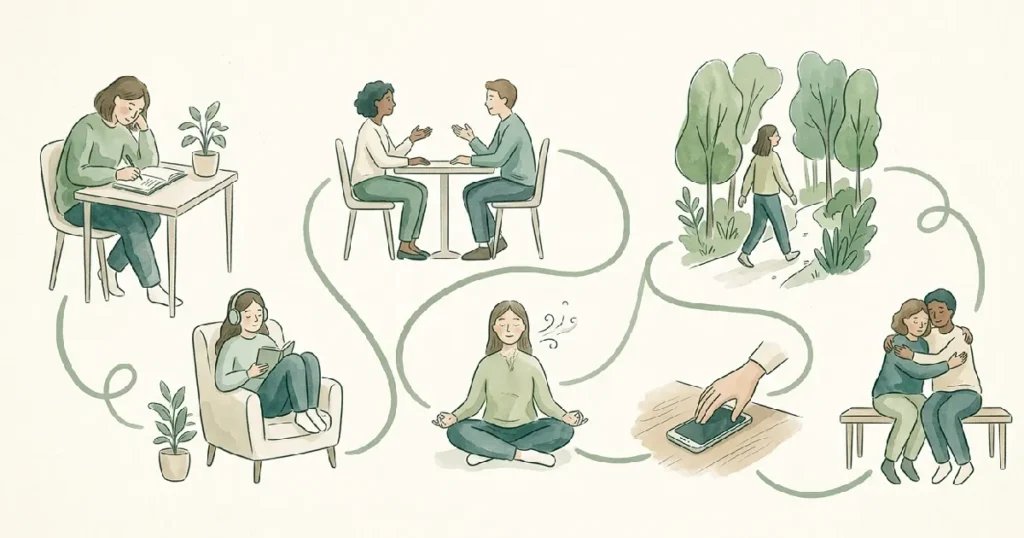
No more generic advice. Here’s what actually works for the empathic brain in today’s world.
Step 1: Run a Biological Baseline Audit
Download a mood-tracking app (Daylio works well) and log your energy every two hours for one week. Note: Are you near screens? Did you just check the news? You need to distinguish between your innate sensitivity and “algorithmic arousal” — the manufactured emotional spike that social media feeds are engineered to trigger.
Step 2: Build “Neural Dark Time” Into Your Day
After any high-contact work period, take 20 minutes in a low-stimulus space. No phone. Low light. Noise-canceling headphones if you have them. Your lower thalamus threshold means you need longer than average to metabolize the sensory data of the day. This isn’t indulgence. It’s maintenance.
Step 3: Use “Cognitive Offloading” Before You Spiral
Grab a journal (or use a structured journaling app like Life Note) and write out the emotional pattern before it loops. Empaths tend to ruminate. Writing externalizes the loop and makes it visible, which is often enough to break the cycle. Try this prompt: “What emotion am I holding right now, and is it actually mine?”
Step 4: Use the DEAR MAN Script for Boundaries
From Dialectical Behavior Therapy, this script gives you a framework that doesn’t require you to be mean to be clear:
- Describe the facts without judgment
- Express your feelings using “I” statements
- Assert your actual need
- Reinforce the benefit for both of you
- Mindful of staying on topic
- Appear confident (even if you’re not feeling it)
- Negotiate a workable solution
Example message you can adapt: “I’ve noticed I’m less effective after back-to-back calls. I need a 15-minute buffer between meetings to show up well. Can we build that into the schedule going forward?” Clean. Specific. Non-dramatic.
Step 5: Build Vagal Tone (Yes, Really)
Your vagus nerve is the biological highway connecting your brain to your emotional regulation system. Singing, humming, cold water on your face, and slow exhales (longer out-breath than in-breath) all stimulate it. Higher vagal tone equals faster emotional recovery after empathic overload. This is body-based, and it works.
Step 6: Do an Emotional Reciprocity Audit
List your five closest relationships and honestly answer this question for each: “Does this person have the capacity to hold space for me, or am I always the container?” Connection without reciprocity becomes slow self-destruction for empaths. This isn’t about cutting people off. It’s about being honest about what each relationship actually costs you.
Step 7: Position Your Empathy as a Professional Asset
In workplaces where AI is handling data processing, your value is in what AI can’t do. Research from the Greater Good Science Center at UC Berkeley shows that empathy-driven leadership improves team cohesion and reduces turnover in measurable ways. Stop trying to compete on speed. Start positioning yourself as the person who notices what the dashboards miss.
Key Takeaway: These aren’t soft suggestions. They’re neural maintenance protocols for a brain running a more complex operating system than most.
Common Mistakes Empaths Make (And How to Fix)

Mistake 1: Treating an AI Chatbot Like a Therapist
A lot of empaths are gravitating toward AI companions because they feel “safer” than humans. And honestly, I get it. But AI doesn’t carry your history. It forgets the weight of what you’ve shared the moment a session ends. It produces warmth without memory, which isn’t connection. It’s a simulation.
The Fix: When you notice you’re turning to a bot more than a person, send this exact message to one trusted human: “Hey, I’ve been feeling kind of disconnected lately. Could we do a 10-minute no-agenda call this week just to catch up?” That’s it. Low stakes. High return.
Mistake 2: Taking On Other People’s Pain as Your Responsibility
Empaths often feel a deep pull to fix everyone around them, even at personal cost. This is especially risky right now when collective anxiety is at unusual heights and everyone seems to need something.
The Fix: Practice this internal script when you feel the pull to rescue: “I can see their pain clearly. That doesn’t make it mine to solve. My first job is to keep my own footing so I have something real to offer.” Write it on a Post-it. I’m serious.
Mistake 3: Going Silent When You’re Overwhelmed in Group Settings
Instead of naming what’s happening, many empaths just disappear — go quiet in meetings, pull back from conversations, become unreachable. This confuses people and erodes trust.
The Fix: Use selective disclosure with one safe person. Try this: “I’m highly attuned to the energy in group settings, and sometimes I need a beat to process before I respond. If I go quiet on a call, I’ll always follow up in writing within the hour.” One sentence of context prevents a lot of misunderstanding.
Mistake 4: Over-Analyzing Digital Text for Emotional Cues That Aren’t There
Empaths are built to read tone, body language, and micro-expressions. Text strips all of that away, so the empathic brain often invents the missing data — usually in the most anxious direction possible.
The Fix: Use what I call the 7.5-Hour Rule. If you’ve spent more than 7.5 cumulative hours in text-only communication, your emotional read accuracy drops significantly. Switch to voice or video for anything emotionally important. Or, if you can, spend 20 minutes with a pet or in nature. Studies on human-animal interaction confirm this resets the mirror neuron system better than almost anything else.
Frequently Asked Questions
Can someone be “too empathetic”?
Clinically, there is no diagnosis of “excessive empathy,” but there is a well-documented state called empathic distress. This happens when your mirror neurons are highly reactive but your cognitive detachment skills are underdeveloped. The goal isn’t less empathy. It’s what researchers call “regulated resonance,” the ability to feel deeply while keeping your own identity intact. Think of it as staying warm without catching fire.
Are all empaths INFJs?
No. While INFJ and INFP types show the highest frequency of empathic traits (around 60% of Feeling-dominant types), the empathic profile also appears in INTPs and ISTPs who process emotional data intellectually before acting on it. These “Logical Empaths” often appear detached but are quietly running deep analyses of the human dynamics around them. The trait cuts across typology.
How do I know if my empathy is a trauma response instead of a trait?
Innate empathy feels like a gift of connection, something that expands you. Trauma-based hyper-vigilance feels like scanning for danger to stay safe. If you’re reading someone’s mood to predict whether they’ll blow up at you, that’s fawning and it’s a coping response, not empathy. True empathy is chosen. Hyper-vigilance is compelled. The difference in your body is usually clear once you start paying attention to it.
What exactly is a Dark Empath?
A Dark Empath scores high on cognitive empathy (accurately reading feelings) but also high on the “Dark Triad” personality cluster (narcissism, Machiavellianism, psychopathy). They understand your emotional state with precision, which makes them extraordinarily effective at manipulation while appearing warm and agreeable. Unlike the affective empath, they don’t feel your pain. They catalog it. This is a research-supported construct, not a social media myth.
Why do I feel physically sick when people around me are arguing?
Your nervous system is genuinely reacting, not overreacting. Your mirror neurons are translating the aggression around you into a physical fight-or-flight signal in your own body. According to the Cleveland Clinic, stress responses like nausea, migraines, and rapid heartbeat are direct outputs of your autonomic nervous system. For empaths, these responses fire at lower thresholds, which is neurologically normal for your wiring.
Can an AI ever be a real empath?
No, and I want to be direct about this. AI can produce responses that feel empathic because they’re statistically calibrated to sound that way. But they lack what researchers call “situational affective empathy,” the biological state of actually feeling something shift in your body in response to another living being. AI simulates attunement. It doesn’t experience it. That distinction will matter more, not less, as these tools become more sophisticated.
Final Takeaway
Here’s the honest summary: being an empath is not about being broken, spiritual, or special. It’s about having a specific neurobiological configuration that makes you remarkably good at some things (reading people, building trust, noticing what’s wrong before anyone else does) and genuinely challenged by others (chronic overstimulation, absorbing stress, struggling in cue-poor digital environments).
The path forward is not to wish your sensitivity away. It’s to understand it well enough to work with it deliberately.
Your action this week is simple. Pick one “cue-deficient” communication channel — maybe it’s a group text thread that spikes your anxiety, or a Slack channel that never stops buzzing — and replace it with one cue-rich interaction. A phone call. A walk with a friend. Even 20 minutes in your backyard without your phone.
Notice what your nervous system does when you stop outsourcing your attunement to an algorithm.
Being an empath means having a neurobiological superpower that the modern world hasn’t fully learned to support yet. Your job is to stop waiting for the world to catch up and start building the structures that let you function brilliantly on your own terms.
My Closing Remarks:
Honestly? I’m going to say the thing most therapists won’t: the world doesn’t deserve your empathy if it hasn’t earned your trust. I’ve sat with clients who gave everything to relationships, teams, and causes that gave nothing back, and called it virtue. It wasn’t virtue. It was self-erasure. Your sensitivity is real, your neurobiology is real, and your limits are real. Stop performing endless compassion for people who aren’t even paying attention. Protect your resonance like it’s the most valuable thing you own. Because it is.
– Nicole Adkins, LMFT
More Related Stories for You
If this article sparked something for you, you might want to keep reading. Understanding your personality on a deeper level changes how you move through the world. Here are two pieces I’d genuinely recommend:
- Curious how personality shows up differently across women’s experiences? Explore female personality types for a grounded look at how gender intersects with your core wiring.
- Want the foundation under all of this? Start with 7 basic personality traits to understand the building blocks that shape how every personality type, including yours, actually functions.