
 Nicole Adkins
The most dangerous form of narcissism doesn’t arrive with arrogance and loud demands. It arrives with a warm smile, a generous gesture, and the slow, quiet erasure of everything you once trusted about yourself.
Key Points
- The signs of a female narcissist are uniquely difficult to detect because they often hide behind socially rewarded traits like warmth, generosity, and emotional sensitivity, making victims doubt their own perceptions for months or even years.
- Research shows that vulnerable or covert narcissism in women is strongly linked to emotional manipulation, chronic blame-shifting, and even intimate partner violence, but these patterns rarely match the stereotypical image of a narcissist.
- Recognizing these 13 hidden warning signs is your first step toward reclaiming your reality, protecting your emotional health, and understanding that what you’ve been feeling is not your fault.
Contents
Table of Contents
When “Too Good to Be True” Becomes Your Entire Reality
You are sitting across from someone who remembers every detail you ever shared. She brought your favorite coffee without being asked. She told your friends how much she admires you. She cried when you told her about your childhood.
And yet, somehow, you feel worse about yourself than you have in years.
You can’t explain it. There’s no yelling. No obvious cruelty. But something is off. You feel smaller. More uncertain. More apologetic for things you never used to apologize for.
If this sounds familiar, you are not imagining things. And you are not alone.
Why Traditional Warning Signs Miss Her Completely
Most people picture a narcissist as someone loud, boastful, and obviously self-centered. That image is based almost entirely on grandiose narcissism, which research consistently associates more with men. But there is a second form that flies under nearly every radar.
It’s called vulnerable or covert narcissism, and a growing body of evidence shows it manifests more frequently in women. A 2021 study published in the Journal of Personality Disorders found that vulnerable narcissism is characterized by emotional hypersensitivity, chronic feelings of inadequacy masked by outward helpfulness, and a deep need for admiration that hides behind a humble exterior. Unlike the grandiose narcissist who demands attention openly, the covert narcissist collects it through sympathy, sacrifice, and carefully performed kindness.
This is precisely what makes the signs of a female narcissist so chilling. The behavior doesn’t look like abuse. It looks like love. It looks like effort. It looks like someone who cares deeply.
Until it doesn’t.
And by the time you see the pattern clearly, your sense of self has already started to dissolve. Think of it like carbon monoxide. You can’t see it. You can’t smell it. But it changes the air in the room so gradually that you don’t realize you’ve been breathing something toxic until you can barely stand.
Here are the 13 signs almost nobody warns you about.
The 13 Hidden Signs of a Female Narcissist
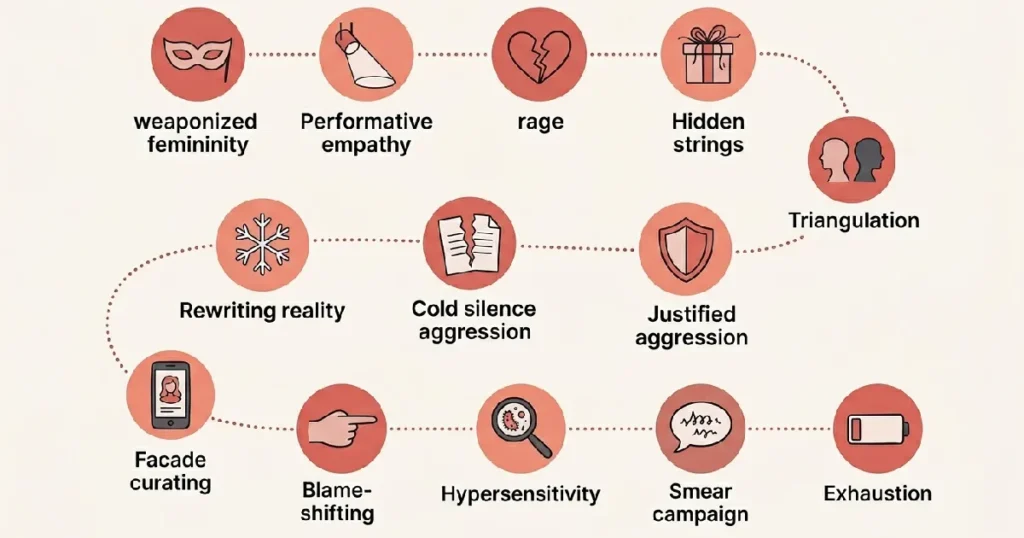
1. She Uses Softness as a Weapon
She speaks quietly. She moves gently. She never raises her voice in public. And that is exactly the point.
This is what researchers describe as “weaponized femininity,” the strategic use of culturally feminine traits to disarm suspicion and avoid accountability. Society does not suspect a soft-spoken, nurturing woman of emotional abuse. She knows this, and she uses it. Behind the gentle exterior, her behavior is calculated. If you ever try to describe what she’s doing to someone outside the relationship, you’ll watch their face shift into disbelief. “Her? She’s so sweet.”
That disbelief is her greatest shield.
2. Her Empathy Has an Audience
In public, she is the first to cry at someone’s story. On social media, she posts about compassion and healing. Friends describe her as “the most empathetic person I know.”
But you have seen what happens when the audience leaves. Behind closed doors, your distress is met with indifference, irritation, or a swift redirect back to her needs. Her empathy is performative. It functions like a stage costume she puts on when others are watching and removes the moment she walks through the front door.
This selective empathy is one of the most disorienting signs of a female narcissist because it makes you question whether you are remembering correctly. You are.
3. Her Rage Erupts When Validation Stops
Her self-worth depends on a constant stream of praise, attention, and reassurance from you. When that stream slows, even briefly, something shifts.
Maybe you forgot to compliment her. Maybe you were distracted by your own stress. It doesn’t matter. What follows is an eruption of anger that seems wildly out of proportion to the situation. In my practice, I’ve seen this described as “entitlement rage,” a volcanic emotional response triggered not by a real offense, but by the perceived withdrawal of admiration she believes she is owed.
This rage often disappears as quickly as it appeared, leaving you confused about what just happened and desperate to prevent it from happening again.
4. Her Generosity Always Has a Price Tag
She gives gifts you didn’t ask for. She helps without being asked. She shows up when you least expect it. It feels wonderful at first.
But here is what nobody warns you about: every gift is a receipt. Every favor is a future debt. A woman I worked with, let’s call her Dana, described it this way: “She would do something incredibly kind for me, and then three months later, she’d use it as proof that I owed her. If I set a boundary, she’d say, ‘After everything I’ve done for you?’ I couldn’t win.”
This is compulsive generosity with hidden strings. The giving isn’t about you. It’s about building leverage.
5. She Creates Invisible Rivalries with Other Women
She doesn’t insult other women outright. She doesn’t need to. She uses a subtler tool: the backhanded compliment.
“You’re so brave for wearing that.” “I wish I could be as relaxed as you about my career.” “You look great, especially for your age.”
Each statement sounds almost kind. But the emotional residue it leaves is unmistakable. This is female triangulation, and it extends to friends, sisters, colleagues, and even her own daughters. She views other women not as allies but as competitors for the spotlight she believes belongs only to her.
6. She Rewrites the Past So She’s Always the Victim
You bring up something that hurt you. Instead of hearing your pain, she rearranges the entire memory. Suddenly, she’s the one who was wronged. Suddenly, you’re the aggressor.
This is the martyrdom rewrite, a form of gaslighting where she uses tears, emotional displays, and revised timelines to make you feel guilty for having feelings at all. Over time, this pattern erodes your ability to trust your own memory. You start second-guessing everything.
That is not an accident. That is the goal.
7. She Punishes You in Ways You Can Barely Name

She doesn’t slam doors. She closes them quietly. And then she disappears emotionally.
Her punishments are passive-aggressive and almost invisible: the silent treatment disguised as “needing space,” the deliberate forgetting of something important to you, the cold politeness that replaces warmth without explanation. You feel punished, but you can’t point to a single dramatic event. This makes you wonder if you’re being too sensitive.
You are not.
8. Her Vulnerability Becomes a Justification for Violence
This is the sign most people refuse to believe. But research published in the Journal of Interpersonal Violence has found a direct link between high levels of vulnerable narcissism in women and emotional, psychological, and even physical intimate partner violence.
She doesn’t see her aggression as aggression. She sees it as self-defense. In her internal narrative, she is always protecting her fragile self-worth from a world that is constantly threatening it, and you become the closest available target. This paradox, fragility fueling harm, is one of the most dangerous and least discussed dynamics in relationships with female narcissists.
9. Her Public Image Is an Obsession
Her social media is immaculate. Her home, her appearance, her relationship milestones are all curated with exhausting precision. She doesn’t just care about how things look. She is consumed by it.
And if anything threatens that perfect public facade? Expect either extreme defensiveness or a full-scale smear campaign against whoever she perceives as the threat. This obsessive facade curating is not vanity. It is survival. Without the image, she has no identity.
10. She Blames You for Her Emotional Weather
She wakes up anxious. She decides it’s your fault. She has a bad day at work. You should have been more supportive. Her finances are a mess. You’re the reason she can’t think clearly.
This chronic blame-shifting is connected to high neuroticism, a personality trait marked by emotional instability, persistent negative mood, and difficulty managing internal stress. Rather than sitting with her own discomfort, she exports it directly to you. Over time, you begin to believe you really are the cause of her unhappiness.
But here’s what no one tells you: her unhappiness existed long before you arrived. And it will persist long after you leave.
11. Normal Feedback Feels Like an Attack to Her
You offer a gentle observation. Maybe you mention that something she said bothered you. Maybe you suggest a different approach to a shared problem.
She receives it as a declaration of war.
Her unstable self-image causes her to interpret neutral or constructive feedback as a deep personal insult. Because she experiences normal boundary-setting as hostility, her response is often disproportionately harsh, vindictive, or retaliatory. You learn quickly that honesty is expensive around her.
12. She Turns Your Secrets Into Weapons
Remember when she asked you to open up? Remember how safe it felt to share your deepest fears, your past mistakes, your insecurities?
She was collecting ammunition.
In the early stages, she gathers your vulnerabilities with what feels like genuine care. Later, she leaks them. Not all at once. Not obviously. She drops a private detail into a casual conversation with a mutual friend. She hints at something you told her in confidence during a group dinner. Each micro-leak is small enough to deny but large enough to damage. This is the covert smear campaign, and it is devastatingly effective because it never looks intentional.
13. You Feel Exhausted in Ways You Can’t Explain
This is the sign that matters most.
You walk on eggshells constantly. You monitor your tone, your word choices, your facial expressions. You have stopped trusting your own memory, your own perceptions, your own feelings. You feel drained in a way that sleep doesn’t fix.
This deep relational exhaustion, the slow erasure of your sense of self, is the clearest evidence that something is seriously wrong. It is not a character flaw. It is the predictable result of living inside someone else’s distorted reality for too long.
What to Do When You Recognize These Patterns
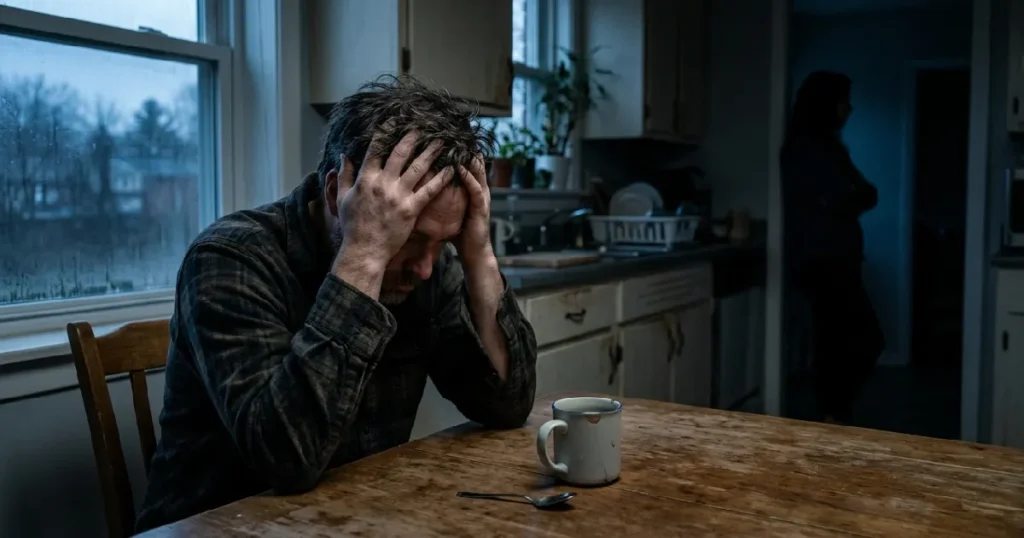
Seeing these signs clearly, perhaps for the first time, can feel overwhelming. But recognition is not the end of the story. It’s the beginning of your way back to yourself.
The Carbon Monoxide Check. Remember the metaphor from earlier? If the air in your relationship has been slowly poisoned, your first job is to step outside and breathe. This means creating physical or emotional distance, even briefly, so you can think without her narrative shaping every thought. One place to start is spending time with people who knew you before this relationship. Let them remind you who you actually are.
The Reality Journal. Start documenting interactions as they happen. Write down what was said, what you felt, and what happened next. Don’t edit. Don’t justify. Just record. Over time, this journal becomes an anchor to objective reality when gaslighting makes you doubt yourself. The next time she rewrites a conversation, you’ll have your own record to return to.
The Boundary Language Shift. Instead of explaining, defending, or justifying your needs, practice stating them once and letting them stand. For example: “I’m not comfortable with that” is a complete sentence. You do not owe an essay-length explanation for having limits. A useful question to ask yourself before any difficult conversation with her: “Am I about to explain my boundary, or am I about to audition for permission to have one?”
The Professional Mirror. Consider working with a therapist who specializes in narcissistic abuse recovery. Not because something is wrong with you, but because what you’ve been through requires a trained guide to help you sort her version of reality from your own. You deserve that support.
You Were Never the Problem
Think back to that moment at the beginning. The coffee she brought without being asked. The tears she cried at your story. The friends who told you how lucky you were.
You weren’t lucky. You were targeted. And the fact that you couldn’t see it at the time doesn’t mean you were foolish. It means the disguise was that good.
The carbon monoxide is clearing now. You can feel the difference between clean air and the version of reality she built around you. That awareness, the one you are holding right now as you read this sentence, is something she never wanted you to have.
It changes everything.
My Closing Remarks
I’ll be honest with you. I’ve sat across from people who spent years believing they were the difficult one, the too-sensitive one, the one who could never get it right, only to realize they had been breathing someone else’s poison the entire time. It’s one of the most painful awakenings I’ve witnessed. But it’s also one of the most powerful. If anything in this article made your chest tighten or your eyes sting, pay attention to that. Your body remembers what your mind was trained to forget. You are not broken. You were bent by someone who needed you small so she could feel big. And now you know.
More Related Stories for You
If you’re beginning to question the dynamics in your marriage, you might also want to explore how to know if your husband is narcissistic, because these patterns don’t exist in isolation. Understanding the full picture is how you start building a life that actually belongs to you.
About The Author