
 Sara Carmen
When silence replaces conversation, here is how to stop chasing, understand the freeze, and protect your sanity.
Key Takeaways
- Stonewalling in marriage is rarely just stubbornness; it is usually an involuntary nervous system collapse or an attempt to control the interaction.
- Chasing an emotionally frozen partner pushes them deeper into hiding and leaves you feeling drained, angry, and alone.
- Rebuilding communication requires replacing desperate pursuit with clear time boundaries, body-level calming, and mutual accountability.
Quick Answer: Stonewalling in marriage happens when one partner abruptly pulls back, refuses to talk, and disconnects during a disagreement. Unlike a planned break to calm down, stonewalling leaves the other person stranded in silence. It usually signals an overloaded nervous system or an attempt to control the room, turning simple conflicts into deep emotional freezes.
Contents
Table of Contents
That Heavy Living Room Silence
We have all been in arguments that got too loud. Voices rise, tempers flare, and someone says something they regret. But there is another kind of fight that hurts worse, and it does not make a sound.
You ask your spouse a normal question about the budget, the kids, or why they seem distant. Instead of answering, they look right through you. They stare at their phone, turn their back to wash a dish that is already clean, or walk out of the front door without saying a word.
You stand there with your heart beating in your throat. You feel invisible, dismissed, and completely abandoned in your own home. That sudden disappearance is stonewalling in marriage, and it eats away at your sense of reality.
When this happens over and over, you start second-guessing yourself. You wonder if you are crazy for wanting a basic conversation, or you find yourself screaming just to force any reaction at all.
That silence is not just an annoying habit. It is an active breakdown of safety between two people, and handling it requires understanding what is actually happening under the surface.
4 Clear Signs of Stonewalling in Marriage
Spotting stonewalling sounds simple, yet couples miss it because it rarely looks like a dramatic movie fight. Most of the time, it looks quiet, subtle, and dismissive.
1. The Sudden Digital Bunker
During a hard talk, your partner does not shout. Instead, they grab their phone, put in earbuds, or turn on the television. They use a screen to build an immediate wall between you two.
Take Sarah and Mark. Whenever Sarah brought up household expenses, Mark would pick up his iPad and start playing chess. If Sarah kept talking, Mark simply tapped the screen faster, acting as if the room around him was completely empty.
That is not someone relaxing after work. That is an active refusal to share a reality with you.
2. The Monosyllabic Brush-Off
This happens when a spouse stays physically present, but vanishes emotionally. You ask what they think about an issue, and you receive nothing more than “Fine,” “Whatever,” or “If you say so.”
Their eyes stay glassy, their posture turns rigid, and their tone is flat. They give you just enough words to avoid being accused of silence, but zero emotional presence.
3. Walking Out Without a Return Ticket
Taking a break when tempers flare is healthy. Walking out of the house, slamming the door, and disappearing for six hours with your phone turned off is not a break.
The difference comes down to an agreement. A healthy break has a time stamp attached to it; stonewalling leaves you hanging on the cliff edge, wondering when or if your spouse will ever return.
4. Selective Friendliness
Perhaps the most painful sign is watching your partner ignore you completely, only to answer the phone a second later with a cheerful, warm voice for their coworker or parent.
This contrast hurts because it makes the silence feel intentional. It makes you feel targeted, as if warmth exists for the rest of the world, but you only get ice.
Silent Treatment vs Stonewalling: Biological Freeze or Pure Control?

People often mix up these two terms, but in clinical practice, understanding the difference is everything.
The difference comes down to what we call the Autonomic Split: is your partner experiencing an involuntary nervous system collapse, or are they using silence as a weapon to punish you?
The Physiological Freeze (Autonomic Flooding)
In research on the Gottman four horsemen stonewalling dynamic, Dr. John Gottman discovered that stonewalling often starts in the body, not the ego.
When conflict gets intense, a person’s heart rate can jump past 100 beats per minute. This triggers diffuse physiological arousal. Adrenaline dumps into the bloodstream, blood leaves the rational brain, and the body prepares to fight a bear or run for its life.
For many people, especially men, the nervous system chooses the “freeze” response. They do not shut down to hurt you; they shut down because their biological system is overloaded. Speech literally feels impossible because their brain perceives talking as gasoline on a fire.
The Punitive Silent Treatment
The silent treatment is different. This is not a flooded body trying to survive; it is an exercise in emotional control.
With punitive silence, the person is not in a panic. Their heart rate is often completely steady. They withhold eye contact, touch, and voice to force you into submission, making you apologize for things you did not do just to break the chill in the house.
If your spouse looks relaxed, smirks, and ignores you for days until you grovel, that is not an emotional flooding nervous system event. That is covert punishment, and treating it like simple stress will only make the dynamic worse.
The Pursuer-Distancer Trap and Walkaway Wife Syndrome Signs
When one partner shuts down, the other partner naturally panics. This creates what family therapists call the Pursuer-Distancer cycle, a dance that drains both people over time.
Consider Elena and David. When David pulled away and went quiet, Elena’s internal attachment alarm went off. She felt an urgent need to fix the disconnect right that second.
She followed David into the bedroom, knocked on the bathroom door, and sent five long text messages explaining her feelings. The more she pushed, the deeper David retreated into his shell.
Elena was not being crazy; she was fighting for connection. David was not being cruel; he was trying to protect himself from what felt like an emotional wave.
Yet, when this loop runs for years without changing, a dangerous shift happens. The pursuer eventually burns out. They stop knocking on doors, stop crying, and stop asking what is wrong.
This quietness is where walkaway wife syndrome signs begin to show up. The distancer mistakenly thinks things have improved because the fighting has stopped. In reality, the pursuer has emotionally detached, packed their bags in their mind, and started planning their exit.
How to Talk to a Husband Who Stonewalls Without Losing Your Dignity
In heterosexual relationships, research consistently shows that roughly 85 percent of chronic stonewallers are men. Men tend to get physiologically overwhelmed faster than women during relationship conflict, and their bodies take longer to return to a calm baseline.
Knowing how to talk to a husband who stonewalls means changing how you approach the conversation before the shutdown starts.
First, stop trying to pick the lock of a closed door. When a man is flooded, your best arguments sound like static noise to him. Trying to force him to open up in that moment will only trigger deeper silence.
Second, practice setting boundaries with a shut down partner that protect your self-respect. Setting boundaries is not about making someone else change; it is about choosing what you will no longer tolerate around yourself.
You do not have to sit in a room with someone who pretends you are not there. You do not have to wait by the phone for hours hoping for a breadcrumb of attention. You can step back, tend to your own nervous system, and require mature communication as the standard for your home.
3 Grounded Ways to Break the Silence
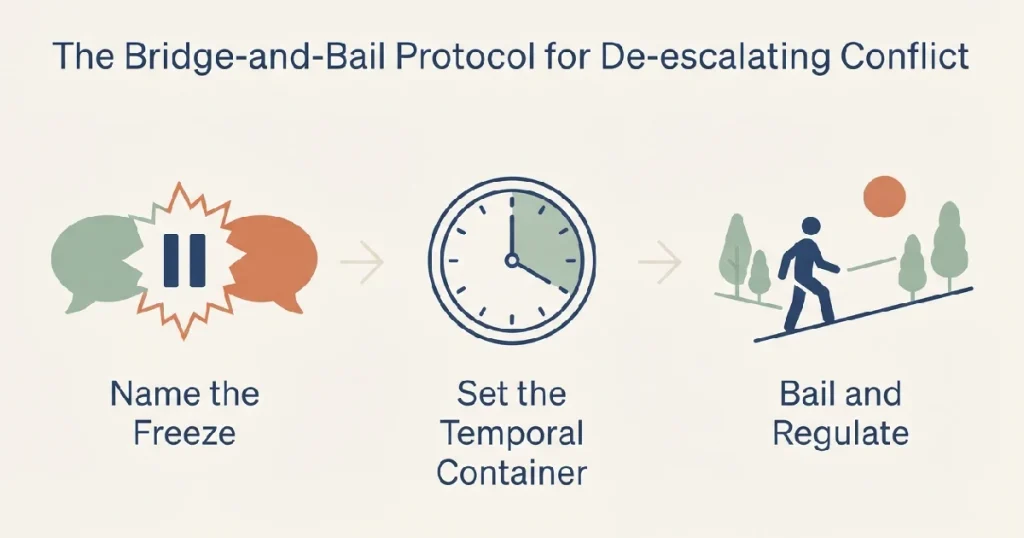
Breaking this pattern does not mean learning fancy psychological tricks. It means replacing reactive panic with steady, structured action.
1. The 20-Minute Autonomic Reset
When you notice glazed eyes, cold shoulders, or one-word answers, call an immediate halt to the talk. Continuing to argue with a flooded nervous system is useless.
One place to begin is by using Gottman’s research on biological cooldown periods. The human body requires at least 20 minutes to metabolize stress hormones like cortisol and adrenaline once an alarm goes off.
During these 20 minutes, both partners must agree to avoid brooding. Do not sit in the other room replaying the fight or drafting your next speech. Listen to music, take a walk around the block, or fold laundry. Give your heart rate room to settle back down.
2. The Temporal Container Script
The biggest problem with a time-out is the fear of abandonment it causes for the person left behind. You can eliminate that fear by placing a clear time container around the break.
Consider testing this simple script when you feel the conversation stalling:
“I can see that we have hit a wall, and neither of us is hearing the other person right now. I care about this topic too much to let us turn it into a cold war. Let’s take a break, step away, and sit back down at this table at 7:30 PM to figure it out.”
Notice what this script does. It does not blame anyone. It names the reality, honors the need for calm, and gives an exact time when the conversation will restart.
If they refuse to agree to a time, state your own: “I am stepping out to run an errand. I will check in with you at 8:00 PM.”
3. The Walk-Away Reset
If your spouse routinely uses the silent treatment as a control tactic, you have to stop rewarding the behavior with desperate pursuit.
When they ice you out, do not hover, do not apologize for things you did not do, and do not ask if they are mad twenty times.
Say once, calmly: “I am ready to talk about this whenever you are ready to be respectful.”
Then, walk away. Make dinner, play with your children, call a good friend, or read a book. When you stop treating their silence like a crisis, you remove the power of the tactic. You show that your peace of mind is not held hostage by their mood.
Frequently Asked Questions
Can a marriage survive chronic stonewalling?
Yes, but only if both partners are willing to admit the pattern exists and work on their emotional reactions. The stonewalling spouse must learn to identify when their body is flooded and ask for healthy breaks, while the pursuing spouse must learn to stop demanding instant answers. If one partner uses long periods of silence purely as a control tool and refuses help, the long-term outlook is poor.
How do I tell the difference between healthy space and stonewalling?
A healthy space request is clear, respectful, and temporary, with the person saying something like, “I am overwhelmed, let’s take an hour to cool down.” Stonewalling is abrupt, cold, and open-ended, leaving the other partner completely shut out with no agreement on when the talk will resume.
What should I do if my spouse ignores me for days?
Do not spend those days walking on eggshells or begging for attention, as that reinforces the behavior. State calmly that you are open to talking when they are ready to engage with respect, and then return to your normal routine, hobbies, and responsibilities. If multi-day silent treatments happen often, it crosses the line into emotional mistreatment and warrants professional couples therapy or individual counseling.
Moving Beyond the Freeze
A quiet home is not always a peaceful home. Sometimes, the quietest houses are the ones filled with the most unresolved grief.
You do not have to spend your marriage knocking on a door that someone has locked from the inside. By understanding the biology of flooding, stepping out of the exhausting pursuer role, and holding firm lines around how you communicate, you shift the dynamic in your living room.
You cannot force your partner to grow, speak, or soften. But you can change how you stand in front of their silence.
When you stop begging for a response and start leading with calm self-respect, you give your marriage its best chance to heal.
My Closing Remarks
Sitting across from couples who are stuck in cold silence is one of the hardest things I see in clinical practice. The pain in the room is thick, and the loneliness runs deep. If you are living through this right now, please give yourself some credit. You are dealing with an exhausting dynamic. Focus on steadying your own heart first. You deserve conversations that feel safe, honest, and mutual.
More Related Stories for You
To understand how silence connects to larger relationship challenges, read our guide on the 4 horsemen of marriage and learn how to catch these warning signs before they become permanent habits.
About The Author