
 Sara Carmen
Unpack the destructive communication patterns quietly pulling your relationship apart and discover the exact scripts to heal them.
Key Takeaways
- Recognizing the 4 horsemen of marriage early allows couples to disrupt toxic cycles before emotional detachment becomes irreversible.
- Chronic conflict usually fails not because of the underlying disagreement, but because defensive interaction styles trigger biological threat responses.
- Applying specific behavioral antidotes replaces blame and withdrawal with emotional regulation, mutual respect, and lasting partnership.
Contents
Table of Contents
The 4 horsemen of marriage (criticism, contempt, defensiveness, and stonewalling) are destructive interaction patterns identified by psychologist Dr. John Gottman that predict relationship failure with over 90% accuracy. Recognizing these toxic communication habits early and replacing them with proven psychological antidotes protects emotional safety and stabilizes long-term partnerships.
We have all stood in that quiet kitchen. An unwashed pan sits in the sink, a car key is misplaced, or a dry comment hangs awkwardly in the air.
Within ninety seconds, a conversation about domestic logistics transforms into an existential argument about your entire future together. Your chest tightens, your partner’s face hardens, and the distance between you feels vast.
When couples sit on my office sofa, they often believe they are fighting about money, division of labor, or lost intimacy. Yet the subject matter of an argument rarely destroys a relationship on its own.
What erodes love is the autonomic defensive armor partners put on when distress arises.
Relationship researcher Dr. John Gottman spent decades observing couples inside his laboratory at the University of Washington. His findings revealed that relationship dissolution is not random. It is announced by four specific, predictable habits of communication.
Learning how to spot the 4 horsemen of marriage allows you to move beyond mutual blame. It offers a practical map to disarm the survival reactions that keep you both feeling alone.
The Gottman Four Horsemen and the Cascade Effect
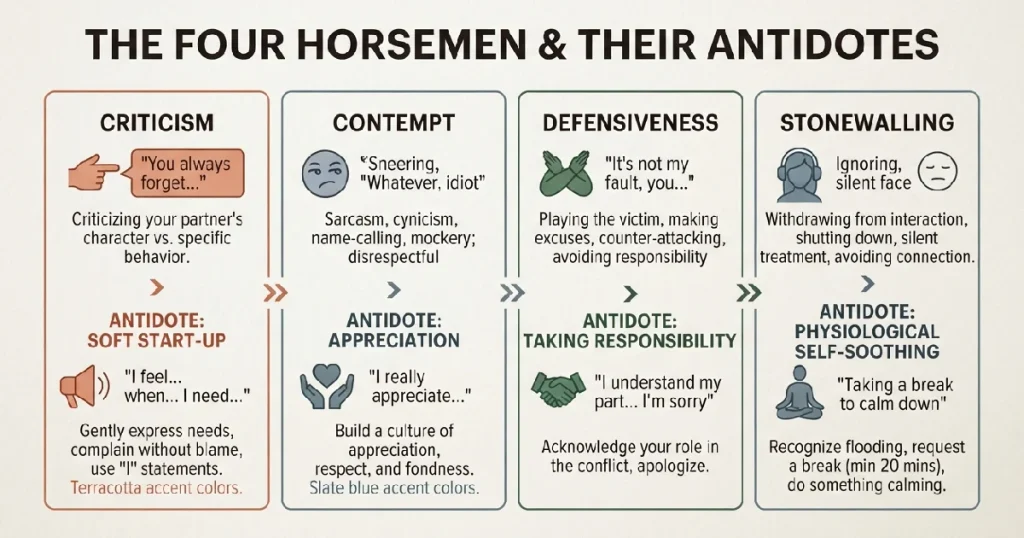
In his longitudinal research, Dr. John Gottman observed hundreds of couples discussing areas of chronic disagreement. By tracking micro-expressions, speech patterns, heart rates, and stress hormones, he identified four distinct behaviors that predicted divorce with extraordinary statistical accuracy.
He termed these habits the Gottman four horsemen, borrowing the biblical metaphor of apocalypse to describe their destructive impact on marital stability.
These behaviors rarely arrive all at once. Instead, they operate as a progressive behavioral cascade.
One partner launches a complaint with harsh character blame. The other partner perceives a direct threat and reflexively builds a defensive shield.
As resentment deepens over unaddressed hurts, hostility hardens into moral superiority and biting mockery. Eventually, the emotional climate becomes so toxic that one or both partners shut down completely to protect their own nervous system.
Recognizing these patterns as progressive relationship red flags is vital. If you can identify where your arguments begin to derail, you can stop the cascade before it runs its full course.
Criticism vs Contempt: From Personal Attacks to Moral Disgust
To change how you fight, you must first understand the crucial distinction between criticism vs contempt. Both attack a spouse, but they occupy very different levels of emotional toxicity.
Criticism occurs when a legitimate complaint about a specific event turns into an assault on your partner’s core personality. A complaint focuses on the action: “I felt overwhelmed when dinner was late tonight.” Criticism targets the person: “You are incapable of managing your time, and you never think about this family.”
The psychological mechanism behind criticism is often a poorly expressed bid for connection. When people feel helpless or unheard, their anxiety frequently manifests as an aggressive character attack.
Consider Sarah and Mark. Mark works long hours and frequently leaves his shoes and coat strewn across the entryway.
Instead of addressing her fatigue, Sarah snaps: “You are entirely thoughtless. You treat this house like a hotel and expect me to clean up after you.”
Mark does not hear her exhaustion. He only hears that he is fundamentally defective in her eyes.
When criticism goes unchecked for months or years, it curdles into contempt.
Contempt is the most lethal of all relationship patterns. It involves communicating from an assumed position of moral superiority. It shows up as eye-rolling, sneering, hostile mockery, and cutting sarcasm.
If Sarah progresses from criticism to contempt, she no longer simply calls Mark thoughtless. She sneers when he walks through the door, imitates his voice to friends, and mutters, “Must be nice to live with zero responsibilities while the adults handle life.”
Gottman’s research demonstrated that chronic contempt does more than break emotional bonds; it even impairs the physical immune system of the receiving partner. It signals pure disgust, destroying the psychological safety required for love to survive.
The Antidotes: Soft Start-Ups and Mutual Appreciation
The antidote to criticism is a gentle start-up. You discuss your feelings about an objective situation and state a clear, positive need without assigning blame.
The antidote to contempt is building a deliberate culture of appreciation. You actively search for qualities your partner exhibits that you admire, verbalizing respect on ordinary days to create a reservoir of goodwill.
Defensiveness Antidote: Dismantling the Blameless Victim Stance
When one partner attacks with criticism or contempt, the receiving partner almost always deploys defensiveness. It is an instinctual survival reflex, yet it invariably accelerates conflict.
Defensiveness is an attempt to protect the ego by deflecting responsibility. It typically takes two distinct forms: playing the blameless victim or counter-attacking with righteous indignation.
When we feel accused, our mammalian threat system perceives danger. Admitting fault feels unsafe, so the brain constructs a rapid counter-narrative.
Take Elena and David. Elena approaches David with a reasonable concern: “We missed the deadline for the property tax payment, and now there is a penalty fee.”
Instead of pausing, David immediately flares: “Well, maybe if you didn’t leave thirty unopened letters on the counter, I could actually locate the bill! Besides, you forgot to pay the water bill two months ago, so do not lecture me about deadlines.”
David feels he is simply defending himself against an unfair implication. To Elena, however, his response feels like total dismissal.
Defensiveness communicates that the other person’s reality has zero validity. It forces the initiating partner to either shout louder to be acknowledged or give up in despair.
The true defensiveness antidote is taking radical responsibility for even a tiny fraction of the problem.
You do not have to accept an inaccurate character assassination to acknowledge your role in an issue. Finding even five percent of the grievance that belongs to you completely changes the emotional tone of the room.
Emotional Stonewalling in Marriage: When Flooding Replaces Connection
The final horseman arrives when the marital system becomes overwhelmed by unmanaged distress: emotional stonewalling in marriage.
Stonewalling occurs when a listener withdraws completely from the interaction, shutting down verbal responses, breaking eye contact, and turning away like a literal stone wall.
Outside observers often mistake stonewalling for cold cruelty, smug silence, or passive-aggressive manipulation. While the silent treatment can sometimes be used punitively, true clinical stonewalling is almost always a biological collapse.
During intense marital arguments, the human autonomic nervous system can enter a state known as Diffuse Physiological Arousal (DPA). The heart rate surges past 100 beats per minute, adrenaline and cortisol flood the bloodstream, and peripheral vision narrows.
In this state of physiological flooding, the prefrontal cortex goes offline. Rational language processing ceases, and the body prepares exclusively for fight, flight, or freeze.
Stonewalling is the freeze response.
Consider Tom and Rachel. Rachel’s voice rises as she presses for an answer regarding their holiday travel plans. Tom feels an intense rush of heat, his pulse thumps in his ears, and he feels entirely cornered.
He folds his arms, stares blankly at the floor, and offers nothing but silence.
Rachel perceives his silence as cold abandonment and pushes harder, raising her volume. The harder she pushes, the more deeply Tom retreats into his shell to keep his heart from pounding out of his chest.
Gottman’s observational studies revealed that roughly 85 percent of stonewallers in heterosexual marriages are men. This is not due to a lack of empathy, but because male autonomic nervous systems typically flood more rapidly and take longer to recover from sustained interpersonal stress.
The Antidote: Physiological Self-Soothing and Structured Pauses
The antidote to stonewalling is intentional physiological self-soothing.
When a partner feels flooded, they must learn to name their state clearly, step away for at least twenty minutes, and quiet their nervous system before resuming dialogue.
The Asymmetry Dilemma: How to Save a Failing Marriage When Only One Partner Tries
One of the most frequent dilemmas couples face is asymmetry: “I want to stop these toxic cycles, but my partner refuses to admit their behavior is a problem.”
This reality leaves many wondering how to save a failing marriage when the effort feels entirely one-sided.
Family systems theory teaches that an intimate relationship functions like a physical mobile suspended from the ceiling. If you change the movement of one piece, every other piece in the structure must adjust its position.
You cannot force your spouse to practice an antidote. You can, however, unilaterally refuse to supply the oxygen that feeds the cascade.
When your spouse approaches you with criticism, you can refuse to respond with defensiveness. When they show signs of defensiveness, you can validate their frustration instead of escalating into contempt.
Stepping out of the predictable choreography breaks the cycle, transforming an explosive loop into a moment of unexpected clarity.
3 Grounded Protocols to Counter the Four Horsemen Today

You do not need to overhaul your entire personality to transform your marriage. You simply need reliable behavioral scripts ready for the exact moments when tension spikes.
1. The Gentle Start-Up Script
When an issue is bothering you, bypass character evaluations entirely. Use this three-part formula:
- State how you feel without using the word “you” as an accusation.
- Describe the objective situation without using “always” or “never.”
- State what you positively need rather than what you want your partner to stop doing.
Try saying:
“I am feeling anxious about our weekend schedule, and I need thirty minutes tonight so we can sit down and coordinate our calendars.”
2. The 20-Minute Nervous System Reset
If you or your partner notice signs of physiological flooding (shallow breathing, clenched jaws, a pounding pulse), call a deliberate pause.
Try using this script:
“I care about what you are saying, but my body is getting flooded right now and I cannot listen well. I need a twenty-minute pause to calm down, and I will be back at 8:15 so we can finish this.”
During those twenty minutes, do not mentally litigate the argument. Read a book, walk outside, or practice slow box-breathing to bring your heart rate under 100 beats per minute.
3. The 2% Responsibility Drill
The moment you feel the urge to explain away a mistake, counter-attack, or offer an excuse, pause and locate the small fraction of truth in your partner’s words.
Try saying:
“You are right that I did not take the trash out before leaving this morning. I lost track of time, and I am sorry that left you in a bind.”
Owning that small sliver of truth instantly disarms the need for your partner to continue attacking.
Frequently Asked Questions
Can a marriage survive if all four horsemen are present?
Yes. The presence of these habits does not mean your relationship is over; it simply shows that your current conflict habits are overwhelmed by stress. When partners commit to identifying these patterns and using their clinical antidotes, even high-conflict dynamics can stabilize and rebuild mutual trust.
How do I tell the difference between healthy space and stonewalling?
A healthy pause is communicative and time-bound. A partner taking healthy space explains that they are overwhelmed, promises to return at a specific time, and uses that window to calm down. Stonewalling is abrupt, open-ended, and leaves the other partner locked out without resolution.
Which of the four horsemen is considered the most destructive?
Gottman’s research identified contempt as the single most destructive behavior for long-term marital health. Because it conveys disgust and moral superiority, it systematically strips away mutual respect and serves as the primary psychological predictor of divorce.
Reclaiming Safety in Your Partnership
Every marriage experiences conflict. The goal of a secure, healthy relationship is never the total absence of anger or disagreement.
The goal is to preserve emotional safety while working through the friction of sharing a life together.
The four destructive habits do not arrive because you married the wrong person. They appear when two well-intentioned people lack the tools to communicate distress without triggering mutual defenses.
By spotting criticism, disarming defensiveness, rooting out contempt, and taking restorative pauses before stonewalling sets in, you rewrite the script of your arguments.
The strength of your marriage is not measured by whether conflict arrives, but by how courageously you choose connection over self-protection when it does.
My Closing Remarks
When couples walk into my practice, they are often terrified that their recurring arguments mean the love is gone. Over the years, I have seen that love does not vanish overnight; it simply suffocates beneath layers of unmanaged physiological defense. If you see your marriage reflected in these descriptions, please take heart. These habits are learned coping strategies, and anything learned can be unlearned. Start small with one gentle start-up or one calm pause this week, and watch how quickly the warmth returns.
More Related Stories for You
To understand the most destructive behavioral habit in depth and protect your relationship, explore our comprehensive guide on the subtle warning signs of contempt in marriage.
About The Author