
 Sara Carmen
When small deceptions quietly dismantle your peace of mind, here is the clinical roadmap to restore safety and stop playing relationship detective.
Key Points
- Learning how to rebuild trust in marriage starts with understanding why tiny lies often hurt more than big ones.
- You can step out of detective mode and still protect your own emotional safety at the same time.
- A research-backed, four-step protocol shows exactly how to turn chronic doubt back into dependable intimacy.
Contents
Table of Contents
Most of us assume betrayal arrives with a bang. An affair. A secret account. A confession that rewrites the whole relationship in one conversation. But for a lot of married couples, trust doesn’t collapse that way at all. It leaks out slowly, one small lie at a time, until you’re lying next to someone you genuinely love and realize you don’t believe a word they just said about where they parked the car.
Someone might think it’s nothing. A missed load of laundry someone swore they’d already done. A receipt tucked into a coat pocket instead of mentioned at dinner. A text that said “leaving now” forty minutes before they actually left. But what they don’t see is the spouse lying awake doing math, quietly recalculating every story from the last six months.
Someone might think the partner who vapes in the garage and denies it when asked is just trying to avoid an unnecessary fight. But what he doesn’t see is that every denial teaches his wife something worse than the truth ever could: that her own perception can’t be trusted inside her own marriage.
Someone might think saying “I already paid that bill” when she hasn’t yet is just buying a few hours of peace. But what she doesn’t see is that she’s training her husband’s nervous system to treat her reassurances as unreliable data.
You’re Not Crazy, and You’re Not Alone in This
You’ve tried talking about it. You’ve picked the right moment, stayed calm, used the “I feel” language every relationship guide recommends. And the small lies keep coming anyway. You start wondering if you’re the one with the problem, too sensitive, too controlling, too quick to turn a $12 receipt into a referendum on the whole marriage.
You are not.
Here’s the short version: small lies damage marriages because they attack something more basic than honesty itself. They attack your ability to predict your own life. Rebuilding trust means replacing verbal promises with observable consistency, not delivering bigger, better speeches about honesty.
Marriage researcher Dr. John Gottman spent decades studying what he calls “sliding door moments,” the small instant where a partner either turns toward you or turns away. Micro-lies are sliding doors too. Each one is tiny. Your nervous system doesn’t process it as tiny, though. It reads a mismatched fact the same way it reads a threat, with a spike in stress hormones and a drop in felt safety.
Psychologists sometimes call this need for cognitive predictability, your brain’s requirement to accurately forecast the people closest to you. When a partner’s words stop matching reality, even over something as small as a parking receipt, your nervous system logs it as data: this source is no longer reliable. That’s why discovering a lie about a $40 purchase can trigger nearly the same biochemical alarm as discovering an affair. The content is different. Your nervous system doesn’t actually care about content. It cares about pattern.
The Slow Bleed: Why Small Lies Damage Marriage Trust More Than Big Secrets
Think of trust in a marriage like a retaining wall holding back a hillside. Each small lie pulls one brick from the bottom row, quietly, without changing the view. The wall doesn’t collapse after one missing brick. It holds, and holds, right up until gravity finds the gap. Then it doesn’t bow. It comes down all at once.
Big betrayals are rare, and most marriages never face one. Small lies are frequent, sometimes daily, which is exactly why they do more cumulative damage. The Gottman Institute’s research on relational trust describes trust as something built through hundreds of ordinary bids for connection, answered honestly, over time. Every softened truth is a quiet withdrawal from that account. Withdrawals compound.
Partners on the receiving end of chronic small deceit describe a particular kind of exhaustion, not heartbreak exactly, something closer to a low-grade dread that never fully switches off. Hyper-vigilance, the state of constantly scanning for threat cues, evolved to keep you alive around actual predators. It was never built to run twenty-four hours a day inside your own living room. Yet that’s exactly where it ends up living once a spouse’s stories stop adding up.
Once you stop believing the small promises, something harder to name goes missing too: the willingness to be soft with each other. Emotional intimacy requires lowering your guard. You cannot lower your guard around someone whose words you’re constantly fact-checking in your head. That fact-checking has a name, and understanding where it comes from is the real starting point.
Chronic Lying in Marriage Psychology: Why Small Things Get Hidden

The Conflict-Avoidance Reflex
Most people who lie compulsively about small things weren’t raised by people who lied about big ones. Often it’s the opposite. Many grew up in homes where mistakes met punishment, sarcasm, or sudden withdrawal of affection. A forgotten chore meant a lecture. A bad grade meant days of cold silence. The child learns a brutally efficient lesson: the truth costs more than the lie. By adulthood, that lesson runs on autopilot, long after the original threat disappeared.
This is the paradox underneath chronic lying in marriage: a partner lies about something that wouldn’t even cause a real argument, purely to dodge five uncomfortable minutes. Most of the time, the lie isn’t a calculated betrayal. It’s a trained reflex firing in a context where it no longer makes sense.
Shame, Inadequacy, and Image Management
The second driver is shame, not guilt. Guilt says, “I did something bad.” Shame says, “I am something bad.” A partner who forgot to pay a bill, skipped the gym again, or made an impulsive purchase may lie not to deceive you, but to protect a fragile self-image from your disappointment. Hiding the fast-food wrapper is rarely about the burger. It’s about not wanting to be seen as the person who broke their diet again.
Left unaddressed, this pattern slides somewhere far more corrosive. The lying partner starts managing your perception of them instead of managing their actual behavior. Caught in a small lie, they deflect: “You’re making a mountain out of a molehill,” or “If you weren’t so uptight, I wouldn’t have to hide things.” That sentence relocates the problem, from their dishonesty onto your reaction. Left unexamined, this pattern doesn’t just strain a marriage. It can quietly become the reason it ends.
Picture the whole thing as a loop: perceived failure leads to fear of conflict, which leads to a small lie, which leads to exposure, which leads to deepened resentment, which lowers the threshold for the next perceived failure. Around and around it goes, usually over things too minor to ever get named out loud.
It’s worth saying clearly: conflict-avoidant lying is not the same as manipulation from someone with narcissistic or antisocial traits. The conflict-avoidant liar typically feels real shame afterward and wants the pattern to stop. A manipulative partner feels satisfaction in control and rarely does. If your spouse shows remorse, attempts repair even clumsily, and the lies involve avoidance rather than exploitation, you’re almost certainly dealing with a treatable pattern, not a character disorder.
Emotional Safety in Marriage: Why Hyper-Vigilance Isn’t Crazy
Here’s what gets missed in almost every piece of advice about rebuilding trust: the checking, the phone glances, the mental replay of old conversations. These aren’t signs you’re controlling or unstable. They’re your threat-detection system doing exactly what it evolved to do inside an environment that keeps sending mismatched signals.
That’s not weakness. That’s wiring.
The goal was never to shame yourself out of hyper-vigilance through sheer willpower, or to have your partner lecture you into feeling safe again. The goal is to change the input your nervous system keeps receiving. Once the data stream becomes reliable, hyper-vigilance fades on its own, because it no longer has a job to do. You cannot think your way out of a nervous system state. You can only out-live it with new evidence.
The Detective Trap: How to Rebuild Trust Without Being Controlling
Checking a partner’s phone, scrutinizing receipts, running your own cross-examinations before bed. These behaviors feel like safety but function like a second job, one with no pay and no end date. Reddit threads are full of spouses describing exactly this: “I hate who I’ve become. I check his location at 11pm and I hate myself for it, but I can’t stop.”
The uncomfortable truth is that surveillance rarely catches lies and never rebuilds a relationship. A determined liar adapts to whatever system you build. What actually changes behavior is not detection. It’s the relational cost of being caught, combined with a genuinely safer place to tell the truth in the first place.
This is where generic advice fails you. Telling a hurt partner to “just let go and trust again,” with zero behavior change from the other side, isn’t trust. It’s denial wearing trust’s clothing. The real move is stepping out of detective mode and into boundary mode, which looks and feels completely different.
A boundary sounds like this: “I’m not going to go through your phone anymore, and I’m also not going to pretend everything is fine. What I need instead is consistent, checkable follow-through, so your word starts meaning something again. If that doesn’t happen, I’ll need to revisit what I’m willing to accept, calmly, without the late-night phone checks.” That sentence hands responsibility back to the person who broke trust instead of making you the full-time auditor of their honesty.
How to Rebuild Trust in Marriage: A 4-Step Protocol for Daily Deceit
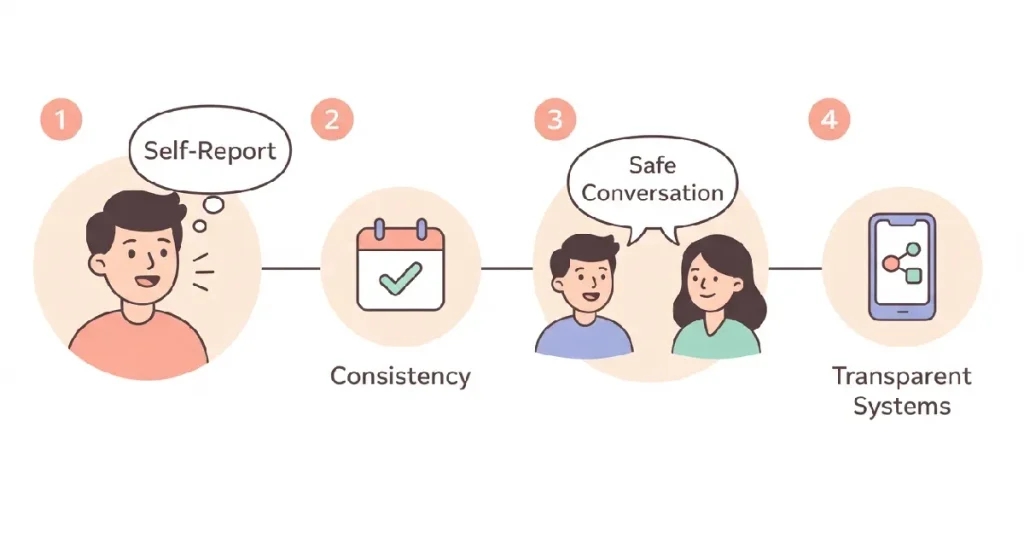
Trust doesn’t return through declarations. It returns through hundreds of small, boring, verifiable moments that match what was promised. This is the protocol clinicians use to rebuild it, piece by piece.
Step 1: Unconditional Self-Reporting
The fastest way a lying partner rebuilds credibility is through what I call the self-correction rule: when you catch yourself about to minimize or soften a truth, you say the real thing first, before you’re caught, without a defensive preamble. “I actually spent $60 on that, not $40, and I should have just told you” lands completely differently than a confession extracted after discovery. Self-reporting proves the lie was never really about you. It was about discomfort, and discomfort can be unlearned.
Step 2: The Sliding Door Consistency Test
This step has nothing to do with grand gestures and everything to do with mundane reliability. Say you’ll be home at 6, be home at 6. Say you’ll handle the dishes, handle them without being reminded. These unremarkable, moment-to-moment choices, not anniversaries or apology flowers, are what actually rebuild the emotional reserve a couple draws from during harder conversations.
Step 3: Neutralizing the Conflict Arena
If every honest disclosure is met with an explosion, you’re accidentally training your partner to keep lying. Neutralizing the conflict arena means agreeing in advance that a hard truth told voluntarily gets a different response than a lie discovered later. A script for the listener: “Thank you for telling me, even though it’s hard to hear. I need a minute, then I want to talk calmly.” A script for the one disclosing: “I need to tell you something I should have said earlier, and I’d like us to stay calm while I do.”
Step 4: Transparent Systems Over Verbal Promises
Words got you into this. Systems get you out. A shared calendar entry instead of a verbal itinerary. A joint banking app instead of a monthly “trust me.” This isn’t parole, and treating it like punishment defeats the purpose. The American Psychological Association’s resources on marriage and relationships point to transparency, offered rather than extracted, as one of the more reliable predictors of repaired trust after a breach. Framed correctly, it’s simply two adults agreeing to make honesty easier to practice until it becomes automatic again.
Mia and Daniel: What Rebuilding Actually Looked Like
Mia found out Daniel had been lying about small things for almost a year: a canceled gym membership he never mentioned, a “late meeting” that was actually a solo drive to clear his head, a credit card balance he quietly rounded down whenever she asked. None of it was an affair. All of it felt like one. For three months, they used exactly the protocol above. Daniel self-reported two slip-ups before Mia ever noticed them, they shared one calendar, and Mia practiced naming her urge to investigate instead of acting on it silently. It wasn’t dramatic. It was repetitive, almost boring. Six months in, Mia realized she’d stopped checking his location, not because she decided to trust him, but because the new evidence had made the old habit unnecessary.
Where to Start Tonight: Practical Steps to Rebuild Trust in Marriage
One place to start is what I call the Two-Minute Debrief: before bed, each partner shares one true thing they almost didn’t say that day, no matter how small. Not a confession session, just a practice rep for honesty under zero pressure.
Consider building a thirty-day Reliability Log, a simple shared note where promised actions, like calling the dentist or being home by seven, get a checkmark once completed. This isn’t surveillance, because both partners see it and both contribute. It just makes consistency visible instead of invisible.
A useful question to ask yourself if you’ve been the one lying: what did I believe would happen if I told the truth about this specific thing, and was that belief actually accurate? Most chronic liars discover the imagined consequence was always worse than the real one.
And if you’ve been the one hurt, the next time you reach for the phone to verify a story, try naming the urge out loud instead: “I’m noticing I want to check this. Can we just talk about it directly?” That single sentence does more for rebuilding trust without being controlling than a hundred silent searches ever could.
A Sturdier Kind of Marriage
Remember that fast-food wrapper hidden in the coat pocket, the burger nobody needed to lie about. That was never really the story. The story was always about whether two people can hand each other an accurate picture of reality, even when that picture is unflattering, small, or inconvenient.
Trust breaks in an instant and rebuilds in installments. That asymmetry isn’t unfair. It’s just how nervous systems work. Give the process months, not days. Watch for consistency over intensity. A partner who keeps showing up with small true things is worth more than one who delivers a single enormous, tearful apology and then returns to old patterns.
A marriage that survives a season of small lies often ends up more honest than it was before the crisis, because both people finally learned what their real thresholds are. The wall can be rebuilt. This time, brick by visible brick, you’ll both know exactly what’s holding it up.
That’s not a smaller marriage. That’s a sturdier one.
My Closing Remarks
In session after session, I’ve watched couples assume small lies were the easy part to forgive and big betrayals the real threat. In practice, it’s often reversed. Couples recover from affairs with the right support more often than people expect, but chronic small dishonesty quietly convinces good partners they’re imagining a problem that is very real. If that’s where you are tonight, you’re not imagining it. You’re paying attention. That’s not the same thing as being broken.
More Related Stories for You
If this resonated, you may also want to read how to build trust in a relationship for the foundational habits that keep couples from ever reaching this point in the first place.
About The Author