
 Nicole Adkins
The Most Revealing Sign Of A Healthy Partner Isn’t What They Do For You. It’s What They Refuse To Do To You.
Key Points
- A good partner in a relationship protects your sense of self, even during conflict, and never uses your vulnerabilities as ammunition.
- The absence of harmful behaviors is a more reliable indicator of relationship quality than the presence of grand romantic gestures.
- Recognizing what a good partner never does helps you stop normalizing patterns that quietly erode your well-being.
Contents
Table of Contents
When Love Feels Like Walking on Eggshells
You replay the argument in your head for the third time today. You said something honest. Something small. And somehow it turned into two hours of silence, a slammed door, and that familiar knot in your stomach that whispers: maybe you shouldn’t have said anything at all.
You start editing yourself. Shrinking. Choosing peace over honesty because honesty has become expensive.
And then you wonder: is this just how relationships are?
It isn’t.
But here’s what makes this question so hard to answer. Most of us were never taught what a good partner in a relationship actually looks like from the inside. We learned what love should feel like from movies, song lyrics, and families that may have modeled something far from healthy. So when a relationship slowly chips away at who you are, you might not even notice because it feels normal.
That’s the quiet danger.
Why the Absence of Harm Matters More Than the Presence of Romance
There’s a concept in relationship science that rarely gets the attention it deserves. Dr. John Gottman’s decades of research at the University of Washington found that stable, satisfying relationships are not defined primarily by how much positivity exists. They are defined by how little negativity is allowed to take root.
Gottman identified what he calls the “Four Horsemen” of relationship breakdown: criticism, contempt, defensiveness, and stonewalling. The presence of these behaviors, especially contempt, predicted divorce with over 90% accuracy.
That finding reframes everything.
It means that a good partner in a relationship is not simply someone who buys flowers, plans dates, or says “I love you” often. Those things are wonderful. But they don’t cancel out patterns that make you feel small.
What defines a truly healthy partner is what they consistently refuse to do. The restraint. The self-awareness. The daily, unglamorous discipline of protecting the relationship from their own worst impulses.
Left unexamined, the absence of that discipline doesn’t just strain relationships. It can quietly become the reason they end.
5 Things a Good Partner in a Relationship Never Does
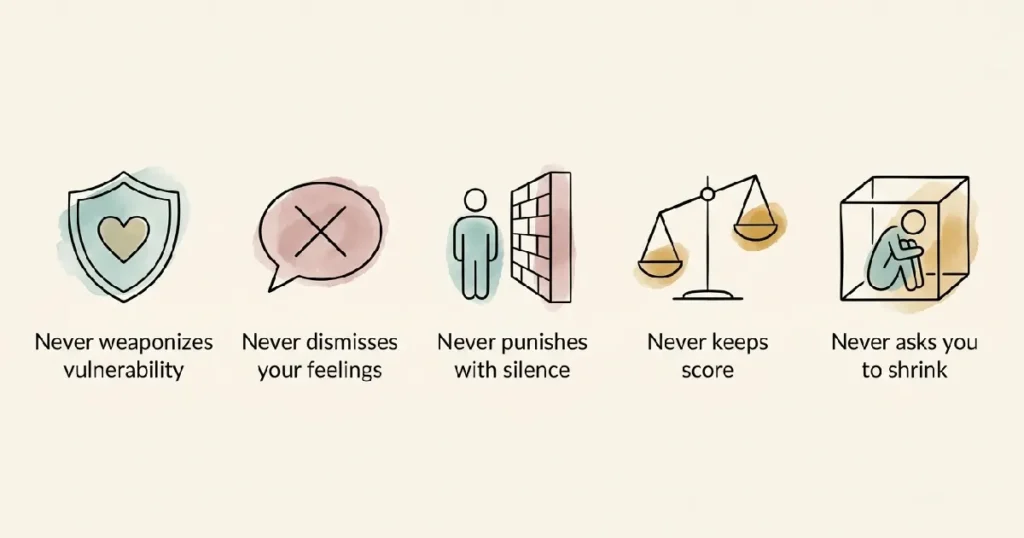
1. They Never Use Your Vulnerabilities Against You
Early in a relationship, you share things. The childhood wound you still carry. The insecurity about your career. The thing your ex said that broke something in you. You share these because intimacy requires risk.
A good partner treats that information as sacred.
They don’t bring up your deepest fear during a heated argument to gain the upper hand. They don’t reference your past trauma to explain why you’re “overreacting.” They never weaponize what you trusted them to hold gently.
I once worked with a woman named Sara who described her relationship this way: “He knows exactly where my soft spots are. And when he’s angry, that’s exactly where he presses.” Sara didn’t realize until months into therapy that what she was describing wasn’t passion or intensity. It was emotional exploitation.
A 2021 study published in the Journal of Social and Personal Relationships found that perceived partner responsiveness, the belief that your partner understands, validates, and cares for your inner world, is one of the strongest predictors of relationship satisfaction and individual well-being.
When someone turns your vulnerability into a weapon, they destroy that responsiveness at its root.
What this means for you: If you find yourself hesitating to share something real because you’re afraid it will be used against you later, that hesitation is information. Pay attention to it.
2. They Never Make You Feel Crazy for Having Feelings
You say, “That hurt me.” And instead of hearing curiosity or concern, you hear: “You’re too sensitive.” “That’s not what happened.” “You always make things into a bigger deal than they are.”
Over time, you stop trusting your own emotional responses.
This is gaslighting in its most common, everyday form. Not the dramatic, movie-villain version. The slow, steady kind where someone consistently redefines your reality until you forget you had one.
A good partner in a relationship may not always agree with your emotional reaction. They may see the situation differently. But they never dismiss your experience as fabricated or irrational.
Think of it this way: your emotions are like a compass. They don’t always point you in the perfect direction, but they are always giving you real data about your internal experience. A partner who constantly tells you your compass is broken doesn’t help you navigate. They just leave you lost.
Most people in this situation don’t realize how gradually it happens. You don’t wake up one morning unable to trust yourself. It erodes one dismissed feeling at a time.
What this means for you: A disagreement about what happened is normal. Being told that what you felt didn’t happen, or shouldn’t have happened, is not.
3. They Never Punish You With Silence
There is a difference between needing space and using silence as a weapon.
A healthy partner might say, “I need thirty minutes to cool down before we keep talking.” That’s self-regulation. That’s maturity.
But withdrawing affection for days without explanation, refusing to acknowledge your existence in your own home, giving you the cold shoulder until you apologize for something you aren’t sure you did wrong? That’s stonewalling. And research consistently links it to deep emotional harm in relationships.
Stonewalling activates the same regions of the brain as physical pain. When your partner shuts you out completely, your nervous system registers it as a threat. Not metaphorically. Literally.
A good partner doesn’t disappear emotionally to control the outcome of a disagreement. They stay present, even when presence is uncomfortable.
But here’s what no one tells you.
The person on the receiving end of prolonged silence often becomes the one who apologizes, not because they did something wrong, but because the pain of disconnection is unbearable. That’s not resolution. That’s compliance born from fear.
What this means for you: If your partner regularly goes silent and you find yourself frantically trying to “fix” things just to restore contact, notice that dynamic. You are not being loved back into connection. You are being trained.
4. They Never Keep Score
“I did this for you last week.” “Remember when I sacrificed that for you?” “You owe me.”
Healthy relationships involve reciprocity. Both people give. Both people receive. But a good partner doesn’t track contributions like a ledger, pulling out receipts every time they want something or feel slighted.
Score-keeping transforms a partnership into a transaction. It creates an unspoken hierarchy where one person is always in debt and the other always holds the power of what’s “owed.”
In my practice, I’ve noticed that couples who keep score often learned to do so in families where love was conditional. Where approval had to be earned, and generosity always came with strings. It makes sense as a survival strategy. But it poisons adult intimacy.
A good partner in a relationship gives freely, not because they’re keeping a tally, but because your happiness matters to them independently of what they get in return. And when imbalance occurs, as it inevitably does, they talk about it directly rather than storing resentment like currency.
What this means for you: Notice whether generosity in your relationship feels like a gift or a deposit. One creates closeness. The other creates obligation.
5. They Never Ask You to Shrink
This one is subtle, and that’s what makes it so dangerous.
They don’t say, “Stop being yourself.” They say, “Do you really need to laugh that loud?” They say, “Your friends are a bad influence.” They say, “I just think you’d be happier if you didn’t focus so much on your career.”
Bit by bit, you become a smaller version of who you were when the relationship began. Your social circle narrows. Your ambitions soften. Your personality dims to avoid friction.
A good partner wants you to take up space. They are not threatened by your success, your friendships, your joy, or your independence. They understand that a healthy relationship consists of two whole people choosing each other, not one person absorbing the other.
Dr. Elaine Aron’s research on highly sensitive people and close relationships highlights how partners with high sensitivity are especially susceptible to gradually silencing themselves in response to a partner’s subtle disapproval. But this pattern affects everyone. You don’t need to be highly sensitive to lose yourself in a relationship that rewards your smallness.
What this means for you: Think about who you were before this relationship. Your interests. Your energy. Your laughter. If those things have faded, ask yourself honestly whether you outgrew them or whether you were encouraged to let them go.
What to Do With This Awareness

Recognizing these patterns is the first step. But recognition without action can leave you stuck in a painful loop of seeing clearly and feeling powerless. So here’s where to begin.
The Mirror Check. At the end of each week, ask yourself one question: “Did I feel more like myself this week, or less?” Don’t analyze. Don’t justify. Just notice the honest answer. Over time, the pattern will tell you everything you need to know.
The Replay Reframe. The next time a conflict ends and you feel that familiar guilt or confusion, try replaying the conversation in your mind but imagine a close friend telling you the same story about their relationship. What would you tell them? The advice you’d give a friend is often the truth you’re not yet ready to give yourself.
The Compass Exercise. When your partner responds to something you’ve shared and your gut tightens, pause. Ask yourself: “Am I being heard right now, or am I being managed?” That distinction, between being heard and being handled, is one of the most important feelings to learn to trust.
The Space Inventory. Write down three things you used to love doing before this relationship. Are you still doing them? If not, why not? If the answer involves your partner’s disapproval, discomfort, or subtle discouragement, that’s a data point worth sitting with.
These aren’t dramatic interventions. They’re small acts of honesty. And small acts of honesty, practiced consistently, have a way of changing everything.
You Already Know
Go back to that moment at the beginning. The replayed argument. The knot in your stomach. The instinct to make yourself smaller so the tension would dissolve.
You now have language for what that is. And language changes what’s possible.
A good partner in a relationship will never make you question whether your feelings are real. Will never punish you for having a voice. Will never treat your trust as leverage or your growth as a threat.
You are not asking for too much. You are asking for the baseline of what love is supposed to be.
And the fact that you’re reading this, searching for clarity, trying to understand what you deserve? That’s not a sign of weakness.
That’s the beginning of everything.
My Closing Remarks
I want to be honest with you. I’ve sat across from hundreds of people who stayed too long in relationships that looked fine on the outside but were slowly dismantling them on the inside. They weren’t weak. They were hopeful. And hope, when it’s directed at someone who repeatedly harms you, becomes its own kind of trap. If anything in this article made your chest tight or your eyes sting, please don’t scroll past that feeling. It’s telling you something you already know. Trust it. You were never the problem.
More Related Stories for You
- If you’re building a future with someone, understanding financial planning before marriage is one of the most loving steps you can take together.
About The Author