
 David Wall
Your calendar is full. Your nervous system doesn’t care. These science-backed mindfulness exercises for anxiety work in under two minutes, no meditation cushion required.
Key Points
- The most effective mindfulness exercises for anxiety don’t require extra time. They work by being stacked onto habits you already perform every day.
- Your nervous system has biological “off switches” you can activate in seconds, including techniques that trigger the vagus nerve and shift your brain out of threat mode.
- Anxiety isn’t a scheduling problem. It’s a regulation problem, and the fix lives in your body, not your to-do list.
Contents
Table of Contents
You Know You Need to Slow Down, but When?
You’re on your third meeting of the morning. Your chest feels tight, but you’re already pulling up the next email. There’s a faint hum in your jaw, a clenching you didn’t notice until just now. You tell yourself you’ll deal with it later. Maybe tonight. Maybe on the weekend.
Later never comes.
If this sounds familiar, you’re not failing at self-care. You’re running a nervous system that was built for saber-toothed tigers inside a world made of Slack notifications and back-to-back Zoom calls. And the advice you’ve been given, “try meditating for twenty minutes,” feels about as useful as someone telling you to nap during a fire drill.
Here’s the part most wellness content leaves out: you don’t need more time to manage anxiety. You need better-targeted interventions that match the speed of your life.
Why Your Brain Stays Stuck in Alarm Mode
Anxiety is, at its biological core, your brain’s threat detection system working overtime. A structure deep in your brain called the amygdala, your internal smoke alarm, scans your environment for danger. When it fires, your sympathetic nervous system activates what most people know as the “fight or flight” response: elevated heart rate, shallow breathing, muscle tension, and a narrowing of focus.
This system is brilliant when you’re dodging traffic. It’s far less helpful when you’re sitting at a desk drafting a quarterly report.
The problem for busy professionals isn’t that this system exists. The problem is that modern work keeps it activated for hours without resolution. There’s no actual bear to run from, so the adrenaline and cortisol just circulate with nowhere to go.
According to a 2023 study published in Cell Reports Medicine by Stanford neuroscientist Andrew Huberman and colleagues, brief, structured breathing exercises were more effective at reducing anxiety and improving mood than an equivalent period of traditional meditation. The key wasn’t the length of the practice. It was the precision of the physiological mechanism being targeted.
That’s the principle behind every exercise in this article. These are not relaxation suggestions. They are specific nervous system resets designed to work within the margins of a busy day.
Think of your nervous system like a volume dial that’s been stuck at nine all day. You don’t need an hour-long spa visit to turn it down. You need to know exactly where the dial is and how to reach it in seconds.
And the next exercise is the single most efficient way to do exactly that.
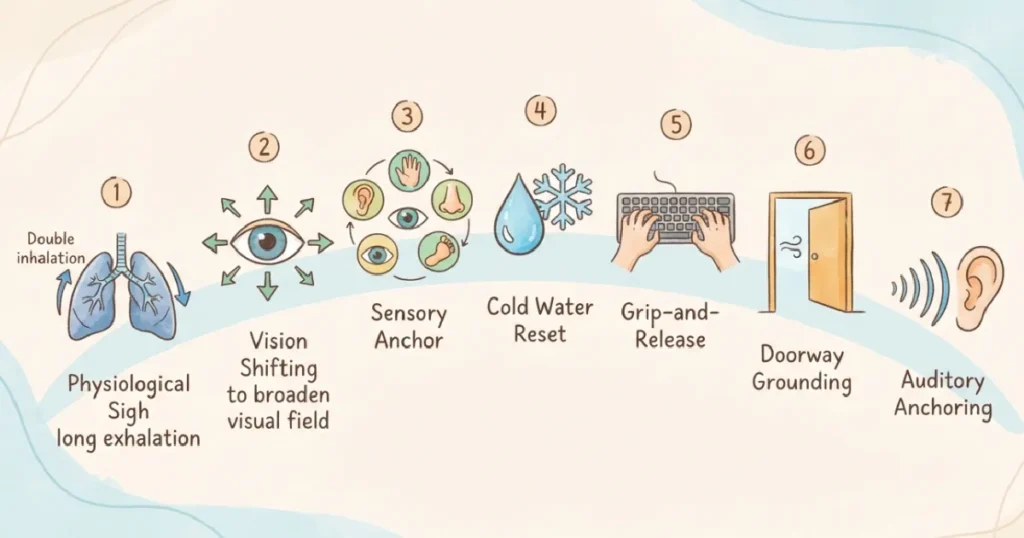
1. The Physiological Sigh: The Fastest Way to Calm Your Nervous System
This is the exercise I recommend more than any other in my practice, because it works in roughly 30 seconds and requires nothing but your lungs.
Here’s the pattern: take two short, sharp inhales through your nose, one right after the other, and then release one long, slow exhale through your mouth. Repeat this cycle three times.
What you’re doing is deliberately inflating the tiny air sacs in your lungs called alveoli, which tend to collapse during shallow, anxious breathing. When those sacs reinflate, they increase the surface area for carbon dioxide exchange. That CO2 offload signals your parasympathetic nervous system, your body’s built-in calming branch, to engage. Your heart rate drops. Your muscles soften. Your focus widens.
The Huberman Lab study found that just five minutes of cyclic sighing per day produced significant reductions in state anxiety. But here’s the practical truth: even a single round of three sighs can interrupt a panic spiral during a meeting.
Try it right now. Two quick inhales through your nose. One slow exhale through your mouth. Notice what shifts.
2. Peripheral Vision Shifting: Turn Off Your Brain’s Threat Scanner
When you’re anxious, your visual system narrows. This is called foveal vision, a focused, tunnel-like gaze that your brain activates during perceived danger. It’s the same focus a predator uses when locked onto prey.
You can reverse-engineer this.
Pick a point directly in front of you, a spot on the wall, a word on your screen. Now, without moving your eyes, deliberately expand your awareness to your far-left and far-right peripheral vision. Try to notice what’s at the edges of your visual field while still looking straight ahead.
This act of panoramic vision, sometimes called optic flow in neuroscience research, deactivates the vigilance circuits in your prefrontal cortex. Your brain literally interprets the widened visual field as a signal that no immediate threat is present. It’s a biological stand-down command.
One of my clients, a project manager named Aisha, started using this technique before high-stakes presentations. She would stand at the front of the room, fix her gaze on the back wall, and silently widen her peripheral awareness for ten seconds. “It feels like someone turned the brightness down on my anxiety,” she told me. “Everything goes from screaming to manageable.”
That’s not a metaphor. That’s neurobiology.
3. The 5-Count Sensory Anchor: A Rapid Grounding Reset
You’ve probably heard of the “5-4-3-2-1” grounding technique. It’s effective, but it’s also slow for someone mid-crisis in a busy workday. Here’s a faster version that does the same job in five seconds.
In one swift pass, name to yourself: one thing you hear, one thing you’re touching, one thing you see, one thing you smell, and then feel the weight of your feet flat on the floor.
That’s it. Five inputs. Five seconds.
What you’re doing is forcing your brain to process present-moment sensory data instead of future-oriented threat projections. Anxiety is almost always about a future that hasn’t happened yet. Your senses can only detect what is happening right now.
This is the neurological equivalent of pulling the emergency brake on a runaway train of “what ifs.”
4. The Cold Water Vagus Nerve Reset: Shock Your Calm Back Online

This one sounds strange. It works anyway.
When anxiety peaks, splash ice-cold water on your face, or hold an ice cube in your closed fist for 30 seconds. What you’re triggering is the mammalian dive reflex, an ancient physiological response that every mammal possesses. When cold water contacts your face, particularly the area around your eyes and cheekbones, your vagus nerve fires a signal that immediately lowers your heart rate and redirects blood flow toward your core organs.
Your body thinks you’ve plunged underwater. The survival response overrides the anxiety response.
This technique is especially useful during acute moments, a panic surge before a call, a racing heart after a difficult email, any moment when your body has escalated faster than your mind can talk it down. Keep a small cup of ice water at your desk. It’s not dramatic. It’s strategic.
But here’s what no one tells you about anxiety management: the most powerful interventions aren’t the ones you use during a crisis. They’re the ones you weave into your daily routine so the crisis never fully arrives.
5. Keyboard Grip-and-Release: Build Somatic Awareness Into Your Work
Your body holds tension in patterns you’ve stopped noticing. Your jaw. Your shoulders. And for most desk workers, your hands.
Try this: the next time your screen loads, a page refreshes, or a file saves, deliberately clench your fists around your keyboard for three seconds. Then release completely. Let your fingers go limp.
This is a micro-version of progressive muscle relaxation, a technique with decades of clinical evidence behind it. The deliberate contraction followed by release teaches your nervous system the contrast between tension and calm. Over time, your body starts recognizing its own tension earlier and releasing it without conscious effort.
The reason this works so well for busy people is that it requires zero additional time. You’re not adding a practice to your day. You’re embedding awareness into something you already do hundreds of times.
This is what researchers call “habit stacking,” attaching a new micro-behavior to an existing automatic routine. It’s the difference between building a new habit from scratch and simply upgrading one you already own.
6. Transition Doorway Grounding: One Breath Between Worlds
Every time you walk through a doorway, touch a door handle, or open a new browser tab, you’re making a transition. Your brain actually registers these moments. Psychologists call it the doorway effect, the well-documented phenomenon where crossing a threshold causes a momentary cognitive reset.
Use it.
Before you walk into a meeting room, as your hand touches the handle, take one slow, intentional breath. Not a deep, dramatic inhale. Just one conscious breath where you notice the air entering your body.
You’re giving your brain a micro-pause between contexts. Instead of dragging the stress of your last interaction into the next one, you arrive fresh. One breath. One doorway. One reset.
Over weeks, this practice creates a rhythm of micro-recoveries throughout your day. Your nervous system stops operating like a car that never downshifts. It starts cycling between activation and rest the way it was designed to.
7. Mindful Commute Auditory Anchoring: Sixty Seconds of Raw Listening

For the first 60 seconds of your commute, whether in a car, on a train, or walking, leave the podcast off. Leave the music off. Just listen.
Not to anything in particular. Just to the raw, unfiltered sound of your environment. The hum of the engine. A voice in the distance. Wind. Footsteps.
The instruction is simple: hear everything without labeling it as good or bad.
This exercise trains a skill called non-judgmental awareness, the foundation of every evidence-based mindfulness program. But instead of requiring 20 minutes on a cushion, it asks for 60 seconds inside something you’re already doing.
What changes isn’t the commute. What changes is your relationship to stimulation. You begin noticing that not every input requires a reaction. And that single realization, that you can receive information without immediately evaluating it, is the seed of every meaningful anxiety reduction.
Putting the Pieces Together: Your Nervous System Toolkit
You don’t need to do all seven. Start with one.
The Morning Anchor: Try the Physiological Sigh before you check your phone. Three rounds. Thirty seconds. Set the tone before the world sets it for you.
The Workday Weave: Pick either the Keyboard Grip-and-Release or the Transition Doorway Grounding and commit to it for one week. Attach it to a trigger you already encounter daily.
The Evening Downshift: Use the Mindful Commute Auditory Anchoring as your bridge between work and home. Sixty seconds of raw listening before you re-enter your personal life.
A useful question to ask yourself at the end of each day: “Did I give my nervous system even one moment of intentional rest today?” If the answer is no, tomorrow is another chance. If the answer is yes, notice how that felt. Build from there.
These are not exercises that demand discipline. They demand only a willingness to interrupt autopilot for a few seconds at a time.
You Were Never Too Busy for This
Remember that tightness in your chest from the opening? The one you told yourself you’d deal with later?
You just dealt with it.
Not by clearing your schedule. Not by becoming a different person. But by learning that your nervous system has access points, biological switches that respond to specific, brief inputs. The volume dial was never stuck. You just didn’t know where it was.
Anxiety tells you that you can’t stop. That the cost of pausing is too high. But the research says something different: the cost of never pausing is the one you can’t afford.
You now have seven ways to pause without stopping.
That’s not a small thing. That’s everything.
My Closing Remarks
I spent years telling anxious clients to “try mindfulness” without giving them tools that fit inside their actual lives. That was my failure, not theirs. The day I stopped prescribing 20-minute meditations and started teaching 30-second nervous system resets, everything changed. People who had written off mindfulness as “not for them” started texting me: “It actually worked.” The truth is, you were never bad at calming down. You were just given tools built for a life you don’t live. These seven exercises are built for the life you do.
More Related Stories for You
- If you want to go deeper into building a sustainable mindfulness practice that fits your real life, start there. Small shifts, repeated often, change everything.
About The Author