
 David Wall
You Don’t Need To Silence Your Mind. You Need To Learn How To Redirect It, And The Science On How To Do That Has Never Been Sharper.
Key Points
- Controlling your thoughts doesn’t mean suppressing them; it means building targeted cognitive skills that interrupt automatic mental patterns before they spiral.
- Your body, your gut, and even your nervous system play a direct role in what your mind replays on loop, and the newest interventions use biology as the entry point.
- Controlling your thoughts becomes possible when you stop fighting the thought itself and start working with the brain’s own reconsolidation and attention systems.
Contents
Table of Contents
That Voice in Your Head Is Not the Boss of You
You’re lying in bed at 2 a.m., and the same thought circles back. Again. Maybe it’s a conversation you replayed forty times. Maybe it’s a future catastrophe that hasn’t happened yet. You squeeze your eyes shut. You tell yourself to stop thinking about it. And the thought gets louder.
You’ve tried deep breathing. You’ve tried distraction. You’ve even tried shaming yourself into mental silence. None of it holds for long.
Here is what most people never hear: the reason you can’t stop a thought by fighting it is because your brain treats resistance as a signal that the thought matters. A 1987 study by Daniel Wegner at Harvard University demonstrated what he called the “ironic process theory” of mental control. When participants were told not to think of a white bear, they thought about it more frequently than the group given no instruction at all. The act of suppression created a mental monitoring process that kept scanning for the very thing it was trying to avoid.
This is the trap. And it explains why willpower alone will never be enough to manage an overactive mind.
But there’s another way in. A way that doesn’t require you to wrestle your own brain into submission. It requires precision instead.
What follows are six methods, each grounded in current neuroscience and clinical research, that give you specific tools for controlling your thoughts without the exhausting mental tug-of-war.
Why Your Brain Won’t Just “Let It Go”
Before we get to the strategies, you need to understand one thing about why your mind does this.
Your brain is not malfunctioning when it loops. It is doing exactly what evolution designed it to do: scan for threats, rehearse worst-case scenarios, and consolidate emotional memories for future protection. The prefrontal cortex, the part of your brain responsible for executive function and decision-making, is supposed to regulate this process. But when stress hormones like cortisol flood your system, the prefrontal cortex goes partially offline and the amygdala, your brain’s alarm center, takes over.
This is why you can be perfectly rational at noon and completely hijacked by spiraling thoughts at midnight. It is not a character flaw. It’s neurochemistry.
According to research published in Biological Psychiatry, chronic stress physically reduces gray matter volume in the prefrontal cortex while increasing activity in the amygdala, essentially weakening the brain’s braking system while accelerating the engine of worry.
The good news? Each of the six methods below targets a different part of this system. Some work on attention. Some work on biology. Some work on memory itself. Together, they represent the most advanced toolkit available for regaining control of your mental life.
1. Retrain Your Attention Before the Thought Even Forms
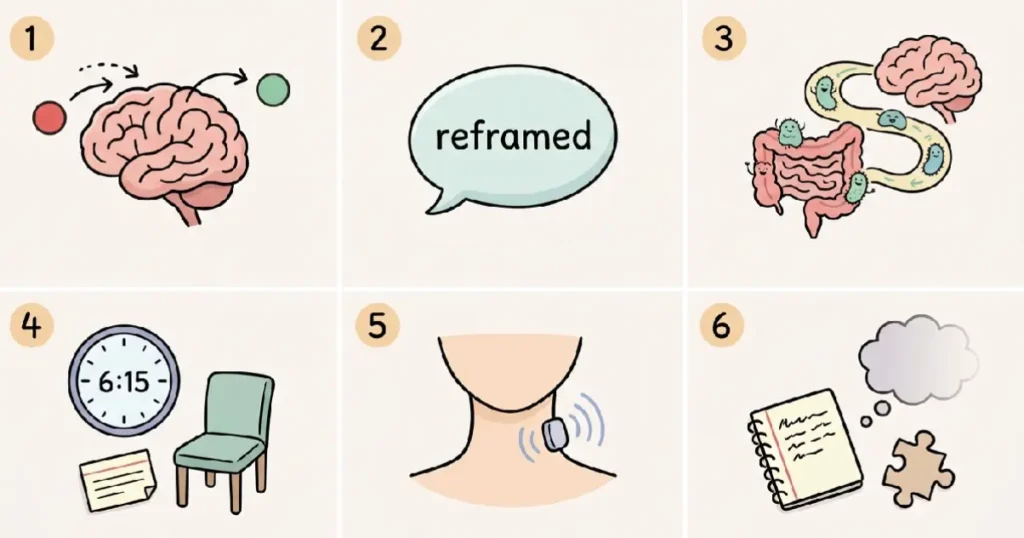
Most people try to manage a thought after it arrives. Attentional Bias Modification, or ABM, works earlier in the process by changing what your brain automatically notices.
Here’s how it works. Your brain has tracking habits. If you have anxiety, your visual system is literally wired to detect threat-related cues faster than neutral ones. You walk into a room and your eyes find the frowning face before the smiling one. This happens in milliseconds, before conscious awareness.
ABM uses gamified digital exercises, often on a phone or tablet, that train your eyes and attention to shift toward neutral or positive stimuli instead of negative ones. Over repeated sessions, the brain’s automatic scanning pattern begins to update.
A woman I’ll call Nadia, a 34-year-old project manager, came to therapy describing her mind as a “security camera that only records bad footage.” Every meeting, every email, every glance from her boss got filtered through a threat lens. After eight weeks of daily ABM exercises alongside our therapy sessions, she noticed something shift. “I stopped assuming every silence meant someone was upset with me,” she told me. “It wasn’t that the thoughts disappeared. It was that they stopped being the first thing my brain reached for.”
That distinction matters. Controlling your thoughts often starts before the thought is fully formed.
2. Label the Process, Not the Content
This one sounds deceptively simple. But it may be the single most powerful cognitive tool available to you.
Cognitive defusion is a technique from Acceptance and Commitment Therapy, or ACT, that asks you to change your relationship to a thought rather than changing the thought itself. The specific method is called metacognitive labeling.
Instead of thinking “I’m going to fail,” you say to yourself: “I am having the thought that I might fail.”
That tiny grammatical shift creates what psychologists call psychological distance. You are no longer inside the thought, looking out from it. You are standing beside it, looking at it. The thought becomes something you observe rather than something you are.
Think of it like this: imagine your thoughts are cars driving past you on a highway. You’ve been standing in the middle of the road, getting hit by every one. Cognitive defusion moves you to the sidewalk. The cars are still there. They’re still moving. But they’re no longer running you over.
Research from the Journal of Behavior Therapy and Experimental Psychiatry has shown that defusion techniques significantly reduce the believability and emotional distress caused by negative thoughts, even in a single session.
Next time a thought grabs you, try this: pause and say, “I notice I’m having the thought that…” and then complete the sentence. You may be surprised how quickly the grip loosens.
3. Fix the Gut to Quiet the Brain
This is the method most people don’t see coming, and it might be the most important one on this list.
Your gastrointestinal system produces roughly 90 percent of your body’s serotonin and a significant portion of its GABA, both neurotransmitters that directly regulate mood, calm, and the speed of neural firing. This is the gut-brain axis, a bidirectional communication pathway between your enteric nervous system, which lines your digestive tract, and your central nervous system.
When gut inflammation is high, whether from processed food, chronic stress, or disrupted microbiome diversity, the signals traveling from your gut to your brain become distorted. The result? Brain fog. Intrusive thoughts. A mind that feels like it won’t stop spinning.
Specific probiotic strains, sometimes called psychobiotics, including Lactobacillus rhamnosus and Bifidobacterium longum, have been shown in controlled trials to reduce cortisol output and lower anxiety-related behaviors. A 2019 study published in General Psychiatry found that over half of the studies reviewed showed positive effects of gut microbiome regulation on anxiety symptoms (BMJ Journals).
This doesn’t mean yogurt cures anxiety. It means that controlling your thoughts is not purely a mental exercise. Your biology is either helping or hindering the process. Addressing gut health through diverse fiber intake, fermented foods, and targeted probiotic supplementation removes one of the hidden physical drivers of mental chaos.
You can’t think your way out of a problem that’s partly happening in your stomach.
4. Schedule Your Worry Like an Appointment

This technique sounds almost absurd at first. But it has one of the strongest evidence bases in cognitive behavioral therapy.
Stimulus control, sometimes called worry postponement, works like this: when an intrusive or anxious thought shows up during your day, you don’t suppress it. You acknowledge it. You write it down briefly. And then you say, “I’ll deal with this at 6:15 p.m. in the kitchen chair.”
You designate a specific 15-minute window every day. Same time, same place. That is your worry appointment. During that window, you are allowed, even encouraged, to worry as intensely as you want. Outside that window, you practice deferring.
What happens over time is remarkable. Your brain begins to learn that intrusive thoughts do not require an immediate emotional response. The thought and the reaction become decoupled. And most people find that when their worry appointment actually arrives, many of the things they wrote down no longer feel urgent at all.
In my practice, I’ve watched this technique transform people who described themselves as “chronic overthinkers” into people who felt, for the first time, like they had a say in when and how they engaged with their own anxiety. The shift isn’t about denying the worry. It’s about teaching your nervous system that you are the one who decides when to attend to it.
That’s not suppression. That’s sovereignty.
5. Use Your Vagus Nerve as an Off Switch
Your vagus nerve is the longest cranial nerve in your body, running from your brainstem down through your chest and into your abdomen. It is the primary channel of the parasympathetic nervous system, the branch responsible for calming you down after a threat has passed.
Non-invasive vagus nerve stimulation, or nVNS, uses wearable bioelectronic devices that deliver gentle electrical pulses to the vagus nerve through the skin of the neck or ear. These pulses signal the nervous system to shift from sympathetic activation, the fight-or-flight state, into parasympathetic mode, rest-and-digest.
The effect on thought patterns is indirect but powerful. When cortical firing slows, the rapid, chaotic neural activity that produces racing thoughts begins to settle. The brain’s alarm system dials down. The prefrontal cortex comes back online. And you regain the ability to evaluate a thought rather than simply react to it.
Devices like gammaCore and certain transcutaneous auricular vagus nerve stimulators have FDA clearance for specific conditions and are increasingly used in clinical settings for anxiety and mood regulation (Mayo Clinic).
This is not science fiction. It is applied neurobiology. And it represents a growing recognition that sometimes the fastest path to controlling your thoughts runs through the body, not the mind.
6. Interrupt the Memory Before It Locks In
This final method is the most counterintuitive, and it comes from research on how the brain stores and strengthens emotional memories.
Every time you recall a distressing thought, your brain doesn’t just replay it. It reconsolidates it, essentially re-saving the memory with its full emotional charge. This is why the same thought can feel just as painful the hundredth time as it did the first. Your brain keeps re-recording it in high definition.
Directed forgetting, or memory reconsolidation disruption, interrupts this process.
Here’s the protocol: write down the recurring thought in explicit detail on paper. Get it all out. Then, immediately after, engage in a demanding spatial-cognitive task. Tetris, a complex puzzle, mental rotation exercises, or even navigating a new route on a map. The task needs to be visually and spatially absorbing enough to compete with the brain’s attempt to re-encode the emotional memory.
Research from Psychological Science has demonstrated that performing a visuospatial task during the reconsolidation window, typically within six hours of a memory reactivation, significantly reduces the frequency and emotional intensity of intrusive mental images (Memory Reconsolidation).
You are not erasing the thought. You are weakening its emotional voltage. Over time, the thought may still appear, but it arrives quieter. Softer. More manageable.
But here’s what no one tells you.
These six methods are not competing philosophies. They are complementary systems. The most effective approach combines a biological intervention like gut health or vagal stimulation with a cognitive strategy like defusion or worry postponement and a memory-level intervention like reconsolidation disruption. That is how you build a mind that doesn’t just cope with intrusive thoughts but genuinely outgrows them.
How to Start This Week: Your Thought Control Toolkit

You don’t need to implement all six methods at once. That would defeat the purpose. Here is how to begin.
The Label-and-Defer Practice: For the next seven days, every time an unwanted thought shows up, do two things. First, use the defusion language: “I notice I’m having the thought that…” Second, write the thought on a small notecard and defer it to a designated 15-minute window later in the day. This combines Methods 2 and 4 into a single habit that takes less than thirty seconds each time.
The Reconsolidation Disruptor: Choose one recurring thought that has been bothering you most. Tonight, write it out in full detail on paper. Then spend ten minutes playing a demanding spatial game or assembling something complex. Notice what happens to the thought’s intensity over the next 48 hours.
The Body-First Check: Before you try another mental strategy, ask yourself: “Have I eaten a diverse range of whole foods today? Have I taken five slow, deep breaths?” Sometimes the fastest way to quiet your thoughts is to change what’s happening below the neck.
A useful question to ask yourself each evening: “Did I respond to my thoughts today, or did I react to them?” The difference between those two words is the difference between mental freedom and mental captivity.
You Were Never Meant to Control Every Thought
Remember that 2 a.m. version of you, staring at the ceiling, trying to force your brain into silence? That person wasn’t weak. That person was using the wrong tools for the job.
You now have better ones.
Controlling your thoughts was never about building a higher wall against them. It was about learning which gate to open, which signal to send, and which biological system to recruit as your ally. The brain is not your enemy. It’s a pattern machine doing what pattern machines do. Your job is not to stop the patterns. It’s to choose which ones get your energy.
The thoughts will still come. They always will. But you no longer have to live at their mercy.
You get to decide which ones you sit with and which ones you let drive past.
My Closing Remarks
I’ll be honest with you. I spent years believing that mental discipline was about sheer force. White-knuckling my way through intrusive thoughts like it was some kind of endurance sport. It wasn’t until I started studying reconsolidation science and gut-brain signaling that I realized how much of my “thought problem” was actually a body problem and an attention problem and a memory-storage problem. The mind is not a single battlefield. It’s an ecosystem. And when you treat it that way, when you stop trying to win a war against yourself and start working with the architecture that’s already there, something shifts. Not overnight. But permanently. You deserve that shift.
More Related Stories for You
- If you’re looking to build on these strategies, you might also enjoy exploring how a consistent mindfulness practice can deepen your ability to observe thoughts without reacting to them.
About The Author