David Wall

Your mind will never go blank. These five skills interrupt stress spirals in the middle of a busy workday.
Key Takeaways
- Mindfulness practice is not about emptying your head, it is about catching a reaction before it runs your afternoon.
- Five targeted skills turn mindfulness practice into a toolkit you can use mid-email, mid-meeting, or mid-spiral.
- A one-minute daily mindfulness practice outlasts the perfect twenty-minute routine you quit by Friday.
Quick Answer: Mindfulness practice is the deliberate, non-judgmental training of attention on what is happening right now, including thoughts, emotions, body sensations, and surroundings. It works by interrupting autopilot reactions, calming amygdala-driven stress responses, and giving the thinking brain time to choose a response. Beginners can start with a one-minute breath check or a mindful chore.
Contents
Table of Contents
We have all been there. It’s 2:40 on a Tuesday, a half-written email glows on the screen, your heart is knocking against your ribs, and your mind is already rehearsing the meeting where you get fired.
Nothing dangerous is happening. Yet the amygdala, your brain’s alarm system, can’t tell a tense inbox from a real threat, so your body reacts as if it were one.
Most people hear “try mindfulness” and picture clearing the mind. That goal is neurologically unrealistic, because a healthy brain produces thoughts the way lungs produce breath, and beginners who chase blankness conclude they are bad at it.
Mindfulness practice works differently. It is an active circuit breaker, a trainable way to notice a reaction before it hardens into behavior. Below you’ll find five skills, the research behind each, and exact scripts to try before your next meeting.
Beyond Meditation: How Modern Science Defines Mindfulness Practice
Start with an uncomfortable number. When Killingsworth and Gilbert (2010) pinged 2,250 adults through a phone app, minds were wandering 46.9 percent of the time, and people felt less happy whenever they did.
Mindfulness, defined plainly, is intentional, non-judgmental awareness of present experience. Catching yourself mid-wander is not a lapse in mindfulness practice, it is the repetition itself, like lowering a dumbbell during a curl.
Imaging studies suggest this training quiets amygdala reactivity while strengthening the prefrontal cortex, which buys a short pause between trigger and reaction.
Mindfulness and behavioral psychology meet in that pause. Habit research describes a loop of cue, routine, and reward, and awareness is the one step most people never rehearse.
Secret 1: Labeling the Inner Dialogue (Mindfulness How to Practice with Racing Thoughts)

Most mindfulness how to guides start with the breath. We prefer starting with thoughts, because that is where the stress ignites.
A thought like “I’m failing” feels like a fact, so the body responds with a tight chest and shallow breathing. Psychologists call this cognitive fusion. The fix is defusion: swap “I am incompetent” for “I notice my mind is generating a thought about incompetence.”
It sounds clunky, and that clunkiness creates useful distance. The American Psychological Association shares empirical research on mindfulness and emotional regulation if you want the clinical background.
Then tag the pattern with one of three labels:
- Dwelling: reliving a past blunder or conversation.
- Worrying: mapping a future catastrophe in high resolution.
- Fuming: building a case fueled by anger and hurt pride.
Naming works fast. Lieberman and colleagues (2007) found that putting a feeling into words, called affect labeling, dampened amygdala activity in brain scans. Keep the label neutral, since a sarcastic one becomes another insult, and an investigation (“why am I worrying again?”) is just rumination in disguise.
Secrets 2 and 3: Working With Intense Emotions and Physical Sensations
Secret 2: Allowing the Emotion Without Fighting It
Daniel Wegner’s classic white bear experiments showed that suppressing a thought makes it return more often, and emotions rebound the same way. Fighting anxiety adds a second layer, feeling anxious about feeling anxious.
Try validating self-talk: “I feel anxious right now, and it is completely safe to let this feeling exist.” Allowing is not resignation, since you can let frustration be present and still decide to answer tomorrow.
Secret 3: Somatic Softening, Breathing Into the Knots
Your body announces stress before your thoughts catch up: a pounding heart, a tight chest, a stomach churning like a washing machine.
Inhale toward the exact spot, name it quietly (tight, hot, fist-sized), and on the exhale let the surrounding muscles soften by about ten percent. This is simple nervous system regulation, and the goal is not making the knot vanish, because chasing that is suppression in better clothes.
The National Institutes of Health clinical evidence on meditation supports benefits for stress and anxiety while admitting that study quality varies.
If sitting in a silent room makes panic worse, you are not alone, and a 2020 systematic review found about 8 percent of meditation participants reported unpleasant effects. Try sensory grounding with your eyes open: the edge of your desk, the hum of the air vent, your feet on the floor.
Secret 4: Halting Autopilot Habits With the STOP Method
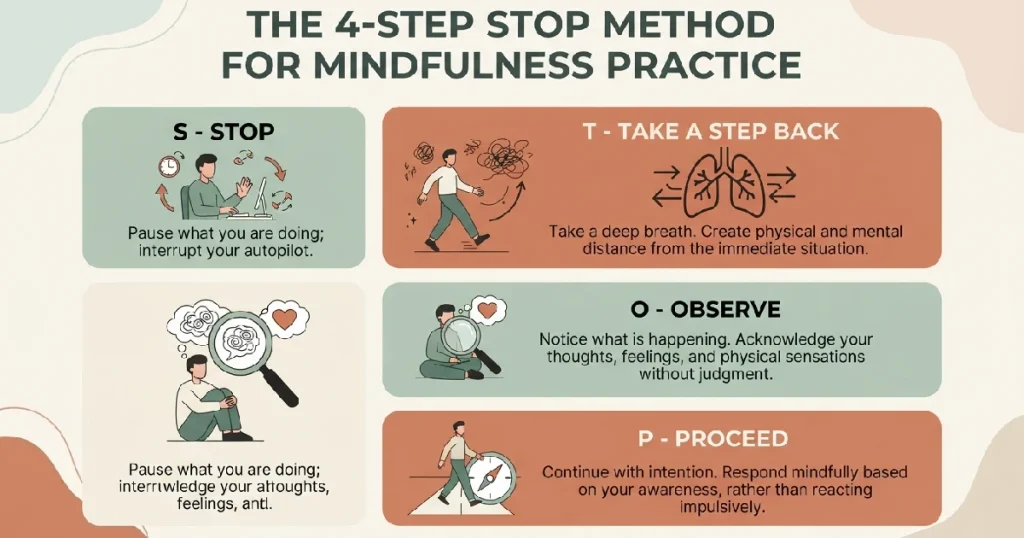
Watch your hands for a day. They open a new tab beside a half-finished report, scroll a feed with no memory of choosing it, or fire off a sharp reply before the thought finishes forming.
Sirois and Pychyl (2013) frame procrastination as short-term mood repair, not a time management flaw. The task stirs discomfort and the scroll soothes it, which is why willpower tips alone often fail.
STOP takes about fifteen seconds:
- S, Stop: freeze your body for one full second.
- T, Take a step back: lift your eyes off the screen and take one deliberate breath.
- O, Observe: what thoughts are running, what is your body doing, what is happening in the room?
- P, Proceed: choose one micro-action, like typing a single sentence.
How to Be Mindfulness-Oriented in High-Stress Work Scenarios
Picture a curt email from a colleague. Your jaw clamps, heat climbs your neck, and a reply drafts itself. Run STOP, notice the thought (“they’re disrespecting me”), then write the reply in a notes app and reread it in ten minutes.
In meetings, STOP shrinks to seconds while someone else talks: feel both feet, release your jaw, notice the urge to interrupt.
Secret 5: Everyday Mindfulness, How to Anchor Presence Without Meditating
The Routine Activity as an Attentional Gym
Routine tasks make ideal attentional anchoring practice because they are boring, which lets autopilot take over and gives you plenty of chances to notice and return.
Try the kitchen sink protocol. Feel warm water over your knuckles, smell the soap, notice the slick weight of a ceramic plate and the clink of cutlery in the basin. When your mind jumps to tomorrow’s meeting, return to the water.
The 1-to-5 Minute Breath Gym
Sit upright, rest attention on your belly rising and falling, and set a timer for one minute. Your mind will wander within seconds, and that is the exercise working. Notice where it went, then come back without a lecture, because each return is one repetition.
In our experience, one minute daily for three weeks beats a heroic twenty-minute session abandoned by day four. Add thirty seconds each week.
Borrow cues you already have. The cold metal of your front door handle, picking up your phone, or an elevator wait can each become a one-breath checkpoint.
What to Do Next: Four Small Tools to Try This Week
One place to begin is choosing just one of these, not all four.
1. The Tally Card. Keep an index card by your keyboard and make a tick each time you catch yourself dwelling, worrying, or fuming. After three days a dominant pattern usually appears, which shows you where defusion will pay off most.
2. The Buy-Time Sentence. When a question lands in a meeting and your chest tightens, consider saying, “Good question, let me think for a moment.” Use that gap for one STOP breath.
3. The Five-Breath Floor. On chaotic days, consider a minimum of five slow breaths before opening your laptop, tied to something automatic like starting the coffee machine.
4. The Evening Replay. Before bed, write one line for each question: Where did autopilot take over today? What did my body say in that moment? What would one pause have changed? Judge nothing, just collect the data.
Frequently Asked Questions About Starting a Daily Mindfulness Practice
Why does practicing mindfulness sometimes make my anxiety feel worse at first?
When you eliminate external noise, you suddenly notice internal physical sensations (like rapid heartbeats or muscle tightness) that were already there. This heightened awareness can feel alarming initially. Instead of fighting these feelings, keep your eyes open, soften your gaze, and anchor attention on physical touch, such as your feet flat against the floor.
Can I build a mindfulness practice without sitting in formal meditation?
Yes. Mindfulness is intentional awareness, not sitting cross-legged in silence. You cultivate identical neural pathways by bringing undivided sensory attention to daily chores like washing dishes, eating meals, or noticing bodily tension before answering emails. Frequent, thirty-second conscious check-ins throughout your workday are often far more practical and effective than seated meditation sessions.
What should I do when self-critical thoughts refuse to stop during practice?
Do not try to force them away; suppression only strengthens cognitive distress. Mentally label the voice as “self-criticism” or “worrying,” treating it as background noise rather than objective reality. Acknowledge the thought’s presence, take one slow breath, and gently redirect your focus toward your immediate task or physical breathing sensations.
Reclaiming Your Day: Small Micro-Resets Lead to Lifelong Calm
Back to 2:40 on that Tuesday. The email is still half-written and your pulse is still up, but now you hold a map: tag the thought, allow the feeling, soften the knot, run STOP, and anchor to something real in the room.
Mindfulness practice was never a discipline that demands silence and a cushion. It is a flexible toolkit for kitchens, elevators, and tense inboxes.
Today, pick one routine moment, washing dishes, walking through your front door, or sitting down at your desk, and run STOP once. Fifteen seconds is enough.
You don’t need a quieter mind, only a kinder, quicker way back to this moment.
My Closing Remarks
I spent years believing I was bad at this because my mind never went quiet. What changed things was a coach telling me that the noticing counts, not the silence. I still drift off mid-breath most mornings, and I still smile a little when I catch it. If you try one pause this week and feel clumsy doing it, you are doing it correctly. Be patient with yourself, and give it a few weeks before judging.
More Related Stories for You
If anxiety is your main reason for starting, this guide to practical mindfulness for anxiety goes deeper on calming the body first.
About The Author