
 Nicole Adkins
You Don’t Need A Quiet Room Or Twenty Spare Minutes. You Need Two Minutes And The Right Neurological Trigger.
Key Points:
- Short mindfulness meditation does not require silence, stillness, or extra time. It requires specific sensory triggers that interrupt your stress response in seconds.
- These seven micro-mindfulness tricks use your body’s built-in calming mechanisms, from the mammalian dive reflex to somatic tension release, to create instant mental clarity during your most overwhelming moments.
- The best mindfulness practice is the one you can actually do. And you can do every single one of these right now, wherever you are sitting.
Contents
Table of Contents
When Meditation Feels Like One More Thing You Are Failing At
You are sitting at your desk at 2:47 p.m. Your inbox has 38 unread messages. Your phone just buzzed with a text you do not want to read yet. There is a dull ache behind your eyes that started around lunch and never left. Someone just asked if you have “a quick sec,” and you felt your jaw tighten before you even answered.
You know you should meditate. Everyone says so. The apps, the articles, your therapist, your well-meaning coworker who swears by her morning Zen routine.
But here is the problem nobody talks about. When your nervous system is already in overdrive, the idea of sitting still and breathing for ten minutes feels about as achievable as running a marathon in your office chair.
That is not a willpower failure. That is biology.
Why Traditional Meditation Fails You at Your Worst Moments
When you are stressed, your brain’s amygdala, the small almond-shaped region that acts as your internal alarm system, is firing at full speed. It is scanning for threats. It is pushing your prefrontal cortex, the part of your brain responsible for calm, rational decision-making, into the background.
This is your sympathetic nervous system at work. It is your fight-or-flight response. And it does not care about your meditation app’s soothing bell sound.
According to research published in Psychiatry Research: Neuroimaging by Hölzel et al. (2011), mindfulness meditation physically changes the structure of the brain over time, increasing gray matter density in areas associated with self-awareness and emotional regulation. But those structural changes require consistency. They do not happen because you white-knuckle your way through one brutal meditation session during a panic.
What does work in the moment? Short, targeted interventions that use your body’s existing neurological wiring to interrupt the stress cycle before it spirals.
Think of it this way. Your stress response is like a runaway car rolling downhill. Traditional meditation builds better brakes over time. But right now, at 2:47 p.m. on a Thursday, you do not need better brakes. You need a curb. Something small, solid, and immediate that catches the wheel.
These seven tricks are that curb.
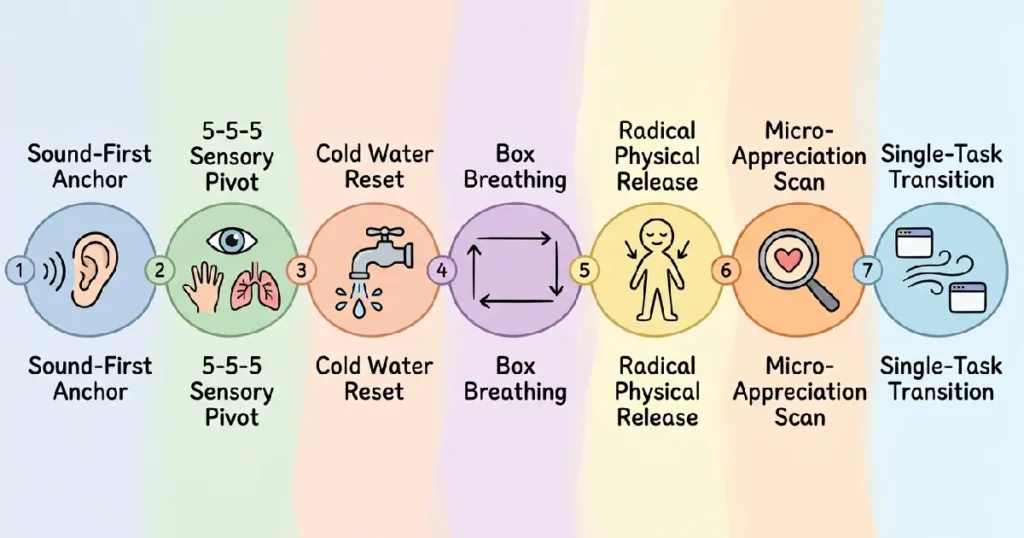
1. The “Sound-First” Anchor: Reset Your Attention Without Closing Your Eyes
Most mindfulness instructions begin with “close your eyes and focus on your breath.” But when your mind is racing, breath-focus can actually increase anxiety. You start monitoring your breathing, which makes it feel unnatural, which makes you more tense.
The trick: Instead, focus entirely on ambient sound. Isolate the farthest sound you can hear. Maybe it is traffic outside, a distant conversation, an air conditioner humming two rooms away. Hold your attention there for five seconds. Then shift to the closest sound. Your own breathing. The click of a keyboard. The fabric of your shirt moving against your chair.
Why this works: Auditory attention forces your brain to process external sensory data, which neurological research confirms immediately disrupts internal loops of rumination. You cannot anxiously rehearse tomorrow’s meeting and track a distant sound at the same time. Your brain has to choose. And you just chose for it.
A woman I once worked with, Priya, was a litigation attorney who had tried and abandoned meditation apps six times. She described her brain as “a browser with 47 tabs open.” The Sound-First Anchor became the one technique she could use in courtroom hallways between appearances. “I do not even look like I am doing anything,” she told me. “But inside, the volume just drops.”
That is the point. Nobody has to know you are meditating.
2. The 5-5-5 Sensory Pivot: Pull Your Mind Out of the Future
Anxiety is almost always future-oriented. You are not panicking about right now. You are panicking about what might happen next. The 5-5-5 Sensory Pivot is an accelerated grounding technique designed to yank your awareness back into the physical present.
The trick: Acknowledge five things you can see. Then five things you can physically feel, like the texture of your sleeve, the temperature of the air on your skin, the pressure of your feet on the floor. Then take five slow, deliberate breaths.
Why this works: This is a rapid cognitive reset that exploits a simple neurological truth: your brain cannot fully process sensory input and generate hypothetical future scenarios simultaneously. According to the principles behind grounding exercises widely used in cognitive behavioral therapy, naming physical sensations activates present-moment processing and reduces the activation of threat-detection centers.
The key word here is “acknowledge.” You are not analyzing. You are not judging. You are simply noticing. That distinction matters more than you might think.
3. The Cold Water Reset: Hack Your Mammalian Dive Reflex

This is the trick that sounds too simple to be real. It is also the one that works the fastest.
The trick: Walk to the nearest sink. Turn the water to the coldest setting. Wash your hands slowly, focusing entirely on the sensation of the temperature against your skin. If you can, splash cold water on your wrists and the sides of your neck.
Why this works: Cold exposure activates your mammalian dive reflex, a hardwired physiological response that slows your heart rate, constricts peripheral blood vessels, and signals your parasympathetic nervous system (the “rest and digest” system) to take over. Your body literally cannot maintain a full fight-or-flight response when cold water hits your skin.
This is not wellness folklore. It is basic mammalian biology. Divers, emergency responders, and dialectical behavior therapy (DBT) practitioners have used cold exposure as an emotional regulation tool for decades.
The whole process takes about 45 seconds. And you walk back to your desk with a heart rate that is measurably lower than when you left.
But here is what no one tells you: it is not the cold that does the work. It is your attention to the cold. The moment you focus on a physical sensation with full awareness, you are doing mindfulness meditation, even if you are standing at a bathroom sink.
4. Box Breathing on a Screen Loop: Meditate While Looking Productive
You cannot always leave your desk. Sometimes the stress is happening while you are staring at a screen with people around you. Box breathing solves that problem elegantly.
The trick: Inhale for four seconds. Hold for four seconds. Exhale for four seconds. Hold for four seconds. While you breathe, trace the four edges of your computer monitor with your eyes: top, right, bottom, left. Repeat for three full cycles.
Why this works: Box breathing, also known as square breathing or four-square breathing, regulates your oxygen and carbon dioxide levels, which stabilizes your autonomic nervous system. The eye-tracing element adds a secondary layer of focus that prevents your mind from wandering back into stress. Navy SEALs use this technique before high-pressure operations. You can use it before a difficult email.
The beauty of this short mindfulness meditation technique is its invisibility. To anyone watching, you are simply staring at your screen. Inside, you are resetting your entire nervous system in 48 seconds.
5. The Radical Physical Release: Tell Your Brain You Are Safe

Right now, as you read this, check in with your body. Are your shoulders lifted toward your ears? Is your jaw clenched? Is your tongue pressed hard against the roof of your mouth?
For most people reading this sentence, the answer to at least one of those questions is yes.
The trick: Drop your shoulders completely. Unclench your jaw. Let your tongue fall to the bottom of your mouth, soft and loose. Take one breath.
Why this works: These three areas, shoulders, jaw, and tongue, are what somatic psychologists call primary tension zones. They are the places your body unconsciously stores stress. When these muscles are contracted, they send a continuous signal to your brainstem that says, “We are not safe.” Releasing them sends the opposite signal. Your brain reads the muscular relaxation as evidence that the threat has passed.
This is called bottom-up regulation. Instead of trying to think your way out of stress (top-down), you change the body first and let the brain follow.
In my practice, I have seen people carry jaw tension for years without realizing it. One client, Marcus, a high school teacher dealing with burnout, described the moment he first intentionally unclenched his jaw during a staff meeting as “the first time my body stopped screaming at me in months.”
Your body is always talking to your brain. This trick changes the message.
6. The “Micro-Appreciation” Scan: Rewire Your Negativity Bias in 30 Seconds
Your brain has a built-in negativity bias. This is a well-documented evolutionary feature where threatening, annoying, or disappointing information gets processed faster and sticks longer than positive information. It kept your ancestors alive on the savanna. It keeps you miserable in your office.
The trick: Look around your immediate environment. Find three small things that are working perfectly right now. Your pen. The chair supporting your weight without collapsing. The lightbulb above you. The glass of water that is clean and drinkable. Notice them. Acknowledge them silently.
Why this works: This is not toxic positivity. You are not pretending your problems do not exist. You are temporarily redirecting your brain’s attention toward functional, reliable elements of your environment. This activates reward pathways in the brain, specifically the ventral striatum, which is associated with satisfaction and motivation. A study by Emmons and McCullough (2003) found that even brief gratitude exercises produced measurable improvements in mood and well-being.
The word “micro” matters here. You are not journaling five pages of gratitude. You are spending 20 seconds noticing that your chair works. That is it. That is enough.
7. The Single-Task Transition: Stop Stress from Bleeding Between Tasks
Multitasking is a myth. What your brain actually does when you switch rapidly between tasks is called context switching, and each switch carries a cognitive cost. Research suggests it takes an average of 23 minutes to fully refocus after an interruption. When you jump from task to task without any pause, the stress from the last task bleeds into the next one. By 3 p.m., you are carrying the accumulated tension of every switch you have made since morning.
The trick: Before you open a new browser tab, start a new email, or shift to a different task, close your eyes for exactly three deep breaths. Not five. Not ten. Three. Then open your eyes and begin the new task.
Why this works: Those three breaths create what cognitive psychologists call a clean attentional break. They give your prefrontal cortex a momentary reset, preventing residual cognitive load from contaminating the next task. It is like rinsing a paintbrush between colors so they do not all turn into mud.
This is arguably the most practical short mindfulness meditation technique on this list because it does not require a separate moment in your day. It lives inside the transitions you are already making. It is mindfulness as a bridge, not a destination.
How to Start Today: Three Practical Steps

If you have read this far and you are wondering where to begin, here are three ways to put this into motion immediately.
The One-Trick Trial: Pick one single trick from this list. Just one. Use it three times today. Do not try to build a full mindfulness routine right now. The goal is not to meditate “correctly.” The goal is to interrupt your stress cycle once, then do it again.
The Habit Stack: Attach your chosen trick to something you already do every day. Before your first sip of coffee, do the Sound-First Anchor. Every time you wash your hands, do the Cold Water Reset. After closing a Zoom call, do the Single-Task Transition. Habit stacking, a concept popularized by behavioral researcher BJ Fogg, is one of the most effective ways to build new behaviors without relying on motivation.
The Body Check-In Question: Three times a day, ask yourself one question: “Where am I holding tension right now?” Do not try to fix it. Just notice. That noticing, that tiny moment of self-awareness, is mindfulness. You are already doing it.
A useful reflection to carry with you: “What would change if I gave myself two minutes of calm instead of zero?”
Not twenty minutes. Not a retreat. Two minutes.
You Already Know How to Do This
Remember that moment at 2:47 p.m.? The inbox, the headache, the tightening jaw.
You are still in that moment. But now you have something you did not have five minutes ago. You have seven specific, evidence-based ways to interrupt what your nervous system is doing and redirect it. Without an app. Without a quiet room. Without anyone knowing.
That is not a small thing.
Mindfulness was never meant to be another item on your to-do list. It was meant to be a way of meeting your own life as it is actually happening, not as you wish it were.
You do not need to become a person who meditates. You just need to become a person who pauses.
And you can start with the next breath.
My Closing Remarks
I will tell you something honestly. For years I recommended traditional meditation to clients and watched most of them quietly abandon it within two weeks. It made me question whether I was helping or just adding to their guilt. Then I started prescribing these micro-tricks instead, one at a time, attached to things they were already doing. The results were not subtle. People came back lighter. Less reactive. More present with the people they loved. I learned that the door to mindfulness does not have to be grand. Sometimes it is the size of a cold faucet handle or three quiet breaths between browser tabs. Start where you are. That is enough.
More Related Stories for You
- If these tricks sparked your curiosity, you might also appreciate exploring a deeper mindfulness practice that builds on the same principles over time.
About The Author