
 Nicole Adkins
You Don’t Need 20 Minutes of Silence to Stop Stress in Its Tracks. You Need 5 Seconds and the Right Mental Move.
Key Points
- Mindful thinking is not meditation. It is a targeted, moment-to-moment mental skill that can interrupt your brain’s stress response in under ten seconds, without closing your eyes or leaving your desk.
- Your nervous system responds to micro-interventions faster than you think. Science shows that specific breathing patterns, sensory anchoring, and cognitive shifts can downregulate your fight-or-flight system almost immediately.
- Mindful thinking works because it changes the conversation between your body and your brain. When you learn to redirect attention with precision, you stop feeding the stress loop and start dissolving it.
Contents
Table of Contents
You are sitting at your desk, staring at a screen full of emails you haven’t answered. Your chest feels tight. Your jaw is locked. You catch yourself holding your breath without meaning to, and somewhere in the back of your mind, a voice keeps repeating: You’re falling behind. You can’t keep up. Something is going to break.
That voice isn’t delivering facts. It is delivering a feeling dressed up as a prediction.
And it is running the show.
If you have ever felt like stress arrives faster than your ability to manage it, you are not failing at life. You are experiencing the biological reality of a nervous system that was designed for survival threats, not overflowing inboxes. The problem is not that you feel stressed. The problem is that no one ever taught you how to interrupt the stress signal before it takes over your entire afternoon.
That is exactly what mindful thinking does. And it works faster than you expect.
Why Your Brain Gets Stuck in Stress Mode
Here is what most people misunderstand about stress: it is not purely a mental event. Stress is a full-body chain reaction. When your brain perceives a threat, whether that threat is a saber-toothed tiger or a passive-aggressive text from your boss, the amygdala fires. That almond-shaped structure deep in your brain triggers a flood of cortisol and adrenaline. Your heart rate climbs. Your muscles tighten. Your prefrontal cortex, the part of your brain responsible for rational thought, planning, and perspective, goes partially offline.
This is the fight-or-flight response. It was brilliant for keeping your ancestors alive. It is terrible for helping you respond thoughtfully to a difficult coworker.
The real danger is not the initial spike. It is the loop. Stress generates anxious thoughts. Anxious thoughts generate more cortisol. More cortisol keeps the amygdala activated. The cycle feeds itself, and before you know it, a single frustrating email has hijacked your entire nervous system for two hours.
According to a 2023 study published in Nature Reviews Neuroscience, chronic activation of this stress loop is associated with reduced cognitive flexibility, impaired emotional regulation, and increased vulnerability to anxiety and depression. In other words, the longer the loop runs, the harder it becomes to think your way out of it.
But here is the part that changes everything.
The loop has entry points. Small, specific moments where a targeted mental move can break the chain. Mindful thinking is how you find those entry points and use them before the stress spiral has a chance to build momentum.
This is not about becoming a person who never feels stress. That person does not exist. This is about becoming a person who catches the signal early and knows exactly what to do with it.
1. The 5-Second Sensory Anchor: How to Pull Your Brain Out of the Future and Into the Room
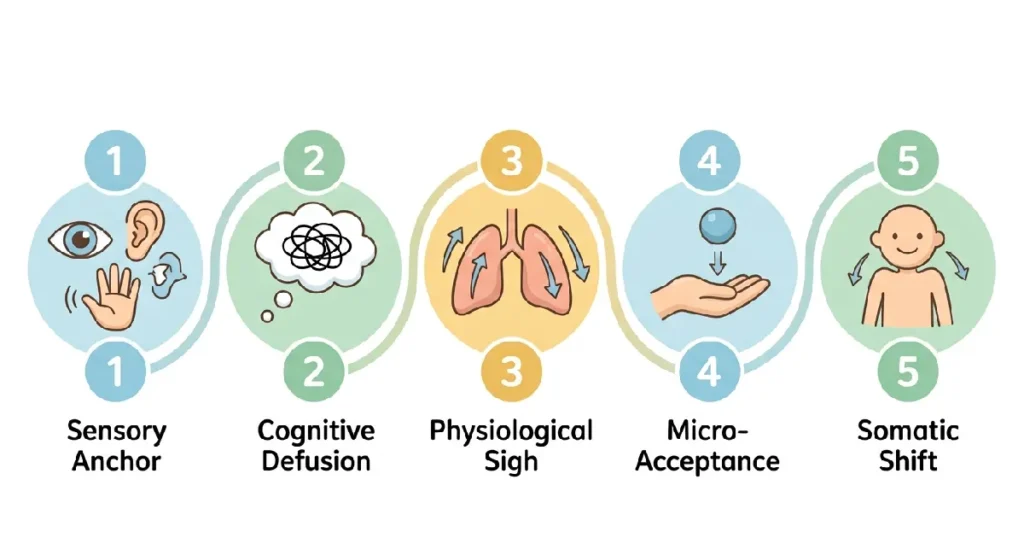
Most stress is not about what is happening right now. It is about what might happen next. Your mind races forward, constructing worst-case scenarios with remarkable creativity. The 5-Second Sensory Anchor works because it forces your brain to stop time-traveling and process what is physically real in this exact moment.
Neuroscience tells us that when you deliberately engage your senses, you shift neural activity away from the amygdala and back toward the prefrontal cortex. You are essentially telling your brain: “Process data from the environment, not data from the imagination.”
The practice is simple. Name one thing you can see right now. One thing you can hear. One thing you can physically feel, like the texture of your shirt against your skin or the weight of your feet on the floor.
That is it. Three sensory observations. Five seconds.
I once worked with a woman named Sara who experienced intense anticipatory anxiety before meetings at work. Her mind would spiral into every possible scenario where she might say the wrong thing or be judged. We introduced sensory anchoring as her pre-meeting ritual. Before walking into the conference room, she would silently note the color of the hallway wall, the hum of the overhead lights, and the feeling of her notebook in her hands.
“It sounds ridiculous,” she told me after a few weeks. “But it works. By the time I sit down, I’m actually in the room instead of in my head.”
That is the mechanism. Mindful thinking through sensory anchoring breaks the mental loop of anxiety by giving your brain concrete data to chew on instead of abstract fears. It is not distraction. It is redirection.
2. Cognitive Defusion: The Linguistic Trick That Creates Instant Distance From Stressful Thoughts
Here is something most people never consider: you are not your thoughts. But you live as if you are.
When the thought “I am completely overwhelmed” appears in your mind, you do not experience it as a passing mental event. You experience it as a statement of truth about your identity. Psychologists call this cognitive fusion, the state where the boundary between you and your thoughts dissolves, and every thought feels like an undeniable fact about reality.
Acceptance and Commitment Therapy (ACT), developed by psychologist Steven Hayes, offers a powerful countermove called cognitive defusion. The goal is not to argue with the stressful thought or replace it with a positive one. The goal is to change your relationship to the thought itself.
The practice: When you notice a stress-driven thought, add a small prefix to it. Change “I am overwhelmed” to “I am having the thought that I am overwhelmed.”
Read those two sentences again. Notice how different they feel in your body.
The first version is a declaration. The second is an observation. That tiny linguistic shift creates what researchers call psychological distance, and it is one of the most effective stress reduction techniques available without a therapist in the room.
You are not arguing with the thought. You are not pretending it does not exist. You are simply stepping back far enough to see it for what it actually is: a sentence your brain generated. Not a verdict on your life.
The more you practice this form of mindful thinking, the more you realize just how many of your “truths” are actually thoughts wearing disguises.
3. The Physiological Sigh: A Breathing Pattern Engineered by Neuroscience to Calm You in One Breath

Think of your stress response like a car alarm that has gone off accidentally. Your body is blaring a signal that danger is present, but the danger is not real. You need a way to manually reset the alarm.
The physiological sigh is that reset button.
This is not generic “deep breathing” advice. This is a specific breathing pattern studied by neuroscientist Andrew Huberman and his team at Stanford University. Their 2023 study published in Cell Reports Medicine found that cyclic sighing, even for just five minutes, was more effective at reducing physiological stress markers than traditional mindfulness meditation.
The practice: Take two quick, sharp inhales through your nose. The first inhale is deep. The second is a short “top-off” inhale immediately after, filling the last bit of lung capacity. Then exhale slowly and completely through your mouth.
That is one cycle. Do it once or twice.
Here is why it works at the biological level. When you are stressed, the tiny air sacs in your lungs called alveoli begin to collapse slightly, which increases carbon dioxide levels in your blood. The double inhale reinflates those air sacs. The long exhale then dumps the excess carbon dioxide from your system. This combination directly activates the parasympathetic nervous system, the branch of your autonomic nervous system responsible for calming you down, slowing your heart rate, and returning your body to a state of rest.
One breath pattern. One physiological reset.
This is mindful thinking expressed through the body. You are not sitting with your thoughts. You are using your lungs to send a direct message to your brain: The danger has passed. Stand down.
4. Radical Micro-Acceptance: Stop Fighting Reality and Free Up the Energy to Actually Fix Things
Here is an insight that might seem counterintuitive at first. A significant portion of your daily stress does not come from the problem itself. It comes from your resistance to the problem.
You are stuck in traffic. The stress is not really about the cars in front of you. It is about the war inside your mind: This shouldn’t be happening. I should have left earlier. Why is this always the way it goes?
That mental resistance, that internal argument with reality, creates what psychologists call emotional friction. You are spending cognitive energy fighting something that has already happened instead of adapting to it. And every ounce of energy you spend on resistance is an ounce you cannot spend on problem-solving.
The practice: When you notice yourself resisting the current moment, silently repeat: “It is what it is right now, and I can handle it.”
This is not passive resignation. This is strategic acceptance.
That distinction matters. Resignation says: “Nothing I do matters.” Micro-acceptance says: “I am going to stop wasting energy on outrage about the present moment so I can use that energy to do something useful.”
Think of it this way. Imagine you are holding a beach ball underwater in a swimming pool. You are pushing it down with all your strength, but the ball keeps fighting back, wobbling, threatening to shoot out of your grip. That is what it feels like to resist reality. The moment you let the ball go, the energy demand drops to zero.
That is not giving up. That is freeing your hands.
Mindful thinking through micro-acceptance is the fastest way to reclaim the mental bandwidth that stress has been stealing from you all day.
5. Somatic Attention Shifts: Use Your Body to Tell Your Brain the Danger Has Passed
Your brain is constantly reading signals from your body to decide how safe you are. This is called interoception, your brain’s ability to sense and interpret internal body signals like muscle tension, heart rate, and breathing patterns.
When stress tightens your shoulders, clenches your jaw, or constricts your chest, your brain does not interpret those sensations as neutral. It interprets them as confirmation that you are in danger. The muscles say “threat,” and the brain responds by keeping the stress chemicals flowing.
But this communication runs in both directions.
The practice: Take three seconds to scan your body. Find the tension. Then consciously drop your shoulders away from your ears. Unclench your jaw. Let your tongue fall away from the roof of your mouth. Soften the muscles around your eyes.
You are not just relaxing your muscles. You are sending a safety signal from your body back up to your brain. You are using the body-to-brain communication channel to override the stress feedback loop.
Research on somatic experiencing and body-based stress interventions shows that this kind of deliberate muscular release can reduce cortisol levels and downregulate sympathetic nervous system activity within minutes.
Most people carry tension they are not even aware of. Right now, as you read this sentence, check your jaw. Check your shoulders.
Were they tense? For most readers, the answer is yes. That unconscious tension has been quietly telling your brain to stay on alert, even when there is no real threat in the room.
That is not weakness. That is wiring.
And now you know how to work with it instead of against it.
Your Stress Toolkit: How to Start Using Mindful Thinking Today

You do not need to master all five techniques at once. In fact, trying to do everything at once would just become another source of stress. Instead, here are three practical ways to begin integrating mindful thinking into your daily life starting right now.
The “First Breath” Ritual. Choose one transition point in your day. It might be the moment you park your car at work, the moment you close your laptop at the end of the day, or the moment you walk through your front door. At that transition point, do one physiological sigh. Two sharp inhales through the nose, one long exhale through the mouth. This becomes your signal that you are shifting from one mode to another.
The Tension Check-In. Set a gentle alarm on your phone for three random times during your day. When it goes off, do a three-second body scan. Drop your shoulders. Release your jaw. That is the entire practice. Over time, you will start catching tension before the alarm even goes off.
The Thought Label. The next time you notice a stressful thought running on repeat, pause and silently say: “I notice I am having the thought that…” and then complete the sentence. You do not need to change the thought. You do not need to judge it. Just label it and watch what happens to its intensity.
A useful question to ask yourself at the end of each day: Which of these five practices would have helped me most during today’s most stressful moment? That answer tells you where to focus your practice tomorrow.
You Were Never Meant to Think Your Way Out of Stress. You Were Meant to Shift Your Way Through It.
Remember that moment at the beginning of this article? You, sitting at your desk, chest tight, jaw locked, a voice in your head telling you that something is about to break.
Now you have five different ways to respond to that moment. You can anchor yourself with your senses. You can label the thought and watch it lose its grip. You can breathe in a way that manually resets your nervous system. You can stop fighting the present moment and reclaim your energy. You can release the tension your body has been holding without your permission.
None of these practices require a meditation cushion, a quiet room, or twenty spare minutes. They require five seconds and the willingness to try something different than what you have always done.
Mindful thinking is not about silencing your mind. It is about changing who is in charge of it.
The stress will still come. It always does. But now, you do not have to let it run the show.
You have your hands on the controls.
My Closing Remarks
I am going to be honest with you. For years, I told people that stress management required discipline, routine, and long-term commitment. And while those things help, I watched too many people burn out trying to build a meditation habit while they were already drowning. The five practices in this article are different because they meet you exactly where you are, in the chaos, in the overwhelm, in the middle of the moment that feels like it is swallowing you whole. I have used every single one of them myself, not in some calm clinical office, but in my car, in my kitchen, in conversations that were going sideways. They work. Not because they are magic, but because they respect the way your brain and body actually function. Start with one. Just one. And notice what shifts.
More Related Stories for You
- If you want to go deeper into building a daily mindfulness practice that fits your real life, this guide is a great next step.
About The Author