
 Nicole Adkins
Old-School Meditation Asks Teenagers To Sit Still And Empty Their Minds. For A Generation Wired On Speed, Sound, And Stimulation, That’s Not Calming. It’s Punishment. These Nine Techniques Meet Teens Exactly Where They Are.
Key Points:
- Mindfulness for teenagers works best when it matches how teens actually interact with the world, through movement, music, screens, and sensory engagement, not forced stillness.
- Evidence-based mindfulness techniques can down-regulate the sympathetic nervous system in under 60 seconds, offering real-time relief during panic, test anxiety, and social stress.
- The most effective teen mindfulness tools are the ones they will actually use, which means they need to feel relevant, fast, and nothing like homework.
Contents
Table of Contents
When Sitting Still Makes Everything Louder
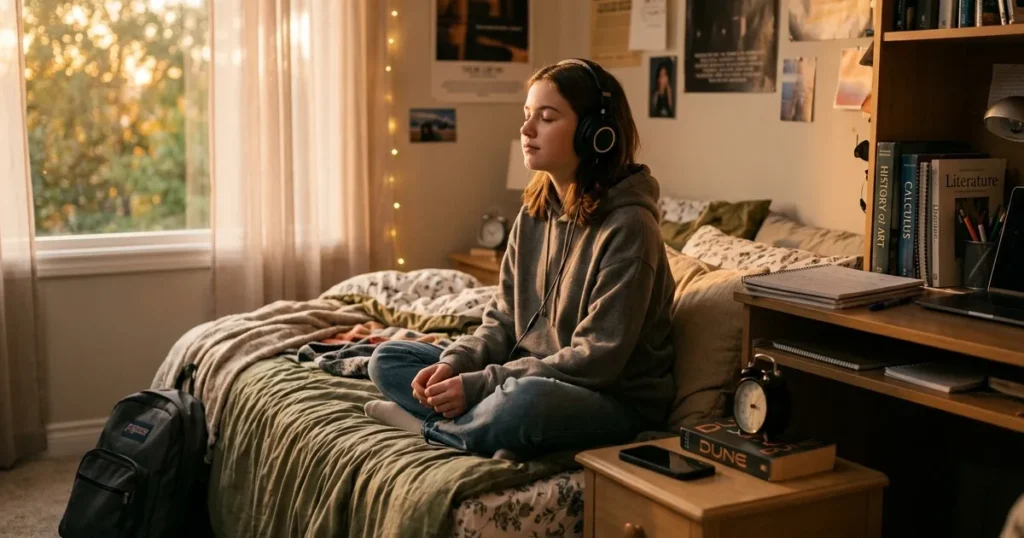
You’re sitting on the edge of your bed at 11 p.m. Your phone is facedown, but your brain isn’t. Tomorrow’s exam. The comment someone made at lunch. That group chat you weren’t added to. The thoughts keep layering, each one pulling the next one in like a current.
Someone told you to try meditating. So you close your eyes, try to breathe, and within eight seconds your mind is louder than before. Now you feel anxious and like you failed at the one thing that was supposed to help.
That’s not a personal failure. That’s a design mismatch.
Most mindfulness programs were built for adult brains in quiet rooms. They weren’t designed for a sixteen-year-old whose nervous system has been marinating in notifications, academic pressure, and social surveillance since middle school.
But here’s what changes everything.
Why Teen Anxiety Demands a Different Kind of Calm
The numbers are hard to ignore. According to the Centers for Disease Control and Prevention (CDC), more than 40% of high school students reported persistent feelings of sadness or hopelessness in recent survey data, and nearly one in three experienced poor mental health. Teen anxiety isn’t a phase or a personality quirk. It’s a public health emergency that has been building for over a decade.
And the traditional tools we hand teenagers often miss the mark. Telling an anxious teen to “just breathe” or “sit and be present” is like handing someone a paper map when they need GPS. The concept is sound. The format is wrong.
What neuroscience tells us is that teenage brains are still undergoing major development in the prefrontal cortex, the region responsible for impulse control, future planning, and emotional regulation. This means their amygdala, the brain’s threat-detection center, tends to run the show during stress. Mindfulness for teenagers needs to work with this wiring, not against it.
The techniques that follow are all grounded in principles from cognitive behavioral therapy, somatic psychology, and nervous system regulation research. But more importantly, they are built for the way teens actually think, move, and live.
Not one of them requires a cushion on the floor or a silent room.
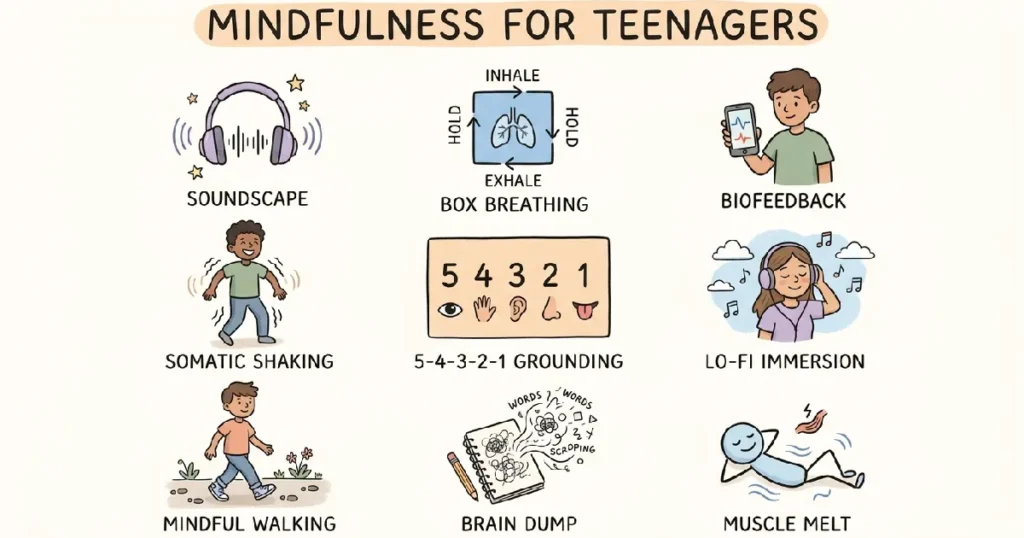
1. The “Soundscape Grounding” Shift: Turning Noise into an Anchor
Here’s a counterintuitive starting point: don’t chase silence. Use sound.
Most grounding exercises ask you to tune out the world. This one asks you to tune deeply into it. Put on headphones without playing any music. Then identify the farthest sound you can hear, maybe a car two streets over. Then find the closest sound, your own breath or the hum of a fan. Then notice the sound of your breathing itself.
This works because of a principle called attentional redirection. When the mind is spiraling, it’s stuck in an internal loop. Asking it to categorize external sounds forces a shift from inward rumination to outward observation. The spiral doesn’t just slow down. It loses its grip.
A teen named Mara, a composite drawn from several teenagers I’ve worked with over the years, used this technique every morning before school. “I put my headphones on and just listened to the house,” she told me. “The fridge buzzing, my brother’s alarm going off down the hall. By the time I took the headphones off, I wasn’t thinking about all the things I was dreading. I was just… here.”
That shift from dreading to here is exactly what mindfulness for teenagers is meant to produce.
2. Gamified Box Breathing: The 4-4-4-4 Method for Instant Nervous System Reset
If you’ve ever watched a teen master a complex video game mechanic in minutes, you already know this: teenagers respond to structured, tactical challenges. That’s what makes box breathing so effective for this age group.
The pattern is simple. Inhale for 4 seconds. Hold for 4 seconds. Exhale for 4 seconds. Hold empty for 4 seconds. As you do it, visualize a square being drawn in your mind, one side per step.
What happens physiologically is significant. Box breathing activates the vagus nerve, the longest cranial nerve in the body, which runs from the brainstem down to the abdomen. Stimulating it triggers the parasympathetic nervous system, your body’s built-in “rest and restore” mode. In plain terms, it tells your brain to stand down from the red alert that anxiety triggered.
Research published in Frontiers in Psychology has shown that structured breathwork techniques reduce cortisol levels and subjective anxiety in as few as five minutes. For a teenager sitting outside a classroom before a test or in a bathroom stall after a social conflict, five minutes can be the difference between a meltdown and a reset.
The gamification element matters. Visualizing the square gives the brain a task that occupies just enough cognitive bandwidth to interrupt the worry loop without requiring effort that feels exhausting.
3. “Biofeedback” Glancing: Rewiring Digital Habits into Mindful Triggers
This is one of the most practical mindfulness for teenagers strategies available, precisely because it doesn’t ask them to put down the phone. It asks them to notice what happens right before they pick it up.
The technique: every time you open a specific app, take one deliberate deep breath first. Before your thumb taps the screen, quickly scan your body. Are your shoulders near your ears? Is your jaw clenched? Are you opening this app because you want to, or because you’re trying to escape a feeling?
This is rooted in what psychologists call the habit loop: cue, routine, reward. For most teens, the cue is discomfort (boredom, anxiety, loneliness), the routine is reaching for a screen, and the reward is a dopamine hit. Inserting a single breath between the cue and the routine creates what behavior change researchers call a “choice point.” It doesn’t ban the behavior. It introduces consciousness into a pattern that was running on autopilot.
That one breath won’t change everything overnight. But over weeks, it builds something powerful: the ability to notice why you’re doing what you’re doing, in real time.
4. Somatic Shaking and Release: Moving the Stress Out of Your Body
Here’s something most adults never told you: sometimes the worst thing you can do when you’re anxious is sit still.
Anxiety is not just a mental experience. It’s a physiological one. When the sympathetic nervous system is activated, your body floods with cortisol and adrenaline. If that energy doesn’t go anywhere, it gets stored as tension in your muscles, your chest, your stomach.
Somatic experiencing, a body-based approach developed by Dr. Peter Levine, recognizes that physical movement can complete the stress cycle your body started but never finished. The technique is absurdly simple: stand up and shake. Vigorously. Shake your hands, your arms, your shoulders, your legs. Do it for 60 seconds.
It looks ridiculous. That’s part of why teenagers actually like it. There’s permission in the silliness.
The focus isn’t on how you look. It’s on how you feel afterward. The tingling in your fingertips. The warmth spreading across your shoulders. The sudden quiet that replaces the buzzing.
That’s not weakness. That’s your nervous system completing a cycle it desperately needed to finish.
5. The 5-4-3-2-1 Sensory Countdown: An Emergency Brake for Spiraling Thoughts
This technique has been a staple of cognitive behavioral therapy (CBT) for decades, and for good reason. It works fast, requires zero equipment, and can be done anywhere, in a classroom, on a bus, in a crowded hallway.
Name 5 things you can see. 4 things you can physically feel. 3 things you can hear. 2 things you can smell. 1 thing you can taste.
Why does this work? When you’re in an anxiety spiral, your prefrontal cortex, the rational, decision-making part of your brain, essentially goes offline. The amygdala has hijacked the controls. The sensory countdown forces you to engage in deliberate observation, which is a prefrontal cortex activity. It’s like manually rebooting a computer that froze.
Think of it this way: anxiety pulls you into an imagined future that hasn’t happened yet. The 5-4-3-2-1 technique yanks you back into the physical present, where the threat usually isn’t real.
For teens who experience sudden waves of panic, this technique can become a quiet, invisible lifeline that no one else even notices they’re using.
6. Lo-Fi Frequency Immersion: Using Music as a Mindful Practice
Music isn’t just background noise for teenagers. It’s emotional infrastructure. And that makes it one of the most natural entry points into mindfulness for teenagers who would never sit cross-legged in silence.
The technique works like this: find a lo-fi, ambient, or binaural beats track, ideally one designed around 432Hz frequency. Then pick a single instrument or bassline and follow it through the entire song. Don’t multitask. Don’t scroll. Just track that one sound as it weaves through the composition.
What you’re doing here is training sustained, selective attention, which is the same cognitive muscle that formal meditation targets. A 2019 study published in PLOS ONE found that binaural beats in the alpha frequency range (8-12 Hz) significantly reduced self-reported anxiety and promoted states of relaxed alertness.
You don’t need a meditation app. You need a pair of earbuds and one good playlist.
And here’s the insight differentiator that rarely gets discussed: music-based mindfulness works for teens precisely because it feels like leisure, not therapy. The moment something feels clinical, most teenagers disengage. But ask them to deeply listen to a song? They’re already there.
7. Dual-Task Mindful Walking: Making Movement Meditative
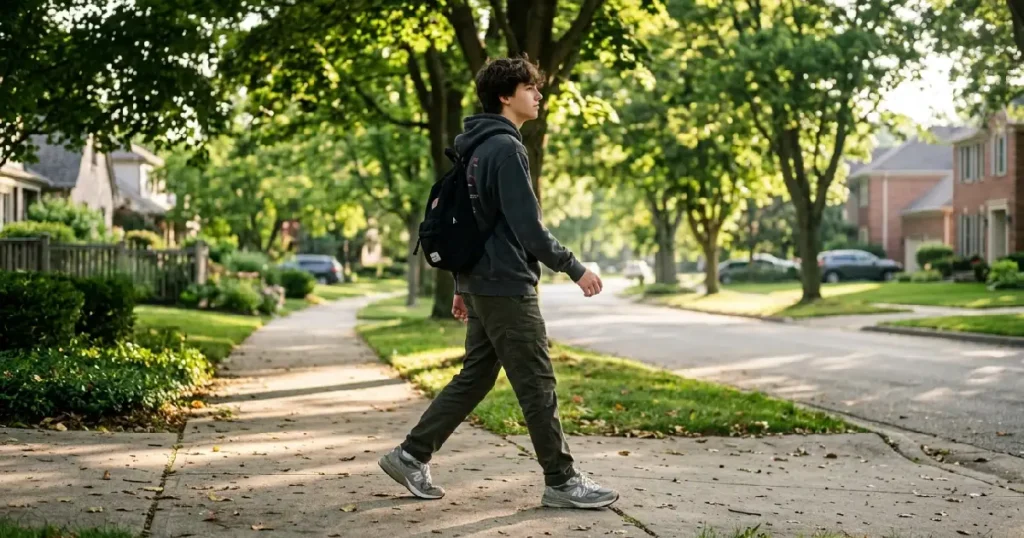
Traditional walking meditation feels aimless to most teenagers. Adding a cognitive task fixes that.
Walk at a natural pace. As you walk, sync your breathing to your steps. Three steps on the inhale, three steps on the exhale. Or silently count each step until you reach 100, then start over.
What makes this powerful is a combination of two mechanisms. First, bilateral stimulation, the rhythmic alternation of left-right movement, has been shown to reduce emotional distress. It’s the same principle behind EMDR therapy, a trauma treatment that uses side-to-side eye movements. Second, pairing a cognitive task with physical movement creates what psychologists call “dual-task interference,” which effectively crowds out anxious thought patterns by occupying the brain’s limited attentional resources.
This is not “going for a walk.” This is a deliberate nervous system regulation tool disguised as a walk.
Try it for ten minutes after school. The difference is noticeable by day three.
8. The “Brain Dump” Text or Journal: Externalizing the Internal Chaos
If journaling feels like homework, reframe it. This isn’t a diary entry. It’s a mental landfill.
Set a timer for two minutes. Open the notes app on your phone or grab any scrap of paper. Write or type every thought in your head without stopping, without editing, without worrying about spelling or grammar or whether it makes sense. When the timer goes off, stop.
The psychological mechanism here is called externalization. When anxious thoughts live only inside your head, they feel enormous, tangled, and permanent. The moment you put them outside of you, on a screen or a page, they shrink. They become objects you can observe rather than storms you’re trapped inside.
Think of your mind like a snow globe that someone keeps shaking. The brain dump is what happens when you set it down and let the flakes settle.
You don’t have to reread what you wrote. You don’t have to keep it. The value is in the act of releasing, not the product.
9. Muscle Melt: Progressive Relaxation for Teenagers Who Can’t Turn Off at Night
Many teenagers carry tension they don’t even know about. Hours spent hunched over desks and phones create chronic tightness in the shoulders, jaw, and lower back. By bedtime, their bodies are wound like springs, and no amount of mental “relaxation” can override a body that is physically locked in stress mode.
Progressive muscle relaxation, sometimes called a “body scan with tension,” works from the bottom up. Starting at the toes, squeeze the muscles as tightly as you can for five seconds. Then release completely. Move to the calves. Then the thighs. The stomach. The fists. The shoulders. The face.
The focus here is on the contrast. The moment of total release after intense tension feels almost startlingly good. That contrast teaches the nervous system what “relaxed” actually feels like, which many anxious teens have genuinely forgotten.
This technique is particularly effective at bedtime. It gives the racing mind a structured, physical task to follow, and the progressive wave of relaxation often triggers sleep onset faster than any screen-dimming app.
How to Start Without Overthinking It

If nine techniques feel like too many, that’s fine. You only need one.
The “One Breath, One Week” Rule: Pick the technique from this list that felt most natural while you were reading it. Not the one that sounds most impressive. The one that made you think, I could actually do that. Practice it once a day for seven days. That’s it. No streaks to maintain. No apps to download. Just one technique, one breath, one week.
The Context Anchor: Pair the technique with something you already do. Brush your teeth? Do the 5-4-3-2-1 countdown while the toothpaste is in your mouth. Open Instagram? Take one deep breath first. Walk to class? Sync your breath with your steps. Anchoring mindfulness to an existing habit removes the need for motivation entirely.
A useful question to ask yourself at the end of each day: Was there a moment today when my body was tense and I didn’t realize it until later? That’s not failure. That’s the beginning of awareness. And awareness is the entire point.
The Technique That Works Is the One You’ll Use
Remember that image from the beginning? Sitting on the edge of your bed, eyes closed, thoughts getting louder, feeling like you failed at the one thing that was supposed to help?
You didn’t fail. You were handed the wrong tool for the job.
Mindfulness for teenagers doesn’t have to look like the version you’ve seen in stock photos. It can look like shaking your arms in your bedroom. Like breathing to a beat count while walking to practice. Like putting on empty headphones and listening to the hum of the house.
The snow globe metaphor holds here: you can’t force the flakes to stop swirling by shaking harder. You have to be willing to set it down, even for two minutes, and watch what settles.
Not every technique on this list will speak to you. But one of them will. And one is enough.
Calm isn’t something you have to earn. It’s something your nervous system already knows how to do. You just need to give it a doorway it’s willing to walk through.
My Closing Remarks
In my practice, I’ve watched teenagers transform, not because they became “good at meditating,” but because they found one small, weird, perfectly personal tool that worked for their brain and their life. I’ve seen a 15-year-old athlete use box breathing before every free throw. I’ve seen a quiet, bookish 17-year-old shake like a wet dog in her bedroom every morning and walk into school feeling like a completely different person. The techniques that change lives aren’t always the ones that look impressive. They’re the ones that get used. If you’re a teenager reading this, or if you’re the parent of one, I want you to hear me: you don’t need to be fixed. You need to be met where you are. And these techniques are a handshake, not a prescription.
More Related Stories for You
- If you’re looking for deeper ways to build a consistent mindfulness practice into your daily routine, this guide can help you move from occasional moments of calm to a lasting shift in how you meet each day.
About The Author