


Your stress isn’t just in your head. It’s in your wiring. These six science-backed mindfulness habits can change both.
Key Points:
- Mindfulness based stress reduction is not about relaxing on command. It is a clinically validated method that physically changes how your brain and nervous system respond to chronic overstimulation.
- The modern nervous system faces threats our ancestors never encountered, from algorithmic feeds to 24/7 notification cycles, and traditional stress advice fails because it ignores this reality.
- Six specific MBSR habits, backed by neuroscience and adapted for how we actually live now, can interrupt your body’s stress loop before it becomes your default setting.
Contents
Table of Contents
When Your Body Won’t Stop Buzzing
You put your phone down at 11 p.m. You close your eyes. And your chest is still humming.
Not with anxiety, exactly. Not with any single worry you can name. Just a low, persistent electrical charge that won’t shut off. Like someone left the engine running inside your ribcage.
You’ve tried the obvious things. You limited caffeine. You downloaded a meditation app, used it three times, then forgot about it. You told yourself to “just relax,” which is about as useful as telling a clenched fist to “just open.”
You are not broken. You are overstimulated.
And the difference between those two things changes everything.
Why Your Nervous System Is Stuck in the “On” Position
Here is what most stress advice gets wrong: it treats stress like a mood. Something you can think your way out of with a positive affirmation or a warm bath.
But chronic stress is not a thought. It is a physiological state. Your autonomic nervous system, the part of you that controls heart rate, digestion, inflammation, and dozens of other processes without your conscious input, has a setting. And for millions of people living in the age of constant digital stimulation, that setting is stuck on high alert.
Researchers call this sympathetic dominance. In plain terms, your fight-or-flight system fires more often, and for longer, than it was ever designed to. The result? Elevated cortisol, disrupted sleep, muscle tension you barely notice anymore because it has become your normal.
Mindfulness based stress reduction, originally developed by Jon Kabat-Zinn at the University of Massachusetts Medical Center in 1979, was designed to interrupt exactly this loop. It is now practiced in over 200 medical centers worldwide and supported by decades of clinical research. A 2024 meta-analysis published in JAMA Internal Medicine found that MBSR programs produced significant reductions in anxiety, depression, and chronic pain, with effects comparable to antidepressant medication in some populations.
But here is the part most people miss. MBSR does not work because it teaches you to be calm. It works because it teaches your nervous system to downshift. The practices physically stimulate the parasympathetic nervous system, your body’s built-in brake pedal, and over time, they change the default setting from “wired” to “responsive.”
Think of your nervous system like a thermostat that’s been bumped to 85 degrees. You don’t fix it by opening a window. You fix it by resetting the thermostat itself.
That is what these six habits do.
1. The Smartwatch Check-In: Turning Your Device into a Mindfulness Cue
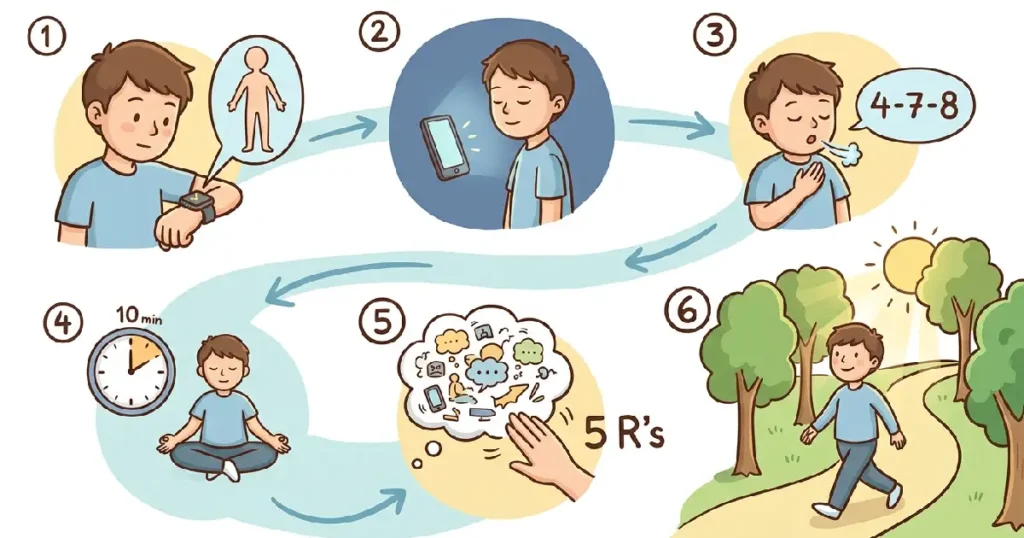
Most people think of their wearable technology as a fitness tracker. A step counter. A notification delivery system strapped to their wrist.
But here is a more useful way to think about it: your smartwatch already detects when your body is under stress. The question is whether you do anything with that information.
This habit is simple. When your wearable alerts you to an elevated heart rate, or when you notice a spike during a stressful moment, you pause for 60 seconds and perform a brief MBSR body scan. You close your eyes if possible. You notice what’s happening in your shoulders, your jaw, your stomach. You name it without judging it.
A 2025 study in the journal Mindfulness found that participants who paired wearable biofeedback with brief interoceptive awareness exercises (the clinical term for tuning into your body’s internal signals) showed significantly greater improvements in stress regulation and reduced stress-related eating compared to those practicing mindfulness alone.
This is the opposite of how most people use technology. Instead of your device pulling you further into stimulation, it becomes an external cue that returns you to your body.
Consider this: your next heart rate alert doesn’t have to be noise. It can be a doorbell reminding you to come home to yourself.
2. The Scroll Pause: Reclaiming Your Attention at the Point of Temptation
You already know that doomscrolling isn’t good for you. That’s not news. What is worth understanding is why it hijacks your nervous system so effectively, and where the intervention point actually is.
Social media platforms are designed to produce what some psychologists now call algorithmic toxicity: a steady drip of emotionally charged content calibrated to keep your sympathetic nervous system activated. Outrage, comparison, urgency. Each swipe delivers a micro-dose of cortisol. Your body doesn’t distinguish between a genuinely threatening news headline and a stranger’s angry comment. It responds to both the same way.
The Scroll Pause habit targets the exact moment of vulnerability. Before you open any social media app, you take three slow, deliberate breaths. Not to “calm down.” You’re not upset yet. You do it to activate conscious awareness before the algorithm activates your stress response.
After you close the app, you follow with five minutes of open monitoring meditation, a core MBSR practice where you sit quietly and notice whatever thoughts, feelings, or sensations arise without chasing any of them.
This is not about telling you to use your phone less. It is about training impulse regulation at the threshold, the precise place where your autonomic nervous system is most susceptible to being captured.
What changes is not your screen time. What changes is your relationship to the pull.
3. Vagus Nerve Breathwork: The Biological Off-Switch You Already Own

There is a nerve that runs from your brainstem all the way down through your chest and into your abdomen. It’s called the vagus nerve, and it is the single most important channel your body has for shifting out of stress and into recovery.
When you hear about the “rest and digest” response, this is the hardware that makes it happen. And the fastest, most reliable way to stimulate it voluntarily is through controlled breathing.
The 4-7-8 technique is one of the most studied: inhale for 4 counts, hold for 7, exhale for 8. Box breathing works similarly: inhale for 4, hold for 4, exhale for 4, hold for 4. Both patterns activate what’s called vagal tone, the measure of how effectively your parasympathetic nervous system can counterbalance stress.
A 2024 randomized controlled trial published in Psychosomatic Medicine confirmed that participants who practiced structured breathwork as part of an MBSR program showed measurable reductions in blood pressure, inflammatory markers, and cortisol levels over eight weeks.
In my clinical work, I have seen people who described themselves as “anxious by nature” discover through breathwork that their anxiety was not a personality trait. It was a breathing pattern.
That realization alone can be quietly transformative.
4. The 10-Minute Daily Minimum: Why Consistency Beats Duration Every Time
Here is a statistic that tells a bigger story than it seems: approximately 69% of adults are aware of mindfulness as a practice. Only about 4.4% practice it regularly.
The gap is not ignorance. It is design failure. Traditional MBSR programs ask for 45 minutes of daily formal practice. For a working parent with a full schedule, that recommendation doesn’t feel ambitious. It feels impossible.
Let me introduce you to someone I’ll call Nadia. She came to therapy exhausted, managing two kids, a demanding job, and a partner who traveled for work. She had tried meditation apps. She liked the idea. But every time she sat down for a 30-minute session, her mind raced with everything she wasn’t getting done, and she quit feeling worse than when she started.
What changed for Nadia was not effort. It was dosage.
She committed to 10 minutes of seated mindfulness meditation every morning. Not 10 minutes “when she could fit it in.” Ten minutes before she checked her phone, non-negotiable, like brushing her teeth.
Recent randomized controlled trials from 2025 confirm what Nadia experienced: app-based, short-form MBSR practices delivered comparable benefits in psychological well-being and cognitive flexibility when practiced consistently, compared to longer traditional sessions.
The mechanism is straightforward. Mindfulness is a skill. Skills develop through repetition, not marathon sessions. You don’t build physical strength by lifting weights for three hours once a month. You build it by showing up for manageable sessions, repeatedly.
That’s not weakness. That’s neuroscience.
5. The 5 R’s: Interrupting the Rumination Loop Before It Spirals

Rumination is the mind’s version of a dog chasing its tail. You replay the same conversation. You rehearse the same catastrophe. You analyze the same mistake from seventeen different angles, and not one of those angles makes you feel better.
This is not just an unpleasant mental habit. It is a measurable neurological pattern. Functional brain imaging studies show that chronic rumination corresponds with hyperactivity in the Default Mode Network, or DMN. This is the brain network that activates when you’re not focused on a specific task. It’s responsible for self-referential thinking, mind-wandering, and, when overactive, obsessive worry.
MBSR practices have been shown to directly dampen DMN hyperactivity. But knowing that doesn’t help you at 2 a.m. when your brain won’t stop.
What helps is a structured interruption. The 5 R’s provide that structure:
Recognize. Notice that you are ruminating. Name it: “I’m looping.”
Relax. Take one slow breath. This is not about fixing the feeling. It is about creating a two-second gap between the thought and your reaction to it.
Review. Ask yourself: “Is this thought solving a problem, or just replaying one?” Be honest.
Respond. Choose a deliberate action. Write the thought down. Set a time to address it tomorrow. Or simply say to yourself, “I’ve noted this.”
Return. Bring your attention back to whatever is actually happening right now. Your breath. The weight of your body in the chair. The sound in the room.
This sequence works because it mirrors what MBSR trains the brain to do: it builds a wedge between stimulus and response. Over time, that wedge becomes automatic. The loop still starts sometimes. But now you have an exit.
6. Nature-Integrated Mindful Movement: The Antidote to Cognitive Pollution
There’s a term gaining traction in environmental psychology: cognitive pollution. It refers to the invisible mental load created by urban environments, screen saturation, open-plan offices, notification sounds, and the low-grade sensory overload that most people absorb without noticing.
You don’t feel cognitively polluted the way you feel a headache. You feel it as flatness. Irritability. A strange difficulty concentrating even when nothing specific is wrong.
The antidote is not complicated, but it is specific: combine mindful walking meditation, a core MBSR technique, with direct exposure to natural light and green spaces.
The practice looks like this. You walk slowly, deliberately, outdoors. You pay attention to the sensation of your feet meeting the ground. You notice temperature, light, sound, not as background noise, but as the primary content of your awareness. You are not walking to get somewhere. You are walking to be somewhere.
Research on nature-based mindfulness interventions shows that this combination targets two systems simultaneously: the cognitive fatigue pathway (restored by nature exposure) and the stress-regulation pathway (restored by mindful attention). Together, they produce greater improvements in emotional regulation than either practice alone.
If you work from a desk, this is especially relevant. Ten minutes of mindful walking outside during a break is not a luxury. It is biological maintenance.
Your Nervous System Is Listening. What Are You Teaching It?

You now have six habits. Not theories. Not platitudes. Habits that directly engage the biological systems responsible for how stressed, wired, or calm you feel on any given day.
But none of them will matter unless you start with one.
Here are two practical ways to begin this week:
The “One Habit, One Week” Experiment. Choose the habit from this list that feels the most accessible to you right now, not the most impressive, the most doable. Practice it daily for seven days. At the end of the week, write one sentence about what you noticed. Not what you achieved. What you noticed.
The “Body Weather Report.” Twice a day, once in the morning and once before bed, pause for 30 seconds and ask yourself: “What is the weather inside my body right now?” Stormy? Foggy? Still? Don’t try to change it. Just name it. This single act of interoceptive awareness is the foundation that every other MBSR habit builds on.
A useful question to ask yourself: “Am I trying to manage my stress, or am I trying to change how my body responds to it?” Those are two very different projects. The first is a coping strategy. The second is a rewiring.
The Thermostat, Revisited
Remember that thermostat stuck at 85 degrees?
You walked into this article feeling the heat. Maybe you didn’t have a name for it. Maybe you just knew that something in your body, your mind, your daily experience of being alive in a hyperconnected world, felt like it was running too hot.
Now you have something different. Not a quick fix. Not another app to download and forget. You have a set of practices that speak directly to your nervous system in the language it actually understands: breath, body, attention, and movement.
Mindfulness based stress reduction was never about becoming a person who doesn’t feel stress. It was always about becoming a person whose body knows how to come back from it.
You already have the hardware. These habits are just the reset.
My Closing Remarks
I’ll be honest with you. For years, I thought mindfulness was something gentle people did in quiet rooms. I was wrong. Mindfulness based stress reduction is one of the most confrontational things you can do, because it asks you to stop running from what your body has been trying to tell you. When I started pairing my own breathwork with those jarring smartwatch alerts, I felt ridiculous for the first three days. By day ten, I felt like I’d found a volume knob I didn’t know existed. You don’t need to overhaul your life. You need to listen to one signal your body is already sending, and respond differently. Start there.
More Related Stories for You
- If you want to deepen your understanding of how daily mindfulness practice can reshape your emotional life, this guide walks you through building a sustainable routine from scratch.