
 Nicole Adkins
You Don’t Need A Cushion, A Quiet Room, Or Even Five Free Minutes To Meditate. You Just Need To Walk Differently.
Key Points:
- Walking meditation transforms your most ordinary daily activity into a research-backed tool for calming your nervous system and clearing mental clutter.
- These seven beginner-friendly walking meditation techniques require no equipment, no experience, and no special setting, just the willingness to pay attention.
- The real power of walking meditation isn’t relaxation. It’s training your brain to stay present when everything inside you wants to drift, spiral, or shut down.
Contents
Table of Contents
When Your Mind Won’t Sit Still, Let Your Feet Lead
You’ve tried to meditate. You really have. You downloaded the app, found the quiet corner, closed your eyes, and sat there while your brain served up a highlight reel of everything you forgot to do, every awkward conversation from the past week, and that one comment from 2017 you still can’t shake.
So you opened your eyes. Turned off the app. And told yourself meditation isn’t for you.
But what if the problem was never your mind? What if the problem was sitting still?
Here’s what most meditation advice misses: for many people, stillness doesn’t produce calm. It produces agitation. Your body wants to move. Your nervous system is wired for action, not inaction. And when you force yourself into a posture that feels unnatural, your brain fights back harder.
Walking meditation changes the equation entirely. It meets your body where it already is: in motion.
Why Walking Meditation Works When Sitting Meditation Doesn’t
The concept behind walking meditation is deceptively simple. Instead of sitting in silence and trying to observe your thoughts, you walk at a deliberate pace and anchor your attention to the physical experience of moving. Your feet become the focal point instead of your breath alone. Your body becomes the meditation space instead of fighting against it.
And the science supports it. A 2014 study published in the journal Evidence-Based Complementary and Alternative Medicine found that Buddhist walking meditation significantly reduced depression and improved both cardiovascular function and stress markers in participants who practiced it regularly. The combination of gentle physical activity with mindful awareness created a dual benefit that seated meditation alone did not consistently produce.
There’s a neurological reason for this. Walking activates your sensorimotor cortex, the part of your brain responsible for processing physical sensation and coordinating movement. When you pair that activation with deliberate attention, you create what neuroscientists call “embodied cognition.” Your brain doesn’t just think about being present. It physically participates in presence.
That distinction matters more than most people realize.
Think of your attention like a kite. In seated meditation, you’re trying to hold a kite steady in a storm with just your hands. In walking meditation, you’ve added a string, a frame, and an anchor. The movement gives your wandering mind something to attach to.
And for beginners, that changes everything.
7 Walking Meditation Techniques Every Beginner Can Start Today
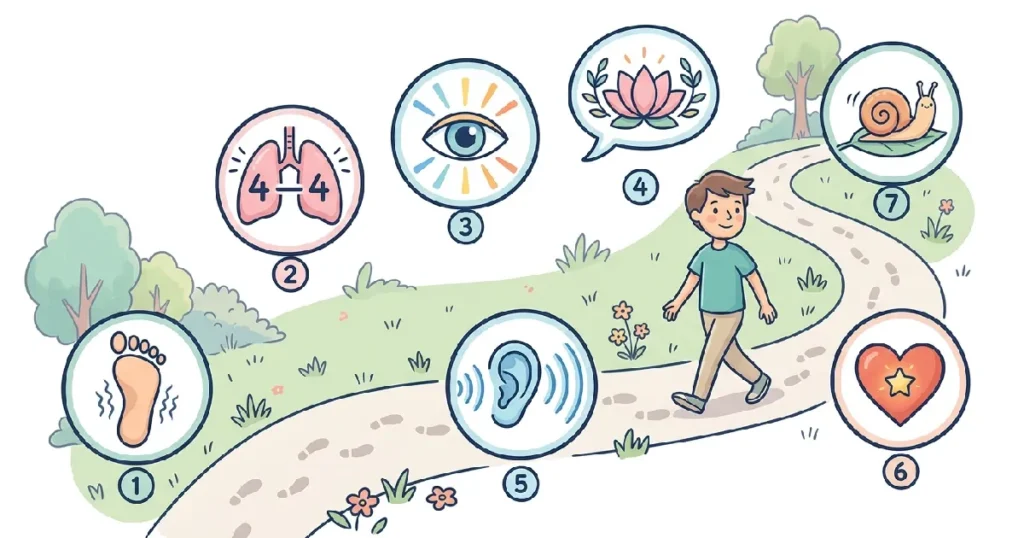
Each of these techniques targets a different aspect of mindful walking. Some work on sensory grounding. Others regulate your breathing or shift your emotional state. You don’t need to master all seven. Pick one. Walk with it for a week. Then try the next.
1. The Soles of the Feet: Sensory Grounding That Calms a Racing Mind
This technique is the foundation of nearly every walking meditation tradition, and it’s the one I recommend starting with.
Here’s how it works. As you walk, direct your entire attention to the bottom of your feet. Notice the heel strike as it contacts the ground. Feel the weight roll forward across your arch. Pay attention to the subtle push-off from your toes just before the next step begins.
That’s it. No mantra. No counting. Just feet.
What makes this so effective is its use of proprioception, your body’s internal sense of where it is in space. When you focus intensely on physical sensation, you activate your somatosensory cortex and quiet the default mode network, the brain region responsible for rumination, self-referential thinking, and mental time travel. In plain terms, you interrupt the spiral.
Consider someone like David, a 38-year-old project manager who came to therapy describing himself as “never able to turn off.” He couldn’t sit for five minutes without checking his phone. But when he tried the Soles of the Feet technique during his morning walk to the train station, something shifted. “I realized I’d been walking on autopilot for years,” he told me. “When I actually felt my feet, it was like my brain got quiet for the first time.”
David’s experience isn’t unique. It’s predictable. Sensation anchors attention. And anchored attention calms the nervous system.
2. The 4-4 Breath Sync: Rhythmic Pacing for Nervous System Regulation
Your breath is a direct line to your autonomic nervous system, the part of you that controls whether you feel safe or threatened. Most people breathe shallowly and irregularly throughout the day without noticing. This technique changes that.
As you walk, inhale slowly through your nose for exactly four continuous steps. Then exhale completely through your mouth for the next four steps. Repeat this cycle without pausing between rounds.
The reason this works is rooted in what’s called vagal tone. Your vagus nerve runs from your brainstem through your chest and into your abdomen. When you lengthen and regulate your exhale, you stimulate this nerve, which signals your brain to shift out of sympathetic activation (fight or flight) and into parasympathetic rest (calm and recovery).
You’re not just breathing. You’re manually switching your body’s stress response.
If four steps feels too rushed, extend to six. The key is matching your breath to your stride so that the two rhythms synchronize. This rhythmic coherence tells your brain that the environment is safe and predictable, which is exactly the message an anxious system needs.
3. The 5-4-3-2-1 Sight Walk: A Mindful Walking Exercise for Anxiety
This technique borrows from clinical grounding exercises used in trauma therapy and adapts them for outdoor walking. It’s especially useful when your mind is locked in a worry loop and you can’t break free through willpower alone.
Here’s the practice. As you walk, silently name five different colors you can see around you. Then identify four textures. Then three shapes. Two things that are moving. And finally, one thing that is completely still.
By the time you finish, your attention has been forcibly redirected from internal catastrophizing to external observation. You’ve engaged your visual cortex, your language centers, and your spatial awareness simultaneously. That’s a lot of neural real estate devoted to the present moment, which leaves very little room for anxiety to operate.
What makes this different from simply “looking around” is the structure. Your brain craves order. When you give it a specific sequence, it latches on. The countdown format creates a gentle cognitive task that is engaging enough to interrupt rumination but simple enough to maintain while walking.
Try this technique on your next walk through a park, a neighborhood, or even a parking lot. The environment doesn’t need to be beautiful. It just needs to be real.
4. Gatha Recitation: Using Silent Phrases to Anchor Your Steps

This practice comes from the Zen Buddhist tradition, specifically the teachings of Thich Nhat Hanh, one of the most influential mindfulness teachers of the past century. A gatha is a short verse or phrase repeated in rhythm with your movement.
The classic version goes like this: as your left foot touches the ground, silently say, “I have arrived.” As your right foot touches, say, “I am home.”
Simple. Repetitive. Powerful.
What you’re doing here is creating verbal anchoring. Each step gets paired with a phrase, and that pairing prevents your mind from drifting into past regrets or future worries. It fills the cognitive space that anxiety or distraction would otherwise occupy.
You can customize your gatha to match what you need. If you’re processing grief, try: “I am here. I am whole.” If you’re working on self-compassion, consider: “I am enough. I belong.” The words matter less than the rhythm. What matters is that each step carries intention.
But here’s what most guides won’t tell you.
The first few minutes will feel silly. Your inner critic will call it pointless. Walk through that resistance. The awkwardness is not a sign that it isn’t working. It’s a sign that your brain is encountering something unfamiliar, and unfamiliar is exactly where growth begins.
5. Soundscape Mapping: Auditory Awareness for Deep Concentration
Most of us walk through sound the way we walk through air: without noticing it at all. This technique asks you to reverse that habit.
As you walk, expand your awareness to the widest possible field of sound. Listen for the most distant noise you can detect. A plane overhead. A dog barking three streets away. Traffic humming on a highway you can’t see. Hold your attention there for 30 seconds.
Then slowly contract your awareness inward. Listen to closer sounds. The wind. Voices nearby. Your own clothing rustling as you move.
Finally, bring your focus all the way down to the sound of your own footsteps.
This expansion-and-contraction pattern trains what psychologists call attentional flexibility, the ability to widen or narrow your focus deliberately. It’s the same skill that allows you to stay calm in a chaotic meeting, listen fully to your partner during a difficult conversation, or tune out distractions when you need deep focus.
The secondary benefit is what researchers call non-reactive awareness. You hear sounds without judging them. A car alarm isn’t “annoying.” It’s just a sound. A bird isn’t “pleasant.” It’s just a frequency. This practice of hearing without labeling trains your brain to observe experience without immediately reacting, a skill that transfers directly to emotional regulation in your relationships and daily life.
6. The Gratitude Step: Emotional Elevation Through Mindful Movement
This technique pairs physical walking with intentional positive emotion, and it does something most mindful walking exercises skip: it actively shifts your emotional baseline.
Here’s the practice. For every ten steps, think of one specific thing you are grateful for. Not a vague category like “my family” but a precise detail. The way your daughter laughed at breakfast. The fact that your car started this morning. The text from a friend you hadn’t heard from in months.
According to research published by the Greater Good Science Center at UC Berkeley, practicing gratitude activates the medial prefrontal cortex and the anterior cingulate cortex, brain areas associated with positive valuation and emotional processing. In practical terms, you are training your brain to notice what is working instead of scanning for threats.
And here’s the mechanism that makes this technique uniquely powerful during walking: locomotion naturally increases blood flow to the brain. When you combine increased neural blood flow with deliberate positive cognition, the emotional shift is faster and more stable than it would be while sitting.
Every ten steps, one gratitude. That’s it. After 100 steps, you have ten genuine reasons your life is more abundant than your anxious mind tells you it is.
7. The Slow-Motion Shift: A Neurological Reset for Autopilot Living
This is the technique that surprises people the most. It is also the one that feels the strangest. And that strangeness is exactly the point.
For just two minutes during your walk, cut your speed in half. Then cut it in half again. Move so slowly that each step becomes a deliberate, exaggerated event. Feel your hip flexors engage. Notice your ankle rotating. Pay attention to the micro-moment when your weight transfers from one leg to the other.
What you’re doing is disrupting automaticity, the brain’s tendency to run familiar motor patterns without conscious input. When you walk at your normal pace, your basal ganglia handle the movement automatically. Your conscious brain is free to wander, spiral, plan, or worry.
But when you slow down dramatically, your prefrontal cortex has to take over. Suddenly, walking requires attention. And that forced attention is a neurological reset. It breaks the trance of autopilot living and drops you back into deliberate, present-moment awareness.
Two minutes is enough. You don’t need to walk slowly for the entire duration. Just two minutes of hyper-slow movement in the middle of a regular walk can shift your mental state for the next hour.
That’s not weakness. That’s neuroscience.
Putting Walking Meditation Into Practice This Week

You now have seven distinct tools. Here’s how to start using them without feeling overwhelmed.
The One-A-Day Method: Choose one technique per day for the next seven days. Walk for just ten minutes using that single technique. At the end of the week, you’ll know which ones your mind and body respond to most naturally.
The Sandwich Walk: Use the Soles of the Feet technique for the first two minutes to ground yourself, then spend the middle portion with any of the other six techniques, and close with the Slow-Motion Shift to reset before you return to daily demands.
The Mood-Match Approach: Ask yourself one question before you walk: “What does my nervous system need right now?” If you feel anxious, try the 5-4-3-2-1 Sight Walk. If you feel numb, try the Gratitude Step. If you feel scattered, try the 4-4 Breath Sync. Let your body choose.
A useful question to consider: “When I walk, where does my mind usually go?” That answer will tell you which technique to try first.
Your Walk Was Never Just a Walk
Remember that feeling at the beginning? The frustration of sitting still, eyes closed, brain racing, convinced that meditation was designed for someone calmer, more disciplined, more naturally serene than you?
You were never the problem. The format was.
You don’t need silence. You don’t need a perfect setting. You don’t need to sit still and perform peace. You need your feet on the ground, your attention gently guided, and the willingness to treat an ordinary walk as something worth noticing.
Walking meditation doesn’t require you to become a different person. It asks you to become more present as the person you already are.
The next time you step outside, you carry seven techniques with you. Seven ways to interrupt the noise. Seven paths back to your own body.
The ground was always there. Now, you know how to feel it.
My Closing Remarks
I’ll be honest with you. For years, I recommended seated meditation to clients and quietly struggled with it myself. My mind is a busy place. Sitting still often made it louder, not quieter. It wasn’t until I started walking with intention, genuinely paying attention to my feet and breath during a ten-minute walk through my neighborhood, that something clicked. The movement wasn’t distracting me from meditation. It was completing it. If you’ve ever felt like the mindfulness world wasn’t built for your kind of brain, please hear me: you’re not broken. You might just need to stand up and walk. Start with one technique tonight. Ten minutes. No pressure. Let the ground do what the cushion couldn’t.
More Related Stories for You
- If you’re ready to build a broader mindfulness practice, these stories will take you deeper.
About The Author