
 David Wall
Why The Calmest Person In The Room Often Becomes The Most Followed, And The Science Behind What Makes A Leader Worth Trusting.
Key Points
- Mindful leadership replaces reactive management with intentional, research-backed habits that build trust and psychological safety.
- These 8 traits address the biological and emotional needs modern teams actually have, not outdated leadership advice from a decade ago.
- Small, specific changes in how a leader responds, rests, and communicates can reduce burnout and turnover across an entire team.
Contents
Table of Contents
You’re staring at your phone at 11:47 p.m., thumb hovering over send. The email could wait until morning. You know that. But you tell yourself it shows dedication, that getting ahead of tomorrow’s fire matters more than tonight’s rest.
Your team will read it differently. They’ll see your name light up their screen and feel their shoulders tighten before they’ve even opened it. And it’s not the first time your urgency has quietly become someone else’s stress.
If this sounds familiar, you are not a bad leader. You are a tired one, running old software in a job that demands something new.
The Real Cost of Reactive Leadership
Most leadership training focuses on strategy, vision, and quarterly targets. Almost none of it addresses what actually happens in your nervous system the moment a deadline slips or an employee pushes back. That gap matters more than most executives realize.
Reactive leadership has a name in psychology: an amygdala hijack. The term, popularized by psychologist Daniel Goleman, describes what happens when your brain perceives a threat and your emotional alarm system takes over before your rational, decision-making brain (the prefrontal cortex) gets a vote. You snap. You overcorrect. You send the email.
Mindful leadership works differently. It isn’t about being endlessly calm or endlessly agreeable. It’s the practiced ability to notice your internal state, pause before reacting, and choose a response that actually serves the goal, not just the discomfort of the moment.
This isn’t a soft skill you can skip. A 2022 workplace survey by the Workforce Institute at UKG found that managers affect their employees’ mental health about as much as their spouse does, more than their doctor or therapist. Read that again. The person running your Monday morning meeting may be shaping your team’s well-being more than their own primary care physician does.
Your leadership style isn’t just a management choice. It’s a daily, cumulative force in someone else’s mental health. That’s not meant to add pressure. It’s meant to explain why small shifts in how you lead create outsized change in how your team functions, feels, and stays.
1. Chrono-Empathy: Leading in Rhythm With the Body’s Clock
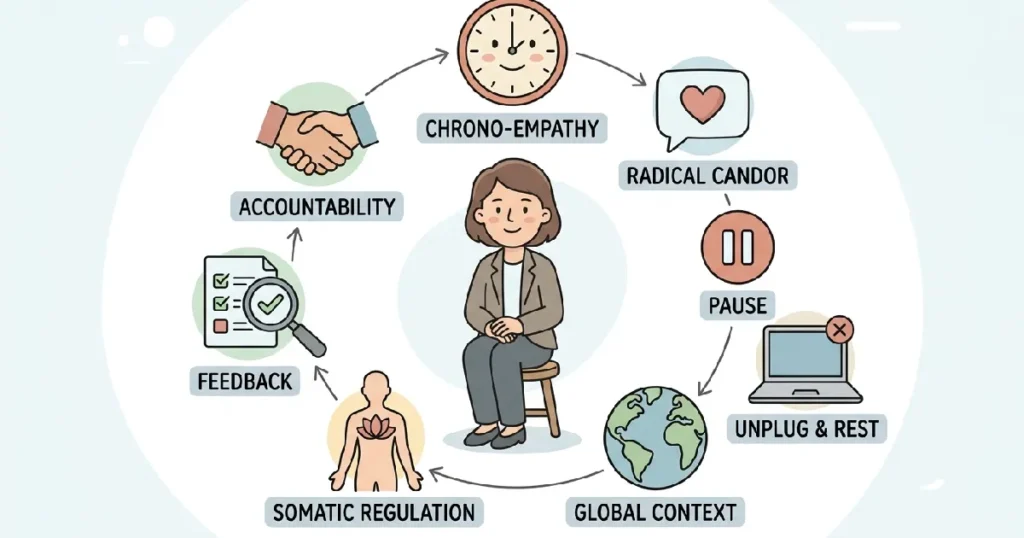
Chrono-empathy means recognizing that your team’s focus and creativity follow biological rhythms, not your calendar. Leaders who practice it stop sending late-night emails and stop scheduling brainstorms during everyone’s predictable afternoon energy dip.
Sleep and circadian rhythm research has long shown that cognitive performance rises and falls in predictable cycles throughout the day. Asking a team for their best creative thinking during a biological low point sets them up to underperform before the meeting even starts.
Consider Devon, a marketing director who used to schedule strategy sessions right after lunch because it fit neatly into his own calendar. His team’s ideas were consistently flat. When he moved those sessions to mid-morning instead, participation nearly doubled within a month.
The next time you schedule a high-stakes meeting, ask yourself whether you’re working with your team’s biology or against it.
2. Radical Candor and Psychological Safety: Truth That Doesn’t Wound
Radical candor means delivering hard truths while still protecting the other person’s dignity. It works alongside psychological safety, a term coined by Harvard researcher Amy Edmondson to describe the shared belief that a team is safe for interpersonal risk-taking, meaning people can admit mistakes or disagree without fear of humiliation.
Edmondson’s research, later validated by Google’s internal Project Aristotle study, found psychological safety was the single strongest predictor of high-performing teams, above talent, tenure, or even resources.
Picture Priya, a operations manager, reviewing a report riddled with errors. Instead of saying “you’re careless,” she says, “this report has three factual errors, let’s find where the process broke down.” Same standard. Completely different message about the person’s worth.
That’s not softness. That’s strategy.
3. Deliberate Response Lag: The Pause That Prevents the Fire
Deliberate response lag means replacing an immediate reaction with an intentional pause, often just a few seconds of breath before you speak or type. Controlled breathing activates your parasympathetic nervous system, the part of your body responsible for calming heart rate and returning full access to rational thought.
Think of mindful leadership like a lighthouse rather than a flashlight. A flashlight chases whatever moves. A lighthouse stays fixed and steady, so the ships moving around it can find their way. Leaders who react to every ripple become flashlights. Leaders who pause become lighthouses.
A leader who takes three slow breaths before responding to a heated email doesn’t lose credibility. She gains it, because her team learns her responses can be trusted, not just endured.
4. Digital Presence Discipline: Full Attention in a Split-Screen World

Digital presence discipline means closing background tabs, silencing notifications, and giving your full attention during video calls and in-person meetings alike. This sounds simple. The psychology behind why it’s so hard is not.
Here’s the part most leadership articles miss entirely. Research by organizational psychologist Sophie Leroy on what she calls “attention residue” found that when you switch away from an unfinished task, part of your working memory stays stuck on it, even when your body has moved to something new. A leader sitting in a team meeting while three browser tabs blink in the background isn’t just distracted. Their mind is chemically split, running the last unfinished problem in the background while pretending to be present for this one.
Your team can feel that split, even if they can’t name it. They sense the half-second delay in your eye contact, the slightly late laugh, the question you ask that was already answered two minutes ago. Closing the tabs isn’t a productivity trick. It’s an act of respect that tells someone their five minutes matter as much as your inbox does.
5. Eco-Systemic Awareness: Leading Beyond the Quarterly Report
Eco-systemic awareness means weighing decisions against their wider community and environmental impact, not just this quarter’s numbers. Leaders who practice this value long-term community health alongside short-term profit.
This isn’t idealism. Deloitte’s annual Gen Z and Millennial workforce survey consistently finds that younger employees rank a company’s social and environmental impact as a top factor in where they choose to work and stay. Talent isn’t just following salary anymore. It’s following purpose.
A leader who explains the “why” behind a business decision, including who it affects beyond the balance sheet, builds a kind of loyalty that a bonus check can’t buy.
6. Somatic Self-Regulation: Modeling Rest as Strength, Not Failure
Somatic self-regulation means noticing physical signals of stress in your own body (somatic simply means “of the body”) before they become full burnout. Tight shoulders, shallow breathing, a clenched jaw during meetings; these are early data, not weakness.
According to the American Psychological Association, chronic workplace stress left unaddressed is a leading contributor to burnout, a state marked by exhaustion, cynicism, and reduced effectiveness at work. The Mayo Clinic notes that recognizing the early physical signs of burnout is far easier to reverse than treating it once it’s fully set in.
Most people in this situation don’t realize their exhaustion is information, not an inconvenience to push through.
A leader who visibly takes a real lunch break, or says out loud, “I’m stepping away for twenty minutes to reset,” gives their team unspoken permission to do the same. That single act quietly dismantles the stigma around rest that so many workplace cultures still carry.
7. Cognitive Decentering: Taking Feedback Without Taking the Hit
Cognitive decentering is the ability to step outside your immediate emotional reaction and view a situation as though observing it from the outside, more like a scientist reading data than a person under attack. Leaders low in this skill hear criticism and immediately internalize it as proof they’re failing.
Leaders high in cognitive decentering hear the same criticism and think, “that’s one data point, what does it tell me?” The Greater Good Science Center at UC Berkeley has published extensive research showing this kind of self-distancing reduces defensive reactivity and keeps problem-solving conversations productive instead of personal.
The next time you receive difficult feedback, try silently labeling it: “this is information,” not “this is an indictment.” That small linguistic shift changes how your body and your team respond in real time.
8. Compassionate Accountability: High Standards Without Shame

Compassionate accountability means holding people to real, high standards while refusing to use shame as the motivational tool. Research by psychologist June Tangney draws a clear line between shame, which says “I am bad” and drives people to hide or withdraw, and guilt, which says “I did something wrong” and actually drives repair.
Maria, a regional sales director, once had to address a team member who missed three consecutive targets. Instead of a warning that focused on his failure, she sat with him and asked what was getting in the way. Together they built a specific ninety-day recovery plan with weekly check-ins. He hit his numbers by day sixty, and later told her it was the first performance conversation in his career that made him want to work harder instead of update his resume.
Trust doesn’t grow during easy conversations. It grows during hard ones handled well.
Building Mindful Leadership Into Your Actual Week
Understanding these traits is the easy part. Living them under deadline pressure is where most leaders quietly give up. A few specific practices make the difference.
The Three-Breath Reset. Before responding to any tense email, message, or comment, take three slow breaths, in for four counts, out for six. This short pause interrupts the amygdala hijack cycle long enough for your rational brain to catch up. Try it the next time a Slack message makes your stomach drop before you type a single word.
The Energy Map. Spend fifteen minutes this week noting when your team seems sharpest and when they seem foggiest. Schedule your highest-stakes conversations and creative work during their peak windows, not just whatever slot was open on your calendar.
The Body Check-In. Before your next difficult meeting, pause for ten seconds and ask yourself, “what is my body telling me right now?” Tight chest, clenched jaw, and shallow breath are all early signals worth naming before you walk into the room.
The Recovery Conversation. The next time someone on your team falls short, name the standard clearly, separate their identity from their error, and ask, “what would help you get back on track?” instead of delivering a verdict.
A useful question to sit with this week: when was the last time your team saw you pause before reacting, rather than after?
What This Actually Changes
Go back to that phone, glowing at 11:47 p.m. The email is still sitting there, half-written. Except now you notice something you didn’t before: the urgency living in your chest has very little to do with the actual deadline.
You set the phone down. You’ll send it tomorrow, at nine, when your team is rested enough to read it without their stomach dropping.
Mindful leadership was never about becoming a different person. It’s about becoming a steadier one, someone whose team can predict calm instead of bracing for the next reaction. A lighthouse, not a flashlight.
That’s the kind of leader people don’t just work for. They stay for.
My Closing Remarks
Here’s what I’ve watched over fifteen years of sitting across from executives: the ones who burn out their teams almost never think of themselves as harsh. They think of themselves as dedicated. That’s the trap. Mindful leadership isn’t a personality trait you either have or don’t. It’s a practice, built one paused breath at a time, and I’ve seen it rebuild trust in teams that had every reason to walk away.
More Related Stories for You
- If this article struck a chord, you may also want to build your own mindfulness practice as the daily foundation these leadership traits are built on, along with sharpening your emotional intelligence skills to carry these habits into every relationship, not just the ones at work.
About The Author