
 David Wall
The answer isn’t in your next goal. It’s already written in the parts of your life you’ve stopped paying attention to.
Key Points:
- Learning how to find what makes you happy starts with reading your body’s energy signals, not chasing bigger achievements.
- Your envy, your childhood memories, and your daily compromises are quietly confessing what you actually value.
- Real happiness lives in small, repeatable habits, not in the next milestone your brain will eventually stop noticing.
Contents
Table of Contents
Most of us were taught that happiness is a prize you win. Get the degree. Get the title. Get the relationship, the salary, the apartment with good light. We keep collecting the milestones, waiting for the moment it finally clicks into place, and somehow it never quite does. You’ve done the gratitude journal. You’ve tried the vision board. And still, some quiet part of you wonders if you’re simply built for less joy than everyone else seems to be having.
You haven’t failed at happiness. You’ve been reading the wrong instruction manual.
Here’s the reframe worth sitting with: happiness isn’t a mood you manufacture through bigger wins. It’s information you decode from the life you’re already living. The clearest clues about how to find what makes you happy aren’t hiding in some future goal. They’re sitting in your energy levels, your envy, your oldest memories, and the values you quietly bend without noticing.
Beyond the Hype: Why Common Happiness Metrics Keep You Miserable
Modern self-improvement culture sold us a simple formula: work hard, gain freedom, feel happy. But that formula has a crack running through it, and the crack is getting wider for early-career professionals in particular.
The Autonomy Paradox: Why Unlimited Freedom Kills Daily Happiness
Remote and hybrid work promised something wonderful: total control over your schedule. Organizational researchers now call the downside of this the autonomy paradox. When boundaries disappear, so does your ability to switch off, and your nervous system stays quietly braced all day long.
According to the American Psychological Association’s Work in America Survey, employees with flexible schedules often report higher stress related to always-on expectations, not less. The freedom to work anytime becomes the pressure to work anytime.
You might think more flexibility should feel like more happiness. But what you don’t see is that your brain, left without structure, starts treating every open hour as a decision it has to make. That’s exhausting, not liberating.
The Hedonic Treadmill: Why Your Last Big Win Already Feels Normal
There’s a second trap, and it’s older than remote work. Psychologists call it the hedonic treadmill, or hedonic adaptation. This is your brain’s tendency to return to a stable baseline mood no matter what happens to you, good or bad.
Researcher Sonja Lyubomirsky’s work on this shows that even genuinely life-changing events, like a big promotion or a new relationship, lose roughly half their emotional charge within a few months. Your brain isn’t broken. It’s doing exactly what it evolved to do, which is stabilize you so you can keep functioning.
Chasing happiness through bigger milestones is a bit like filling a bathtub with the drain left open. You keep pouring in achievements. The water level barely rises. Something is quietly draining it out the entire time, and that something is adaptation.
This is exactly why so many people feel hollow after reaching the goal they swore would fix everything.
The 7 Honest Clues to How to Find What Makes You Happy
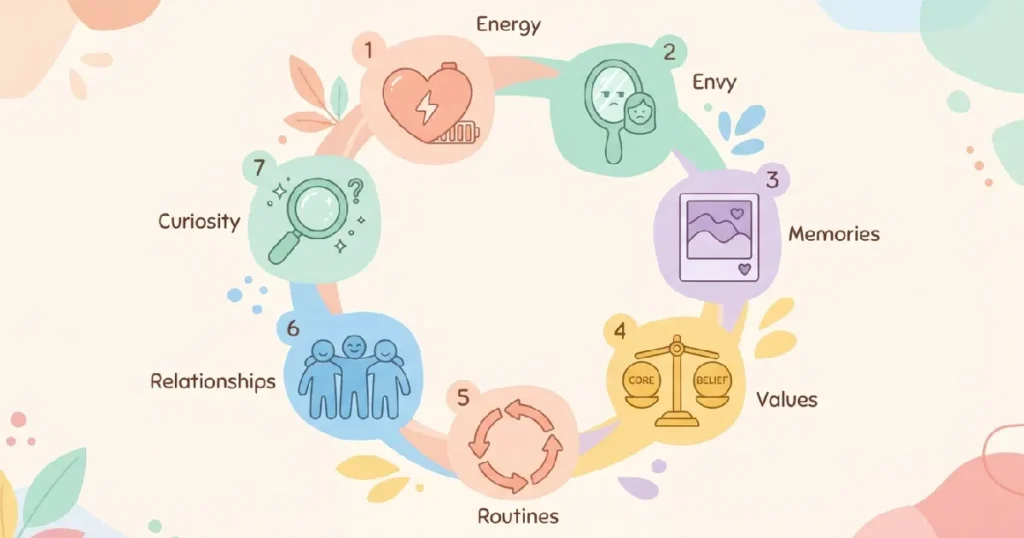
If bigger goals won’t fix the drain, something else has to. The clues below aren’t new goals to chase. They’re signals your life is already sending you, whether or not you’ve been listening.
Clue 1: Somatic Energy, What Invigorates vs. Drains Your Battery
The claim: Your body knows things your calendar doesn’t. Somatic energy simply means the physical sense of aliveness or depletion you feel in your body, separate from what you think you should feel.
The evidence: This connects to a real skill called interoception, your brain’s ability to read internal signals like heart rate, tension, and fatigue. People with stronger interoceptive awareness tend to make choices that better match their actual needs, rather than choices driven by obligation or habit.
So what: If unstructured freedom leaves you drained rather than energized, your happiness metric isn’t more autonomy. It’s more structure. Track which hours of your week leave your shoulders loose versus locked, and you’ll find a map most productivity apps could never give you.
Clue 2: Subversive Envy, Using Comparison Pain to Map Hidden Desires
Envy gets treated like a moral failing, something to feel guilty about and hide. That shame is exactly why most people never learn anything from it.
The claim: Envy is a confession disguised as discomfort. Specifically, it points toward something you want but haven’t given yourself permission to pursue.
The evidence: The World Happiness Report has tracked a widening happiness gap in recent years, with steep declines among young adults linked heavily to algorithmically curated social feeds that fuel constant comparison. The pain isn’t random. It’s specific, and specificity is useful.
But here’s what nobody puts on a vision board: not all envy points the same direction.
Envy over someone’s vacation photos is usually about rest, not travel. Envy over a peer’s promotion often points to a hunger for recognition, not the title itself. The trick is asking what the envy is really about underneath the surface detail, not the surface detail itself.
So what: Next time comparison stings, write down exactly who triggered it and why. Read it back a day later. You’ll usually find a want, not a flaw.
Clue 3: Pre-Prestige Memories, Finding Joy Before Social Validation
The claim: Before you cared about your resume, you had activities you returned to simply because they felt good. Psychologists call the process of examining these early experiences autobiographical memory work, and it’s one of the most reliable ways to locate intrinsic, rather than borrowed, preferences.
The evidence: In my practice, I’ve watched this exercise crack open cases that months of goal-setting couldn’t touch. One client, I’ll call her Elena, spent years chasing leadership roles that left her flat and tired. When we mapped her pre-prestige memories, she kept landing on the same image: organizing her grandmother’s recipe boxes by category for hours, alone, completely content. She wasn’t craving leadership. She was craving systems and order. Within a year she moved into operations strategy, work almost nobody applauds at parties, and reported the first sustained sense of calm satisfaction she’d felt in a decade.
So what: Pick three memories from before age eighteen where you lost track of time. Look for the pattern underneath the activity, not the activity itself. That pattern is closer to your real wiring than any personality quiz.
Clue 4: The Morality Ledger, Where Self-Interest Clashes With Values

Here’s a differentiator most happiness content skips entirely: satisfaction and happiness are not the same thing.
The claim: Psychologists distinguish between hedonic well-being, pleasure and comfort in the moment, and eudaimonic well-being, a deeper sense of meaning tied to living in line with your values. You can have plenty of the first and almost none of the second, and it will still feel hollow.
The evidence: A widely cited study by researchers Elizabeth Dunn, Lara Aknin, and Michael Norton, published in Science and summarized by Berkeley’s Greater Good Science Center, found that spending money on others produced more lasting happiness than spending the same amount on oneself. Self-serving comfort and genuine happiness are not the same currency.
So what: Notice where a goal requires you to bend a core value, honesty, generosity, loyalty, to reach it. That goal might deliver comfort. It will rarely deliver joy that survives the following morning.
Clue 5: Low-Stakes Routines, The Power of Boring Habits
The claim: The happiest people you know probably aren’t the ones with the most exciting lives. They’re the ones with the most protected boring ones.
The evidence: Because hedonic adaptation flattens intense highs so quickly, researchers studying mood stability have found that people with rigid, repetitive routines, like a fixed sleep-wake time even on weekends, report fewer mood disorders and steadier baseline contentment than people who structure their lives around occasional peak experiences.
So what: Look at the unglamorous habit you protect even when no one is watching, the walk, the specific coffee ritual, the fifteen minutes with a book before bed. That’s not procrastination from a bigger life. That’s often the actual load-bearing wall of your happiness.
Clue 6: Relational Circles, The People Who Deepen Your Self-Worth
The claim: Self-determination theory, a well-established framework in psychology, names relatedness, feeling genuinely connected to others, as one of three core needs required for lasting well-being, alongside autonomy and competence.
The evidence: The Harvard Study of Adult Development, one of the longest-running studies on adult life ever conducted, found that the quality of close relationships was a stronger predictor of long-term happiness and even physical health than income, fame, or career achievement.
So what: List the people who leave you feeling more like yourself after time together, not just entertained. Protect time with them the way you’d protect a paycheck. Most people don’t realize that this list is usually shorter, and more telling, than their entire contact list combined.
Clue 7: Intentional Curiosity, The Free Topics You Can’t Stop Studying
The claim: Intrinsic motivation, doing something for the reward of the activity itself rather than money or praise, is one of the purest indicators of genuine interest.
The evidence: Psychologist Mihaly Csikszentmihalyi’s research on flow, the state of full absorption in a task, found that people entering flow states most often describe activities they’d choose even without compensation or an audience.
So what: What do you read, watch, or research for free, at 11 p.m., with no deadline attached? That subject isn’t a hobby you’re wasting time on. It’s a candidate for the life you actually want to build.
How to Build Your Personal Happiness Audit

Knowing the clues is the first half. Reading them consistently is what actually changes your life.
Moving From Consumer Self-Care to Real Community Connection
Self-care culture often sells rest as a product, a candle, a retreat, a subscription. That’s not wrong exactly, but it’s incomplete. The Harvard research above suggests something quieter and less marketable: consistent, unglamorous connection outdoes almost every self-care purchase available.
Consider trading one solo self-care habit this month for one shared one. A solo bath becomes a standing walk with a friend. The cost is lower. The evidence suggests the payoff is higher.
Structuring a Weekly Friction Log to Track Your Happiness Signals
One useful place to start is a friction log, a short, honest record you keep for one week.
Each evening, jot down three things: one moment your energy spiked, one moment you felt envy or comparison, and one moment you compromised a value for convenience. No analysis required yet, just observation.
At the end of the week, read it as a whole. A useful question to ask yourself: if a stranger read only this log, what would they guess I actually want out of life? The answer is usually more accurate than anything you’d write on a job application.
You don’t need a new five-year plan to find what makes you happy. You need to stop drowning out the small, honest signals your life has been sending you the entire time. The bathtub was never the problem. The drain was. Once you know where it is, you finally stop pouring water in blind, and you start plugging the leak that was costing you all along.
That’s not a bigger life. That’s a truer one, and it lasts a lot longer than the next milestone ever could.
My Closing Remarks
Here’s my honest take after years of watching clients chase happiness like it’s a finish line: the people who find it stop treating their envy, boredom, and fatigue as problems to fix. They start treating them as messages. I’ve seen careers change, marriages soften, and grown adults cry in my office over a childhood memory of stacking rocks by a creek. That’s not small. That’s the whole map, hiding in plain sight the entire time.
More Related Stories for You
If you want to go deeper into locating your own version of joy, this piece on what genuinely makes people happy is a strong next stop.
About The Author