
 David Wall
The answer isn’t a purchase, a promotion, or a personality overhaul. It’s something far simpler, and far harder to accept.
Key Points
- The honest answer to “what will make me happy” is that happiness cannot be chased directly. It shows up as a side effect of connection, autonomy, and meaning.
- Forcing positive feelings acts like a mental tax, draining the exact brainpower you need to build a satisfying life.
- Real change comes from widening your circle of care and rebuilding boundaries, not from another wellness app or another milestone.
Contents
Table of Contents
We have all stood at the same invisible fork in the road, wondering if the next choice is finally the one that fixes everything. You have typed the exact phrase “what will make me happy” into a search bar at least once, probably late at night, probably right after scrolling something that made you feel worse instead of better. You have tried the gratitude journal. You have tried the promotion, the trip, the new apartment, the relationship that was supposed to complete the picture. And still, something in you stays quietly unconvinced.
Here’s the brutal honest answer. Happiness was never something you were meant to find. It’s a byproduct, not a destination. Chasing it directly, through treats, hacks, or hard-won milestones, drains the very mental energy you need to build the connection and meaning that create happiness as a side effect.
That sentence might sting a little. Good. Let’s unpack why it’s true.
Why Searching for “What Will Make Me Happy” Is Making You Miserable
Someone might think they simply lack discipline when their good mood never sticks. But what they don’t see is that the constant self-checking, “am I happy yet, am I happy now,” is its own kind of labor. It’s exhausting in a way that has nothing to do with willpower.
In my practice, I have watched clients white-knuckle their way through gratitude lists and affirmations, only to end the day feeling more depleted than before they started. That’s not a personal failure. That’s a predictable psychological pattern.
The Cognitive Drain: How Forcing Yourself to Feel Happy Exhausts the Brain
Your brain has a limited pool of self-regulation, the mental fuel it uses to control attention, emotion, and behavior. Psychologists call this the strength model of self-control, first described by researcher Roy Baumeister and colleagues, and it explains why willpower feels finite by the end of a long day.
A 2026 study out of the University of Toronto took this idea further. Researchers found that treating happiness itself as a constant goal, something to track, audit, and correct in real time, burns through that same limited fuel. Your brain isn’t just living your life anymore. It’s grading your life while you live it.
Here’s what no one tells you.
The harder you consciously monitor your own joy, the faster you use up the mental stamina required to actually build it. That’s the regulatory tax. It’s the hidden cost of trying to “just be positive” on command, and it’s a big reason toxic positivity culture leaves so many high achievers feeling hollow instead of recharged.
The Hedonic Treadmill: Why the Next Big Milestone Won’t Make You Happy Either
You already know the feeling. You hit the goal, you land the job, you buy the thing, and the high lasts about as long as a good weather forecast.
Psychologists call this the hedonic treadmill, a well-documented tendency for humans to return to a stable baseline of mood no matter what happens to them, good or bad. The concept was first outlined by researchers Philip Brickman and Donald Campbell, and it holds up remarkably well across decades of follow-up research.
This connects directly to something researchers now call the arrival fallacy, the belief that a specific achievement will finally deliver lasting satisfaction. You believe the next milestone is different. It never is, because your baseline resets almost immediately.
Consider Maya, a 29-year-old marketing manager who spent three years chasing a director title. She got it. She cried happy tears in the parking lot. Two weeks later, she was back to scrolling job boards on her lunch break, wondering what was wrong with her. Nothing was wrong with her. She had just met the hedonic treadmill, and it welcomed her the same way it welcomes everyone.
The Reality Check: What the Research Gets Wrong About Happiness
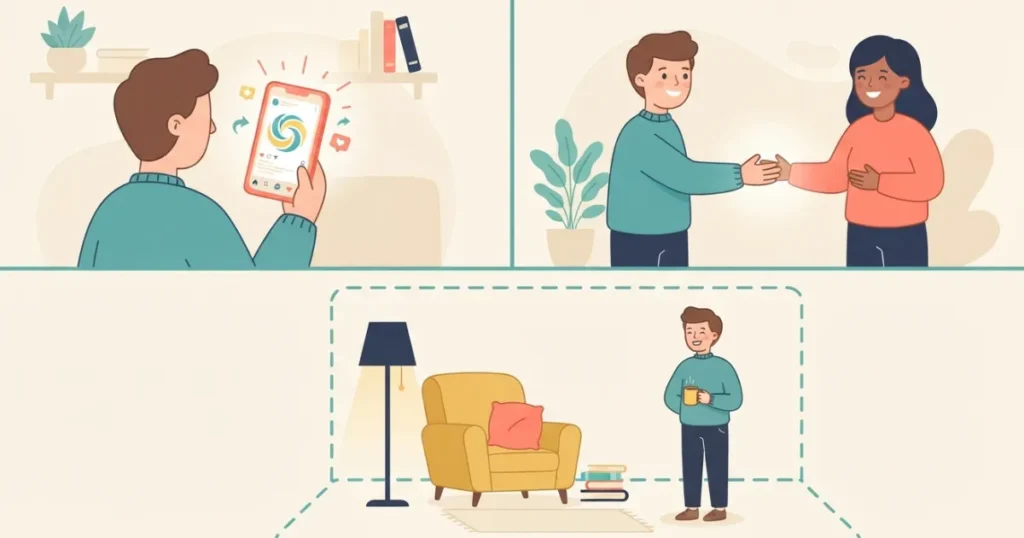
Most people assume the fix for existential dread is more freedom. Fewer meetings. More flexibility. A life you design yourself, on your own schedule, from anywhere in the world. The data tells a more complicated story.
The Remote Work Paradox: Why Job Flexibility Didn’t Cure Your Existential Dread
Large-scale workplace data continues to confirm that flexible and remote arrangements genuinely improve job satisfaction, how you feel about your specific role and tasks. But that improvement barely moves the needle on overall subjective well-being, the broader sense of whether your life feels good.
Why the disconnect? Boundary collapse. When the line between your private life and your work life dissolves completely, your brain never fully exits work mode. You gain flexibility and lose the psychological off-switch that used to protect your evenings, and that trade often cancels itself out.
Jordan, a freelance designer who fought hard for full remote freedom, described it this way in a session: “I got everything I wanted, and I still answer emails from bed at 11 p.m.” The work-from-anywhere lifestyle didn’t solve his dread. It just moved the dread into his living room.
Algorithmic Traps: How Your Feed Is Quietly Feeding Your Unhappiness
The 2026 World Happiness Report made a point most digital wellness content still misses entirely. It’s not how much time you spend on your phone that predicts misery. It’s the architecture of what you’re looking at.
Platforms built around direct connection, seeing what actual friends are doing, messaging people you know, correlate positively with well-being. Platforms driven by algorithmic discovery feeds, the endless scroll of strangers, influencers, and curated highlight reels, spike stress and social comparison dramatically.
This is why a digital detox often fails. You come back from your week off social media, open the same algorithmic feed, and within ten minutes you’re comparing your unfiltered kitchen to someone’s staged vacation. The problem was never the phone in your hand. It was the invisible hand curating what appeared on the screen.
The Brutal Honest Answer: Three Pillars of Real Happiness

So if forcing positivity backfires, if milestones don’t stick, and if freedom alone isn’t the cure, what actually works? Global research spanning 66 countries points to something almost embarrassingly simple, and it has nothing to do with self-improvement culture.
Radical Connection Beats Passive Self-Care Every Time
Community connectedness, the depth and reliability of your relationships and sense of belonging, shows up again and again as one of the strongest predictors of life satisfaction across cultures. Not income. Not achievement. Connection.
Consumer marketing has spent years training you to look for happiness in isolated self-care, another app, another supplement, another solo retreat. That framing quietly disconnects you from the actual cure, which requires other people, not another purchase.
This is the piece competitor advice tends to leave out completely. Self-care sold to you as a product is designed to keep you looking inward, buying, optimizing, tracking. Real satisfaction requires you to look outward and invest in people, which is a much harder sell for a company but a far better outcome for you.
Autonomous Agency: The Overlooked Ingredient in Life Satisfaction
Autonomy, having genuine control over your own choices and time, matters enormously. But here is the detail most advice columns skip entirely: autonomy without boundaries doesn’t feel like freedom. It feels like being on call permanently.
This is the connection point most people never make. Your individual habits and the structural conditions around you, your job’s expectations, your platform’s design, your culture’s always-on norms, interact constantly. You can meditate every morning and still burn out if your work environment demands availability at all hours. Fixing your mindset without addressing your boundaries is like bailing water out of a boat with a hole still open beneath your feet.
Real agency means choosing when you’re reachable, not just choosing where you sit while you work.
Eudaimonic Meaning: The Difference Between Pleasure and Real Happiness
Psychologists draw a distinction between hedonic happiness, the pleasure you get from treats, comfort, and short-term rewards, and eudaimonic happiness, the deeper satisfaction that comes from purpose, growth, and contribution to something bigger than yourself.
Chasing happiness directly is a bit like trying to catch your own shadow. Sprint toward it and it moves exactly as fast as you do. Stop chasing, turn around, and get invested in something outside yourself, and it simply follows you home.
Hedonic treats give you a spike and a crash. Eudaimonic meaning builds slowly, and it doesn’t collapse the moment the treat wears off. That’s the real trade you’re making every time you choose a quick fix over a slower, deeper investment.
A Realist’s Plan for What Will Actually Make You Happy

Understanding the mechanism is one thing. Doing something with it by tomorrow is another. Here are three places to start.
Step 1: Audit Your Feed for Connection vs. Algorithm
One place to start is a simple feed audit. Open your most-used app and notice, honestly, whether your scroll is filled with people you know or strangers you’ve never met.
Consider muting or unfollowing accounts that consistently trigger comparison, and prioritizing direct messages and group chats with real friends instead. This single shift, favoring connection-based platforms over discovery-based ones, has been linked to meaningfully better mood in recent well-being research.
Step 2: Widen Your Circle of Care to Quiet Self-Fixation
A useful question to ask yourself: when was the last time you did something for someone with zero benefit to your own image or resume? Widening your circle of care means directing attention outward, toward a neighbor, a struggling friend, a local cause, instead of endlessly inward at your own mood.
The next time you feel the urge to fix your happiness through another purchase, try redirecting that energy toward one small act of connection instead. Call someone. Show up for someone. This isn’t a moral lecture. It’s a practical redirection of the exact mental energy the regulatory tax was draining.
Step 3: Rebuild Boundaries to Protect Your Private Self
Consider naming one specific window of time each day that belongs entirely to your private life, no notifications, no work, no performance. Even ninety protected minutes can begin restoring the psychological off-switch that boundary collapse erodes.
A helpful frame here is the “Off-Duty Hour.” Pick a consistent time, tell the people who need to know, and protect it the way you’d protect a doctor’s appointment. Left unexamined, boundary collapse doesn’t just strain your evenings. It can quietly become the reason burnout feels permanent instead of temporary.
You Already Have What You Need
You don’t need a better personality, a bigger salary, or a more disciplined morning routine to answer the question that brought you here. You need less self-auditing and more real contact with other people. You need agency protected by boundaries, not agency without limits. You need purpose that outlasts a purchase.
That 2 a.m. search, the one where you typed “what will make me happy” into a glowing screen, wasn’t a sign that something is broken in you. It was a sign you were finally asking a better question. You just needed a truer set of answers.
Happiness was never hiding at the finish line. It was waiting in the people you haven’t called yet.
My Closing Remarks
Here’s the part that might annoy you a little. I don’t think most people actually want the honest answer, because it’s harder than a purchase and slower than a hack. But in eight years of clinical work, I have never once seen a client’s life improve because they finally found the right app. I have seen lives change when someone finally called their sister back, or joined the volunteer group they kept postponing. That’s the unglamorous truth. Sit with it anyway.
More Related Stories for You
- Curious how well the people closest to you actually understand your inner world? Take a look at these revealing questions about who really knows you best.
About The Author