
 Sara Carmen
Your brain isn’t broken. It’s in withdrawal. And once you understand the mechanism behind the obsession, you can finally interrupt it.
Key Points
- Learning how to move on from an ex starts with understanding that intrusive thoughts are a chemical withdrawal pattern, not a character flaw.
- Your brain treats an ex’s mixed signals like a slot machine, and every social media check triggers a reward it didn’t earn.
- Real closure isn’t something your ex hands you. It’s a script you have to write for yourself.
Contents
Table of Contents
We’ve all had that night. The one where you’re lying awake at 1 a.m., phone glowing against your face, thumb hovering over a name you swore you’d stop typing into the search bar.
You know it won’t help. You do it anyway.
That’s not a lack of discipline. It’s your nervous system running a program it doesn’t know how to shut off. And if you’ve spent weeks or months trying to logic your way out of missing someone, only to find yourself right back where you started, you’re not failing at healing. You’re using the wrong tool for the job.
Someone might think you’re just “not over it yet” because you keep checking his Instagram story. But what they don’t see is the tiny, involuntary spike of relief that comes right before the ache, the same pattern a gambler feels pulling a lever they know is rigged against them.
Someone might think you’re overanalyzing the breakup because you’re smart and like control. But what they don’t see is that your brain is genuinely searching for a missing piece of information it needs to file the relationship as “closed.”
Someone might think time alone will fix this. But what they don’t see is that without a specific strategy, time just gives the loop more laps to run.
Why You Can’t Move On From an Ex: The Neuroscience of Withdrawal
Here’s the part almost nobody tells you clearly enough: your brain does not know the difference between heartbreak and substance withdrawal.
In a widely cited neuroimaging study, researcher Helen Fisher and her colleagues scanned the brains of people who had recently been rejected by a partner. They found activation in the same reward regions of the brain that light up in cocaine and nicotine cravings. Not sadness regions. Reward regions.
That distinction matters more than it sounds.
When you were with your ex, your brain got a steady, semi-predictable supply of dopamine and oxytocin. Dopamine is the neurochemical tied to motivation and craving. Oxytocin is the one tied to bonding and safety. Together they built a kind of emotional home base you didn’t have to think about.
When that supply is cut off suddenly, your brain doesn’t calmly accept it. It starts searching for the source. That search shows up as intrusive thoughts, sleep disruption, and a physical restlessness that feels almost identical to detoxing from a substance.
In my practice, I’ve watched women describe this exact sensation and immediately apologize for it, as if wanting someone back makes them pathetic. It doesn’t. It makes them human, with a brain doing exactly what brains are built to do.
That’s not weakness. That’s wiring.
The Anatomy of an Obsessive Thought Loop That Keeps Pulling You Back
Here’s where the “slot machine” comparison earns its keep.
Slot machines are addictive because the reward is unpredictable. If you knew you’d win every tenth pull, you’d feel bored. It’s the not knowing that keeps your hand on the lever.
Your ex’s mixed signals do the exact same thing to your brain.
A random “hey, thinking of you” text after three weeks of silence. A story where he seems to be looking at the camera the way he used to look at you. A like on an old photo that appears out of nowhere. Each of these functions as an unpredictable reward, and your brain interprets unpredictability as more valuable, not less.
Picture Maya. She’s 29, six weeks out from a relationship that ended without a real conversation. She deleted his number, then found herself checking his best friend’s public account “just to see.” When his name popped up as an unexpected story view, she felt a jolt of hope so strong it scared her. That jolt wasn’t love. It was a dopamine spike, the neurological signature of a reward she didn’t actually receive, only anticipated.
This is why “just stop checking” never works as advice. You’re not choosing to check. You’re responding to a habit loop your brain has already wired and rewarded dozens of times.
The good news is habit loops can be starved. But starving them requires more structure than willpower alone can offer, which is exactly what the next section is for.
Escaping the Soft Breakup: How to Find Closure When They Leave Things Unsaid
Some breakups end with a clear conversation. A lot don’t.
Relationship researchers have noted a rising pattern of what’s often called the “soft breakup,” where a relationship fades through slower replies, canceled plans, and quiet distance instead of an actual ending. No fight. No explanation. Just absence.
If this describes your situation, your mind is stuck in a specific kind of limbo. Psychologists call the discomfort of holding two conflicting realities at once cognitive dissonance, which is the mental tension that shows up when your emotional experience doesn’t match the facts in front of you.
Your body knows the relationship is over. Your nervous system, though, is still waiting for the official signal that says it’s safe to stop hoping.
Most people in this situation don’t realize that waiting for an ex to provide closure is often the very thing keeping them stuck. If they wouldn’t give you clarity while things were ending, there’s little reason to expect they’ll offer it now.
So you have to write the ending yourself.
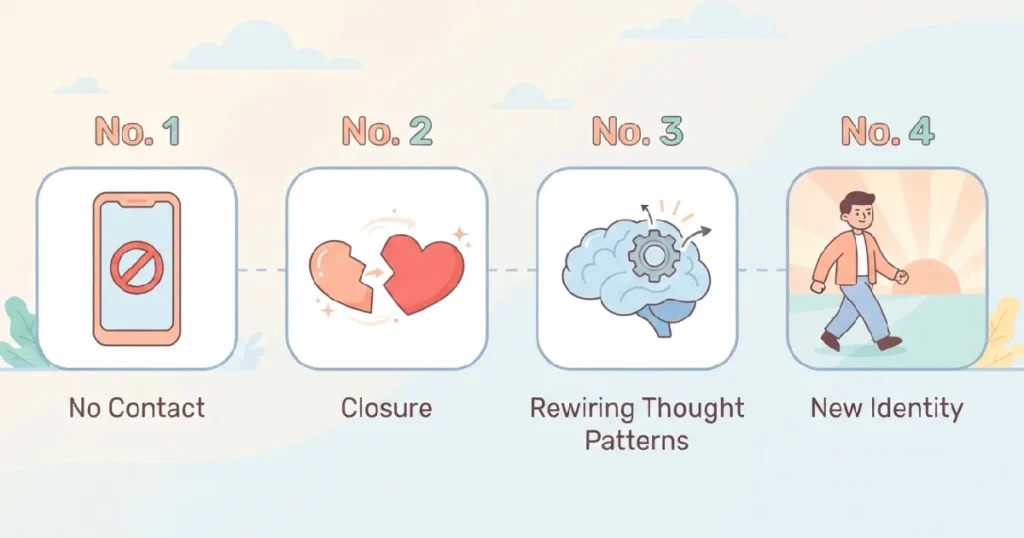
This is what I call an internal closure script, a short, honest statement you say to yourself that names the relationship as finished, without needing your ex’s agreement or explanation. It might sound like: “This relationship ended on [date]. I don’t have every answer, and I’m choosing to stop waiting for one.”
It feels strange the first time you say it. Say it anyway. Your brain needs an event to mark as the end, even if you’re the one creating it.
Breaking the Dopamine Habit: A No-Contact Guide to Move on From an Ex

Here’s the part that separates real recovery from spinning your wheels: no contact isn’t a punishment for your ex. It’s a detox protocol for your own brain.
Think of every text, every profile check, every “just one more look” as a small hit that resets your withdrawal timer back to zero. Even if you go five days without checking, one relapse and your nervous system responds as if none of that progress happened.
This is where the reframe most people miss comes in. You’ve probably heard no contact described as an emotional boundary. It’s more accurate to think of it as a neurochemical fast. Your dopamine system needs a sustained gap without stimulation in order to recalibrate its baseline. Research on behavioral addiction consistently shows that intermittent access, even small amounts, prevents the natural decline of craving intensity over time, the same mechanism that makes occasional relapse so much more damaging than people expect.
A workable version of this looks like:
Muting or unfollowing, not just avoiding. Willpower fails at 1 a.m. Structural removal doesn’t ask you to be strong; it removes the lever entirely.
Deleting saved messages and photos for a defined window, say 60 to 90 days, rather than forever. This isn’t about erasing the relationship. It’s about giving your brain a real stretch without stimulation.
Replacing the urge, not just resisting it. When the craving hits, your brain wants a hit of something. Texting a friend, stepping outside, or doing ten minutes of a physically absorbing task gives it a substitute reward instead of an empty demand for restraint.
None of this makes the ache disappear overnight. It does interrupt the loop that’s been keeping it alive.
Rewiring Your Identity: How to Move on From an Ex By Rebuilding Yourself
There’s a layer underneath the craving that most breakup advice never touches.
You’re not only mourning a person. You’re mourning a version of yourself that existed inside that relationship.
Psychologists Erica Slotter, Wendi Gardner, and Eli Finkel studied this directly and found that people going through a breakup often experience a measurable shrinking of their self-concept clarity, meaning their sense of who they are becomes genuinely less defined, not just emotionally, but cognitively. The study found that the more a person’s identity had been intertwined with their partner’s, the more disoriented they felt after the split, independent of how much they still loved that person.
This is the insight most people miss entirely: you don’t primarily miss him. You miss the version of you that felt certain, chosen, and defined. That certainty was borrowed from the relationship, and now it’s gone, and your brain is scrambling to fill the vacancy.
Your brain resists updating this identity because change costs energy. Maintaining an old self-concept is metabolically cheap. Building a new one is expensive, which is exactly why your mind keeps defaulting back to “his girlfriend” or “the version of me who had someone,” even when you consciously know it’s over.
Rebuilding identity isn’t a metaphor here. It’s a biological requirement for your attachment system to stop treating the old bond as unfinished business.
Now What? Turning Insight Into Action

Understanding the mechanism is only half the work. Here’s where you put it to use.
Start a 72-hour delay rule. The next time the urge to check, text, or drive past his place hits, commit to waiting 72 hours before acting on it. Most craving spikes peak and fall within a day. Naming the delay out loud, even to yourself, interrupts the automatic nature of the loop.
Write your internal closure script and read it daily for two weeks. Keep it short. Keep it factual. The goal isn’t to convince yourself you feel nothing. It’s to give your brain a fixed endpoint to file the relationship against.
Build one new identity marker each week. This could be a class, a solo trip, a skill you’ve put off, or simply eating dinner at a new restaurant alone. Each new experience gives your brain fresh material to build a self-concept that doesn’t depend on the relationship.
A useful question to ask yourself most nights this week: Am I responding to who he actually is, or to the ache of an old reward pattern asking to be fed?
One place to start tonight, specifically, is deleting the one thread you check most. Not archiving. Deleting. Notice what comes up in the hour after. That discomfort is the withdrawal talking, not the truth.
Think back to that 1 a.m. moment, phone glowing, thumb hovering. You now know what’s actually happening in that instant. It isn’t proof you still love him more than you thought. It’s a dopamine system asking for one more pull of a lever that was never fair to begin with.
You get to put the phone down now, not because you’ve stopped caring, but because you finally understand what you’re caring about.
Moving on was never about forgetting someone. It’s about giving your nervous system permission to stop waiting for a reward that isn’t coming.
My Closing Remarks
Here’s the truth no one puts on a mug: some nights you will still want to text him, and that will happen long after you’ve technically “moved on.” That’s not regression, that’s a nervous system finishing its detox on its own timeline. I’ve watched women mistake this for failure more than almost anything else in this work. It isn’t. You’re not broken, you’re detoxing from a person, and detoxing takes exactly as long as it takes.
More Related Stories for You
If unresolved trust wounds from a past relationship are part of what’s keeping you stuck, this piece on the lingering damage of infidelity breaks down why betrayal trauma lingers longer than heartbreak alone.
About The Author