
 David Wall
The signs were never hiding. You were just trained to look past them.
Key Points:
- What makes you happy is rarely a mystery. It’s a message your body, your envy, and your sense of peace have been sending you every single day.
- The clues that reveal what makes you happy are usually quiet, small, and easy to override with logic, guilt, or a to-do list.
- Learning to read these five signals can help you build a life that actually fits you, instead of one that just looks good from the outside.
Contents
Table of Contents
We have all been handed the same instructions for a good life. Work hard, check the boxes, do the responsible thing, and happiness will show up as a reward for good behavior. Most of us followed those instructions almost perfectly. And yet you still find yourself lying awake some nights wondering why the promotion, the wedding, or the newly renovated kitchen didn’t feel the way it was supposed to.
Someone looking at your life right now might think you have it figured out. You show up early. You handle whatever gets thrown at you. You rarely complain. But what they don’t see is the tightness in your jaw by three in the afternoon, or the strange pinch in your chest when you scroll past a friend’s pottery class photos.
Or maybe your surface looks like ease instead. A stable job. A comfortable relationship. Weekends that follow a predictable rhythm. Underneath, though, there’s a quiet hum of restlessness you’ve learned to call gratitude instead of naming it for what it is.
Here’s the part that surprises most people. Happiness was never missing from your life. It has been leaving clues the entire time. You just weren’t trained to read them.
True happiness isn’t a feeling you chase or a milestone you finally earn. It’s a pattern your body, your envy, and your sense of peace have already mapped out for you. The five clues below show you how to read that pattern instead of guessing at it.
Why Your Current Definition of Success Isn’t Making You Happy
Psychologists have spent decades measuring what a good life actually requires. For a long time, the answer split into two camps. There’s hedonic well-being, which is about pleasure and comfort. And there’s eudaimonic well-being, which is about meaning and purpose.
More recently, researchers added a third piece to that picture. A 2022 study by psychologists Shigehiro Oishi and Erin Westgate, published in Psychological Review, introduced the idea of psychological well-being as something bigger than either comfort or meaning alone. They call it psychological richness: a life built on interesting, perspective-changing experiences, even the difficult ones.
This matters because most people in this situation don’t realize they’ve been measuring happiness with the wrong ruler for years. If your only categories are “pleasant” and “productive,” you’ll miss the third thing entirely. You’ll miss the moments that stretch you.
In my practice, women rarely walk in worried about happiness directly. They walk in worried about exhaustion, and happiness turns out to be the missing variable nobody asked about.
Left unexamined, this pattern doesn’t just drain your evenings. It quietly decides the shape of your next ten years, your career choices, even who you build a life with.
The Somatic Energy Clue: How Your Body Reveals What Makes You Happy
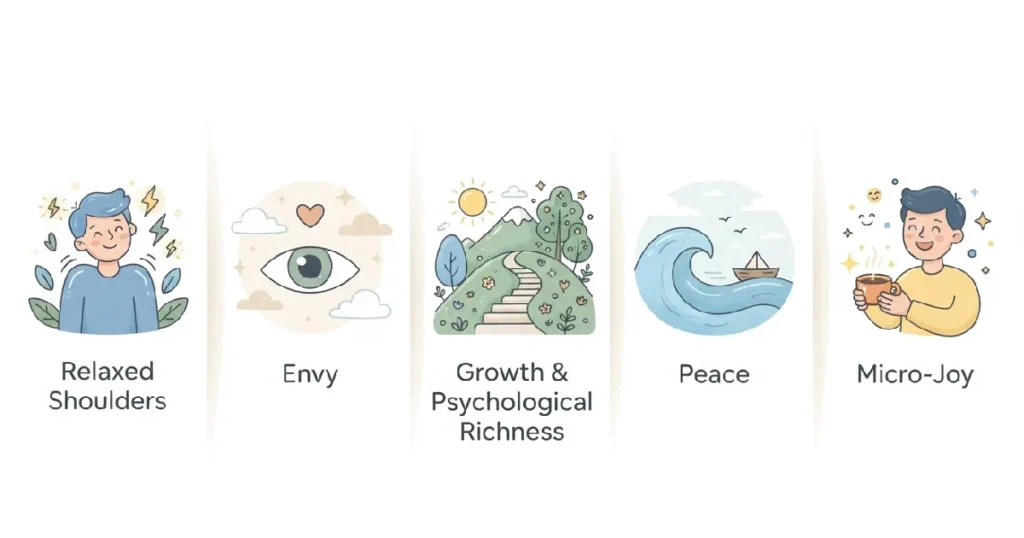
Your body registers emotional truth before your brain catches up. This is sometimes called the somatic marker hypothesis, a theory developed by neuroscientist Antonio Damasio. It describes how physical sensations, like a tight chest or relaxed shoulders, carry emotional information your conscious mind hasn’t processed yet.
Jenna, a composite of clients I’ve worked with, spent years believing her twelve-hour workdays meant she loved her job. She was good at it, after all. But every night around six, her jaw ached and her shoulders sat up near her ears without her noticing. Meanwhile, the twenty minutes she spent reorganizing a bookshelf on Sunday left her breathing slower, her hands loose.
That’s not stress management failing. That’s information.
The task list will always tell you what you’re capable of doing. It won’t tell you what actually feels good in your body while you’re doing it. Those are two very different questions, and only one of them points toward happiness.
The next time you finish something, skip the mental checklist for a second. Notice your jaw. Notice your shoulders. That’s your nervous system voting, whether you asked it to or not.
Decoding Your Envy: The Hidden Map to What Makes You Happy
Envy has a bad reputation. Most of us were taught to feel ashamed of it, so we suppress it the moment it appears. But researchers studying envy have found something more useful hiding underneath.
A 2015 study by psychologists Jan Crusius and Jens Lange distinguished between two kinds of envy. Malicious envy wants to tear the other person down. Benign envy, on the other hand, motivates you toward the very thing you admire. The feeling is the same sting. The direction it points is completely different.
Think of envy less like a moral failure and more like proprioception, your body’s sense of where your limbs are in space, except this version tells you where your unclaimed desires are sitting. If a friend’s watercolor paintings give you a stomach drop, your brain isn’t angry at her. It’s pointing at a room in your own life you haven’t walked into yet.
So the next time envy shows up uninvited, try asking a different question. Not “why am I like this,” but “what is this pointing toward.” That single shift turns a shameful emotion into a working map.
Psychological Richness vs Comfort: Why Easy Choices Don’t Always Make You Happy

Comfort is easy to mistake for happiness because it’s quiet and it doesn’t hurt. But comfort and happiness are not the same thing, and confusing them is one of the most common traps I see.
Picture a glass of still water. It looks calm. Nothing is happening in it, which is exactly the point. Now picture stirring that water. It looks unsettled for a moment, cloudy even, before it clears into a shape it never had before. A psychologically rich choice works the same way. It disturbs you first and clarifies you second.
This is the part of the equation that surprises people most, especially women who were raised to prioritize safety over discovery.
A choice that leaves you deeply changed, even if it was uncomfortable in the moment, may be feeding your long-term happiness more than a choice that simply left you relaxed. The solo trip, the career pivot, the hard conversation you finally had. None of those felt calm going in. Most of them left you different coming out.
Peace Over Excitement: The Real Metric for Lasting Happiness
Pop culture sells happiness as intensity. Passion, spontaneity, a love story with a soundtrack. So when your actual life feels stable, predictable, and a little bit boring, it’s easy to assume something is wrong.
Researcher Stephen Porges developed a concept called neuroception, the term for how your nervous system constantly scans for safety or danger, mostly without your awareness. When that scanning finally quiets down, life can start to feel uneventful. That stillness isn’t a warning sign. It’s often the first evidence your body has stopped bracing for impact.
Priya, another composite drawn from years of client work, spent two years waiting for her steady, kind partnership to feel like the relationships in movies. When it stayed calm instead of electric, she assumed something was missing. What she eventually recognized was that calm was the safety her nervous system had been asking for the entire time.
Before deciding a stable choice is boring, it’s worth checking whether it’s actually just safe. Emotional safety rarely feels dramatic. It just feels like the absence of a fight you didn’t realize you’d been having for years.
The Micro Joy Audit: Small Clues That Reveal What Makes You Happy
Barbara Fredrickson’s research on positive emotion, published in American Psychologist, found something counterintuitive. Small, frequent positive moments build lasting resilience more effectively than rare, large ones. Her broaden-and-build theory describes how even brief positive emotions widen your thinking and slowly build psychological resources you can draw on later.
This means the specific taste of your coffee at 7 a.m., or a thirty second laugh with a coworker in the hallway, aren’t small consolation prizes while you wait for the “real” happiness to arrive. According to the World Happiness Report, the accumulation of everyday emotional texture matters more to long-term life satisfaction than most people assume.
If you can’t name the small moments that lifted you today, that’s worth paying attention to. No amount of macro-change, a new job, a new city, a new relationship, will satisfy you if the micro-moments keep going unnoticed underneath it.
How to Start Tracking What Makes You Happy This Week

Reading your own clues takes practice, not perfection. A few small habits can start building that skill within days.
The Clenched Jaw Check. Three times a day, notice your jaw and shoulders without judging what you find. Over a week, patterns will emerge about which parts of your day tighten you up and which ones let you soften.
The Envy Debrief. The next time envy hits, write down exactly what triggered it and what quality you were actually reacting to. Consider whether that quality is something you could invite into your own life in a small, low-stakes way this month.
The Weekly Richness Question. Instead of asking “what made me comfortable this week,” ask “what changed me this week, even a little.” Comfort and change aren’t opposites, but they answer different questions about your life.
The Joy Crumbs List. For seven days, jot down one tiny moment of unexpected joy each day, nothing bigger than sixty seconds. By day seven, you’ll likely notice a theme you didn’t plan for.
A useful question to carry into any of these: does this leave me more like myself, or less?
You Were Never Bad at Happiness
The water in that glass eventually settles into a new shape, clearer than before. That’s what happens when you stop overriding your own signals and start reading them instead.
You are not behind. You are not broken for feeling exhausted by a life that looks fine on paper. You simply had access to information no one taught you how to read.
Now you do.
You were never bad at happiness. You were just reading someone else’s map.
My Closing Remarks
Here’s what I wish someone had told me years ago: happiness was never going to look like the highlight reel I was chasing, and it doesn’t for most of the women I sit across from either. The clients who end up feeling most alive aren’t the ones with the fullest calendars. They’re the ones who stopped negotiating with their own jaw tension and started trusting it instead. Your body has been keeping notes on your life longer than your mind has. Start reading them. That’s not soft advice. That’s the whole job.
More Related Stories for You
- If you’ve ever wondered how accurately the people closest to you actually understand who you are, this piece on who really knows you best might be your next read.
About The Author