
 David Wall
Your Brain Isn’t Broken. It’s Stuck In A Loop. And Mindfulness Doesn’t Just Quiet The Noise. It Physically Changes The Hardware Running It.
Key Points
- Mindfulness for anxiety doesn’t just calm you down. It shrinks the brain’s fear center and strengthens the region responsible for rational thought, creating lasting structural change.
- Your body keeps score, and mindfulness resets it. Regular practice lowers cortisol, activates your vagus nerve, and shifts your nervous system out of survival mode.
- Mindfulness for anxiety teaches you to watch your thoughts instead of believing them. This single cognitive shift, called decentering, is one of the most powerful tools modern psychology has to offer.
Contents
Table of Contents
When Breathing Feels Like a Battle
You’re lying in bed at 2 a.m. Your eyes are open. Your chest is tight. Your mind is running through tomorrow’s meeting, last week’s awkward conversation, and a vague sense that something is wrong but you can’t name what. You’ve tried telling yourself to relax. You’ve tried deep breathing. It felt like putting a bandage on a broken pipe.
And then someone suggested mindfulness.
Maybe you rolled your eyes. Maybe you tried it once, felt nothing, and moved on. Maybe you’ve wondered whether sitting still and watching your breath could possibly do anything about the electric storm in your nervous system.
Here is what most people never hear: mindfulness for anxiety doesn’t work the way you think it does. It’s not about relaxation. It’s not about emptying your mind. It’s about changing your brain at the level of tissue and chemistry. And the research behind it is far more dramatic than the calm, gentle image most people associate with the practice.
Why Your Brain Gets Stuck in Anxiety Mode
To understand why mindfulness for anxiety is so effective, you first need to understand what anxiety actually is at the biological level.
Anxiety is not a character flaw. It’s a survival system running on outdated software. Your brain has a small, almond-shaped structure called the amygdala, and its job is to detect threats and trigger your fight-or-flight response. In our ancestors, this was lifesaving. A rustle in the grass could mean a predator. The amygdala fired, adrenaline surged, and you survived.
But in modern life, your amygdala can’t tell the difference between a genuine threat and an email from your boss. It fires the same alarm either way. And when this system stays activated too long, it starts to rewire itself. The amygdala grows more reactive. The prefrontal cortex, the part of your brain responsible for logical reasoning and emotional regulation, gets drowned out. You stop being able to think clearly when you’re afraid.
This is the anxiety loop. Fear triggers a reaction. The reaction reinforces the fear. The brain literally builds stronger pathways for panic and weaker pathways for calm.
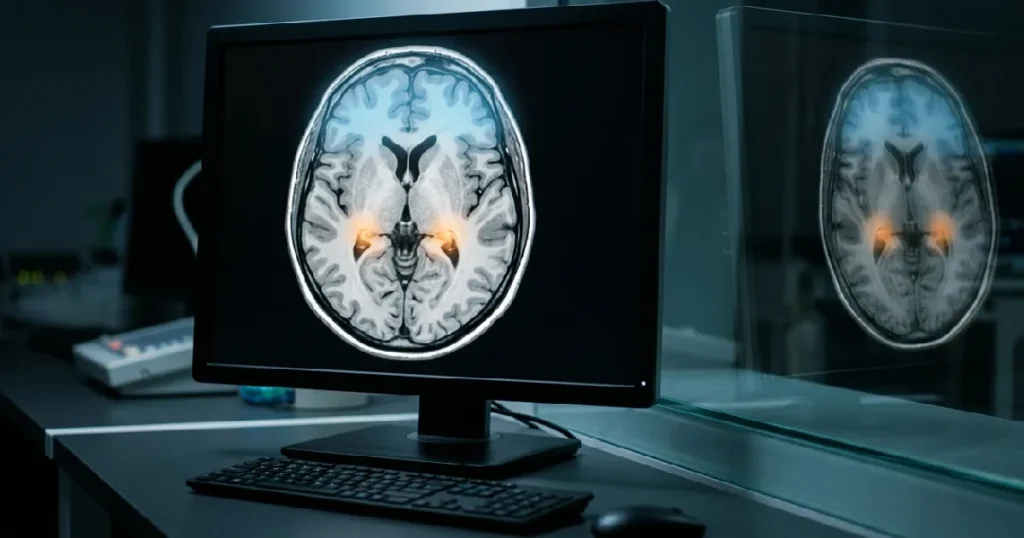
According to a landmark 2011 study by Hölzel and colleagues at Harvard, published in Psychiatry Research: Neuroimaging, eight weeks of mindfulness meditation produced measurable changes in brain structure. Participants showed decreased gray matter density in the amygdala and increased density in the prefrontal cortex and hippocampus, regions associated with self-awareness, learning, and emotional regulation.
That’s not a metaphor. That’s your brain physically reshaping itself.
And the most important part? You don’t need to believe in it for it to work. The changes happen through practice, not faith.
The Three Ways Mindfulness Rewires an Anxious Brain
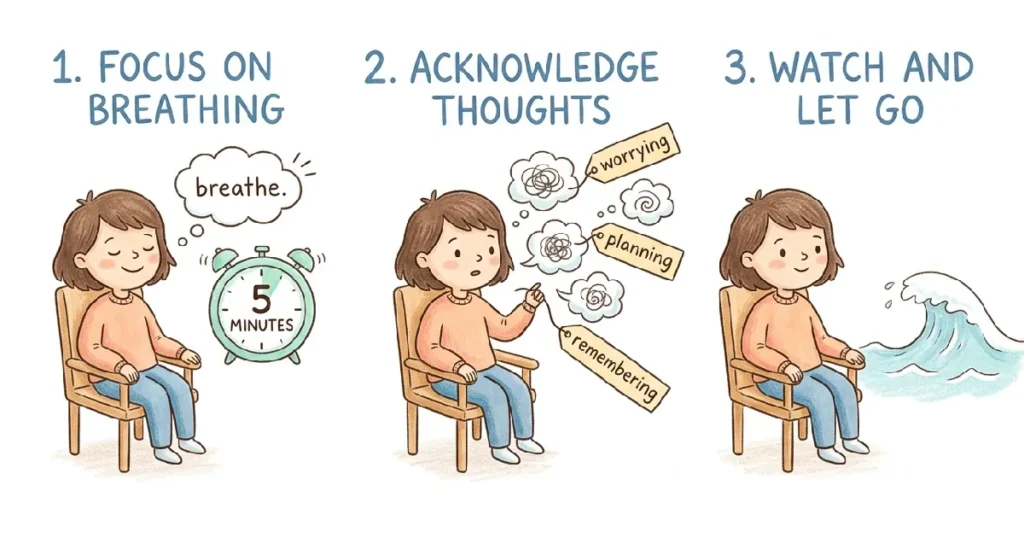
Most articles about mindfulness for anxiety tell you to “be present” and “observe your thoughts.” That’s technically accurate. But it’s like telling someone a car works because you turn a key. Here is what’s actually happening under the hood.
1. Your Brain’s Fear Center Physically Shrinks
Think of your amygdala as a smoke detector. In an anxious brain, that smoke detector is hypersensitive. It goes off when you burn toast. It goes off when someone doesn’t text back fast enough. It goes off at 3 a.m. for no identifiable reason.
Mindfulness practice gradually turns down the sensitivity of that detector.
The Hölzel study found that participants who practiced mindfulness for just 27 minutes a day over eight weeks had measurably less gray matter in their amygdala. Less gray matter in this case means less reactivity. The alarm still exists. It just stops firing at every shadow.
At the same time, the prefrontal cortex, which sits right behind your forehead, gets thicker and more connected. This is the part of your brain that says, “Wait. Is this actually dangerous, or does it just feel dangerous?” When the prefrontal cortex is strong and well-connected to the amygdala, it can override the panic signal before it takes over your whole body.
This is what neuroscientists call top-down regulation. Logic doesn’t just compete with fear. It learns to interrupt it.
2. The “What-If” Machine Goes Quiet
There’s a network in your brain called the Default Mode Network, or DMN. It’s active when you’re not focused on any specific task. It’s the part of your brain that wanders, daydreams, replays old conversations, and spins elaborate “what-if” scenarios.
For people without anxiety, the DMN is relatively harmless. It’s background noise.
For people with anxiety, the DMN is a rumination engine. It takes a small worry and runs it through every possible worst-case scenario on a loop. “What if I lose my job? What if they’re angry at me? What if something is seriously wrong with my health?”
Here is the part that changes everything: mindfulness practice has been shown to reduce activity in the DMN. A 2011 study from Yale University by Brewer and colleagues, published in Proceedings of the National Academy of Sciences, found that experienced meditators had significantly less DMN activity compared to non-meditators. Even more importantly, when the DMN did activate, meditators showed stronger connectivity to brain regions responsible for self-monitoring and cognitive control.
In plain language: mindfulness doesn’t stop your brain from wandering. It gives you the ability to notice when it wanders and bring it back. The “what-if” machine still turns on. But you stop getting trapped inside it.
3. Your Body Stops Living in Emergency Mode
Anxiety isn’t just in your head. It lives in your chest, your stomach, your shoulders, your shallow breathing. That’s because chronic anxiety keeps your sympathetic nervous system, the fight-or-flight system, perpetually activated. Your body circulates higher levels of cortisol, the primary stress hormone. Over time, elevated cortisol contributes to inflammation, disrupted sleep, digestive problems, and even cardiovascular risk.
Mindfulness directly addresses this.
Regular practice stimulates the vagus nerve, the longest cranial nerve in your body, running from your brainstem all the way down to your abdomen. When the vagus nerve is activated, it triggers the parasympathetic nervous system, essentially the body’s “all-clear” signal. Heart rate slows. Breathing deepens. Muscles release. The biological emergency gets called off.
This is not a placebo effect. It’s measurable physiology. Researchers have documented increases in what’s called heart rate variability, or HRV, among regular mindfulness practitioners. Higher HRV is a marker of a resilient nervous system, one that can shift smoothly between stress and recovery rather than getting locked in one mode.
That’s not weakness. That’s wiring.
The Cognitive Shift Most People Miss
Beyond the brain scans and hormone levels, mindfulness for anxiety produces a cognitive change that may be the most powerful of all. Psychologists call it decentering.
Decentering is the ability to observe a thought without becoming that thought. Right now, when an anxious thought enters your mind, “Something bad is going to happen,” it doesn’t feel like a thought. It feels like reality. Your brain treats it as fact, and your body responds accordingly.
Mindfulness trains you to insert a tiny space between the thought and your response. Instead of “Something bad is going to happen,” you learn to recognize, “I’m having the thought that something bad is going to happen.” The content is identical. The relationship to it is completely different.
I think of it this way: imagine your thoughts are cars on a highway. Right now, you’re standing in the middle of traffic, getting hit by every car that passes. Decentering moves you to the overpass. The cars are still there. They’re still moving fast. But you’re watching them from above instead of getting struck by each one.
This shift is not trivial. Research on Mindfulness-Based Cognitive Therapy, or MBCT, has shown that decentering is one of the key mechanisms that prevents relapse in depression and generalized anxiety. It’s not about changing your thoughts. It’s about changing your position relative to them.
The Power of Sitting With Discomfort
There’s a related skill that emerges from regular practice called urge surfing. When anxiety spikes, your instinct is to do something immediately: check the door lock again, refresh your email, seek reassurance from a partner, or avoid the situation entirely. These reactions provide brief relief but reinforce the anxiety cycle.
Urge surfing is the practice of noticing the anxiety spike, staying with it, and doing nothing.
Not suppressing it. Not analyzing it. Just watching.
What happens is remarkable. Anxiety follows a predictable wave pattern. It rises, peaks, and then, if you don’t feed it with reaction, it naturally falls. In my practice, I’ve watched clients discover this for themselves. It often looks like surprise. They expected the anxiety to keep climbing forever. It didn’t. It never does.
By sitting through the wave without reacting, you teach your brain something new: discomfort is survivable. And each time you survive it without acting on the urge, the next wave arrives a little smaller.
A Story of What This Looks Like in Practice

A woman I’ll call Maya came to therapy with generalized anxiety that had been building for years. She described a constant undercurrent of dread, a feeling that at any moment something would go wrong. She had tried talk therapy, journaling, and exercise. All of them helped somewhat, but the baseline hum of anxiety remained.
We introduced a simple 10-minute daily mindfulness for anxiety practice, starting with breath awareness. The first two weeks, Maya reported feeling more anxious during practice, not less. This is common. When you stop distracting yourself, the noise gets louder before it gets quieter.
By week four, something shifted. Maya noticed she could catch an anxious thought mid-spiral. She described it as “stepping back from the edge of a cliff I didn’t even know I was standing on.” By week eight, her sleep had improved. Her resting heart rate had dropped. And most significantly, she told me: “The anxiety still comes. But it doesn’t feel like me anymore. It feels like weather.”
That sentence captures the entire promise of mindfulness for anxiety. Not the elimination of difficult feelings. The transformation of your relationship to them.
What You Can Try This Week
You don’t need a meditation retreat or an app subscription to begin. Here are three specific, evidence-based practices you can start with today.
The 5-Minute Anchor Practice
Set a timer for five minutes. Sit in a chair with your feet on the floor. Close your eyes or soften your gaze. Focus your attention on the physical sensation of breathing, not controlling it, just noticing it. When your mind wanders (and it will, within seconds), gently bring your attention back. Each return is one repetition. That’s the exercise. It’s not about staying focused. It’s about practicing the return.
The Thought Labeling Technique
The next time an anxious thought arrives, try naming it silently: “Worrying.” Not analyzing the worry. Not arguing with it. Just labeling the mental activity. “Planning.” “Catastrophizing.” “Remembering.” This small act of labeling activates the prefrontal cortex and weakens the amygdala’s grip. Research from UCLA’s Lieberman lab has shown that putting feelings into words, a process called affect labeling, reduces the intensity of emotional reactions in real time.
The 90-Second Rule
Neuroscientist Jill Bolte Taylor observed that the chemical lifespan of an emotion in the body is approximately 90 seconds. After that, any continued emotional intensity is being fueled by your thoughts about the emotion, not the emotion itself. The next time anxiety surges, try this: set a mental timer. Notice the physical sensations. Watch the wave rise. Wait. Most of the time, if you don’t add narrative, the peak passes within that window. You’re not enduring it. You’re outlasting it.
The New Way to See Yourself at 2 A.M.
You’re lying in bed again. The chest tightness is there. The mind starts its familiar loop.
But this time, something is different. You notice the tightness instead of drowning in it. You label the thought: “Worrying.” You feel the wave rise. You stay still. You don’t fight it. You don’t fix it. You watch it crest and, slowly, begin to fall.
You’re not a calmer person. You’re not someone who has transcended anxiety. You’re someone who has learned to stop standing in the middle of traffic and started watching from the overpass.
Mindfulness for anxiety doesn’t promise you a life without fear. It promises you a life where fear no longer makes your decisions.
And that changes everything.
My Closing Remarks
I’ll be direct with you: I resisted mindfulness for years. It felt too soft for something as sharp as anxiety. I was wrong. Not theoretically wrong. Personally wrong. The first time I sat with my own racing thoughts and watched them pass without chasing them, I felt something I hadn’t felt in a long time. I felt like I had a choice. Not a choice about whether to feel anxious, but a choice about what to do next. That’s what I want for you. Not the absence of hard feelings. The presence of a steady hand on the wheel while the storm is still blowing. You deserve that. And you’re more capable of it than you realize.
More Related Stories for You
- If you’re looking to build a deeper mindfulness practice, start with small, consistent steps rather than dramatic overhauls.
About The Author