
 David Wall
Forget Everything You Know About Sitting Still And Clearing Your Mind. The Most Powerful Mindfulness Exercises Don’t Calm Your Brain. They Deliberately Disrupt It.
Key Points
- The most effective mindfulness exercises work by introducing strategic confusion and novelty to your nervous system, not by helping you relax.
- These nine creative mindfulness exercises target specific brain regions, from the insula to the prefrontal cortex, triggering neuroplasticity in ways that traditional meditation simply cannot.
- True mindfulness is not about escaping stress. It is about training your brain to stay present inside challenge, building cognitive flexibility you can carry into every relationship and decision.
Contents
Table of Contents
You Already Know How to Breathe. Now What?
You are sitting cross-legged on the floor. Your eyes are closed. You are trying, really trying, to focus on your breath.
And your brain could not care less.
It is already three conversations ahead, replaying a fight from last Tuesday, and composing a grocery list, all at the same time. You open one eye. It has been four minutes.
If this sounds familiar, you are not failing at mindfulness. You are bumping up against its ceiling. The standard toolkit of body scans, guided breathing, and the classic “notice five things you can see” exercise got you started. And that was real. But your brain adapted. It figured out the pattern, automated the response, and went right back to running on autopilot.
That is not a flaw in you. That is how brains work.
Why Your Brain Stops Responding to Familiar Practices
Here is the core problem: the human brain is a prediction machine. Neuroscientist Karl Friston’s free energy principle suggests that the brain is constantly trying to minimize surprise. Once it learns a pattern, it offloads processing to lower-level circuits and stops paying close attention.
This is why your morning commute feels like a blur. It is why you can brush your teeth while mentally rehearsing a work presentation. And it is exactly why the mindfulness exercises you have been doing for months no longer feel like they are doing anything.
Your Default Mode Network, or DMN, the brain’s “wandering mind” system, becomes especially active during familiar routines. A study published in the Proceedings of the National Academy of Sciences by Raichle and colleagues found that the DMN dominates brain activity during repetitive, low-novelty tasks. In other words, when the exercise feels easy, your brain has already checked out.
So what does work?
Novelty. Disruption. Controlled confusion. The exercises that force your brain to pay attention because it genuinely does not know what comes next.
Think of traditional mindfulness as walking along a familiar trail. These exercises are more like stepping off the trail entirely and asking your brain to build a new path through dense forest. That is where neuroplasticity, the brain’s ability to form new neural connections, actually happens.
Here are nine ways to make that happen.
1. Concept Dissolution: Strip the Labels Off Reality
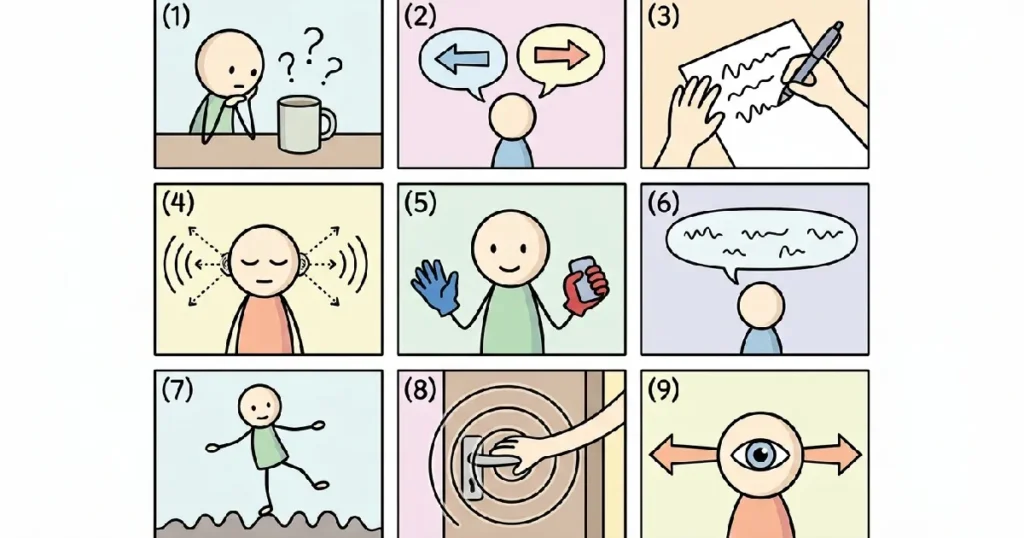
The Action: Pick up an everyday object. A coffee mug, a pen, your phone. Now stare at it while deliberately erasing everything you “know” about it. Remove the name. Remove its purpose. Remove the memory of who gave it to you. Try to see it as a shape. A texture. A pattern of light hitting a surface.
The Brain Mechanics: When you strip away language and categorization, you temporarily quiet the DMN and force your prefrontal cortex, the brain’s executive processing center, to engage with raw sensory data. You are seeing the world without the shortcut of concepts. This is extraordinarily difficult. Most people can sustain it for only a few seconds before the label snaps back into place.
That difficulty is the point. Each attempt stretches your capacity for present-moment awareness beyond what a standard body scan ever could.
2. Ideological Mirroring: Argue Against Yourself
The Action: Choose a belief you hold deeply. Political, personal, spiritual, it does not matter. Now spend ten minutes constructing the strongest possible case for the opposite position. Not a straw man. A real, thoughtful, empathetic argument. Hold space for it without judgment.
The Brain Mechanics: This exercise creates what researchers call cognitive friction. Your brain’s executive control network has to override the amygdala’s emotional threat response, which fires whenever your identity feels challenged. Over time, this builds extreme cognitive flexibility, the ability to hold discomfort without reacting. In my practice, I have seen this single exercise transform how people handle conflict in their closest relationships.
You are not abandoning your beliefs. You are training the muscle that lets you stay present when someone disagrees with you.
3. Non-Dominant Motor Mapping: Make Your Hands a Stranger
The Action: Use your non-dominant hand for a complex daily task. Tie your shoes. Unlock your phone. Write a sentence. Button a shirt. The clumsier, the better.
The Brain Mechanics: Routine motor tasks are handled almost entirely by the cerebellum and basal ganglia, deep brain structures that operate below conscious awareness. When you force your non-dominant hand to lead, those circuits cannot help you. Your motor cortex has to take over manually, recruiting attention and spatial awareness in a way that feels almost childlike.
A client I worked with, a software engineer named Marcus, started unlocking his phone with his left hand every morning. “It’s like my brain wakes up twenty minutes earlier now,” he told me. That was not a metaphor. The unfamiliar motor pattern was literally pulling his prefrontal cortex online faster.
4. Saccadic Sound Tracking: Point Your Eyes at What You Hear

The Action: Close your eyes in a sound-rich environment, a park, a coffee shop, a busy street. As different sounds arise, use small, quick eye movements called saccades to “point” your closed gaze directly at the source of each sound. A bird to the left. A car to the right. A voice behind you.
The Brain Mechanics: This exercise forces a highly unusual cross-modal integration between your auditory cortex, which processes sound, and your visual-spatial mapping systems, which are normally responsible for tracking what you see. The brain does not usually merge these two processing streams in this way. When you ask it to, it has to build new pathways to manage the task.
The result is an almost startlingly sharp sense of spatial presence. You are not just hearing the world. You are mapping it in three dimensions with your eyes closed.
5. Temperature Splitting: Confuse Your Interoceptive Radar
The Action: Hold an ice cube in one hand and a warm mug in the other. Direct your attention to the cold hand. Then the warm hand. Then back. Gradually try to hold awareness of both conflicting signals at the same time.
The Brain Mechanics: Your insula, a brain region deep in the lateral cortex, acts as your body’s interoceptive radar. It processes internal signals like temperature, hunger, heartbeat, and emotion. By feeding it contradictory thermal data simultaneously, you are essentially stress-testing its processing limits and expanding your capacity for interoceptive awareness.
Why does that matter in daily life? Because interoceptive awareness is directly linked to emotional regulation. People who can sense their internal states with greater precision tend to manage anxiety, anger, and relational conflict more effectively.
You are training your emotional thermostat by literally holding hot and cold at the same time.
6. The Sub-Vocal Braking System: Slow Your Inner Voice to a Crawl
The Action: When you notice your inner monologue racing, do not try to stop it. Instead, repeat the exact words you are thinking out loud, but at an unnaturally slow pace. One word every five seconds. “I… am… not… good… enough.”
The Brain Mechanics: Your inner narrator operates at roughly the speed of speech, about 150 words per minute. When you forcefully decelerate it, you disrupt the automatic loop between your subvocal speech centers and your amygdala, the brain’s emotional alarm system. Negative self-talk gets much of its power from speed. Slowing it down exposes it for what it often is: a habit, not a truth.
That is not weakness. That is wiring.
And you can rewire it by simply refusing to let the loop run at its preferred pace.
7. Vestibular Instability Pauses: Shake Your Balance on Purpose
The Action: Stand on one leg on an uneven surface like a rolled-up towel. Close your eyes. Slowly rotate your head from side to side. Try to hold this for thirty seconds.
The Brain Mechanics: Your vestibular system, located in the inner ear, is constantly calculating your position in space. When you destabilize it while removing visual input, your cerebellum goes into overdrive, recruiting every available attention resource to keep you upright. There is no room for mind-wandering here. Your brain is fully, urgently present.
This is mindfulness through physical necessity. Your brain cannot afford to wander when it is genuinely uncertain whether you are about to fall.
8. Chrono-Savoring: Stretch Two Seconds Into Sixty

The Action: Choose a micro-action that normally takes about two seconds. Opening a door handle. Picking up a glass of water. Lifting a pen. Now perform it in ultra-slow motion over a full sixty seconds. Maintain continuous, unbroken focus on every millimeter of movement.
The Brain Mechanics: This exercise recalibrates what researchers call your internal “sensory frame rate,” the speed at which your brain samples incoming information. Most of daily life is processed in low-resolution because the brain already knows the script. By radically slowing a familiar action, you force high-resolution processing onto something your brain had dismissed as unimportant.
The effect is a strange, almost cinematic clarity. A woman named Priya in a mindfulness group I facilitated described it as “suddenly noticing that opening a door has about forty steps my brain usually skips.” That kind of granular awareness transfers directly into how you listen to people, how you notice tension in your body, and how quickly you catch yourself before reacting.
9. Peripheral Horizon Expansion: See Everything Without Looking
The Action: Fix your gaze on a single point directly ahead. Without moving your eyes, deliberately widen your attention to detect movement and detail in your extreme left and right peripheral vision simultaneously. Hold this expanded field for sixty seconds.
The Brain Mechanics: Here is something most people never learn: activating your peripheral vision naturally down-regulates your sympathetic nervous system, the fight-or-flight response. When your visual system narrows to a tight focal point, it signals threat. When it widens, it signals safety.
This is not relaxation. It is neurological recalibration. You are using your visual system as a lever to shift your entire autonomic state from reactive to responsive. It is one of the fastest ways I know to move from anxiety into calm alertness without closing your eyes or taking a single deep breath.
Putting It Into Practice: Three Ways to Start This Week
You do not need to attempt all nine of these exercises. In fact, trying to do them all would defeat the purpose. These mindfulness exercises work precisely because they demand full attention. Spreading yourself thin turns them into just another checklist.
The One-A-Day Experiment: Pick one exercise each morning for a week. Spend just three to five minutes on it. Notice what changes in your attention, your mood, or your reactivity for the rest of the day.
The Friction Stack: Pair one of these exercises with a moment in your day that already frustrates you. Stuck in line? Try peripheral horizon expansion. Caught in a negative thought spiral? Deploy the sub-vocal braking system. Let the discomfort become the cue.
The Curiosity Journal: After each exercise, write one sentence about what surprised you. Not what you “got right.” What surprised you. This trains your brain to approach mindfulness as discovery, not performance.
A useful question to consider: “Which of these exercises makes me the most uncomfortable?” That discomfort is probably pointing you toward the exact neural pathway that needs the most attention.
The Real Point of Mindfulness Is Not Peace. It Is Presence.
Remember that image of yourself sitting on the floor, eyes closed, brain three conversations ahead?
You now have nine ways to catch that brain mid-drift and hand it something it cannot ignore. Not through force. Not through willpower. Through strategic surprise.
The most powerful mindfulness exercises do not ask you to be calm. They ask you to be there, fully, specifically, even awkwardly present, for the exact moment you are living.
Your brain does not grow by repeating what it already knows. It grows when you give it something it has never done before.
So give it something new.
My Closing Remarks
I will be honest with you. For years, I taught the standard mindfulness toolkit, and I watched smart, motivated people plateau and quietly give up. That bothered me. It was not until I started deliberately uncomfortable exercises in my own life, standing on a rolled towel with my eyes closed, feeling ridiculous, slowing my self-talk to a painful crawl, that I understood: real awareness lives on the other side of convenience. If even one of these exercises makes you feel strange or clumsy, please know that is not failure. That is your brain paying attention, maybe for the first time in months. Stay with that feeling. It is the beginning of something your autopilot never could have built.
More Related Stories for You
- If you are ready to build a deeper daily mindfulness practice, these exercises are a powerful place to begin.
About The Author