


Your brain is not broken. It is hunting for a chemical baseline that instant gratification burned out.
Key Points
- Addictive personality disorder is not a medical diagnosis, but the exhausting cycle of chasing stimulation is completely real.
- Your brain is not weak. It is running on a lowered dopamine baseline that makes ordinary life feel painfully dull.
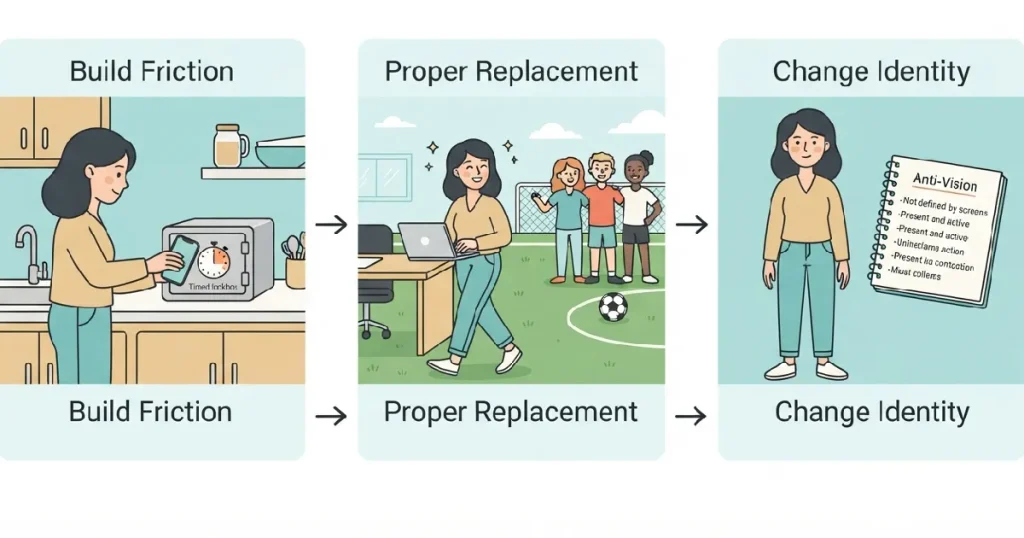
- Freedom comes from friction, proper replacement, and identity change, not from more willpower.
Contents
Table of Contents
We know the pattern by heart. We quit one thing and another takes its place before the first week is over. The drink goes, the phone stays glued to our hand. The cigarettes stop, the late-night food starts. We call it addictive personality disorder because that is the only language we have been given for a brain that will not sit still.
You have tried. You have really tried. And the cycle keeps finding a new costume.
Someone might think they finally beat their drinking. But what they don’t see is the three hours of midnight scrolling that quietly took its place.
Someone might think their 5 a.m. gym obsession is discipline. But what they don’t see is the panic that arrives on a rest day, as if stillness itself were a threat.
Someone might think they just have no self-control. But what they don’t see is a nervous system that treats quiet as danger and boredom as pain.
Here is the short version. What people call addictive personality disorder is not a formal diagnosis. It is a cluster of traits, impulsivity, emotional reactivity, and a lowered dopamine baseline, that makes ordinary life feel painfully dull. You do not need more willpower. You need a different relationship with reward.
That last sentence is the whole map. The rest of this piece shows you how to walk it.
The Myth vs. The Reality of Addictive Personality Disorder
The feeling is valid. The label is not.
You are not imagining the pull. You are not dramatic for noticing that you can drop one habit and pick up another before the withdrawal even fades. The medical community simply does not treat that pattern as a single personality disorder sitting in a manual.
Why addictive personality disorder is not on your medical record
Clinicians do not diagnose “addictive personality disorder” because addiction is not a personality type. It is a neurobiological process, a change in how the brain learns, wants, and repeats. The DSM-5 groups these patterns under substance-related and addictive disorders, which covers both chemical dependence and certain behavioral loops such as gambling.
That distinction matters. A personality disorder implies a fixed identity. A process can be interrupted. One keeps you trapped inside a story about who you are. The other hands you a mechanism you can work with.
As Psych Central notes when unpacking addictive personality traits, there is no single cookie-cutter type of person who becomes addicted. Intense craving, poor impulse control, and a habit of using stimulation to manage emotion can look like a personality. They are closer to a learned survival strategy.
The Big Five personality traits behind compulsive behavior
Researchers who study this do not hunt for a fictional disorder. They look at trait combinations that raise risk.
The profile that shows up again and again is high neuroticism, high impulsivity, and low conscientiousness. Neuroticism, in plain language, is how strongly you feel stress, shame, and emotional swings. Impulsivity is how fast a feeling turns into an action. Conscientiousness is your ability to stick to a plan when the feeling has already left the room.
A prospective study on personality traits and addictive behaviors found that these traits predict both substance-related and non-substance-related compulsive patterns over time. Shopping, gaming, social media, and binge eating sit on the same risk pathway as alcohol or nicotine.
You are not “an addict type.” You are a person whose nervous system learned that stimulation is the fastest way out of discomfort. That is a very different sentence to live inside.
The Dopamine Deficit Behind an Addictive Personality
If you have spent years blaming your character, this section will feel like someone finally turned the lights on.
Dopamine is not the pleasure chemical. That is the myth that keeps people ashamed. Dopamine is the wanting chemical. It is the brain’s “go get that” signal. It rises in anticipation, not just in the high itself.
Chronic under-stimulation and the chase for a baseline
Think of your reward system like a well that keeps getting deeper. Every hit of cheap stimulation, a scroll, a sugar rush, a late-night binge, a notification, pours a little more out. The water sits farther from the surface. Everyday life, a walk, a conversation, a quiet evening, no longer reaches it.
That is a lowered dopamine baseline. Your receptors have adapted to constant spikes, so ordinary reward registers as nothing. Quiet starts to feel like withdrawal. Boredom starts to feel like a threat.
This is why “just stop” fails. You are not choosing pleasure over discipline. You are trying to escape a state of under-stimulation that your brain now reads as pain.
You cannot out-willpower a chemical deficit.
Most people in this situation do not realize that the enemy is not desire. The enemy is a nervous system that has forgotten how to sit with a low signal.
ADHD, executive dysfunction, and addictive personality traits
Here is the piece almost no popular guide names clearly enough. A large number of adults who swear they have an addictive personality are living with an undiagnosed or late-diagnosed dopamine deficit already.
ADHD is a useful example. Executive dysfunction, the brain’s trouble with starting, stopping, planning, and waiting, leaves you hunting for anything that can jump-start focus. That hunt looks like addiction from the outside. It is often a brain trying to reach a usable baseline.
Autism can do a version of this through sensory seeking and the comfort of intense, repeatable loops. Bipolar patterns can do it through the crash after a high, when the empty space feels unbearable. Trauma can do it by teaching your body that stillness is unsafe.
The Mayo Clinic Health System outlines addictive traits such as an inability to stick to self-imposed rules and a pattern of using habits to regulate mood. Those signs matter. They also overlap heavily with untreated attention and regulation problems.
If your “addictive personality” showed up in childhood as constant novelty-seeking, and then followed you into every adult habit, you may not need a new identity. You may need a more accurate one.
The Vice Switching Trap of Poly-Addiction
This is the part that makes people feel crazy.
You do the hard thing. You quit. You tell everyone. Then, two weeks later, you are six hours deep into something else and calling it a hobby.
Why quitting alcohol frequently leads to doom-scrolling
Your brain does not mourn the specific vice. It mourns the function.
Alcohol lowered social anxiety, filled the evening, and gave your body a reliable downshift. Remove it and the job is still vacant. The phone is sitting right there, offering novelty, numbness, and a reason not to sit with yourself. Same contract. Different vendor.
This is poly-addiction in everyday clothes. Poly-addiction means more than one compulsive pattern running at once, or in sequence. You are not “starting over from zero.” You are transferring the same reward contract to a new supplier.
The switch often happens so fast that it feels like proof you are broken. It is actually proof that the underlying need was never named.
Clean vices and the hidden face of addictive personality
Then there is the version nobody wants to confront because it looks like success.
Obsessive gym-going. Extreme clean eating that slides into orthorexia, an unhealthy fixation on “pure” food. Eighty-hour work weeks praised as hustle. These are clean vices. They wear the mask of virtue while running the same circuitry: intensity, control, escape from under-stimulation, and a rising panic when the habit is interrupted.
Left unexamined, a clean vice does not just steal your evenings. It can quietly become the reason relationships thin out, rest disappears, and your identity collapses the moment the routine does.
A partner watching this from the outside often cannot tell recovery from relocation. That confusion is fair. The body language of obsession looks similar whether the object is whiskey or a perfect macro count.
Marcus quit drinking. Then his brain found a new target
Marcus, 31, stopped drinking after a weekend he could not fully remember. For six weeks he felt proud and strangely empty. By week seven he was gaming until 3 a.m. When he deleted the games, he started training twice a day and tracking every gram of food. His friends called it a glow-up. He called it control. What he did not say out loud was that a rest day made his chest tight in the same way last call used to.
The turning point was not more grit. It was the day he wrote down what each habit was actually doing for him. Alcohol had muted social fear. Games had given him competence and a world with rules. Training had given him a measurable self when everything else felt blurry. Once he could see the job each vice was hired to do, he could hire something healthier for the same role.
That is the reframe. You are not collecting addictions. You are repeatedly hiring the wrong employee for a real job.
How to Break Free From Addictive Personality Patterns

Willpower is a short battery. Environment is the charger. The people who actually get free stop arguing with the urge and start changing the conditions that feed it.
Step 1: Build friction with micro-barriers, not more willpower
A micro-barrier is a small physical delay between you and the habit. The urge peaks and falls in about ten minutes. Friction is what keeps you busy until it falls.
Put the phone in a timed kitchen safe after 9 p.m. Delete saved payment details from shopping apps. Do not keep trigger food in the house. Log out of every account that opens a loop. Charge the laptop in another room.
This is environmental design. You are not becoming a stronger person in the abstract. You are becoming a person whose worst impulse has to climb a fence first.
One place to start tonight is a single barrier on your most automatic vice. Not five. One.
Step 2: Map your vices and execute proper replacement
You cannot delete a habit and leave a hole. The brain will fill it. Proper replacement means matching the underlying need, not the surface activity.
If gaming gave you skill growth and social contact, a team sport or a difficult co-op hobby is a closer match than “just read more.” If scrolling gave you numbness after work, a hot shower, a walk without headphones, or a timed journal dump is closer than “be more present.” If workaholism gave you identity, a craft with visible progress can hold some of that weight.
A useful question to ask yourself: what job was this vice hired to do? Then hire something that can do that job without charging interest.
There is also a quieter technique that Reddit and recovery communities keep repeating because it works. Instead of fighting the habit, acknowledge it. Literally think, “Thank you, brain, for using this to get me through stress. This is now harming me. Let’s pick a better option.” That is not softness. That is taking your nervous system off a war footing so it can hear a new instruction.
Step 3: Drop the Disorder label and build an anti-vision
The sentence “I have an addictive personality” becomes a permission slip. It turns a pattern into a fate. Shift the identity toward something you practice. “I am someone who builds friction.” “I am someone who does not negotiate with a ten-minute urge.”
Pair that with an anti-vision. An anti-vision is a vivid, specific picture of the life you will have in five years if nothing changes. Not a vague “I’ll be unhealthy.” The actual Tuesday. The actual body. The actual relationship. The actual way you talk to yourself at 1 a.m. with a new vice that used to be a joke.
Write it by hand. Read it when the urge arrives. Instant gratification hates a concrete future. The well gets shallower when you stop pouring, and an anti-vision is what keeps your hands off the bucket long enough for that to happen.
Consider trying this for seven days: one micro-barrier, one honest replacement, and one paragraph of anti-vision on your nightstand. That is enough to start teaching your brain a new baseline.
Professional Treatment When Behavior Management Is Not Enough
Some patterns are older and deeper than a lockbox can reach. If your loops sit on trauma, untreated ADHD, depression, or a substance that has already taken over daily function, self-help is a starting point, not a finish line.
Behavioral therapies such as CBT and motivational work can target the exact reward contracts described above. Addiction Help offers a clear overview of addictive personality patterns and paths into therapy, local groups, and clinical care in both the US and the UK.
In my practice I have watched people loosen a decade of vice-switching once the right diagnosis, ADHD, PTSD, a mood disorder, finally sat next to the habit instead of underneath it, unnamed.
You already survived the cycle. That is not nothing. What you have now is a more accurate map of why the cycle kept winning.
The next time the old pull shows up, you will not have to call it your personality. You can call it a well that got too deep, and you can stop pouring.
Freedom is not a personality transplant. It is a baseline you rebuild on purpose.
My Closing Remarks
I have sat with enough people who hate themselves for “starting over again” to know the shame is usually louder than the habit. What I keep coming back to is this. A brain that learned to chase stimulation was doing its best with the tools it had. That does not make the damage smaller. It does make the next choice less of a moral test and more of a design problem. If you take one thing from me, take this. You are allowed to build a life that is interesting enough that cheap stimulation finally looks cheap.
More Related Stories for You
- These loops rarely stay private. They change how you show up with the people closest to you. If the pattern is straining a relationship, it helps to remember what healthy connection actually requires, including the qualities of a good partner that make repair possible instead of another escape.