
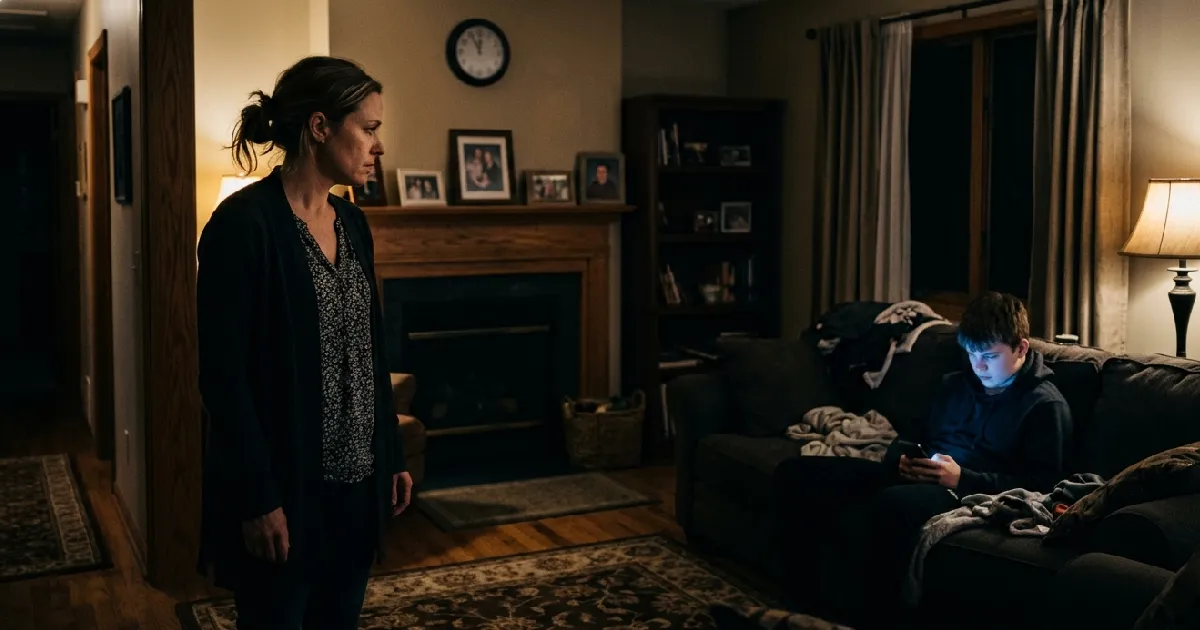

You’ve watched your teenager disappear into something. A game. A phone. A habit. A loop. And at first, you told yourself it was just a phase. But something in your gut has shifted. It doesn’t feel like a phase anymore.
You’ve Googled. You’ve found generic lists of signs addictive personality traits that could describe half the teenagers on the planet. And you’re still stuck in the same painful place: you don’t know if you’re overreacting, or if you’re already dangerously late.
Here’s what almost no article will tell you straight: “addictive personality” is not an official clinical diagnosis. It doesn’t appear in the DSM-5-TR. But that doesn’t make it imaginary. Not even close. What research does confirm is a measurable cluster of neurobiological and behavioral patterns that predict compulsive behavior years, sometimes many years, before any substance ever enters the picture.
The problem isn’t that the signs aren’t there. The problem is those signs look completely different from what parents were taught to watch for. They look like TikTok. They look like betting apps disguised as investing. They look like an AI chatbot that’s become your teenager’s closest “friend.”
Below, you’ll find a clinically grounded framework built specifically for this moment, not another recycled list, but a real decision tool that helps you tell the difference between teenage passion and addiction architecture, with exact words to use when you’re ready to act.
Addictive Personality Redefined: What Science Actually Says Right Now
Why “Addictive Personality” Is Both a Myth and a Measurable Reality
Let’s get one thing straight first, because this distinction matters.
Table of Contents
The phrase “addictive personality” gets thrown around constantly, but it’s not a formal diagnosis. You won’t find it in any clinical manual. What you will find in research is a consistent pattern of neurobiological traits that cluster together in people who go on to develop compulsive behaviors. Heightened reward sensitivity, low distress tolerance, high novelty-seeking, and impulsivity. Researchers like Mary Jeanne Kreek at Rockefeller University have spent decades mapping the molecular neurobiology behind these patterns. The traits are real. The label is just imprecise.
Think of it less like a diagnosis and more like an architectural vulnerability. Some brains, due to genetics, early environment, and developmental timing, require more stimulation to reach a baseline feeling of satisfaction. This is sometimes called Reward Deficiency Syndrome, a concept introduced by Dr. Kenneth Blum, and it explains why the same movie, meal, or moment of success lands differently in different brains. Not a character flaw. A neurological reality.
Here’s why teenagers are especially at risk. The prefrontal cortex, the part of the brain responsible for impulse control, long-term thinking, and consequence evaluation, isn’t fully developed until roughly age 25. According to the National Institute of Mental Health, adolescence is the highest-risk developmental window for the formation of compulsive behavioral patterns precisely because the “brakes” aren’t fully online yet. This is what I’d call the Executive Function Deficit Cascade: reward sensitivity is high, self-regulation is low, and digital environments are specifically engineered to exploit that gap.
The Research Shift That Changes Everything
Here’s an idea that most parents haven’t heard yet: behavioral addiction now precedes substance use in the majority of adolescent cases studied. Data from longitudinal adolescent tracking research, including findings referenced in Monitoring the Future, consistently shows that compulsive gaming, social media spiraling, and micro-betting behaviors establish the neurological grooves that substances later slide into. We’re talking a 2-4 year head start.
The addiction isn’t waiting for the substance. It’s already building its infrastructure inside your teenager’s brain right now.
That means the window for real intervention isn’t when substances appear. It’s now.
7 Signs of an Addictive Personality in Teenagers: The Observable Pattern
Signs of an addictive personality include heightened reward sensitivity, inability to moderate pleasurable activities despite consequences, rapid tolerance escalation, emotional dysregulation when access is removed, secretive or deceptive behavior around the activity, cross-substitution between compulsions, and persistent return to the behavior after attempted cessation, particularly when these patterns appear before age 18.
Before you read through these, one important note: one sign in isolation isn’t a crisis. What you’re looking for is a pattern, and specifically, how many of these show up at the same time and with what intensity.
Sign 1: Tolerance Escalation Without Any Substance Involved
What it looks like: Your teen needs increasingly extreme versions of the same experience. Casual gaming turns into needing to play for five hours to feel satisfied. Social media moves from posting occasionally to obsessively tracking engagement numbers. The thrill bar keeps rising.
Do this: Track escalation velocity over two weeks. How quickly does “enough” stop being enough? A journal or even notes on your phone work fine.
Not that: Don’t focus only on screen time totals. Time is a poor proxy. Forty minutes of compulsive dopamine-loop scrolling is neurologically more damaging than three hours of creative game design. Watch for intensity and escalation rate, not the clock.
Why it matters: Tolerance escalation is the single strongest predictor of addiction progression in adolescent behavioral models. It tells you the brain is already recalibrating its baseline.
Sign 2: Emotional Deregulation When You Remove Access
What it looks like: Disproportionate rage, sobbing, physical complaints, or days-long sulking when you interrupt the activity. Beyond normal teenage frustration. Something that feels like you’ve pulled the floor out from under them.
Do this: Run a 48-hour “soft removal” observation, meaning you don’t punish, you just create a natural interruption (a family trip, a phone left at home), and watch how quickly their emotional baseline returns. Healthy response: frustration that settles within a few hours. Warning sign: emotional intensity that builds or persists over multiple days.
Not that: Don’t confiscate devices as punishment without a conversation first. Device removal as punishment creates what’s sometimes called trauma bonding with the object, where the phone or game becomes associated with control and conflict rather than something they can develop a healthy relationship with.
Why it matters: Withdrawal from behavioral stimuli mirrors neurochemical withdrawal patterns in substance dependence. Physiologically, the brain doesn’t care whether it’s alcohol or algorithm.
Sign 3: Cross-Substitution and Compulsion Migration
What it looks like: You limit gaming, and suddenly they’re obsessively checking a crypto app. You take the phone, and they become fixated on something else with the same feverish quality. The compulsion doesn’t disappear. It relocates.
Do this: Keep a simple “what replaced what” log over 30 days. Three or more substitutions in six months is a red flag.
Not that: Don’t celebrate when one habit stops without checking what filled the vacuum. The vacuum itself is the issue, not any single behavior.
Why it matters: Cross-substitution reveals that the vulnerability lives inside the person, not inside any specific activity. The reward architecture is the problem. This is one of the most overlooked signs and one of the most diagnostically significant.
Sign 4: Secretive or Deceptive Behavior Around the Activity
What it looks like: Hidden accounts, cleared browser history, a second phone, coded language with friends, consistently lying about how much time they’ve spent on something.
Do this: Pay attention to the sophistication of the concealment. Closing a laptop when you walk in is early-stage privacy (normal). Setting up a burner account, using a VPN to get around parental controls, or having a whole secondary digital life is advanced deception architecture, and it signals something very different.
Not that: Don’t interpret all privacy as pathological. Teenagers need and deserve privacy. The clinical differentiator is deception under consequence threat: they know you’d be concerned, they know there would be consequences, and they can’t stop anyway.
Why it matters: Deception indicates two things happening simultaneously: awareness that the behavior is problematic, and inability to stop despite that awareness. That combination is a hallmark of compulsive disorders across the board.
Sign 5: Social Contraction Organized Around the Compulsion
What it looks like: Old friends fade. Sports, clubs, hobbies drop away. Their entire social world reorganizes around either the activity itself or people who share it. Their world gets smaller and smaller.
Do this: Pull up their social calendar from six months ago and compare it to today. How many activities, friendships, or interests have quietly disappeared? Three or more is significant.
Not that: Don’t confuse introversion or a natural friend-group shift with social contraction. The key word is involuntary. Are they choosing to step back, or does the compulsion make everything else feel pointless by comparison?
Why it matters: According to research published by the American Psychological Association, social contraction predicts addiction severity more reliably than the frequency of the behavior itself. It’s the canary in the coal mine.
Sign 6: Persistent Return After Genuine Quit Attempts
What it looks like: Your teenager has actually tried to stop or cut back. Maybe they deleted the app. Made rules for themselves. Announced they were done. And then, quietly, went right back.
Do this: Ask this directly, in a calm, non-accusatory moment: “Have you ever tried to cut back on [activity] and found it harder than you expected?” Their answer, even if they only give you two words, is extraordinarily revealing. You’re listening for self-awareness of loss of control.
Not that: Don’t wait for your teen to walk up to you and say “I think I’m addicted.” Adolescents almost never have the vocabulary for that. Watch for behavioral patterns instead: quiet delete followed by quiet reinstall. Rules they set for themselves that they break within 48 hours.
Why it matters: Self-attempted cessation failure is an actual DSM-5 criterion for substance use disorders. Its behavioral equivalent carries equal clinical weight. If they’ve tried to stop on their own and failed multiple times, that’s not a willpower problem. That’s a neurological one.
“The addiction isn’t in the substance. It’s in the loop.”
— Dr. Nora Volkow, Director, National Institute on Drug Abuse -This matters because it reframes everything. If the loop is the problem, you can interrupt it long before any substance appears. That’s the whole point of early behavioral identification.
Sign 7: Reward Insensitivity to Normal Pleasures
What it looks like: Things that used to bring them joy, family trips, their sport, music, friends, now feel flat. Boring. Pointless. They go through the motions but you can see there’s nothing lighting them up.
Do this: Offer three previously enjoyed activities in one week, no pressure, no lecture. Just create the opportunity. Watch for genuine emotional response versus flat compliance. You’re not looking for enthusiasm. You’re looking for any sign of real engagement.
Not that: Don’t chalk this up to “just being a teenager.” Anhedonia outside the compulsion, meaning the actual neurological inability to feel pleasure from normal experiences, is a measurable biological marker, not an attitude.
Why it matters: This signals dopamine downregulation. The brain has recalibrated its entire reward system around the compulsive stimulus. Everything else registers as insufficient by comparison. This is serious. And it’s reversible, but the window narrows with time.
The Critical Distinction: ADHD Hyperfixation vs. Addictive Compulsion

Why This Confusion Destroys Families
This is the one I see cause the most damage in families. Roughly 30-40% of teenagers with ADHD will be misidentified as having addiction patterns by parents who are paying close attention and genuinely trying to help. The overlap is real because both involve dopamine dysregulation. But the treatment paths are completely different, and using the wrong one makes things worse.
Here’s a four-point differential that actually works in practice:
- Joy vs. relief. ADHD hyperfixation feels joyful from the inside. The teen is genuinely absorbed, energized, lit up. Addictive compulsion is about anxiety reduction. They’re not doing it because it feels good anymore. They’re doing it because stopping feels unbearable.
- Natural flexibility. Hyperfixation shifts when the novelty fades. The ADHD teen who was obsessed with astronomy for six months moves on to something new. Addictive compulsion persists despite boredom. The behavior continues even when it’s stopped being fun.
- Source of distress. ADHD distress comes from external interruption of flow. The addictive distress comes from internal craving that builds between sessions.
- Identity integration. Hyperfixation becomes identity with pride: “I’m a musician, I’m into coding.” Addictive compulsion generates shame: “I can’t stop, I know I should stop, I hate that I can’t stop.”
What to Do If You’re Genuinely Unsure
Seek a neuropsychological evaluation before you apply any addiction-framework intervention. I can’t stress this enough. Applying an abstinence or removal model to an ADHD teen who’s hyperfixating can create real psychological harm and escalate the very patterns you’re trying to interrupt. Wrong framework, wrong treatment, real damage.
This is where finding an adolescent behavioral health specialist rather than a general therapist makes a meaningful difference.
A Story That Shows What This Actually Looks Like
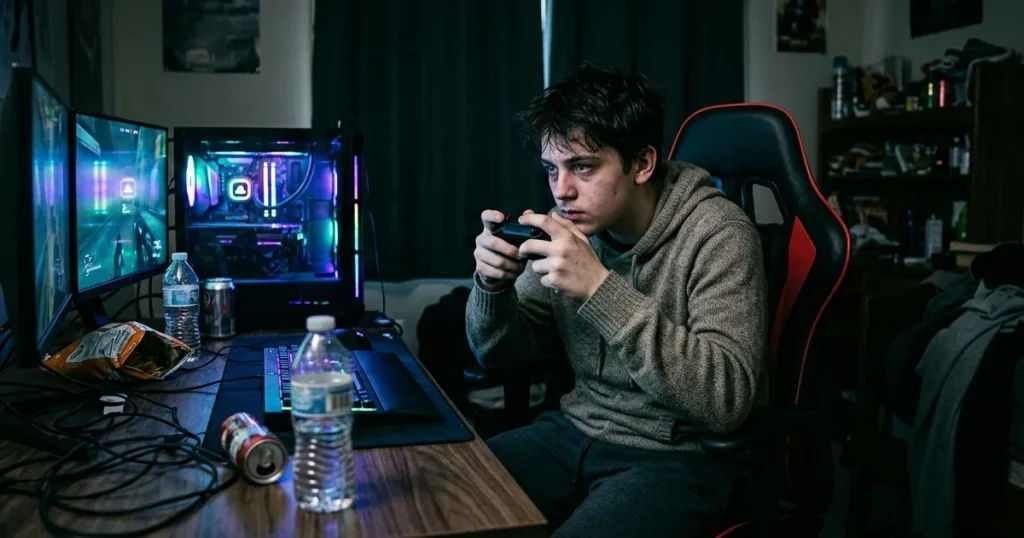
It was 11:30 on a Tuesday night when Maria finally sat down at the kitchen table and Googled “is my son addicted to gaming.”
Her son, Daniel (name changed), was 16. He’d started competitive online gaming two years earlier, and at first, it seemed fine. Normal, even. He was good at it. His friends played too. But somewhere in the past eight months, things had quietly shifted.
The games themselves had changed. He’d moved from skill-based play into games with loot boxes and betting mechanics. There was a second phone she’d found in his backpack, bought with money she couldn’t account for. His two closest friends from soccer had stopped texting. He’d quit the team in October, saying he just wasn’t “feeling it.”
When she’d mentioned the gaming once, gently, he’d gone completely silent for three days.
Maria almost wrote it off as teen drama. But she used the framework she’d found: she asked him, on a car ride home from the grocery store at around 6 PM, with the radio low, with no accusation in her voice: “Have you ever tried to cut back on the gaming and found it harder than you expected?”
Daniel stared out the window for a long moment. Then he said, “Yeah. A lot of times actually.”
That was the moment everything changed. Not because she’d caught him. Because she’d finally asked the right question. And listened.
She had him evaluated within two weeks. The results showed a clear compulsion pattern, not ADHD hyperfixation, and they started motivational interviewing with a specialist. Three months later, he wasn’t “fixed.” But the acceleration had stopped. The trajectory shifted.
“Adolescence is not a disease. But it is the highest-risk developmental window we have for addiction architecture to form.”
— Dr. Francis Jensen, neuroscientist and author of “The Teenage Brain” – Understanding this transforms how you respond. Urgency without panic. Action without judgment.
Digital-Age Addictive Patterns Most Parents Don’t Recognize
Algorithm-Driven Habit Formation as the New Gateway
TikTok’s scroll loop and slot machines activate nearly identical neural pathways. That’s not a metaphor. It’s neuroscience. The variable reward mechanism, meaning you don’t know if the next piece of content will be amazing or boring, is the same architecture behind every gambling machine ever designed.
Gacha game mechanics (the “loot box” pull in mobile games) are gambling dressed up in cartoon graphics and marketed directly to minors. The house always wins, but the dopamine hit of possibility keeps the player coming back.
And here’s the 2026 pattern almost no one is talking about yet: AI companion dependency. Platforms like Character.AI are being used by teenagers as emotional primary relationships. When a teenager’s closest source of emotional validation, conflict resolution, and daily intimacy is an AI that’s designed never to challenge them, never to disappoint them, and always to be available, that’s a dependency pattern with serious developmental consequences. We don’t have enough long-term data yet, but the early behavioral signs are already recognizable.
Why Standard “Screen Time” Rules Miss the Point Entirely
Four hours of writing music in a digital audio workstation is not the same as four hours of dopamine-loop content scrolling. They are neurologically opposite experiences.
Parents need to stop measuring duration and start assessing engagement architecture. The right question isn’t “how long are they on their phone?” It’s “what is the reward mechanism of the specific thing they’re doing, and is that mechanism designed to be impossible to stop?”
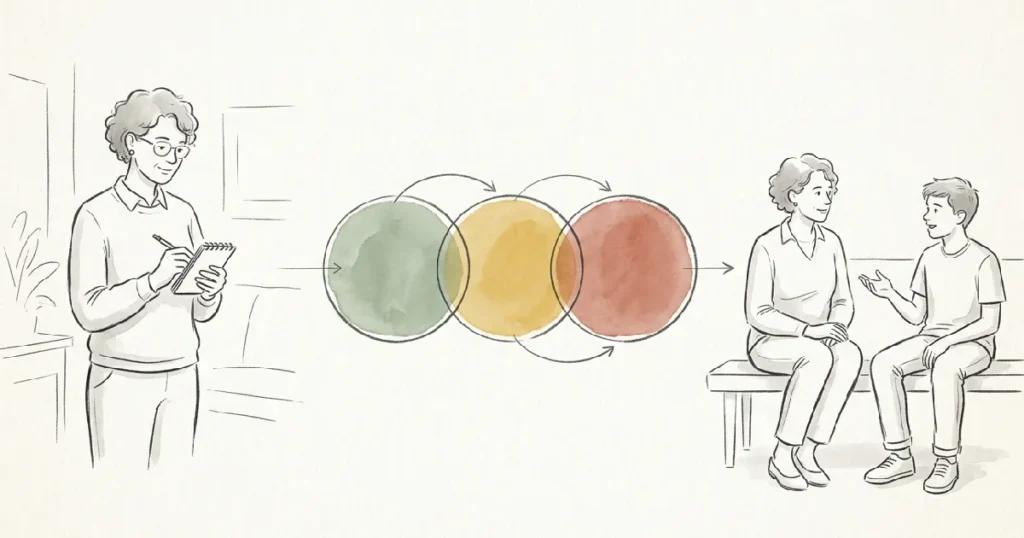
When to Seek Help: The Traffic Light Framework
Green Zone (Monitor at Home)
One or two signs present, mild intensity, no meaningful functional impairment. Your teen is maintaining friendships, keeping up academically, and shows genuine enjoyment of other activities. Continue observing with the 7-sign framework for 30 days.
Yellow Zone (Structured Family Intervention)
Three to four signs present, OR any single sign at high intensity, OR one failed self-directed quit attempt, OR beginning social contraction. This is where you start using motivational interviewing techniques at home, bring in the school counselor, and conduct structured 30-day observation with documentation.
Red Zone (Professional Help Is Non-Negotiable)
Five or more signs present. Or deception combined with cross-substitution. Or three-plus failed quit attempts. Or significant academic or social collapse. Or any self-harm ideation connected to the compulsive behavior. At this point, you need an adolescent behavioral health specialist within seven days, not a general therapist, not a school counselor alone, a specialist.
Common Mistakes Parents Make (And How to Avoid Them)

Mistake 1: Confiscating Devices Without Any Conversation
This feels like action, but in 2026, it accomplishes almost nothing practically and creates real psychological harm. Teenagers have redundant access everywhere: school devices, friends’ phones, smartwatches, library computers. Removal creates secrecy. It doesn’t create cessation.
Instead, say exactly this (choose a car ride, a walk, anywhere low-stakes and side-by-side, not face-to-face):
“I’m not taking this away from you. I’ve noticed [specific behavior, be concrete]. I want to understand what it gives you that other things don’t. Can we just talk about it? Nobody’s in trouble.”
Then: stop talking. Wait. A full three minutes of silence if needed. Let them fill it.
Mistake 2: Applying a Substance-Addiction Framework to Behavioral Patterns
Abstinence models, complete removal of the phone, the game, the platform, ignore the fundamental reality: the vulnerability is internal, not in the device. You can remove every screen in the house and the reward architecture is still there, waiting.
The shift that actually works: Instead of subtracting, add. Introduce three competing sources of dopamine (physical activity, genuine social novelty, a mastery-based skill challenge) while maintaining moderated access. The goal is reward diversification, not reward deprivation.
Reframe it out loud: “We’re not going to take things away. We’re going to add things and see what happens.”
Mistake 3: Waiting for Substances to Appear Before Taking Action
By the time substances enter the picture, the neural architecture is already deeply established. The behavioral compulsion was the first chapter. Substances are chapter three or four.
Track the 7 signs regardless of whether any substance is involved. The compulsion is the clinical concern. Don’t wait for confirmation you were right to be scared. Act on the pattern.
Mistake 4: Using an Online “Addictive Personality Test” as a Diagnostic Tool
Online quizzes have zero clinical validity. They over-pathologize normal adolescent intensity and create label anxiety that can actually damage your relationship with your teen before you’ve had a single real conversation.
Do this instead: Use the 7-sign framework above as an observation guide over 30 days. Write down specific, concrete behavioral observations (not impressions, actual incidents with dates). Then bring that documentation to a developmental specialist. Real data beats a quiz result every time.
Frequently Asked Questions
Is addictive personality a real clinical diagnosis?
No. “Addictive personality” is not recognized in the DSM-5-TR or ICD-11. However, research consistently identifies a measurable cluster of neurobiological traits, heightened reward sensitivity, low distress tolerance, impulsivity, and novelty-seeking, that significantly predict addiction vulnerability. Clinicians treat it as a risk profile, not a disorder label. The traits are real; the single-label diagnosis is not.
Can you have an addictive personality without ever using drugs or alcohol?
Absolutely. Addictive personality traits manifest through any compulsive behavior, including gaming, gambling, social media, shopping, or even exercise. The defining feature is the inability to moderate a pleasurable activity despite negative consequences, not the specific substance or behavior involved. Behavioral addictions activate identical brain reward pathways as substance dependence.
What’s the difference between ADHD hyperfixation and addictive personality signs?
ADHD hyperfixation involves joyful immersion that shifts naturally when novelty fades, whereas addictive compulsion persists despite boredom and is driven by anxiety relief rather than genuine interest. The key differentiator: hyperfixation doesn’t produce shame or repeated failed quit attempts. When genuinely uncertain, a neuropsychological evaluation is essential before any intervention is applied.
At what age can you first identify signs of an addictive personality?
Researchers observe early indicators, extreme reward sensitivity and low frustration tolerance, as young as age 7-9. However, reliable pattern recognition typically becomes possible during early adolescence, around ages 12-14, when executive function demands increase and digital exposure widens the opportunity for compulsive loops to form and entrench.
Can addictive personality traits be treated or managed successfully?
Yes. Adolescent-focused interventions including motivational interviewing, cognitive-behavioral therapy, reward diversification strategies, and family systems work show strong outcomes when implemented before neural patterns consolidate, typically before age 20-22. According to research from the American Academy of Pediatrics, early identification remains the strongest predictor of successful long-term management.
Should I tell my teenager I think they have an addictive personality?
Avoid using the label directly. It often triggers defensiveness and identity-level shame in adolescents. Instead, name specific observed behaviors without diagnostic language: “I’ve noticed you’ve tried to cut back on this a few times and it keeps pulling you back. That sounds really frustrating. Can we figure it out together?” That framing opens doors the label slams shut.
What You Do This Week Matters More Than You Think
Here’s your one concrete task for tonight or the next low-pressure moment you have alone with your teenager.
Ask this question: “Is there anything you do where you’ve tried to stop or cut back, and it was harder than you expected?”
Don’t react to the answer. Don’t problem-solve immediately. Don’t lecture. Just listen. Write down what they say, and over the next seven days, observe your teen through the lens of the 7-sign framework above. Keep notes on your phone. Specific incidents, not general impressions.
At the end of that week, you will know whether you’re in the green, yellow, or red zone. And you’ll know your exact next step, whether that’s continued observation at home, a structured family conversation, or a referral to an adolescent behavioral health specialist.
The window for intervention is open right now. The question is whether you’ll use it.
My Closing Remarks:
I’m going to be straight with you because I think you deserve that. In my work with families, the parents who wait for certainty before acting are often the ones who end up in my office wishing they’d moved sooner. You don’t need a diagnosis to trust your gut. You need a framework to sharpen it. The signs were there before the crisis. They’re almost always there. The question I want you to sit with tonight is this: what will you do with what you now know?
– Nicole Adkins, LMFT