


Let’s talk about you for a second. You are the person everyone else relies on. You are disciplined, high-achieving, and obsessive. But in the quiet hours of the night, you realize that your drive has stopped being a choice. It has become a mandate you can no longer turn off. If you are secretly searching for the Signs of an Addictive Personality, you are probably not looking for permission to check into rehab.
You are looking for a mirror. You want to know if your high-intensity habits are trending toward a clinical disorder. Standard advice tells you to just have more willpower. But modern neurobiology proves that for a high-reward brain, willpower is not the issue. It is a biological switch in your brain that turns passions into prison bars. Let’s fix that.
What Signs of an Addictive Personality Really Means Today
The medical community is moving away from the outdated stereotype of the completely broken individual who has hit rock bottom. Today, we understand that high achievers are often the most at risk.
Table of Contents
Signs of an addictive personality are often missed because they manifest as positive traits like intense drive, obsessive focus, and high risk tolerance. Informally, the term describes a neurobiological predisposition where the brain’s stress-response system chemically disrupts habit-regulating neurons. This specific disruption leads to rigid, compulsive behaviors that persist despite escalating negative personal costs.
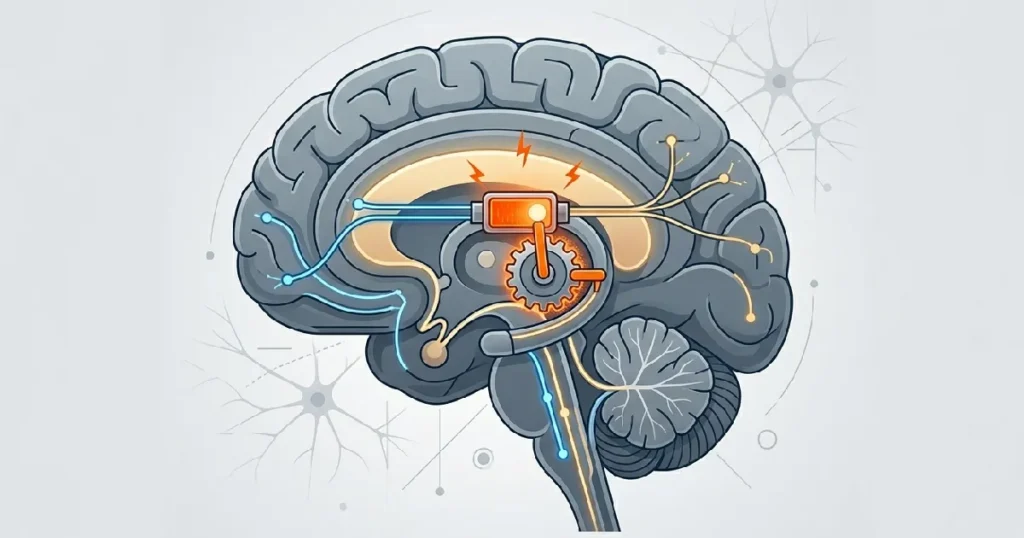
To truly understand this, we have to look at the neurobiology of the “rigid brain.” A major 2026 study from Texas A&M University completely changed how we view compulsions. It involves the direct line of communication between your brain’s stress centers and the dorsal striatum, which is the seat of your habits. Under normal conditions, stress signals help your brain stay flexible. If a car swerves into your lane, your stress signal helps you break your habit of driving straight and switch to swerving.
But if you have a high addiction liability, a chemical messenger called Corticotropin-releasing factor (CRF) behaves very differently. It aggressively over-activates Cholinergic Interneurons (CINs). These tiny cells act as your brain’s traffic controllers. When they are over-activated, they release too much acetylcholine, which paradoxically makes your brain completely inflexible. This is the “broken switch.” It is exactly why you can logically know you are burned out, know your phone is ruining your marriage, and yet physically find yourself reaching for the device the moment a stressful email hits your inbox.
“The question is not why the addiction, but why the pain.”
Dr. Gabor Maté perfectly captures the reality of our compulsions here. He reminds us that our rigid habits are simply coping mechanisms we use to run away from an uncomfortable nervous system.
Here are a few core characteristics of a broken habit switch:
- You feel a physical tightness in your chest when you try to delay a habit.
- You use highly structured routines to completely avoid spontaneous social interactions.
- You experience intense irritability when an external factor interrupts your workflow.
- You secretly feel like you are performing your success while entirely losing control behind closed doors.
9 Brutal Signs of a High-Reward Profile You Dangerously Miss
As a therapist, I sit across from highly successful people every single day. They do not think they have a problem because society cuts them a massive paycheck for their obsessions. But your nervous system keeps the score. Here is step-by-step guidance to audit your own behavior.
Step 1: The Novelty-Satiety Gap
Do you have a graveyard of abandoned hobbies and businesses? Addictive personalities often have slower dopamine reuptake. This means you feel a massive, world-altering surge of energy when something is brand new, but you experience an aggressive crash once the project becomes a daily routine.
- Do This: Track the actual duration of your excitement for new projects on a calendar. Force yourself to push through the first two weeks of boredom.
- Not That: Do not confuse temporary inspiration with permanent passion.
Step 2: Respectable Escape (Workaholism)
For high-masking adults, work is the ultimate, socially acceptable addiction. It completely hides the noise of your mind. It allows you to abandon your partner and your kids while claiming you are being a responsible provider.
- Do This: Establish strict “low-input” time blocks where your phone is in another room and you are totally unreachable.
- Not That: Do not use modern hustle culture to mask your sheer terror of being alone with your own thoughts.
Step 3: High Delay Discounting
This is a classic marker used in behavioral psychology. It is the tendency to choose a smaller, immediate reward right now over a much larger, delayed reward later.
- Do This: Practice intertemporal choice visualization. When you want to indulge, vividly picture your life ten years from now. Ask that future version of yourself if this choice is worth it.
- Not That: Do not rationalize short-term, destructive impulses by telling yourself you are just “seizing the day.”
Step 4: The Body Sway and Stress Reactivity
This is a fascinating biological marker. Research indicates that individuals biologically predisposed to dependencies exhibit higher “body sway” (physical instability) when standing totally still with their eyes closed. Ironically, this physical instability stabilizes when they are actively engaging in their addiction. You literally lean toward your rewards to feel balanced.
- Do This: Monitor your physical stability under stress. Notice if your leg bounces violently until you check your stock portfolio. Use deep grounding breaths to stabilize your body first.
- Not That: Do not ignore how your body physically reacts and begs for its next dopamine hit.
Step 5: The Digital Validation Loop
We cannot talk about the modern era without addressing social media. Compulsive posting is deeply tied to Factor II Psychopathy (high impulsivity and reckless behavior) and Vulnerable Narcissism (hypersensitivity to criticism paired with a hidden sense of entitlement). You use your smartphone as a safety blanket to get social admiration without any real-world vulnerability.
- Do This: Use a “post and ghost” protocol. If you share something online, close the app immediately and do not check it for a full 24 hours.
- Not That: Do not check your notifications every three minutes to soothe your fragile ego with artificial validation.
Step 6: Optimization Anxiety (The Biohacking Trap)
The wellness industry has accidentally created a playground for compulsive personalities. Tracking your sleep scores, continuous glucose monitors, and exact macro-nutrients can trigger the exact same habit-switch failure as a substance.
- Do This: Focus on Bioharmony. This is the 2026 shift away from rigid tracking toward physical intuition. Listen to your body, not a spreadsheet.
- Not That: Do not obsessively track every biological metric to the point of complete mental exhaustion.
Step 7: The Rational Addiction Perspective
Highly intelligent people are the absolute worst at seeking help. Why? Because you can perfectly rationalize your bad behavior. You use well-meaning goals to justify your compulsive loops. “I need this stimulant so I can finish this project and pay for my kid’s college.”
- Do This: Audit your rationalizations. Write down the excuses you make for overindulging and read them out loud to a trusted friend.
- Not That: Do not believe you are too smart or too successful to become dependent on a behavior.
Step 8: Intermittent Reinforcement Sensitivity
Your brain is not addicted to winning. It is addicted to the uncertainty of the win. This is why checking cryptocurrency prices, swiping on dating apps, and refreshing your email is so intoxicating.
- Do This: Identify the habits in your life that rely on variable, unpredictable rewards. Put strict physical barriers between you and those triggers.
- Not That: Do not assume a habit is safe just because it only sometimes gives you a good feeling.
Step 9: High Neuroticism Reacting to Challenges
Neuroticism is the strongest “Big Five” personality predictor for turning to behaviors for emotional escape. If your default reaction to a delayed flight, a spilled coffee, or a mild criticism is total rage or deep depression, your nervous system is primed for an addiction.
- Do This: Develop cognitive flexibility exercises. When something goes wrong, verbally list three alternative ways to view the situation without anger.
- Not That: Do not respond to every minor threat in your life with a full-blown emotional meltdown.
The Simplest Reality Check: Mark’s Story

It was 11:45 PM on a Tuesday. Mark, a 42-year-old CFO in New York, sat bathed in the cold blue light of his multiple monitors. He never touched drugs or alcohol. In fact, he prided himself on his total discipline. He was just addicted to the win. His life was a rigid loop of high-stakes trading, obsessive marathon training, and tracking his bio-data on complex spreadsheets. He believed his intense nature was his greatest advantage.
But his family life was quietly collapsing in the background. His wife would speak to him, and he would simply nod, his eyes automatically darting back to his smartwatch to check his resting heart rate or the Asian market open. Mark was not emotionally present. He was completely trapped in a lonely cycle of optimization anxiety.
One evening, after missing his daughter’s piano recital because he had to finish one last financial report, the deafening silence of his dark, empty house finally broke him. He realized his incredible drive was not a choice anymore. He applied a 30-day biological reset to normalize his dopamine receptors. He traded his spreadsheets for what we now call Bioharmony, taking long walks in the park without a phone or a fitness watch. Slowly, his mental flexibility returned. Mark discovered that by lowering his rigid reward focus, his actual financial decisions improved. He was finally choosing his life instead of compulsively reacting to it.
4 Common Mistakes and How to Avoid Them

People constantly misdiagnose their own psychological issues because they are looking at outdated information. As a therapist, I see my clients make the same four mistakes when trying to gain control over their lives. Let’s correct them right now.
“We are all vulnerable to addiction in a world of superabundant dopamine.”
Dr. Anna Lembke perfectly highlights the danger of our modern environment here. She shows us that when everything from social media to work emails offers an instant reward, our biological systems simply cannot keep up with the overload.
The Immunity Myth
You believe you are too successful, too wealthy, or too educated to have an addictive personality. You compare yourself to a stereotype on television rather than looking at your actual neurological flexibility.
- Step 1: Stop comparing your behavior to rock bottom. Look at your daily habits.
- Step 2: Ask yourself if you can easily stop your favorite behavior for 48 hours.
- The Script to Use: Look in the mirror and say, “I am evaluating my habits based on my mental flexibility, not my social status or my bank account. If I cannot stop this for two days without severe anxiety, I have a problem.”
Cross-Addiction
You decide to quit drinking, but suddenly you are working 80 hours a week. You quit smoking, but now you are obsessively tracking your macros and running 15 miles a day. You have not fixed the broken switch; you just changed the object of your compulsion.
- Step 1: Track your intensity levels across all areas of your life.
- Step 2: Notice if a sudden healthy habit is destroying your relationships.
- The Script to Use: Tell your partner, “I am trying very hard not to just swap one bad habit for a socially acceptable one. Please tell me if my new fitness routine starts feeling like an obsession.”
Hyperconnectivity as a Badge of Honor
You mistake your constant digital checking for professional duty. You think being available at 11:00 PM on a Saturday makes you a great employee, when in reality, it is a compulsion.
- Step 1: You need to establish a Digital Magna Carta for your life.
- Step 2: Implement a nervous system reset every single evening.
- Practical Rules for Your Digital Magna Carta:
- No screens within 90 minutes of your scheduled sleep time.
- Keep your phone charging in the kitchen, not on your nightstand.
- Turn off all non-human notifications (like sports scores and social media likes).
Ignoring High-Masking Burnout
Many people searching for answers about their addictive traits are actually dealing with high-masking neurodivergence, like adult ADHD or Autism. You use work or intense routines to hide your sensory overwhelm from the world. When you finally collapse, it is not laziness; it is total systemic burnout.
- Step 1: Identify if you are using your respectable addiction to hide your neurodivergent traits.
- Step 2: Give yourself permission to rest without earning it.
- The Script to Use: Tell yourself, “I am allowed to be completely unproductive and not okay today. I do not need a massive task or a substance to justify my existence on this earth.”
Frequently Asked Questions
Is an addictive personality an official medical diagnosis?
No, it is not an official diagnosis found in current medical diagnostic manuals. Clinicians use it informally to describe a collection of behavioral traits, such as high impulsivity, risk-taking, and emotional instability. These specific temperamental traits significantly increase your overall biological vulnerability to developing compulsive habits or severe substance use disorders over the course of your entire lifetime.
How does the Texas A&M study explain habit loops?
The recent study reveals that chronic stress chemically disrupts traffic-control cells called Cholinergic Interneurons. This disruption is caused by a stress chemical called CRF. It effectively breaks the mental switch that allows you to be flexible. This is why you feel physically locked into a damaging routine even if you logically want to stop right now.
What are respectable addictions for high-achieving professionals?
These hidden compulsions include extreme workaholism, obsessive health tracking, and digital validation seeking. Because these habits often lead to promotions, public praise, or improved physical health metrics, they are completely masked as positive character traits. This deception makes it incredibly difficult for high-performing professionals to recognize when they have completely lost control over their own choices.
Can these vulnerable personality traits be genetically inherited?
Yes, genetic factors are estimated to account for roughly half of an individual’s total vulnerability to addiction. This does not mean you inherit an addiction directly. Rather, you inherit a specific set of temperamental traits, like high reward reactivity or slower dopamine processing, that make compulsive behaviors feel much more biologically rewarding to your brain.
What is Bioharmony and why is it trending now?
Bioharmony is a mindful shift away from the rigid, data-obsessed wellness movement. It actively encourages individuals to listen to their body’s internal physical cues and move with natural intuition rather than strict spreadsheets. This massive trend emerged as a quiet cultural rebellion against the extreme burnout and constant productivity pressure that heavily fuels modern behavioral addictions.
Final Takeaway
You now have the vocabulary and the science to understand what is happening inside your brain. You know about CINs, CRF, and the broken switch. But reading about neurobiology from the National Institute on Drug Abuse or studying delay discounting concepts from the American Psychological Association means absolutely nothing if you do not change your behavior.
Here is your one small, immediate task: The Inversion Test. Choose your most respectable habit right now. It could be checking the stock market, looking at your work emails, or tracking your calories. On Monday morning, deliberately delay that exact habit by exactly two hours. Sit in the quiet. Observe the physical itch, the deep irritability, and the mental noise. Notice how this rigid behavior impacts your ability to connect, as outlined by experts at regarding relationship distress.
If you cannot sit in the boredom of that delay without severe anxiety, your habit-flexibility switch is highly compromised. This is your biological signal to step back, put the phone down, and start moving toward true Bioharmony.
My Closing Remarks
I am going to be brutally honest with you. Your obsession is not your superpower. It is a trauma response wrapped in a very expensive suit. I have sat across from billionaires who were completely bankrupt inside because they could not put their phones down for ten minutes to look their children in the eye. Stop romanticizing your compulsions just because society cuts you a paycheck for them. You deserve to own your mind, not rent it out to the highest dopamine bidder. Take your life back today.
More Related Stories for You
Understanding yourself is the first step toward lasting change.
- If you found yourself nodding along to this article, you need to look at how your underlying traits dictate your entire life path. Dive deep into understanding your baseline personality traits to see where your natural blind spots are.
- If you are in a relationship, these compulsive behaviors can quickly become severe red flags before marriage, destroying intimacy before it even starts.
- Finally, if you naturally fall into a more reserved, hardworking archetype, learning about the delta male personality can explain why you might use work as a shield against emotional vulnerability.