
 Nicole Adkins
Your income, your relationships, and your career ceiling aren’t random. They’re the compound interest of seven traits quietly running in the background of every choice you make.
Key Points
- The 7 basic personality traits go far beyond the Big Five, breaking broad categories into specific, measurable sliders that predict real outcomes.
- Small, repeated behaviors driven by these traits compound over years into your income, your relationships, and your professional reputation.
- You can audit and adjust these traits starting today, using the same behavioral tracking methods clinicians use in formal assessment.
Contents
Table of Contents
We like to believe our lives are shaped by a handful of big decisions. The job we accept. The person we marry. The city we finally move to.
But most of what determines where you land ten years from now has almost nothing to do with those moments. It comes from something much quieter: the same seven personality traits, running in the background of every ordinary Tuesday, deciding whether you send the follow-up email, hold your composure in a hard conversation, or reach for your phone instead of starting the task in front of you.
Someone might look at a colleague’s promotion and call it luck. What they don’t see is eighteen months of unglamorous follow-through that nobody applauded.
Someone might describe a friend as “too intense” at work. What they don’t see is a nervous system working overtime to control every variable, because uncertainty feels unbearable to that person.
Someone might envy a stranger’s easy charm at a networking event. What they don’t see is that the charm was built the same way a muscle is built, through hundreds of small, uncomfortable reps.
None of this is random.
The Science of Personality: Moving Beyond the Big Five
For decades, psychologists have leaned on the Big Five model, often remembered by the acronym OCEAN: openness, conscientiousness, extraversion, agreeableness, and neuroticism. It’s a solid framework. It’s also, for anyone trying to actually change their life, too blurry to act on.
Conscientiousness is a good example. The Big Five treats it as one trait. Researchers using more detailed models have split it into at least two separate sliders: industriousness, meaning how hard and how consistently you work, and methodicalness, meaning how organized and deliberate your systems are. Those two sliders don’t always move together. You can meet someone who works sixteen-hour days but produces chaos, or someone who is perfectly organized but never actually starts.
This is where seven-factor models earn their place. They add resolution to a picture that used to be out of focus.
In my practice, I’ve watched clients score “average” on standard conscientiousness tests while being dangerously low on one slider and unusually high on the other. That single distinction explained years of confusion about why their effort never translated into results.
There’s also an older, deeper layer worth understanding: the difference between temperament and character. Temperament is the biological, instinctive part of your personality, the part you were mostly born with, similar to your resting heart rate. Character is the part you built on top of it through your choices, your values, and your self-narrative. Psychiatrist C. Robert Cloninger mapped this exact distinction in his Temperament and Character Inventory, a tool still used in clinical research today.
The takeaway is simple. Some of your wiring came from your genes. The rest is under construction, and you’re the contractor.
The 7 Basic Personality Traits Shaping Your Future
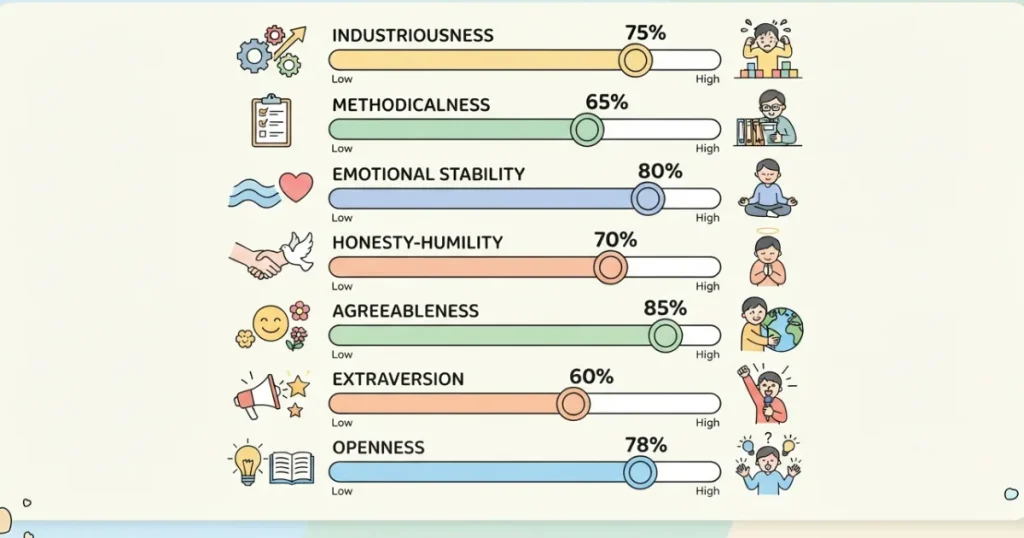
Here’s what these seven traits actually look like when you zoom in, and how each one quietly writes a chapter of your future.
1. Industriousness: The Execution Engine
This trait measures your goal-directed determination, your capacity to keep working after the initial motivation disappears. It’s the difference between wanting a result and grinding toward it on the days you don’t feel like it.
Low industriousness doesn’t look lazy from the outside. It looks like a person who starts strong and quietly drifts once the task stops being fun.
This single trait sets your income ceiling more than almost any other factor on this list. Careers rarely stall because someone lacked talent. They stall because effort quietly declined once nobody was watching.
2. Methodicalness: The Strategic Blueprint
Methodicalness measures your orderliness, how much you plan, sequence, and double-check before you act. It’s not about being uptight. It’s about whether your effort has a container to pour into.
A high-industriousness, low-methodicalness person works incredibly hard and still misses deadlines, because nothing is written down and nothing is prioritized. Their days feel like fire drills, even when they’re doing everything right.
This is the trait that determines whether you build something that scales or something that constantly needs you to hold it together by hand.
Here’s the part most personality quizzes never tell you. Industriousness and methodicalness are not the same skill, and treating them as one is exactly why so many hardworking people stay stuck. Research using instruments like the Jackson Personality Inventory-3 has found that these two sliders, measured separately, predict long-term career earnings and job stability far more precisely than a single conscientiousness score ever could. If you’re industrious but not methodical, you’re a rocket with no guidance system. If you’re methodical but not industrious, you’re drawing a perfect map you’ll never walk.
3. Emotional Stability: The Crisis Anchor
Emotional stability tracks how well you keep thinking clearly when pressure spikes. Its opposite, neuroticism, is the tendency toward anxiety, self-doubt, and reactive decision-making under stress.
This trait rarely shows up when things are calm. It shows up during the layoff announcement, the failed launch, or the client who is furious on the phone.
The people who lead well through hard seasons aren’t the ones who never feel fear. They’re the ones whose fear doesn’t drive the car.
4. Honesty and Humility: The Integrity Filter
This trait measures how well you mute your own ego, your willingness to play fair even when cutting corners would be easier and nobody would notice. It’s the opposite of manipulation, entitlement, and the quiet self-justification that precedes most ethical failures.
Low scores here don’t always look like villains. They often look like talented people who genuinely believe the rules exist for everyone except them.
Reputation is built in public but damaged in private. This trait determines which side of that line you end up on, and it compounds slower than any other trait on this list, which makes it easy to underestimate until it’s too late.
5. Agreeableness: The Relational Glue
Agreeableness balances genuine warmth and cooperation against the ability to hold a boundary. Too little, and people find you difficult to work with. Too much, and you become the person who resents everyone quietly.
The healthiest version of this trait isn’t endless niceness. It’s proactive empathy paired with the willingness to disagree constructively when it matters.
This is the trait that determines how fast your professional network grows, and how many people choose to stay on your team when they have other options.
6. Extraversion: The Social Amplifier
Extraversion captures your social energy, how assertive, expressive, and comfortable you are putting yourself forward in a room. It’s not about being loud. It’s about whether you’re willing to be visible.
Quiet competence rarely gets discovered on its own. High extraversion doesn’t make you more capable, but it does make your capability easier for other people to see, fund, and promote.
This trait shapes how quickly opportunity finds you, simply because opportunity tends to go looking for people it can already picture in the room.
7. Openness to Experience: The Innovation Driver
Openness measures intellectual curiosity, your comfort with abstract ideas and ways of doing things that don’t match how you were trained. It’s the trait most responsible for whether you adapt or become obsolete.
Low openness once looked like a safe, stable choice. In a job market being rewritten by new technology every few years, it’s becoming one of the riskier traits to score low on.
This is the trait that decides whether change feels like a threat to defend against or a door you’re curious to walk through.
Maya’s Turning Point: How Naming Her Traits Changed Her Career
Maya came to me convinced she was “just bad at follow-through.” On paper, she was talented: sharp, likable, full of ideas that made people lean forward in meetings. But eighteen months into her business, she was exhausted and broke.
When we mapped her traits, the picture got clearer. Her extraversion and openness were sky-high, which explained the ideas and the charisma. Her methodicalness, though, was almost nonexistent. She wasn’t lazy. She had no system catching any of her good ideas before they evaporated.
We didn’t try to change her personality. We built external scaffolding around the one slider that was low. Six months later, her revenue had tripled, not because she got smarter, but because she stopped relying on a trait she never had in the first place.
Reprogramming Your Mindset: How to Adjust Your Trait Sliders

Here’s the myth worth killing first: personality is not fixed concrete. Longitudinal research on trait stability, including a well-known review by psychologists Brent Roberts and Wendy DelVecchio, found that personality traits can and do shift across adulthood, especially when someone deliberately practices new behavior instead of just hoping to feel different.
Think of your seven traits like a dashboard of sliders instead of a fixed label glued to your forehead. You didn’t choose your starting position on most of them. You absolutely get a say in where they sit five years from now.
One place to start is what I call the Scaffolding Method. Instead of trying to become a fundamentally more organized person overnight, you build one external structure, like a single weekly planning ritual, that does the organizing for you until the behavior becomes automatic.
Another useful tool is the Trait Audit. Once a week, pick the one trait that cost you the most that week, whether that was low emotional stability during a hard meeting or low agreeableness in a text you regret sending. Write down what triggered it and what a half-point shift in that trait would have looked like in the moment.
A useful question to ask yourself: which single trait, if it moved just slightly, would change the outcome of most of your hard days? Start there. Not with all seven at once.
The Predictive Power of Personality in Career and Legacy
None of this matters if it stays abstract. The real value shows up when you connect these traits to the life you’re actually trying to build.
Recent research on purpose and happiness, featured by Psychology Today, found that people whose daily actions align with a clearly defined sense of purpose report significantly higher life satisfaction than people chasing achievement alone. Your seven traits are the mechanism that either supports that alignment or quietly works against it.
High industriousness without a defined purpose just produces busy exhaustion. High openness without emotional stability produces brilliant ideas that never survive a hard season. But when your traits are aimed at something that actually matters to you, they stop fighting each other and start compounding.
This is what financial independence, a strong professional network, and a legacy you’re proud of actually have in common. They’re not the result of talent. They’re the result of seven ordinary traits, pointed in the same direction, for long enough.
Conclusion: Take Command of Your Subconscious Coding
Your seven traits have been running your life since before you had language for them. That’s not an accusation. It’s just true, the same way gravity was true before Newton named it.
The difference now is that you know where to look. You know that the promotion, the relationship that finally worked, the business that finally scaled, was never about luck. It was about which sliders were turned up on an ordinary Tuesday, over and over, for years.
You don’t need to overhaul who you are. You need to know which one or two traits are quietly running the show, and start turning the dial.
Destiny was never mystical. It was just math you hadn’t seen yet.
My Closing Remarks
In my years working with driven, capable people, the ones who change fastest aren’t the most talented. They’re the ones willing to look honestly at which trait is quietly running their life, without turning it into another reason for self-criticism. I’ve watched a single adjustment, like building one external system around a low methodicalness score, change someone’s entire trajectory within a year. You don’t need a personality overhaul. You need honest data and one small, deliberate shift, and that’s genuinely available to you starting this week.
More Related Stories for You
- Personality also shapes how people read warmth, status, and praise in everyday talk, including what it can mean when a guy calls you beautiful.
About The Author