
 Sara Carmen
The problems ending most marriages aren’t dramatic betrayals. They’re small, invisible habits repeated every single day.
Key Points:
- Real healthy marriage tips aren’t about chasing perfect harmony. They’re about correcting five specific, research-backed mistakes before they calcify.
- The biggest threat to your marriage probably isn’t one big fight. It’s the quiet buildup of mind-reading, phone scrolling, and unspoken resentment.
- Small, repeated repair moments, not grand romantic gestures, are what separate couples who stay connected from couples who slowly drift into being roommates.
Contents
Table of Contents
We treat marriage like a finished product. The vows get said, the photos get framed, and we assume the hard part is over. Then the years pile up and you find yourself sitting on the same couch with someone you barely recognize.
Someone might think a quiet house means peace. But what they don’t see is two people who stopped reaching for each other weeks ago.
Someone might think their partner is just tired after work. But what they don’t see is a person who no longer feels chosen, only managed.
Someone might think one big date night will fix the distance. But what they don’t see is that the last three “dates” turned into meetings about bills, kids, and whose mother is visiting this weekend.
Healthy marriage tips that actually work are not about perfect chemistry or never going to bed angry. They are about catching five specific mistakes early: attacking character instead of the problem, expecting mind-reading, hiding money, replacing each other with screens, and treating romance as optional.
Left alone, this pattern does not just strain a relationship. It can quietly become the reason it ends.
Recent legal data on divorce points to a lack of foundational commitment behind roughly 75% of filings, with chronic conflict close behind at 57.7%. That is not a sudden catastrophe. That is two people who stopped acting like a team and only noticed after the warmth was gone.
The Illusion of a Perfect Marriage Under Real Stress
Popular advice sells you a fantasy of constant closeness. Real life sells you overdue bills, a buzzing phone, and a body that is too tired to talk at 11 p.m.
Why “Never Go to Bed Angry” Fails Healthy Marriage Tips
You have heard it at every wedding. Never go to bed angry. It sounds noble. In practice it is often harmful.
When you force a hard conversation past midnight, you are not being devoted. You are flooding. Emotional flooding is what happens when your nervous system is so overloaded that you cannot think clearly. Your heart rate climbs. Your listening shrinks. You say the sharpest version of what you mean.
An exhausted brain does not resolve conflict. It defends. It scores points. It stores new wounds for tomorrow.
Going to sleep angry is not a moral failure. Sometimes it is the most adult thing you can do. Rest first. Repair in the morning when your prefrontal cortex (the part of the brain that handles judgment and empathy) is back online.
Most Marriage Fights Are Not Meant to Be “Solved”
Researchers at the Gottman Institute have shown that about 69% of marital conflicts are perpetual. Perpetual problems are disagreements that never fully disappear because they grow out of personality, values, or temperament.
One of you wants the house silent at 9 p.m. The other comes alive at night. One of you spends to feel free. The other saves to feel safe. You will not “fix” that in a single talk.
The goal is not elimination. The goal is management with respect. Couples who last learn to talk about the same old difference without turning it into a character trial.
When Money Stress Turns You Into Logistics Partners
Financial anxiety has a sneaky effect on marriage. You stop being lovers and start being co-managers of a small, stressed company. You talk about the car repair, the grocery bill, the school email. You do not talk about wanting to be held.
Most people in this situation do not realize they have drifted until the crisis eases. Then the house is quieter, the paycheck is steadier, and the distance is suddenly obvious.
That distance did not appear overnight. It was practiced.
Healthy Marriage Tips: 5 Mistakes Breaking Couples (And How to Reverse Them)
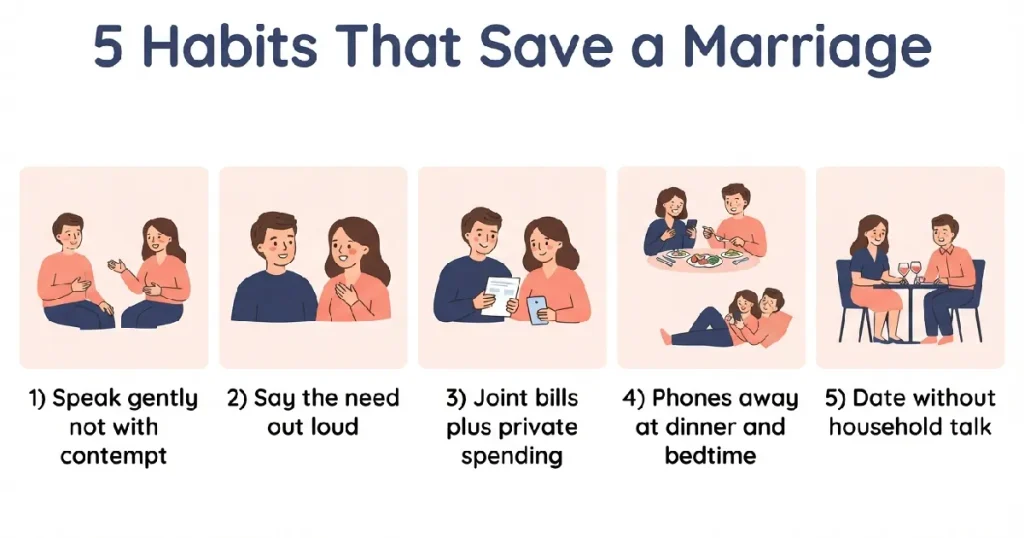
These five mistakes show up in ordinary kitchens and ordinary bedrooms. They are common. They are understandable. They are also reversible if you catch them while there is still some goodwill left.
1. Letting Criticism and Contempt Run the Conversation
The claim is simple. Friction is normal. Character attacks are not.
John Gottman named four communication patterns that predict divorce: criticism, contempt, defensiveness, and stonewalling. Together they are called the Four Horsemen. Criticism attacks who your partner is, not what they did. Contempt goes further. It is eye-rolling, sarcasm, and talking down as if you are above them. Contempt is the strongest predictor of a marriage falling apart.
Maya, 36, used to say, “The kitchen is a mess.” After two years of carrying the mental load (the invisible work of remembering appointments, snacks, forms, and laundry cycles), it became, “You never help. You are like another child.” Jordan heard that he was defective, not that the sink was full. He shut down. She got louder. The sink was never the real subject.
The so-what is this. Swap the global accusation for a gentle start-up. A gentle start-up names your feeling, names a specific situation, and asks for a positive need. “I feel overwhelmed when the kitchen is cluttered. Can we wipe it down together after dinner?” That is not softness. That is strategy.
Here is the unexpected trap. Some couples swing to the opposite extreme. They import corporate therapy talk into the living room. Every passing thought must be “processed.” Every irritation must be named in real time. That is not intimacy. That is surveillance. Radical transparency without kindness creates chronic paranoia. You start scanning your partner for hidden meaning instead of sitting beside them. Healthy marriage tips include honesty. They do not include turning your home into a performance review.
2. The Mind-Reading Trap and the “I Shouldn’t Have to Ask” Myth
The claim: unspoken expectations are not romance. They are a setup for punishment.
You sigh. You go quiet. You hope they will notice the trash, the calendar, the look on your face. When they do not, you collect evidence that they do not care. This is the “I shouldn’t have to ask” myth. It feels like a standard of love. It functions like a test your partner did not know they were taking.
Most people in long relationships fall into this. You live with someone long enough and your brain starts assuming they can see inside your head. They cannot.
The so-what is a simple rule: verbalize or release. If you cannot say it out loud, you do not get to punish them for missing it. In the first minute of a hard talk, tag what you need. “I want you to help me fix this” or “I need you to sit in this with me and not offer advice.” That one sentence prevents a well-meaning partner from “solving” a feeling you only wanted witnessed.
Weaponized incompetence (pretending not to know how so you will take over) is real. So is honest confusion. Direct language sorts one from the other. “I need you to own bedtime on Tuesdays, not wait for me to assign it” is clearer than a week of cold silence.
3. Financial Silos, Secret Spending, and the Trust Leak
The claim: money fights are rarely about dollars. They are about safety, power, and whether you are actually on the same side.
According to the Institute for Divorce Financial Analysts, money arguments play a role in a large share of separations, with some analyses putting the figure near 40%. Hiding a debt, micro-managing a $12 lunch, or refusing to talk about long-term goals all send the same message: I do not fully trust you with our life.
Newlyweds often skip this conversation because it feels unromantic. Struggling roommates skip it because it already feels tense. Both delays cost you.
The so-what is a tiered setup. Put household overhead (rent or mortgage, utilities, groceries, insurance, shared savings) in one transparent joint account. Give each of you a smaller personal account for private spending that does not require a hearing. Autonomy is not betrayal. It is a boundary that keeps resentment from growing around every coffee and birthday gift.
Talk once a month, on a calm day, about the next 90 days. Not a trial. A huddle. Spending habits, debt, and investment goals belong in daylight. Secrets belong in the category of things that quietly end marriages.
Keep intrusive in-laws out of those choices. Your spouse is your first family now. Parents can be loved and still be held at a polite distance when they try to vote on your budget, your home, or your weekend.
4. The Roommate Routine and Phubbing in Your Own Home

The claim: you can share a house and still abandon each other.
Phubbing is phone snubbing: ignoring the person in front of you to attend to a screen. It looks small. It trains your nervous system to treat your partner as background noise. You sit on the same sofa. You scroll in parallel. You call it relaxing. Your body reads it as rejection.
This is where mundane teamwork matters more than people admit. Washing dishes side by side is not glamorous. It is a low-pressure place to talk without a spotlight. Turning a chore cycle into a shared rhythm (you wash, I dry, we both put phones in a drawer) rebuilds the feeling of being a unit.
The so-what is a perimeter. Make the dinner table and the last thirty minutes before sleep phone-free. You do not need a grand gesture. You need repeated micro-moments of eye contact. Those tiny bids for connection (a comment about your day, a hand on a shoulder, a look that says “are you with me?”) are how safety is built. Miss enough of them and the house gets polite and lonely.
But here’s what no one tells you.
You can love someone and still train yourself not to see them.
5. Stopping the Pursuit After the Wedding
The claim: marriage is not a destination where romance runs on autopilot.
If you stopped dating your partner, you started assuming they would wait. Date nights vanish. When they happen, they become logistics meetings. Kids, calendar, that weird noise the dryer makes. No wonder the spark feels dead. You have been holding a staff meeting in a restaurant.
Action-based intimacy beats forced chemistry. Feelings follow behavior more often than the reverse. You do not wait to want your partner and then act. You act in small, structured ways and wanting has a place to return.
The so-what is the novelty rule. Plan recurring time together where household talk is off-limits. Try something neither of you has done in years. A new walking route. A terrible bowling night. Cooking a cuisine you both burn. Novelty helps the brain lay down fresh reward loops with the same person, which is the opposite of the roommate trance.
And when you feel far away, do not start with intercourse as a test of whether the marriage is “still alive.” Start with ordinary physical contact. A longer hug in the kitchen. Sitting close on the couch. Kissing like you are not clocking it. Repair the rupture first. Desire often follows safety, not the other way around.
Maya and the Silent Kitchen
Maya and Jordan had been married eight years when they stopped fighting and started disappearing. She carried every school form in her head. He came home and opened a screen. She told herself a good husband would notice the dishwasher. He told himself a good wife would just say what she needed. They tried the old rule and stayed up until 1 a.m. “resolving” things, then woke up raw. What changed was not a speech. Maya started tagging her asks. “I need help, not a pep talk.” They put both phones on the dresser after dinner and did the dishes together. It was awkward for a week. Then it was a conversation. Then it was a marriage again, not a shared address.
When Healthy Marriage Tips Are Not Enough
If contempt is daily, if you cannot remember the last repair, if you feel nothing where you used to feel hurt, you may be past self-help.
Couples often wait about six years too long before they ask for help. By then resentment has hardened into indifference. Indifference is harder to treat than anger. Anger still cares.
Overcoming that delay means treating therapy as maintenance, not as a last rite. A skilled couples therapist helps you restore attunement, which is the ability to notice and respond to each other’s inner world. The work is not to never rupture. Every close bond ruptures. The work is to repair before your brain files your partner under “threat” instead of “home.”
If you are in a high-conflict loop, start with safety. Shorter talks. No character attacks. One repair attempt a day, even if it is clumsy. “I was sharp earlier. I do not want us to stay there.” Clumsy repair still counts.
What You Can Practice in the Next 24 Hours
One place to start is the Fix-or-Feel Tag. Before the next loaded conversation, say whether you want a solution or a witness. Ten seconds. Fewer misfires.
Consider the Phone Perimeter tonight. Dinner and the last half hour before sleep, screens in another room. Notice what fills the quiet. That quiet is information.
A useful question to ask yourself is this: “Did I pursue my partner today in a way that had nothing to do with the household?” If the answer is no, send one specific, warm bid. Not “we need to talk.” Something closer to “I liked watching you laugh at dinner.”
The next time a fight is still hot at midnight, try the Pause and Park. Name one sentence of goodwill (“I am on your side, even if I am frustrated”), then sleep. Put the topic on a calendar slot within 24 hours so it does not vanish. Rest is not avoidance when you have a return ticket.
Think of your marriage like a campfire. You do not need a roaring blaze every night. You need someone who keeps feeding it small pieces of wood so it never goes cold. Most couples stop feeding it and then act shocked when they are sitting in the dark.
You already know that couch. The one where you sit together and feel alone. Nothing about that scene is proof that you chose the wrong person. It is proof that the five mistakes above have been practicing themselves without a plan.
You now have a plan. Not a personality transplant. Not a demand that you feel spontaneous passion on a Wednesday. A set of small, named moves that put you back on the same side of the problem.
Love is not a mood you wait to arrive. It is a practice you return to.
My Closing Remarks
I have sat with couples who waited until they felt nothing. The marriage was not on fire. It was already cold. What still moves me is how often the turnaround starts with one ordinary sentence said without a sneer. You do not need to become a different person this week. You need to stop feeding the five habits that starve the bond. If tonight you put the phone down, name what you need, and stay on the same team for twenty minutes, that is not small. That is how a marriage remembers itself.
More Related Stories for You
- If you want more good advice for a relationship that stays practical and close to real life, start there next.
About The Author