
 Sara Carmen
The love that lasts is not louder, grander, or more honest. It is better timed, better bounded, and far more ordinary than you were taught.
Key Points
- The most useful good advice for a relationship is not “talk more.” It is knowing when your brain is too tired to talk well.
- Lasting couples are built in five-second moments of attention, not in anniversary trips that try to repair a month of neglect.
- You stay close by remaining two whole people, not by asking one partner to be your entire emotional world.
Contents
Table of Contents
We keep following the same love rules and wondering why we still feel lonely next to the person we chose. We book the dinner. We say how we feel. We push the fight past midnight because someone once told us never to sleep angry. Then we wake up just as far apart, only more exhausted.
Someone might think the spark simply died. But what they don’t see is a nervous system that never gets a chance to settle.
Someone might think they need more honesty. But what they don’t see is that dumping every raw thought is not intimacy. It is unfiltered overflow.
Someone might think they have grown into different people. But what they don’t see is a hundred tiny ignored moments stacking up like unpaid bills.
Here is the answer most people never hear. Lasting love is not built on perfect communication or constant closeness. It is built on regulating your own body before you speak, staying two complete people, and answering the small bids your partner makes every single day.
That is the good advice for a relationship that rarely makes it onto a mug or a movie script. It is quieter than romance culture promised. It is also the only version that holds up under real fatigue, real phones, and real resentment.
The pattern exists for a simple reason. Your brain was not designed for late-night conflict, constant digital interruption, or the modern demand that one person be lover, best friend, therapist, co-parent, and meaning-maker. When those pressures pile up, popular advice often makes things worse. It tells you to merge more, talk harder, and stay in the fight after your prefrontal cortex (the part of the brain that helps you stay reasonable) has already clocked out.
Left unexamined, this pattern does not just strain a partnership. It can quietly become the reason it ends.
Unlearning the Relationship Advice That Sounds Wise and Backfires
The first piece of good advice for a relationship is unlearning the slogans that feel moral and work against your biology.
The biological case for going to bed angry
“Never go to bed angry” sounds devoted. At 11:47 p.m., after a long day, it is often a recipe for cruelty.
Late at night, sleep pressure rises and blood sugar drops. The prefrontal cortex, which helps you pause, choose words, and see your partner’s side, gets sluggish. The amygdala, the brain’s alarm system, gets louder. You are not becoming a worse person at midnight. You are becoming a more primitive one.
Forcing a resolution in that state is like trying to do surgery with shaking hands. You may finish the job. You will not like the scar.
Most people in this situation do not realize they are arguing with chemistry, not character.
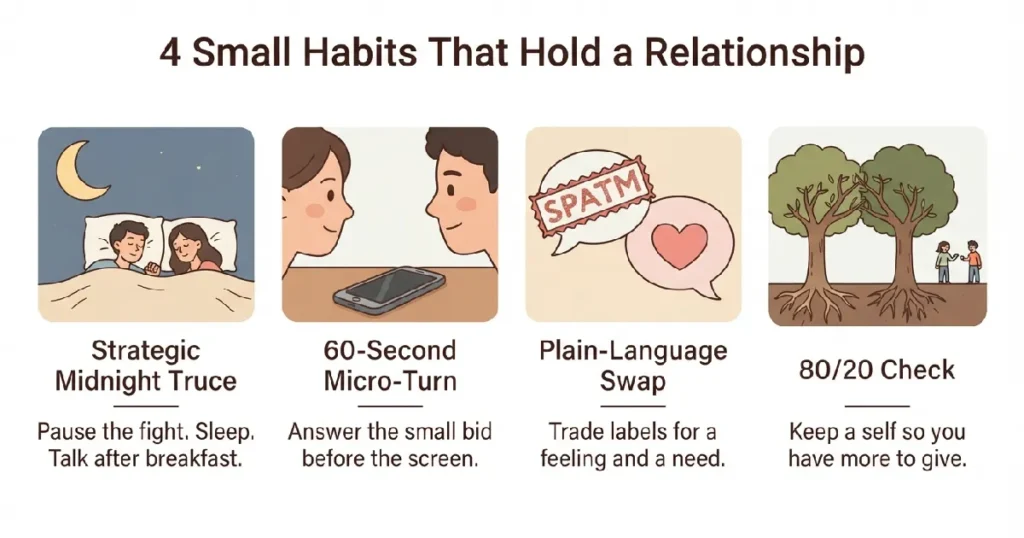
A more useful protocol is the Strategic Midnight Truce. You agree, in a calm hour, on one sentence you will both honor: “This matters, and we are too tired to do it justice. We are pausing. We will come back to it after breakfast.” Then you stop. You sleep in the same bed if you can. You do not keep scoring points from the pillow.
You are not avoiding the issue. You are waiting until your brain can hold it without burning the house down.
Why total honesty without tact is just damage
Authenticity got confused with unfiltered release. “I have to say this or I am being fake” can become a permission slip to hand your partner every spike of irritation the moment it appears.
Before a hard conversation, run a simple filter: Need to Say versus Need to Process.
Need to Process is the raw material. The rant in the car. The journal page. The text you delete. It is for you.
Need to Say is the cleaned version. It names the feeling, the specific event, and the request. It does not include a character diagnosis of the person you live with.
If the sentence starts with a label for their personality, it is usually still processing. If it starts with what happened in you, it is closer to ready.
The Science of Micro-Bids: How Lasting Love Is Built in Five Seconds
Grand gestures get the photos. Daily attention keeps the bond.
Researchers at The Gottman Institute found that couples who stay together turn toward each other’s small bids for connection about 86 percent of the time. Couples who later separate do so only about 33 percent of the time. A bid is any tiny reach: a sigh, a meme, a comment about the sky, a hand on your back as you pass in the kitchen.
Turning toward means you answer it. Turning away means you miss it or delay it into nothing. Turning against means you meet it with irritation.
Someone might think a weekend away will reset months of distance. But what they don’t see is that a vacation cannot outvote a thousand micro-rejections.
Think of daily attention like a dimmer switch, not a light switch. Love rarely slams off in one fight. It fades through ignored glances, half-heard stories, and “one second” that never comes back.
The 60-second micro-turn
You do not need a new personality. You need a shorter delay.
When your partner starts a sentence, shows you a screen, or looks at you with that small expectant face, close the tab. Put the phone face down. Give them one full minute of actual presence. Then you can return to the email.
That minute is not politeness. It is a deposit. Connection works like compound interest. Tiny daily deposits of attention grow into something sturdy. Miss enough of those deposits and no anniversary trip can cover the overdraft.
Technoference is not a phone problem. It is a rejection problem.
Phubbing is the awkward word for snubbing someone in favor of a phone. It sounds minor until you feel it in your chest.
A Pew Research Center report found that 40 percent of partnered adults are bothered by how much time their partner spends on devices. The wound is not the screen itself. It is the message the screen sends: this rectangle is more compelling than you.
Digital fragmentation also steals something quieter. Couples regulate each other’s nervous systems through gaze, tone, and shared stillness. When both of you are half-present, your bodies never fully arrive in the same room.
Willpower is a weak plan at 8 p.m. A better one is friction-based tech zoning. Put a charging dock outside the bedroom and off the dining table. The phone has a home that is not your hand. You are not being dramatic. You are removing the easiest way to abandon each other without leaving.
But the third habit is the one most couples miss entirely.
Emotional Differentiation: Why You Must Stay Two People to Remain One Couple
A lot of relationship advice treats closeness as the goal and separateness as a threat. That is how two adults become one anxious organism.
Differentiation is the ability to stay connected to your partner while remaining a self. You can disagree without collapsing. You can soothe some of your own distress. You can want them near you without needing them to complete you.
Emotional fusion is the opposite. Your mood becomes their job. Their silence becomes your emergency. Every independent interest starts to feel like betrayal.
This is more common than people admit. Modern romance sold you a beautiful lie: one person should be able to meet nearly every need. Best friend. Passionate lover. Co-parent. Financial partner. Witness to your whole inner life. That is not a relationship. That is a staffing shortage.
The Harvard Study of Adult Development has followed lives for more than eight decades. Warm, reliable relationships predict health and well-being far more than drama-free passion. Safety and steadiness win. Constant peak intensity does not.
The 80/20 interdependence rule
Keep the core 80 percent of emotional safety, affection, and shared life inside the partnership. Offload a healthy 20 percent of intellectual spark, hobby talk, and recreational energy onto friends, mentors, and community.
This is not cheating on the marriage with a book club. It is refusing to crush one human under the weight of being your entire world.
When you expect your partner to be the only interesting conversation you have, you start to resent them for being tired. When you have a life of your own, you come back with something to give.
That’s not distance. That’s oxygen.
De-escalating Conflict Without Weaponizing Therapy Language

Healthy language can become armor. You have probably heard it. Maybe you have used it.
“That’s gaslighting.”
“You’re crossing my boundary.”
“I need you to hold space.”
“This is toxic.”
Sometimes those words are accurate. Often they are a way to win. Clinical terms, when misused, put one person on the moral high ground and the other in the defendant’s chair. The American Psychological Association has long treated clear, specific, non-pathologizing communication as a foundation of relational health. A label is not a feeling. A diagnosis is not a request.
Most people who reach for therapyspeak are not trying to be cruel. They are trying to sound legitimate because plain hurt feels too small.
Try the translation instead.
Instead of “You’re gaslighting me,” try “I remember that differently, and I need us to slow down.”
Instead of “You’re crossing my boundary,” try “I am overwhelmed and need twenty minutes of quiet.”
Instead of “You never hold space for me,” try “I need you to listen without fixing this for five minutes.”
Plain language is more vulnerable. That is why it works. It gives your partner something they can actually do.
The Pause-Breathe-Repair circuit
When an argument starts to heat, your heart rate climbs. Once it stays high, listening becomes theater. You are defending a body that thinks it is in danger.
Use a three-step breaker.
Pause. Say, “I want to get this right, and I am getting too amped. I need twenty minutes.” Then actually leave the room. Do not use the break to draft a closing argument.
Breathe. Walk. Wash your hands in cold water. Let your heart rate come down. Twenty minutes is not a random number. It is roughly how long physiological flooding takes to ease.
Repair. Come back with one sentence about your part and one request. “I got sharp when I felt dismissed. Can we start with what you heard me say?”
You are not losing the fight. You are refusing to let your nervous system write the ending.
Elena and Marcus had been together nine years when they arrived in that dull, dangerous place where everything was either a logistics meeting or a landmine. She worked late with her laptop on the couch. He scrolled through scores on his phone at dinner. When they finally fought, it was after 11, and she would say he was being toxic for shutting down. He would say she was attacking him. Both felt unseen. Both were technically communicating.
What changed was not a speech about love. They named a midnight truce. They put a charger in the hallway. They agreed that “I need twenty minutes” was not abandonment. Elena started saying “I felt alone when you didn’t look up” instead of “You always check out.” Marcus started answering her small comments about her day before he answered the screen. Nothing cinematic happened. The house got quieter in a better way. They became two people in the same life again, not two prosecutors sharing a lease.
That is what repair actually looks like. Ordinary. Repeatable. Slightly unglamorous.
Operational Maintenance: Treat Relationship Health Like Physical Health

You would not expect your body to stay strong on one heroic gym session a quarter. A partnership is the same. It needs boring, scheduled care.
Research summarized by the National Institutes of Health has linked stable social bonds with lower stress load and better physiological regulation over time. Predictability is not the enemy of passion. For a mammal sharing a home, predictability is how safety gets built.
The Sunday State of the Union
Pick twenty minutes. Same day most weeks. Keep romance out of it.
Cover the household: bills, calendar, chores, upcoming stress. Write it down. End with one appreciation each. Then close the meeting.
This one habit stops a lot of “Why didn’t you tell me?” fights that are really calendar fights wearing emotional clothing. Logistics deserve a meeting. They do not deserve to colonize every evening.
Daily anchors that keep the dimmer up
A six-second morning embrace. Shared coffee without devices. The first ten minutes after you walk in the door belong to each other, not to the inbox.
These are not cute tips. They are cues to your nervous system that the bond is still online.
In my practice I have watched capable, loving people do every popular recommendation and still feel like roommates. The missing piece was almost never more intensity. It was better timing, cleaner language, and a little more selfhood.
What to Practice This Week
You do not need a new philosophy of love by Friday. You need one or two named habits that can survive a real Tuesday.
The Strategic Midnight Truce. Agree on the pause sentence while you are calm. Use it the next time a fight crosses 10:30 p.m. Come back when you have slept and eaten.
The 60-Second Micro-Turn. The next time your partner bids for you, finish the sentence they started before you finish the thing on your screen. One minute. Full face. Then you can return.
The Plain-Language Swap. Catch one clinical label this week and replace it with a feeling plus a request. Notice how the room changes when you stop prosecuting and start locating yourself.
The 80/20 Check. Ask a useful question: Which need am I dropping at my partner’s feet that actually belongs to a friend, a hobby, or my own quiet time?
One place to start is tonight. Not the whole system. One truce, or one phone dock, or one honest sentence without a diagnosis attached.
You already know how to love this person. What you may not have been taught is how to stop asking love to override biology.
The couple on the couch at 11:47 p.m. does not need more passion in that moment. They need a way back to morning, and a way to find each other in the small hours of an ordinary day.
Keep turning the dimmer, a little at a time.
Love lasts where attention is practiced, not where it is performed.
My Closing Remarks:
I am done pretending that pretty rules save people. I have sat with couples who quoted every slogan and still flinched when the other walked in. The honest good advice for a relationship is almost insultingly small. Put the phone down. Sleep before you draw blood. Stay a person. Answer the tiny reach. If that sounds too plain to be serious, good. Plain is what your nervous system can actually use. Grand love is easy to announce. Steady love is the one that stays in the room.
More Related Stories for You
- If you are working on closeness without turning your private life into public content, keep your relationship private and protect the bond you are trying to rebuild.
About The Author