
 David Wall
The choice is less about money and more about whether your marriage can stay primary under someone else’s roof.
Key Points:
- Living with family after marriage can accelerate your finances, but only when it is time-bound and protected by clear rules.
- The deeper risk is not your in-laws. It is regressing into a child role and making your spouse feel secondary.
- A written co-living agreement, private space, and a hard exit date protect the relationship more than good intentions.
Contents
Table of Contents
We all like to believe our marriage will feel the same no matter where we sleep. Then rent renews at a number that feels offensive. Childcare math starts looking like a second mortgage. Your parents mention, again, that their basement has a private entrance. Suddenly living with family after marriage shifts from a fallback plan to a serious financial strategy.
Here is the direct answer. Living with family after marriage is a smart move if you treat it as a time-bound, goal-driven arrangement with written money rules, clear privacy zones, and an exit date. It becomes harmful when the arrangement quietly overrides your autonomy, your intimacy, or your role as each other’s primary person.
This guide gives you a practical framework to decide. It looks at the financial rewards, the hidden psychological costs, and the exact structures that keep a shared household from swallowing your marriage.
The Rise of Multigenerational Living: Tradition Meets Economic Pressure
Living with extended family is no longer a cultural outlier. According to the Pew Research Center, millions of Americans now live in multigenerational households. The U.S. Census Bureau reports the same steady climb. For many couples, money is the thermostat. Housing costs, student loans, and childcare inflation make a parent’s spare suite look less like a compromise and more like a financial accelerator.
But there is a difference between choosing this path and sliding into it. Couples who choose it with written goals often thrive. Couples who slide into it because “it just makes sense” often find themselves trapped in unspoken expectations. The distinction matters more than the square footage.
The Housing and Childcare Cost Squeeze
In many metro areas, full-time infant care now rivals or exceeds the median mortgage payment. A couple paying $2,200 a month in rent plus $1,900 in childcare can save a life-changing amount by sharing a home. But the saved money has a psychological price. That price shows up later.
Demographic Trends: Who Is Choosing Shared Living?
This is not a path chosen only by young couples. It cuts across ages, incomes, and cultures. Some families share housing to care for aging parents. Others do it to pool childcare. Still others see it as a wealth-building strategy. The common thread is not dependency. It is financial pressure meeting available space.
Why Living With Family After Marriage Can Accelerate Your Finances
Fast-Tracking Debt Freedom, Investments, and a Down Payment
If you calculate the full monthly savings from rent, utilities, food, and possible shared insurance, the number can reach $2,000 to $4,000 in expensive areas. That is not just breathing room. That is a down payment fund, a student loan payoff, or six months of emergency savings. The financial argument is undeniable.
But here is what no one tells you: free rent has a compound interest rate too.
You are not just saving dollars. You are spending privacy, spontaneous sex, and the freedom to have a bad day without an audience. Think of that as an emotional overhead charge. If the financial return is high enough, the charge may be worth paying for 12 to 24 months. If it is not, no spreadsheet can fix the resentment.
Shared Domestic Labor and Childcare Support
The practical help can be substantial. Generations United reports that most multigenerational families experience improved financial stability and daily caregiving support. Built-in grandparent childcare can reduce the frantic pickup panic. Shared meals can lower the mental load. When the system works, it works well.
But shared support is not automatically supportive. It can come with opinions about feeding, discipline, bedtime, and how you load the dishwasher. The same grandmother who saves you $1,800 a month in childcare may also correct your parenting in front of your child. That is the trade-off hiding inside the convenience.
The Hidden Psychological Costs of Living With Family After Marriage
The Loss of Spousal Intimacy and Unfiltered Privacy
Marital intimacy is not only sex. It is the ability to have a lazy Sunday in your underwear, argue without an audience, and reconnect physically whenever the mood strikes. In a shared home these small freedoms shrink. Many couples do not realize that their sexual frequency drops not because desire falls, but because the house never feels empty.
Privacy is a fundamental ingredient in adult partnership. Without it, you can start to feel like you are performing marriage rather than living it. That performance exhausts people faster than a long commute or a tight budget.
The Regression Trap: When a Spouse Becomes a Child Again
Family systems psychology uses the term regression to describe a return to an earlier developmental state under familiar conditions. When your husband moves back into his childhood bedroom, his nervous system may reactivate old patterns. His mother might start doing his laundry. His father might manage minor conflicts. Before long, you are married to a sixteen-year-old in a thirty-five-year-old body.
This is the hidden risk of living with family after marriage. It is not that anyone is malicious. It is that the old household script is stronger than the new marriage script. Most people in this situation do not realize the change is happening until one partner says, “I feel like I married your family, not you.”
The real question is not whether your in-laws are difficult. It is whether your spouse can remain your spouse instead of becoming someone’s child again.
Try a quick self-assessment. Who plans meals? Who resolves conflicts? Who sets the schedule? If the answer keeps becoming a parent, the marriage is being demoted.
In my practice I saw this with Maya and Daniel. They moved into Daniel’s parents’ finished basement after the wedding. The plan was two years of aggressive saving. Six months in, Daniel stopped setting alarms because his mother knocked on the door. Maya stopped walking to the kitchen in a tank top because his father had strong opinions about decency. Their date nights became shared family dinners. They assumed they would adjust. Instead Maya started counting months until they left. They recovered only after they wrote a co-living charter and booked a weekend away every four weeks. The question changed from “when will they change” to “what do we need to stay us.”
In-Law Triangulation: When Two Become Three
Family therapists call it triangulation. It happens when tension between two people gets redirected through a third person. Your spouse says, “Mom agrees with me about this.” Suddenly the marriage is no longer deciding things. The parent is now an anchor in the disagreement.
Peer-reviewed research on in-law relationships shows that discordant perceptions of extended family predict lower marital quality. You can read more from the National Institutes of Health on this dynamic. The issue is rarely one bad comment. It is the slow accumulation of divided loyalties.
The Early Years of Marriage Project added another layer. Husbands who formed close bonds with in-laws had a 20 percent lower divorce risk. Wives, however, often experienced close unbuffered in-law ties as added strain. The difference is not personality. It is boundary load. The partner who married into the family carries more scrutiny, more unsolicited input, and more pressure to adapt.
That does not mean wives should avoid in-laws. It means the couple must buffer the relationship with clear boundaries. Closeness without privacy becomes enmeshment. Enmeshment is closeness with the locks removed.
Think of your marriage as a young tree growing under a large oak. The oak offers shade and stability. But if the young tree never gets direct sunlight, it bends and weakens.
Psychological Rules for Protecting Your Marriage While Living With Family

The United Front Principle
No family meeting should happen before a couple meeting. Decide budgets, schedules, parenting, and guests together. Present decisions as “We decided,” not “My mom thinks.” The biological partner delivers hard news to their own parents. That keeps loyalty inside the marriage.
The Spousal Veto
The partner who married into the home gets a veto. If a recurring family habit feels invasive, that partner can pause it. The other spouse handles the conversation with their family. No debate in front of parents. No minimizing. The veto exists because the non-biological partner carries the heavier emotional load.
The Financial Firewall
Keep a private joint account for the couple. Contribute a set amount to the shared household. Do not let parents audit your spending or attach strings to help. A gift with surveillance is not a gift. It is a leash.
Most couples do not realize that the tension they blame on in-laws is often actually tension between spouses. The boundaries fail at home first. Then the family enters through the gap.
How to Make Living With Family After Marriage Work: The Structural Blueprint
Drafting a Formal Co-Living Agreement Before Move-In
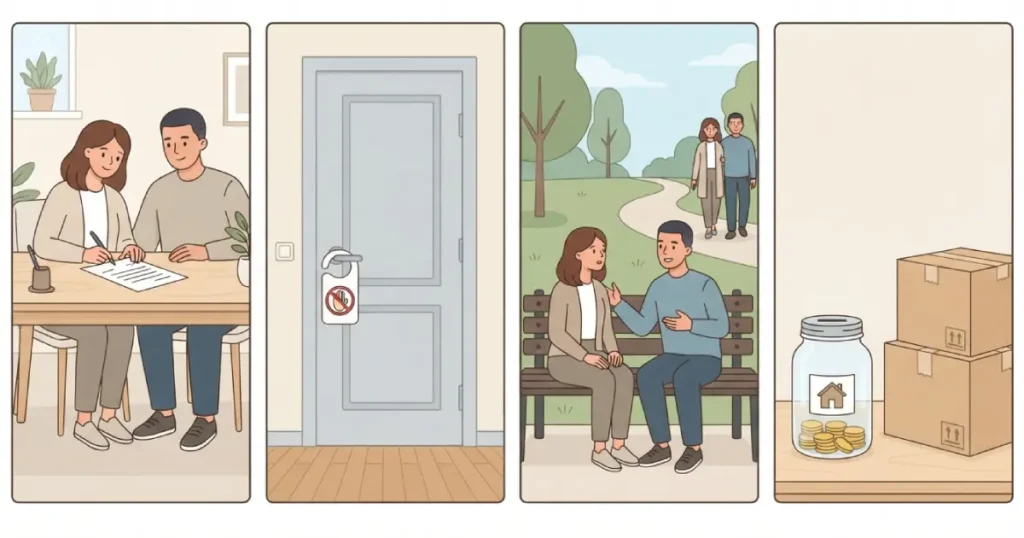
This is not a legal contract. It is a clarity document. Cover groceries, utilities, household chores, guest policies, private space, quiet hours, and conflict resolution. The ambiguity, not the in-laws themselves, causes most resentment. Write it down before anyone starts assuming.
Physical Space Separation: Creating Private Micro-Sanctuaries
The single best predictor of well-being in shared living is physical separation. Buyers now search for accessory dwelling units, dual primary suites, or basement apartments. Real estate data shows multigenerational home purchases make up roughly 14 to 17 percent of transactions.
If an ADU is not possible, create small autonomy zones. A mini fridge and coffee station. A separate bathroom if available. A white noise machine. A firm rule that closed doors mean do not knock unless it is an emergency. These may seem minor. They are not. They signal that adult privacy is real.
Protected Marital Time: The Weekly Spousal Check-In
Every week, leave the house. A walk, a coffee, a drive. Ask three questions. What felt hard this week? What boundary blurred? What do you need from me? This is not a complaint session. It is a marriage maintenance ritual.
The Parental Supremacy Rule
Grandparents yield final discipline, sleep, and schedule decisions to the parents. They can love, spoil, and support. They do not outrank you in front of your child. If this rule cannot be honored, the childcare savings are not worth the long-term cost to parental authority.
How to Know When It Is Time to Move Out

Milestone Triggers Beat Vague Dates
Open-ended arrangements create chronic stress. Give the stay a hard job. Move out when you hit a savings target, pay off a specific debt, or reach a career milestone. Vague timelines stretch. Concrete numbers force decisions.
Warning Signs That Living With Family After Marriage Is Damaging Your Relationship
Ask yourselves these five questions.
- Do you confide in a parent before your spouse?
- Do you avoid sex because someone is always home?
- Does your spouse side with parents in marital disagreements?
- Do you count days until you leave more than you enjoy the present?
- Has your partner’s adult initiative visibly dropped?
If you answer yes to two or more, the exit timeline needs to accelerate. Not someday. Now.
Left unexamined, this pattern does not just drain intimacy. It can quietly become the reason the marriage ends.
The Close
The original math question was whether you could afford to live alone. The deeper question is whether you can afford not to protect the marriage. Sharing a home with family can be a bridge to your future. But a bridge is meant to be crossed. It is not a permanent address.
Your marriage can grow under a large oak. It just needs its own patch of sunlight.
The house is only a roof. The marriage is the home.
My Closing Remarks
After years of watching couples make this choice, I have learned one unromantic truth: free rent is never free. You pay in privacy, autonomy, or small daily surrenders. A clear exit date and a partner who protects your union above parental approval can turn it into a smart financial chapter. If either condition is missing, no savings account will repair the marital erosion. Choose your marriage first. Every single time.
More Related Stories for You
- When home starts to feel like a chore chart, the right family activities can restore some lightness.
About The Author