
 David Wall
You don’t need to become someone new to heal. You need to learn how to carry your history without letting it drive.
Key Points
- Everyone carries emotional baggage. What separates people who thrive from people who stay stuck isn’t the amount of baggage they hold. It’s how they manage it.
- Unprocessed pain doesn’t just cause trust issues. It shows up in your sleep, your stomach, your jaw, and the exhausting habit of overworking just to avoid sitting still with yourself.
- Real healing happens in the body as much as the mind, and the steps below come from people who have actually done the work, not just talked about it.
Contents
Table of Contents
We have all walked into a new room carrying more than we admitted. A joke that landed too close to an old wound. A partner who went quiet for an hour and suddenly we were seventeen again, waiting for someone who never came home. The backpack was already on before the first date even started.
You have been told to let it go. You have journaled, vented, and promised yourself this time would be different. And yet the same flinch shows up. The same silence. The same urge to please, to flee, or to pick a fight over something small.
You cannot release emotional baggage by ignoring it or by talking about it forever. You unpack it by naming what you carry, feeling where it lives in your body, extracting the lesson, and then choosing new behavior. The past explains you. It does not get to steer you.
Someone might think they are “too much work” for a healthy partner. But what they don’t see is that the weight is not the history itself. It is the unprocessed part of the history still running the nervous system like a live wire.
Someone might think a new relationship will finally prove they are over it. But what they don’t see is that a new person cannot metabolize an old injury. They can only trip over it.
Someone might think using the right label, avoidant, anxious, traumatized, is the same as healing. But what they don’t see is how easily a diagnosis becomes a permission slip to stay exactly where they are.
Left unexamined, this pattern does not just strain closeness. It quietly becomes the reason closeness ends.
Understanding the Weight of Emotional Baggage
Emotional baggage is not a personality flaw. It is an accumulation of unprocessed psychological stress. That can include adverse childhood experiences, which researchers call ACEs, meaning painful or chaotic events in early life that the nervous system never fully filed away. It can also include a toxic relationship cycle you survived but never metabolized.
Think of it as a suitcase you packed in the dark. You keep carrying it because you are afraid of what you will find if you unzip it. A locked suitcase does not get lighter with time. It just gets more expensive to check.
When a painful memory is not integrated, the brain does not store it as a finished story. It stores it as an active alarm. That is why a late text can feel like abandonment, and why a raised voice can feel like danger even when you are objectively safe. Unresolved memories keep the nervous system in a state of hypervigilance, a constant low-grade scan for threat. Advanced treatments such as EMDR therapy exist because the brain sometimes needs help moving those memories from “happening now” into “this already happened.”
That is the mechanism underneath the mood. Not drama. Wiring that never got an off switch.
How Emotional Baggage Quietly Runs Your Relationships
Unhealed material does not stay in the past. It chooses your attachment style, which is the patterned way you reach for, or pull away from, closeness.
If early care felt inconsistent, you may land in an anxious-preoccupied pattern. You scan for distance. You need reassurance the way other people need air. If closeness once cost you your sense of self, you may land in an avoidant-dismissive pattern. You prize space. You feel crowded by need, including your own. HelpGuide’s guide on attachment and adult relationships lays out how these early templates replay in adult intimacy with almost embarrassing accuracy.
Researchers at Columbia University Psychiatry have described a clear resurgence of attachment science for a reason. People are hungry for a map of why they keep choosing the same fight in a different apartment.
Here is the part most conversations skip.
Having a style is information. Using the style as a shield is something else. A growing number of people now announce “I’m just avoidant” or “I have an anxious attachment” the way someone might announce a food allergy. The label becomes a demand that the partner adjust, soothe, and walk on eggshells. Therapy language is meant to increase accountability. Weaponized therapy speak does the opposite. It turns a wound into a permanent exemption from growth.
Your attachment pattern explains your reflex. It does not excuse the reflex once you can see it.
Physical Signs You Are Carrying Too Much Emotional Baggage
The body is not a metaphor here. It is the storage unit.
Chronic jaw clenching. A stomach that knots before hard conversations. Exhaustion that sleep does not fix. A sudden shift in how you rest, either racing nights or the urge to disappear under the covers. These are somatic markers, meaning the stress is living in tissue, not just in thought.
The behavioral signs are quieter and easier to praise. Extreme people-pleasing that looks like kindness. Toxic hyper-independence that looks like strength. Chronic overworking that looks like ambition. A victim identity that rejects every workable solution because staying wounded still feels safer than becoming responsible for the next chapter.
Most people in this situation do not realize they are not “bad at dating.” They are still living inside an unfinished story.
The Crowd-Sourced Guide to Unpacking Emotional Baggage
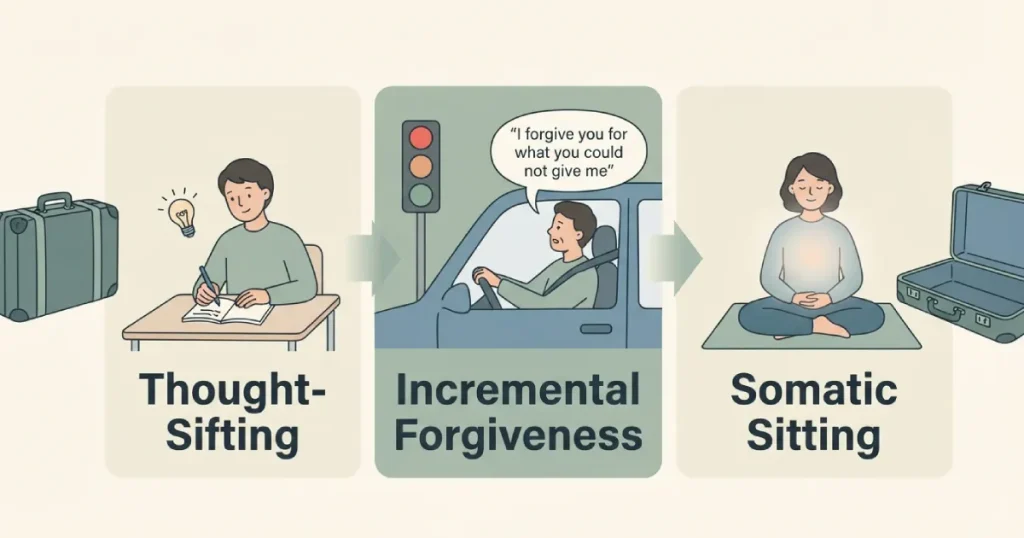
Talking about the bag is not the same as opening it. People on Reddit and Quora have been blunt about this. They knew more about their pain after years of conversation and still flinched at the same old cue. What follows is not a personality makeover. It is a sequence for moving mental weight from “live wire” to “historical data.”
1. Thought-Sifting Turns Old Hurt Into Usable Wisdom
The claim is simple. A memory stays heavy when it is only a feeling. It gets lighter when you force it to produce a lesson.
Write down one painful recurring scene. Not the whole childhood. One scene. Then strip the self-blame and the hero-victim plot. Sift until you can name a single objective takeaway. Maybe the wisdom is “I ignore early disrespect because I am afraid of being alone.” Maybe it is “I confuse intensity with love.” That sentence is the point. You are converting an emotional trigger into a boundary-based data point.
Maya, 34, did this after a decade-long partnership that began when she was barely an adult. She kept replaying the final year as proof she was unlovable. When she sifted the scene of her ex shutting down every hard talk, the usable line was not “I am too much.” It was “I stayed in rooms where my needs were treated as noise.” That one sentence changed who she answered in her inbox.
The so what is this. You stop asking the memory to justify your worth. You ask it to train your future standards.
2. Incremental Forgiveness Loosens the Grip of Resentment
Forgiveness, in this practice, is not a greeting card. It is a way of moving mental energy off a person who is still renting space in your nervous system.
The method that shows up again and again in real-world discussions is almost annoyingly small. You silently think, “I forgive you for what you could not give me.” You say it toward a parent, an ex, or an earlier version of yourself. You do not wait to mean it. You repeat it in small doses until the automatic heat in your chest has less fuel.
This is not spiritual theater. Resentment is a form of unfinished contact. Each time you rehearse the injury, you re-activate the same neural pathway. Incremental forgiveness is a pattern interrupt. It tells the brain the case file can close even if the other person never apologized.
You may not feel generous. You are not doing this for them. You are evicting a tenant who stopped paying rent years ago.
3. Somatic Sitting Lets the Body Finish What Talk Therapy Started
Here is the content gap people keep naming out loud. They understood their story. They still had the story in their shoulders.
Somatic work means tracking sensation rather than explaining it. Somatic therapy starts from the mind-body connection: the grief you can name in a session may still be sitting as a fist in your gut at 11 p.m.
The 20-minute screen-free drill is the practical version. Sit without a phone. When a wave of sadness, shame, or anger shows up, do not narrate it and do not outrun it. Locate it. Chest tightness. Throat close. Heat in the face. Let the sensation stay long enough to rise and fall on its own. You are teaching the nervous system that the feeling can complete without a crisis and without a distraction.
That is not weakness. That is wiring, finally getting a chance to stand down.
Rebuilding Intimacy Without Projecting Emotional Baggage

Unpacking is only half the work. The other half is refusing to hand the open suitcase to the person beside you and calling it closeness.
The Partner Versus Therapist Boundary
Healthy vulnerability sounds like this: “When plans change last minute, my body still reads it as rejection. I am working on that. What I need in the moment is a clear sentence, not a long analysis.”
Trauma dumping sounds like this: a two-hour monologue about every wound, followed by the unspoken contract that your partner must now regulate you, never trigger you, and become the proof that the past is over.
One is intimacy. The other is unpaid clinical labor.
Your partner can witness your history. They cannot metabolize it for you. When you use them as the only calming system you have, two things happen. They burn out. You never build the internal capacity that actual security requires. Earned security, the attachment term for safety you build in adulthood rather than inherit from childhood, comes from repeated moments of self-regulation plus trustworthy connection. It does not come from turning a boyfriend or girlfriend into a crisis hotline.
If you notice you only feel calm when they are available, that is useful data. It is also a signal to widen your support, not to tighten your grip.
When a Long Relationship Took Your Sense of Self With It
A distinct kind of emotional baggage shows up after a partnership that lasted a decade or more, especially one that started in youth. The bag feels larger than other people’s because the relationship was not only a romance. It was an identity.
If that is you, the work is not “getting over them” on a timeline that looks good on paper. The work is re-anchoring a self that was braided into someone else’s habits, friends, and weekends.
Start smaller than a reinvention. Reclaim one hour a week that belongs only to your taste. A class. A route you walk. A room you arrange without negotiation. Treat the post-breakup season as a clean page, not as proof of deficit. You are not behind your peers. You are building a foundation they may have had more years to assemble in public.
The question that helps is not “Who am I without them?” It is “What did I postpone while I was busy being us?”
When Words Stop Being Enough
If you can explain your pattern in perfect sentences and still freeze, consider a body-centered modality. EMDR uses guided eye movements or other bilateral stimulation to help the brain refile traumatic memory. Somatic Experiencing works by tracking activation and release in the body so the threat response can complete. The Trauma Therapist Institute’s comparison of EMDR and Somatic Experiencing is a clear place to start if you want the operational difference without the sales pitch.
Neither tool is magic. Both exist because insight alone sometimes stalls at the neck.
Maya Puts the Suitcase Down
Maya did not become a new person in a month. She thought-sifted the shutdown scene until she had a standard she could actually use. She whispered the forgiveness line at red lights, mostly toward the 24-year-old who stayed too long. She sat for twenty minutes on a Tuesday and let the grief live in her ribs until it bored itself out. When she started seeing someone new, she told him one true paragraph about her history and then asked about his weekend. She did not audition him for the role of healer.
The flinch still visited. It just stopped getting to drive.
What You Can Practice in the Next 24 Hours
One place to start is the One Scene Inventory. Tonight, write a single memory that still hijacks you. Under it, write one sentence that begins with “The lesson I am keeping is…” If the sentence blames your character, rewrite it until it names a boundary or a skill.
Consider the Red Light Forgiveness Line. The next time you are waiting, in a car or a queue, repeat “I forgive you for what you could not give me” three times. Notice whether the heat in your body drops even a little. That drop is the point.
A useful question to ask yourself after a hard moment with a partner is the Caretaker Check: “Did I share this so we could be closer, or so they would fix a feeling I have not been willing to sit with?” Honest answers here protect the relationship you actually want.
If the body is louder than the mind, try one 20-minute sit before you book anything expensive. If the wave is bigger than you can safely hold, that is information to take to a licensed clinician, not a reason to shame yourself.
The locked suitcase only stays locked if you keep walking past it. You now have a zipper.
You walked into this page carrying more than you wanted to admit. You can walk out knowing the weight was never proof that you are unlovable. It was proof that something in you is still waiting to be processed, then set down.
Your past can explain the flinch.
It does not get to choose the next room you stay in.
My Closing Remarks
I have sat with people who could map every wound with stunning precision and still could not sleep next to someone they loved. Knowing the story is not the same as finishing it. If you are tired, that fatigue makes sense. You have been driving with a bag in the back seat that rattles at every turn. You do not need a brand-new personality. You need a few honest hours with what you have been lugging, and then one cleaner choice in the next hard moment. That is available to you. Even this week. Especially this week.
More Related Stories for You
- Once the old weight is lighter, you start reading a partner more clearly, including the quiet signs someone is ready to build a future with you.
About The Author