
 David Wall
You can love someone fiercely and still lose the relationship if you keep treating mood episodes like weather you simply wait out.
Key Points
- Bipolar disorder and relationships do not collapse from a lack of love. They collapse when one person becomes the unofficial clinician and the other becomes the patient.
- Mood episodes rewrite intimacy, trust, and daily rhythm. Partners who learn a shared operating system recover faster than partners who only try harder.
- Stability is not a personality trait. It is a set of practiced skills you can build together.
You cannot out-love a mood episode. We tell ourselves that patience, loyalty, and a bigger heart will be enough. Then the spending starts, or the silence arrives, or the person you know best looks at you as if you are the problem. You stay. You soothe. You search for the right words at 2 a.m. And still the same cycle returns, only heavier.
Someone might think a partner who withdraws during depression is choosing distance. But what they don’t see is anhedonia, the loss of the brain’s ability to feel pleasure, making even a kind conversation feel like a climb.
Someone might think a sudden surge of desire, late-night plans, or risky texts means the relationship is finally exciting again. But what they don’t see is hypomania, a milder high that can look like charm and confidence while judgment quietly leaves the room.
Someone might think reminding them about pills, sleep, and appointments is simply being a good partner. But what they don’t see is how easily care turns into surveillance, and how surveillance turns love into a job.
Here is the short answer most partners never hear. Bipolar disorder and relationships survive when you stop managing a person and start co-building a rhythm. Love remains the reason. Skill becomes the method.
That shift is the whole map.
How Mood Episodes Quietly Rewrite Bipolar Disorder and Relationships
Bipolar disorder is a mood disorder marked by episodes of mania or hypomania and depression. According to the National Institute of Mental Health, these episodes change energy, sleep, judgment, speech, and the drive for reward. That is not a personality swing. It is a change in the brain’s regulation system.
In a relationship, that change does not stay inside one body. It rearranges the space between you.
Think of a mood episode as weather that moves inside the house. You do not need a better umbrella. You need a better floor plan.
During mania or hypomania, speech speeds up. Sleep shrinks. Ideas multiply. Irritability can arrive dressed as certainty. Hypersexuality, a sharp rise in sexual drive or risky sexual behavior, can appear as hunger, restlessness, or a sudden need to feel wanted. During depression, the opposite happens. Conversation thins. Touch feels costly. The future looks sealed shut.
Both states alter what psychologists call relational reciprocity, the easy back-and-forth that makes a couple feel like a we. When reciprocity breaks, you start doing the emotional work of two people. That is when resentment grows in the dark.
Most people in this situation don’t realize that the relationship is being rewritten in real time. You are not imagining the change. You are living inside it.
The Reality of Intimacy During Highs and Lows
Intimacy is often the first room the weather enters and the last room couples know how to talk about.
In a high, your partner may want sex more often, more intensely, or with less regard for your pace. That can feel flattering for a night and frightening by the weekend. In a low, the same person may go quiet, turn away, or treat closeness as one more demand they cannot meet.
Neither version is a verdict on your attractiveness. Both are symptoms traveling through attachment.
The useful move is not to moralize desire and not to disappear from it. Name the pattern without naming a villain. “I want us close, and I also need us safe” is a sentence that keeps dignity on both sides. If hypersexuality includes risk, secrecy, or pressure, that is no longer a private preference. It is a clinical signal that belongs in the treatment conversation.
Open talk here is not dirty. It is protective.
Communication Under Pressure in Bipolar Relationships
When a mood rises, feedback can sound like an attack. When a mood drops, even a soft question can sound like a burden. That is why ordinary couple advice fails so fast. “Just communicate” assumes both nervous systems are online.
They are not.
Left unexamined, this pattern doesn’t just strain bipolar disorder and relationships. It can quietly become the reason they end. Not because anyone stopped caring. Because every hard talk happens at the worst possible voltage.
The goal is not perfect calm. The goal is a lower-voltage channel you can both find again.
Communication Skills That Protect Bipolar Disorder and Relationships
Empathy is a feeling. Communication is a practice. In bipolar disorder and relationships, practice is what keeps empathy from burning out.
Cognitive behavioral therapy, often called CBT, is a structured form of talk therapy that helps people catch unhelpful thoughts and test them against reality. The American Psychological Association notes that psychosocial treatments like CBT sit alongside medication as a core part of care. You do not need to become a therapist to borrow one of its simplest tools: separate the story from the data.
Data: He slept three hours and spent $800.
Story: He does not care about our future.
The story may be understandable. It is still not the same thing as the data. When you lead with data, you reduce shame. When you reduce shame, you increase the chance of a real conversation.
Family-focused therapy, or FFT, takes this further. It is a structured family treatment built on three parts: education about the illness, communication training, and joint problem-solving. Research led by David Miklowitz has shown that adding FFT to medication can lower relapse risk and shorten depressive episodes. You can feel that finding in the clinical literature. The point for you is practical. You are not supposed to invent a family system from scratch. A method already exists.
Scripts That Lower the Temperature
Try this sequence the next time worry starts climbing.
First, describe one observable fact. “You have been awake past 3 a.m. three nights this week.”
Second, name your feeling without a verdict. “I feel scared, not angry.”
Third, make one request that is small enough to succeed. “Can we set a lights-out time tonight and check in at breakfast?”
That is not niceness. That is de-escalation.
FFT also warns against emotional overinvolvement, the loving but intense style of hovering, correcting, and forecasting disaster. It feels like protection. To a person already flooded, it can feel like a spotlight. Calm, specific, and brief beats passionate and global.
That’s not coldness. That’s voltage control.
Problem-Solving as a Team, Not a Courtroom

A four-step loop keeps you out of the courtroom.
Define one problem in a single sentence.
List possible solutions without judging them yet.
Choose one option you can try for seven days.
Review what worked, then adjust.
Elena, 34, used to wait until Marcus crashed to “have the real talk.” By then she had a month of evidence and he had a month of shame. In our work they built a Sunday twenty-minute meeting with the same four steps. No character analysis. No greatest-hits list of old injuries. One problem. One experiment. One review. The illness did not vanish. The house stopped being a crime scene.
Treatment Partnership and Daily Routines in Bipolar Relationships
Medication is often the load-bearing wall. It is also the place where couples get stuck in a grim role play: one person monitors, the other resists.
Up to about 60 percent of people with bipolar disorder stop medication at some point. The reasons are rarely laziness. Side effects can flatten sexuality, thicken thinking, or change weight. Cost can quietly decide the week. Stigma can make a pill bottle feel like a verdict. Anosognosia, a reduced ability to recognize that one is ill, can make the whole subject feel invented by other people.
If you become the enforcer, you may win a dose and lose the bond.
A better frame is shared problem-solving. Ask what the medication is costing them, not only what skipping it will cost you. Bring that information to the prescriber as a team. Sometimes the answer is a different dose, a different drug, or a slower change rather than a lecture.
Clinicians who write for partners often stress early warning signs because the first two days of a shift are more workable than the fourteenth. Practical guidance on spotting those early changes is the kind of plain clinical teaching that belongs in a couple’s playbook, not only in a waiting room.
Building a Shared Routine as Your Daily Shield
Interpersonal and social rhythm therapy, known as IPSRT, is a treatment that stabilizes mood by stabilizing daily timing: sleep, meals, work, and social contact. The science underneath is circadian, meaning it involves the body’s 24-hour clock. When that clock slips, mood often slips with it.
Ellen Frank’s research on IPSRT showed that more regular social rhythms can reduce mood symptoms. That is why a bedtime is not a lifestyle tip here. It is a relapse-prevention tool.
You do not need a military schedule. You need five anchors that stay roughly in place even when life bends: wake time, first meal, movement, wind-down, and lights out. Track them together for two weeks. Look for drift before you look for drama.
A shared calendar is not romance. On some weeks, it is how romance survives.
Repair After an Episode: Rebuilding Trust in Bipolar Relationships

After the high or the crash, many partners want two things at once: an apology and a guarantee. The first is possible. The second is not.
Remorse is a feeling. Accountability is a pattern. Remorse says “I hate that I hurt you.” Accountability says “Here is what I will do differently, and here is how you will be able to see it.”
Repair works best when it is specific. Name the harm. Name the plan. Name the check-in date. If money was spent, look at the statements together. If trust was broken through secrecy or sexual risk, rebuild with transparency that is agreed in advance, not extracted in an argument. Couples therapy can hold that process so you are not both acting as judge.
Then, during stable stretches, put the illness down long enough to remember you are still a couple. A weekly ritual that has nothing to do with symptoms matters more than a grand reset. A walk. A shared meal with phones away. One question that is not about mood: “What felt good between us this week?”
Connection is easier to keep than to resurrect. Keep it on the calendar before you need it.
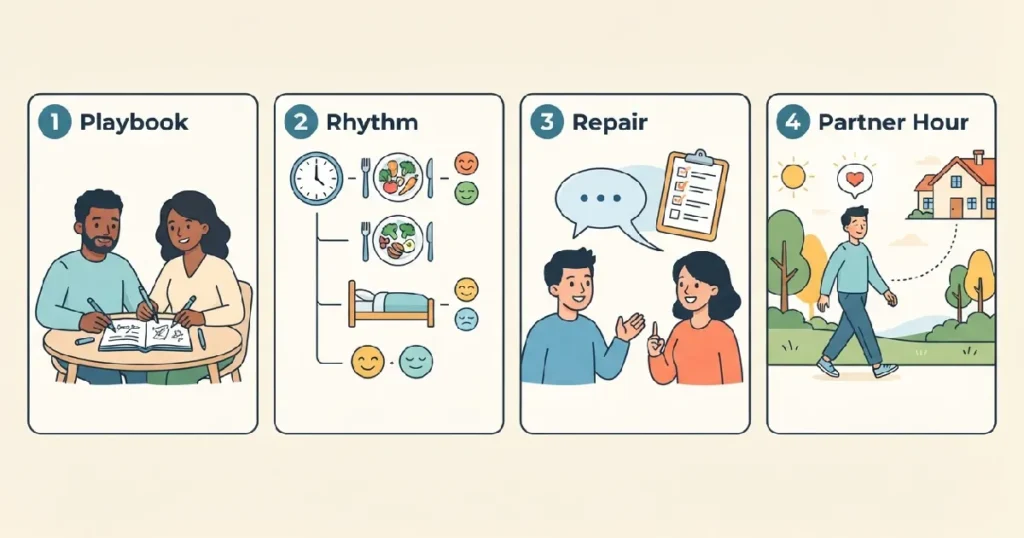
Four Practices That Turn Care Into Partnership
One place to start is the Illness Playbook. Sit down when both of you are stable and write a living document: early warning signs, helpful language, unhelpful language, who to call, and what each of you will do in the first 48 hours of a shift. Keep it short enough to use under stress.
Consider the Rhythm Check. Each night, mark sleep, meals, medication, and one mood word. Use a paper log or a mood-tracking app. The point is not surveillance. The point is a shared picture that can travel into a clinical appointment without a fight about whose memory is right.
A useful question to ask yourself is whether you are offering a Repair Conversation or a replay. A repair conversation has a time limit, one harm, one request, and one next step. A replay has a soundtrack of every old wound.
The next time exhaustion arrives, try the Partner Hour. One protected hour a week that belongs to your life, not the illness. A walk, a friend, a class, a closed door. Caregiver burden is the wear that builds when you carry another person’s illness without enough rest or recognition. Groups and education through the Depression and Bipolar Support Alliance exist because this load is common, not because you failed.
None of these practices make you a nurse. They keep you a partner.
You now have a floor plan.
The late-night version of you, the one scanning for signs and rehearsing speeches, does not have to live on alert forever. Mood episodes may still enter the house. They do not have to own the deed. Love got you this far. Skill is how you stay.
Stability is something you build with both hands.
My Closing Remarks
I have sat with partners who could recite every symptom and still could not ask for a single need of their own. That silence looks loyal. It is often the beginning of goodbye. If this is your life, stop auditioning for the role of perfect caregiver. Become a co-author of the next calm week. Ask for help before you disappear inside the job of loving someone. You are allowed to want a relationship, not a posting.
More Related Stories for You
- When the dust settles after a hard episode, many partners want to reassure him without pretending the hurt never happened. Reassurance works best when it sits next to a real plan.
About The Author