
 David Wall
Your love is not failing. Your shared nervous system is overloaded.
Key Points
- Mental health in relationships is no longer a private project you finish alone and then bring back to the person you love.
- Emotional wellness now decides whether a couple can stay kind under pressure, not just whether they can stay together.
- When you treat stress as a team condition instead of a personal defect, connection becomes possible again.
Contents
Table of Contents
We used to treat mental health as something you handled in private and then returned to the relationship like a repaired appliance. That model is breaking. You can feel it when you sit beside someone you chose on purpose and still cannot find the energy to be warm. The tension is not that you stopped caring. It is that the pressure outside your home has started living inside your body.
Mental health in relationships matters more now because stress no longer stays in one person’s head. Economic worry, digital fatigue, and leftover isolation have turned emotional wellness into a shared condition. When one partner’s mind is overloaded, the bond itself starts to fray.
Someone might think their partner has become cold. But what they don’t see is a person whose nervous system never fully powers down after work, news, bills, and a phone that never stops asking for attention.
Someone might think the money fights are about the budget. But what they don’t see is two people whose bodies are already flooded with cortisol, the stress hormone that makes patience expensive and small comments feel like attacks.
Someone might think the phones are just a bad habit. But what they don’t see is a couple using screens as a quiet exit from a closeness they no longer have the capacity to hold.
This is not a failure of love. It is a failure of leftover energy. And that distinction changes everything.
Mental Health in Relationships Is No Longer a Private Matter
Your partnership has a shared thermostat. When one person’s anxiety spikes, the temperature in the whole house rises. You cannot cool only your half of the room.
That is the mechanism most couples miss. Mental health in relationships is not two separate weather systems. It is one climate. Researchers who study couples have shown that financial strain does not stay inside the person who earns less or worries more. It moves across the pair. One partner’s distress raises the other partner’s distress. The American Psychological Association has long connected money pressure with relationship strain, and that link has only grown tighter as costs stay high and certainty stays low.
In my practice, I have sat with couples who still loved each other and still could not access that love after 6 p.m. They were not out of affection. They were out of regulation.
Regulation is a clinical word for a simple thing: the ability to stay steady enough to be decent. When your system is flooded, you do not become a worse person. You become a narrower one. You hear criticism where there was a request. You protect yourself where you used to reach.
Most people in this situation don’t realize they are fighting a physiological problem with a conversational tool. That mismatch is why “just talk more” so often fails.
Left unexamined, this pattern does not just make evenings tense. It can quietly become the reason a good relationship ends.
How Relationship Stress Changes the Way You Hear Each Other
When you are depleted, you do not listen for meaning. You listen for threat.
That is why a question like “Did you pay the electric bill?” can land like “You cannot be trusted.” The content is practical. The body hears danger. This is especially true when economic anxiety is already running in the background. Global prices, job uncertainty, and the feeling that one surprise expense could undo months of careful living keep the threat system on a low simmer.
The Family Stress Model, a well-established framework in couple research, predicts exactly this chain. Financial pressure raises emotional distress. Distress lowers warmth. Lower warmth raises conflict. Conflict then makes the original money problem harder to solve.
So the argument is not really about the bill.
It is about whether you still feel like a team inside a world that feels less stable.
Maya and Jordan had been together for eleven years. They did not fight about loyalty or attraction. They fought about groceries, bedtime, and who forgot to answer the landlord. Maya would come home already braced. Jordan would open his laptop “for five minutes” and disappear. By 9 p.m. they were polite roommates with a shared lease and a thinning sense of us. What looked like a communication problem was actually two overloaded systems trying to negotiate from empty. Once they stopped asking “Who is being difficult?” and started asking “Who is already maxed out?”, the tone of the house changed before the chore chart did.
That is the reframe. The problem is not that you married the wrong person. The problem is that you are both trying to love from a nervous system that never gets to stand down.
Why Emotional Intimacy Collapses When Your Attention Never Comes Home
There is a quieter leak in mental health in relationships, and it lives in your pocket.
A 2013 study by Przybylski and Weinstein found that the mere presence of a phone during a conversation reduced feelings of closeness and empathy, even when nobody touched the device. You do not have to scroll to create distance. You only have to keep an exit visible.
This is how intimacy erodes now. Not through one dramatic betrayal. Through a thousand tiny absences. You are physically on the couch and mentally in a feed, a thread, a headline, a work chat. Your partner is doing the same. You call it relaxing. Your attachment system calls it abandonment with Wi-Fi.
Digital burnout is not just tired eyes. It is a brain that never completes a stress-recovery cycle. Screens keep the mind in a state of partial alert. Partial alert is a terrible place from which to offer tenderness.
Texting through conflict makes this worse. Written messages strip out tone, pace, and repair. You send a sentence. Your partner receives a verdict. The fight lasts longer and resolves less. Voice would have given you warmth. A screen gives you evidence.
This is more common than you think. Plenty of devoted couples are not falling out of love. They are falling out of attention.
And attention is the raw material of emotional intimacy.
The Mental Load That Quietly Taxes Partner Mental Health

Not every drain is digital or financial. Some of it is invisible labor.
The mental load is the unpaid project management of a household: remembering the forms, the birthdays, the empty toothpaste, the pediatrician, the fact that the car inspection is due. Research on household labor keeps finding the same sting. It is not only who does more. It is who feels unseen.
Perception of unfairness harms satisfaction more than the raw count of chores. When one of you becomes the household’s operating system and the other becomes a helpful intern, resentment is not a personality problem. It is a logical response to an unbalanced cognitive tax.
That tax shows up as irritability, shutdown, and the famous “I have to ask you to notice” exhaustion. By the time the argument starts, the tired partner is no longer talking about dishes. They are talking about dignity.
You cannot solve that with a nicer tone. You solve it by making the invisible work visible, then sharing the remembering, not just the doing.
John Gottman’s work on lasting couples points in the same direction. Partners who stay connected turn toward small bids for attention most of the time. A bid can be a sigh, a joke, a “look at this,” a request for help with the calendar. When mental load and digital fog are high, those bids get missed. Missed bids accumulate into loneliness.
The loneliness then looks like a mystery. It is not. It is a pile of unanswered reaching.
What Changes When You Treat Mental Health in Relationships as Team Care
Here is the turn.
If the relationship is a shared climate, then one person’s therapy, one person’s walk, one person’s “I just need a minute” is necessary but not sufficient. Individual care still matters. The World Health Organization describes mental health as more than the absence of illness. It is the capacity to cope, contribute, and relate. In a couple, that capacity is co-owned.
That does not mean you are responsible for curing your partner. It means you stop pretending their depletion has no weather effect on you.
When you adopt this frame, several things shift at once. Money talks become anxiety management plus planning, not a trial. Phone habits become a boundary you design together, not a character indictment. Chores become a fairness conversation, not a moral scorecard. Conflict gets a pause button because you finally admit that a flooded brain cannot do intimacy on demand.
That’s not weakness. That’s wiring.
The National Institute of Mental Health is clear that daily habits, support, and early attention protect mental health. In a partnership, those daily habits are often the relationship itself: sleep, fairness, undistracted time, and the feeling that you are not carrying the house alone.
You do not need a perfect life to protect love. You need a shared plan for the life you actually have.
Four Ways to Protect Mental Health in Relationships This Week

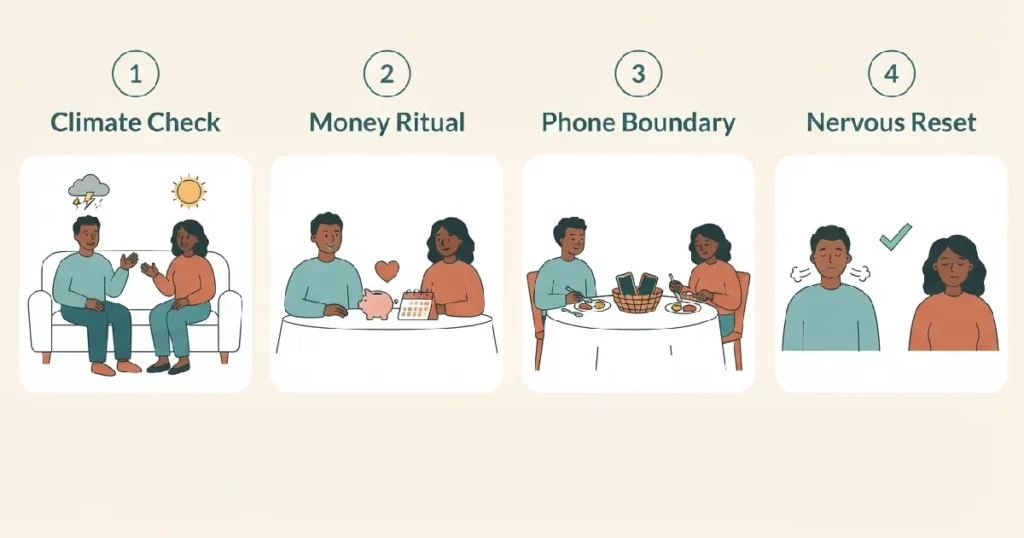
One place to start is the Shared Climate Check. Once a day, each of you names your internal weather in one sentence. “I am at a 7 and brittle.” “I am at a 3 and lonely.” No fixing. No debate. You are reading the thermostat before you try to cook dinner on it. Maya started saying “I am already spent” before she walked into the kitchen. Jordan stopped taking her silence as rejection. The evening got shorter and kinder.
Consider the Financial Resilience Ritual. Put 30 minutes on the calendar once a month. The first five minutes are not numbers. They are fear. Each of you says one money worry out loud and the other only reflects it back: “You are scared the next car repair will wipe the buffer.” Then you look at the actual accounts. Planning after validation works better than planning on top of panic, because the body has to stand down before the brain can budget.
A useful next move is the Attention Boundary. Choose one zone that stays device-free. The table. The last 20 minutes before sleep. The first coffee. Ask for it in the language of desire, not prosecution: “I want your face for twenty minutes” lands differently than “You are always on that phone.” You are not confiscating a toy. You are reclaiming the only resource intimacy cannot fake, which is undivided presence.
The next time a hard talk is about to start and you can feel your chest tighten, try the Neurological Reset. Agree in advance that either of you can call a 15-minute pause. During the pause, you do not rehearse your closing argument. You breathe slowly, wash your hands with cold water, or step outside. Then you return with one appreciative sentence before the complaint. Shared warmth lowers arousal. Lower arousal makes fairness possible again.
A question worth sitting with: Are you asking your relationship to produce comfort it has not been given the conditions to produce?
You Already Have More Power Than the Exhaustion Suggests
Go back to that couch. The one where you sit next to the person you love and still feel alone. That scene does not mean the love is gone. It means the climate got too hot for tenderness to grow.
You now have a different map. The fights about money, phones, and chores are not proof that you chose poorly. They are signals from a shared nervous system asking for relief, fairness, and attention. That knowledge is not decorative. It is leverage. You can check the climate. You can put the phone in another room. You can tell the truth about being spent before you become cruel.
The strongest couples are not the ones who never break down. They are the ones who refuse to break down alone.
My Closing Remarks:
I am tired of watching good people diagnose themselves as unlovable when they are simply overdrawn. If your patience vanished, it may not be because the marriage died. It may be because nothing in your week restored you. That is a hard sentence and I mean it. Stop performing closeness on an empty battery and then calling the emptiness a mystery. Tell the truth about your capacity. Ask for a smaller, realer form of together. Then keep it.
More Related Stories for You
- If the distance in your partnership has started to feel like a lack of emotional reassurance, that thread is worth following next.
About The Author