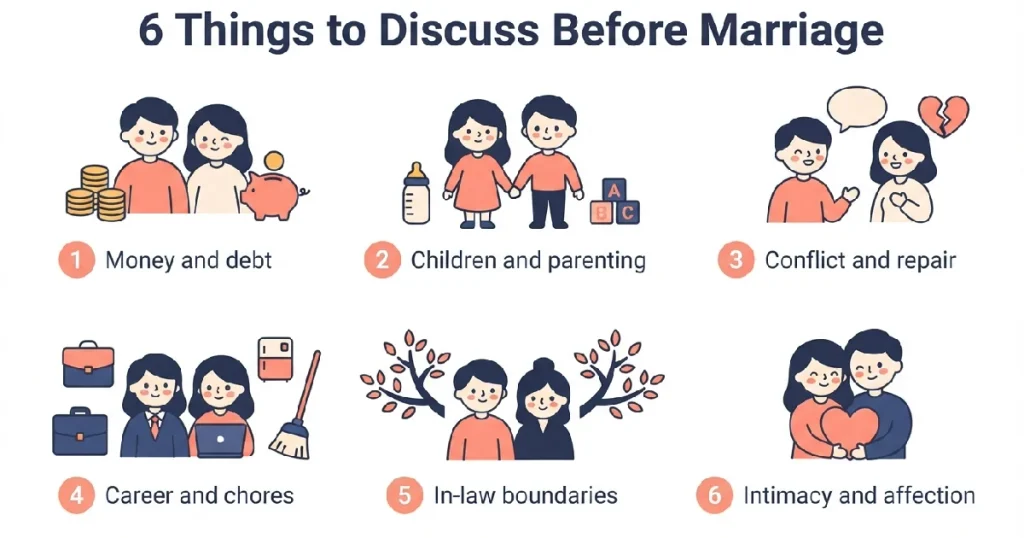
Most premarital advice is a lie. Not a malicious one, but a lazy one. It hands you a tidy checklist of things to discuss before marriage, things like finances, kids, and where to spend the holidays, and then pats you on the head, sending you off feeling accomplished. You nod along because the list feels familiar.
But here is the uncomfortable truth: those conversations are the bare minimum. The real danger isn’t the topics you know you should cover; it’s the silent, invisible assumptions you’ve both been carrying your entire lives and don’t even realize you’ve never said out loud.
You’ve discussed your five-year plan, but have you discussed the unspoken rule about whose career takes a backseat when life gets messy? You’ve talked about having children, but have you talked about the deep, inherited belief that a “good mother” does all the emotional heavy lifting? If a quiet unease is still sitting in your chest after all your talks, you’re not imagining it. That feeling is your internal compass telling you that talking about the big, obvious topics is not the same as preparing for the life you’re about to build together.
Quick Insight: The most important things to discuss before marriage go far beyond money and children. Hidden fracture points include silent relational contracts, emotional labor imbalances, attachment styles in conflict, mental health histories, digital boundaries, and individual identity. These topics are rarely addressed until they become sources of irreversible resentment, leaving couples blindsided by problems they never saw coming.
What “Things to Discuss Before Marriage” Actually Means
Most people treat premarital conversations like a final exam you cram for and then forget. You spend a few evenings going through a list of “questions to ask before getting married,” and when you’ve answered them all, you breathe a sigh of relief, convinced you’ve done the work. This approach is a trap. Real preparation is not a checklist you complete. It’s an ongoing relational excavation, a process of unearthing the unconscious rules and inherited beliefs you each bring to the partnership without even knowing it.
Table of Contents
Family therapists call these hidden rules silent relational contracts. They are the unspoken agreements you have with yourself about how a marriage “should” function, who “should” do what, and what “should” happen next. One partner may have grown up in a home where anger was never expressed, silently learning that love equals peace at all costs. The other may have grown up where loud, passionate arguments were a Tuesday night ritual and a sign of engagement, not disrespect. Neither person has ever verbalized this. They just assume their version of reality is the default. And when these silent contracts collide, it doesn’t feel like a simple miscommunication. It feels like a devastating personal betrayal, a sign that your partner is wrong or, worse, doesn’t love you enough. The work is not just asking questions. The work is uncovering why you are asking some questions and avoiding others.
When do these traditional tips fail?
Search for this topic online, and you will find the same safe, predictable list repeated across dozens of websites. It’s frustrating. The standard advice tells you what to discuss but never teaches you how to survive the emotional aftermath when a conversation uncovers a deep incompatibility.
It presents a clinical, detached view, as if discussing childhood trauma is as simple as negotiating who takes out the trash. This is the failure. It ignores the fact that these conversations are terrifying not because the topics are complex, but because they risk revealing that you and the person you love might be fundamentally misaligned on something that matters.
The mental load of who remembers the social calendar, the grief of who gives up a career dream, the shame attached to financial debt, and the fear of disclosing a mental health struggle. Without guidance on how to handle the emotional fallout, that standard advice leaves you more prepared to plan a wedding than a marriage.
12 Hidden Topics That Fracture Marriages

This is not a checklist for a reason. Do not print it out and interrogate your partner over dinner. Read through these topics slowly and let yourself sit with the ones that make your stomach tighten. That feeling? That’s where the real work begins.
1. The Silent Contracts You Inherited
You didn’t just grow up. You absorbed an entire instruction manual for marriage by watching the adults around you. You learned who cooks, who manages the money, who initiates intimacy, how much time alone is acceptable, and how anger gets expressed. The trouble is, your partner absorbed a totally different manual.
- Common Mistake: Assuming your “normal” is universal. Believing that if your partner loved you, they would just know what you need.
- How to Avoid It: Go first. Be the one to say, “I realize I’ve been carrying around this idea that a good wife always has dinner on the table. I realize I got that from my dad, and I actually don’t believe it. What invisible rules did you inherit that you might be bringing into our marriage?” This isn’t a debate. It’s an excavation.
2. The Shame Story Behind Your Money
Talking about how much debt you have is just the surface, and a frankly boring one at that. The conversation that will actually save your marriage is about your emotional relationship with money. What does money mean to you? Is it security? Freedom? Power? Proof of your worth? Does spending feel like a reward for surviving a hard week, or does it trigger a panic attack that you’ll end up destitute? One of you might have grown up with financial chaos and has a scarcity mindset, while the other sees money as a tool for immediate enjoyment.
- Common Mistake: Reducing the money talk to a spreadsheet of assets and liabilities. Treating it like a business merger.
- How to Avoid It: Start with vulnerability, not numbers. You can say, “I want to talk about money, but not the numbers first. I want to tell you about the money stories I grew up with, the ones that still make me anxious, even if they don’t make sense. Will you tell me yours?” This reframes the entire conversation from a stressful audit to a critical act of intimacy.
3. The Old Ghosts in Your Family of Origin
You aren’t just marrying a person. You’re marrying their entire family system, and they are marrying yours. The patterns you learned as a child, the ways of handling conflict, the habits of expressing love or withholding it, will show up in your marriage. It is a near-certainty. A person who grew up with a rageful parent may interpret any raised voice as a catastrophic threat, while their partner, who grew up in a conflict-avoidant home, may see even a calm, direct request as an attack.
- Common Mistake: The silent belief that “our love is different” and will magically protect you from repeating the painful patterns you witnessed growing up.
- How to Avoid It: Directly name them. Ask each other, “What is the specific dysfunctional pattern from your family that you are most terrified of recreating in our marriage?” Be brave and specific. You need to know the ghosts you are up against so you can spot them when they arrive.
4. The Unseen Work of Emotional Labor
Emotional labor is the invisible, unpaid, and often unrecognized mental load of managing a life and a relationship. It’s noticing the fridge is empty, remembering your mother-in-law’s birthday, sensing the tension in the room and feeling responsible for fixing it, tracking the kids’ school forms and doctor’s appointments, and initiating the difficult “how are we really doing?” conversations. This load silently and disproportionately falls on women in most relationships, and it is a primary, hidden driver of divorce, a slow-burn resentment that can go unaddressed for years.
- Common Mistake: The partner doing less simply not seeing the work. They can’t see it because it’s a mental list, not a physical chore. So they never say thank you, and the resentment grows.
- How to Avoid It: Make the invisible visible. Each of you take a piece of paper and write down every single thing you do to keep your joint life running for a week, from scheduling the HVAC repair to planning the weekend. Then, swap lists. More advice? Agree to swap a task entirely. If one of you always manages the social calendar, hand it over completely. The point is not just to “help more.” The point is to redistribute the cognitive load so one person’s mind is not the sole hard drive of the marriage.
5. Your Digital Boundary Blueprint
What counts as cheating in a world of DMs, disappearing photos, and infinite scrolling? A marriage can slowly bleed out from a thousand tiny digital paper cuts. Emotional affairs can thrive entirely in a direct message conversation. Professional flattery from a coworker online can feel like a lifeline. And simply being glued to a screen while your partner sits next to you, feeling invisible, builds a wall brick by silent brick.
- Common Mistake: Assuming you both share the exact same definition of “emotional infidelity” online. You almost certainly do not.
- How to Avoid It: Get excruciatingly specific. Instead of asking “Are you okay with my phone habits?”, ask, “How would you feel if I had a private, deep, late-night text thread with an attractive coworker about our personal lives? Is that friendship or an emotional affair? Where exactly is the line for you?” Define what phone- and screen-free time looks like in your daily rhythm.
6. The Architecture of Long-Term Intimacy
Most couples rely on the explosive chemistry of early love as a permanent predictor of future intimacy. This is a risky gamble. Desire is not a fixed trait. It will be hammered by grief, stress, childbirth, health issues, medication, and sheer exhaustion. The couples who thrive are not the ones who always desire each other with equal intensity. They are the ones who have a clear, compassionate plan for what to do when their desires are miles apart, and they can talk about that gap without shaming each other.
- Common Mistake: Treating this as a one-time compatibility check. “Yep, our drives match now. Checked that off.” Life will laugh at this assumption.
- How to Avoid It: Shift the conversation from “how often” to “how do we handle it when we want different things?” Try saying, “I know our desire for each other will change over the years. When you feel rejected or I feel pressured, what will be our code word or signal to pause, reconnect emotionally first, and talk about it without blame?”
7. Your Fight Styles and a Repair Plan
How you fight is infinitely more important than what you fight about. Researcher John Gottman’s work identified four communication styles that are so destructive, he called them the Four Horsemen of the Apocalypse: Criticism, Contempt, Defensiveness, and Stonewalling. Being able to spot these in yourself is not a fancy skill. It is emergency surgery for your future conflicts.
- Common Mistake: Believing that good love means never fighting dirty. It means you will fight dirty and need a plan to clean it up.
- How to Avoid It: Map your conflict styles. Ask each other, “When you feel hurt or attacked, what is your immediate survival instinct? Do you shut down and need space? Do you escalate and need to talk it out right now, even if it’s 2 a.m.? What does a ‘time-out’ look like for us?” You must create a non-negotiable repair attempt, a silly word or a specific gesture that means, “I love you, we’re on the same team, take a breath.”
8. The “Who Am I Allowed to Be?” Dilemma
Marriage can feel like a powerful gravitational pull toward a single, fused identity: “The Couple.” But the complete loss of individual self, a person’s own friends, dreams, and private hobbies, is a slow-motion suffocation that often leads to a midlife explosion. One partner might suddenly feel that they gave up who they were to become half of a “we,” and they will blame the marriage for it.
- Common Mistake: Assuming you must do everything together to prove your love, and slowly letting your solo friendships and private passions wither from neglect.
- How to Avoid It: Explicitly protect your individuality in your weekly schedule. Ask, “What fills your soul that doesn’t involve me, and how can I protect that for you? What solo time and space do you need each week to feel like yourself?” You have to give each other permission to exist apart, not as a sign of weakness in the marriage, but as a sign of its strength.
9. The Full, Uncensored Dream

You shared your five-year career plan. Good. Now, share the dream that feels completely insane to say out loud. The one about moving to a remote cabin to write a novel, starting a business that might fail, or taking a year off to sail with the kids. These dreams that feel too wild to speak are exactly the ones that will turn into a silent, festering grief years later if the marriage has no room for them.
- Common Mistake: Silencing a deeply held personal ambition to keep the peace, believing you’re choosing the relationship over your own selfish desire.
- How to Avoid It: Schedule a “dream dump” date. The only rule is full, uncensored honesty and zero judgment. Take turns finishing this sentence: “A life dream I’m almost too afraid to say out loud is…” Don’t solve it. Don’t budget it. Just listen. Just see your partner fully.
10. The Wound You’re Still Healing
Disclosing a history of depression, anxiety, an eating disorder, trauma, or a medication you take can feel like a terrible professional risk in your relationship. Shame tells you this part of you is a liability. You fear your partner will see you as broken, too much, or a risk. The danger is not the condition itself. The danger is hiding it, leaving your partner unprepared and disconnected when a difficult season hits.
- Common Mistake: Waiting for a crisis, a panic attack or a depressive episode, to reveal this part of your story for the first time.
- How to Avoid It: Frame it as a gift of trust, not a confession of a crime. You can say, “I need to share something about my health history because I want you to fully know me. This is what a hard season looks like for me, and this is exactly how you can best support me if it happens. What questions do you have?”
11. The Clash of Childhood Programming
You learn how to attach to people in your earliest years, and that deep programming follows you. An anxiously attached partner will process emotional distance as a terrifying threat and will chase. An avoidantly attached partner will process too much closeness as a loss of self and will flee. This pursuer-distancer dance is a tragic comedy that plays out in millions of bedrooms every night, and both people feel completely rejected by the other’s survival strategy.
- Common Mistake: Personalizing your partner’s attachment style as a direct measure of their love. They aren’t pulling away because they don’t love you; it’s their nervous system’s protective response.
- How to Avoid It: Both of you should take a quick, free online attachment style quiz. Then, share your results not as a diagnosis, but as a user manual. “It says here I need extra reassurance during conflict. When I’m upset, can you just physically put a hand on my shoulder? That would tell my nervous system you aren’t going anywhere far better than words would.”
12. Your Cross-Cultural Operating System
You can be from the same town and still come from different cultures of family obligation, gender roles, and emotional expression. But for couples from different ethnic, religious, or national backgrounds, the silent contracts about “whose traditions take priority” carry the weight of entire histories. Love does not automatically bridge a gap when one person deeply values individual freedom and the other has a core value of collective family duty.
- Common Mistake: Romanticizing differences without doing the gritty, unromantic work of negotiation. “Our love is bigger than our cultures” is a beautiful sentiment, not a plan.
- How to Avoid It: Get specific about the friction points. Ask, “When we have kids, what religious or cultural traditions from your side are non-negotiable for you? Which ones from my side bother you? Where will we clash, and how will we decide what wins in those moments?”
A Real Conversation That Saved a Marriage

I want to tell you about Marcus and Elena. They were two months from their wedding, and on the surface, everything was perfect. But on a random Tuesday night, after a long, draining day at work, they had a volcanic fight over something absurd: the proper way to do laundry. Marcus, who grew up in a home where a spotless house was the only proof of a woman’s love, had been silently feeling uncared for by Elena’s more relaxed habits. Elena, a teacher who used every ounce of her energy on her kids at school, interpreted his nitpicking as a personal criticism that she was a failure.
The fight spiraled, and old words their parents had used started flying out of their mouths. They stood in their tiny kitchen, the air thick with the smell of drying pasta, and for the first time, they weren’t just fighting over chores. They were fighting for proof that the other person saw them. It was terrifying. But it forced them to their first premarital therapy session, where a counselor introduced them to the concept of the silent contract. He said, “We didn’t learn these rules by choice; we learned them by survival, and they will run your marriage until you speak them out loud.” That single sentence changed the entire frame.
The problem wasn’t their love. The problem was their invisible instruction manuals. They’re still married, and that first ugly, honest fight? They now call it the luckiest moment of their engagement. It forced them to build from truth, not from a fantasy of assumed agreement.
How to Master These Conversations
Let’s get practical. Here is how you actually start talking about these hidden things without causing a fight or a shutdown.
- Open the Door, Don’t Kick It In. Choose a calm moment and state your intentions. You can literally say, “I want to talk about something that feels a little vulnerable, but my goal is just for us to feel closer and more prepared. It’s not a crisis. It’s just a door I want to open with you.” This simple script creates psychological safety before a single hard word is spoken.
- Use Soft Startups. A “hard startup” is an accusation (“You never help me with the mental load!”). A “soft startup” is a gentle invitation (“I’m realizing I’m carrying a lot of the invisible to-do list in my head, and it’s making me feel lonely. Can we talk about that?”). The first invites a fight. The second invites a teammate.
- Become a Journalist, Not a Judge. When your partner reveals something hard, your most powerful tool is not a solution. It’s a single question asked with kindness: “Tell me more about that.” This does three things at once: it buys you time to regulate your own reaction, it communicates deep curiosity instead of judgment, and it prevents the conversation from ending in a shutdown.
- Create a “Repair Phrase” Before You Need One. A repair phrase is a pre-agreed-upon signal that means, “I’m getting flooded, I’m about to say something awful, and I need a 20-minute break because I love you, not because I’m leaving you.” Ours is simply, “I’m feeling fuzzy.” It’s stupid and simple, and it has saved me from saying a thousand things I couldn’t take back.
Common Mistakes in Premarital Conversations

1. Mistaking Agreement for Understanding
Couples often hear their partner say, “I agree, we should save more money,” and they close the book. Check! Done. But “agreeing” is not the same as understanding the deep, emotional, and often traumatic story behind why they want to save. One person saves from a place of security; the other saves from a place of fear. Those two people will clash violently in a crisis, despite having “agreed” on the surface.
How to Avoid It: After any major agreement, follow up with a single layer-deepening question. “I’m glad we both want to save. But for my own understanding, what happens inside you emotionally when our account dips below a certain number? What memory does that bring up for you?”
2. Turning the Conversation into a Performance
This is the toxic cousin of the checklist mindset. You’re not trying to audition for the role of “perfect spouse.” You don’t need to give the right, sanitized answer to pass the test. If you feel yourself performing, saying what you think a “good future wife” or “mature future husband” would say instead of telling the messy truth, you are actively sabotaging your own future. You are marrying a fictional version of you.
How to Avoid It: If you catch yourself filtering, call it out. It is a powerful act of vulnerability to say, “I just heard myself give you the ‘right’ answer, but I need to be more honest. The truth is, I still have a lot of complicated shame about money that I’m not proud of.”
3. Dodging the Boring, Repetitive Reality
Some of these conversations, especially the ones about chores and the mental load, are tedious. They are not romantic. The temptation is to have one beautiful, deep, candlelit talk about your childhoods and call it a day. But marriage is a thousand mundane Tuesdays. It is not the deep conversation but the daily, boring, who-emptied-the-dishwasher reality that breaks you down if the load is unequal.
How to Avoid It: Don’t just talk about the load. Gamify it for a week. Use a shared note to tally every single invisible task you each complete. Seeing the list grow on your partner’s side while yours stays empty is a far more effective teacher than any lecture. Visibility is the antidote to obliviousness.
4. Focusing Only on Problems
It’s easy to pathologize your relationship and turn these talks into a grim audit of your faults. But the goal is not just to uncover fracture points. It is to radically understand the person you are choosing. Ask your partner about what works, too. Ask them, “When have you felt the most loved, safe, and seen by me? What was I doing?” Master that, and do it on purpose.
How to Avoid It: Bookend every hard conversation with a gentle, affirming question. “Before we dive into the tough stuff, can you tell me one thing I’m doing lately that makes you feel incredibly loved?” It’s a powerful anchor that reminds you both you’re on the same team.
Frequently Asked Questions
What are the most important, non-obvious things to discuss before marriage?
You must discuss silent relational contracts, emotional labor distribution, and the shame-based stories behind your financial history. Also vital are your attachment styles in conflict, digital privacy boundaries, and the full, uncensored version of your individual life dreams. These hidden topics fracture marriages far more often than disputes over chores or money alone.
How do I start a difficult conversation without it turning into a fight?
Choose a calm, neutral moment and state a loving intention first, like “I want to feel closer to you, not to start a conflict.” Then use a soft startup. Frame your concern gently with “I’ve noticed…” rather than an accusatory “You always…” And agree on a silly, specific repair phrase to signal an immediate 20-minute pause if emotions escalate.
Is it a problem if my partner refuses to have these conversations?
Yes, it is information, not just silence. Refusal may signal deep conflict avoidance, an avoidant attachment style, or intense shame around the topic. Before interpreting it as a fatal red flag, gently explore the fear behind the refusal. A few sessions with a premarital counselor can often create the emotional safety required to unlock this door.
Do we really need premarital counseling, or can we just talk on our own?
You can start on your own, but a skilled counselor sees the blind spots you cannot, as a couple, see for yourselves. They are trained to surface silent contracts and destructive patterns in real-time. Research consistently shows couples who participate in evidence-based premarital education have significantly higher long-term marital satisfaction and lower divorce rates than those who do not.
What if a conversation reveals a complete, terrifying dealbreaker?
First, breathe. Many perceived dealbreakers are actually profound differences that feel catastrophic in the moment but can be navigated with help. A true dealbreaker is a core, non-negotiable value like whether to have kids. Before ending the relationship, seek a skilled couples therapist specifically to discuss this one finding. The goal is clarity, not just a quick reaction.
When is the best time to talk about these deeper, harder topics?
The most critical topics, like family-of-origin wounds and financial shame, should ideally be discussed before you become engaged, because this information could realistically alter your decision to move forward. Conversations about emotional labor and digital boundaries become essential in the busy, stressful year leading up to the wedding, when the reality of your shared life begins to take concrete shape.
Final Takeaway
The couples who make it aren’t the ones who never find a scary, incompatible truth. They are the ones who have the courage to stop performing, to own their silent contracts, and to demand that their relationship be built on reality, not hope. The thing you are most afraid to say out loud to your partner right now? The shame, the doubt, the honest dream? That is the exact key that will unlock the next level of your love, or it will set you both free. Either way, the truth is the only safe ground there is.
My Closing Remarks
I have sat across from couples who have every reason on paper to divorce, and the ones who survived share one common trait: a radical commitment to reality. Feeling terrified of a hard conversation doesn’t mean your relationship is fragile. It means your bullshit detector is working. That anxiety in your gut isn’t a warning sign that you’re with the wrong person. It’s the growing pain of learning that a real, lasting marriage is not built on the comfortable silence of assumed agreement. It’s built right on top of the awkward, shaky, terrifying words you dare to say anyway.