
 Sara Carmen
One honest evening with your numbers can save you years of quiet resentment, hidden debt, and a marriage built on guesswork.
Key Points
- Couples who talk about money before marriage cut their odds of joining the one-in-four couples whose divorce traces back to finances.
- Hidden debt, secret crypto wallets, and mismatched spending habits don’t disappear because you avoid the conversation, they just wait for a worse moment to surface.
- A five-step audit, a fair prenup conversation, and one AI prompt can turn money from your marriage’s biggest threat into its strongest bond.
Contents
Table of Contents
We like to believe love is enough. We plan the venue, the playlist, the flights for the honeymoon, and somewhere in the excitement we quietly agree not to look too closely at the numbers. You’ve probably done this too. You’ve smiled through a comment about student loans, glanced away when your partner’s credit card statement flashed on their phone, or told yourself that once you’re married, the money will just work itself out.
Someone might think a joint Netflix account and splitting the check at dinner means you’re financially aligned. But what they don’t see is the $22,000 in unpaid business debt sitting quietly under their partner’s name, discovered only after the wedding invitations were mailed.
Someone might think avoiding the prenup conversation protects the romance. But what they don’t see is that silence now almost guarantees a harder, angrier version of that same conversation later, usually with lawyers in the room instead of a shared cup of coffee.
Someone might think a joint bank account is the finish line of financial teamwork. But what they don’t see is one partner quietly resenting every purchase the other makes, because nobody ever agreed on what “ours” actually means.
The short answer: couples who talk about money before marriage, fully and specifically, lower their risk of joining the roughly one in four marriages that end over financial conflict. Hidden debt, secret spending, and mismatched money values don’t resolve on their own. They wait, then surface, usually at the worst possible time.
Why Your Brain Avoids the Money Talk Before Marriage
Here’s what’s actually happening underneath the avoidance. Psychologists use the term “money scripts” to describe the private, often unconscious beliefs you carry about what money means: safety, freedom, self-worth, or danger. You didn’t choose these beliefs. You absorbed them from watching your parents pay bills, panic over rent, or never mention money at all.
According to research on financial stress and relationships from the American Psychological Association, money remains one of the top reported sources of tension between partners, and the arguments are rarely about the dollar amount itself. They’re about what that amount represents to each person’s nervous system.
That’s why “just communicate better” has never actually fixed anything. You cannot talk your way out of a mismatch you haven’t named yet. If your partner’s money script treats debt as a normal tool and yours treats debt as a threat, you’re not having a budgeting disagreement. You’re having a values disagreement wearing a budgeting costume.
Most people in this situation don’t realize how common their avoidance is. It isn’t a character flaw. It’s a nervous system trying to dodge a conversation that feels like exposure.
But here’s what no one tells you.
The exact window when couples are least motivated to talk about money, the engagement season, is the same window when hidden financial problems are easiest to fix and hardest to forgive later. Once the rings are exchanged, the same disclosure that felt like planning starts to feel like betrayal.
Nightmare 1: The Debt Reveal That Shows Up After the Wedding
Think of hidden money the way you’d think of termites in a foundation. You don’t see them while the house looks fine on the surface. By the time the floor gives way, the damage has been building for years.
Take Priya and Sam, a composite of a pattern I’ve seen repeat in my practice more than once. Sam had let a failed side business rack up $18,000 in debt and simply never mentioned it, hoping to pay it down before the wedding. Priya found out through a collections call two months into the marriage. The debt itself wasn’t the real wound. The silence was.
The Consumer Financial Protection Bureau’s guidance for couples and money recommends full disclosure before combining finances, precisely because half-told truths about debt predict far more relationship damage than the debt amount itself.
The fix is what I call the Naked Financial Audit: one evening, two people, full transparency. Both partners pull their credit reports, list every liability including business debt and family loan obligations, screenshot crypto wallet balances, and disclose any side income. Write it all in a shared notes app so nothing stays only spoken. Nothing verbal gets forgotten conveniently.
Nightmare 2: The Slow Bleed of Financial Infidelity
Financial infidelity gets defined too narrowly almost everywhere you look. Most guides stop at “a secret credit card.” The real definition is broader: any pattern of hiding, minimizing, or unilaterally deciding on money matters that affect your partner. That includes undisclosed side-hustle income, a crypto wallet your partner doesn’t know exists, or spending on a stepchild that was never agreed on together.
Here’s the irony almost nobody names out loud. The Knot’s recent wedding data shows 75% of engaged couples now request cash gifts instead of physical presents, which means most couples are already comfortable being financially transparent with a room full of relatives and coworkers. The harder transparency, the one that actually protects the marriage, is the one between the two people getting married.
Watch for the specific red flags: defensiveness when you ask about a purchase, vague or shifting answers about salary, sudden secrecy around mail or banking apps, or a repeated pattern of “I’ll tell you later” that never arrives. Normal debt gets disclosed with a repayment plan attached. Financial infidelity gets concealed until discovery forces the conversation.
Nightmare 3: The Prenup You Wish You’d Signed
Prenups are getting rebranded, and for good reason. They used to be marketed as exit strategies for the wealthy. Now they function as planning documents for anyone entering marriage with assets, debt, a business, or an inheritance worth protecting, according to a neutral legal overview on prenuptial agreements.
The legal terrain shifts depending on where you live, and almost no guide explains both sides clearly. In the United States, prenups are generally binding contracts, though the exact rules depend on whether your state follows community-property or equitable-distribution law, and marriage itself changes how the IRS treats your combined income and assets going forward. In England and Wales, prenups are not automatically binding, but UK government guidance confirms courts routinely uphold them when both partners received independent legal advice and fully disclosed their finances beforehand.
If you’re relocating between countries or marrying a partner from a different legal system, this difference isn’t a footnote. It determines whether your agreement holds any weight at all.
The Crypto and Side-Hustle Clause Most Prenups Still Miss
Digital assets almost never appear in standard prenup templates, yet plenty of couples now hold real wealth in Bitcoin mined before marriage, NFTs, or online business income that grew after the vows. A basic clause should specify the value of any wallet or digital asset at the date of marriage, and separately track any appreciation that happens afterward, since courts typically treat pre-marital value and marital growth differently.
The script for raising this without wrecking the mood is simpler than you’d think: “I want to protect what we’re building together, not plan for its ending.” Hire separate lawyers, insist on full disclosure from both sides, and if you’re in England or Wales, document that independent legal advice in writing.
Nightmare 4: The Resentment That Builds Inside a Badly Built Joint Account

“Just open a joint account” is outdated advice for how most couples actually live now. It ignores the psychological reality that autonomy and teamwork aren’t opposites, they’re both requirements.
The current standard is a hybrid structure: one joint account for rent, mortgage, and utilities, two separate personal accounts for individual spending with zero explanation required, and one joint investment or savings account for shared goals like a house or kids. Automate the transfers the day after payday so the system runs without a monthly argument.
This works best when you also understand your financial personality. A quick five-question compatibility check can reveal more than months of vague conversation:
- When money feels tight, do you cut spending immediately or wait and see?
- Does an unexpected $500 expense feel like a crisis or an inconvenience?
- Would you rather have savings or an experience you’ll remember?
- Do you check your bank balance daily, weekly, or rarely?
- Does debt feel like a tool or a threat?
If your answers cluster toward caution, you likely lean Security Seeker. If they cluster toward flexibility, you lean Risk Taker. Neither is wrong. But a marriage between an unnamed Security Seeker and an unnamed Risk Taker fights about “money” for years when the real issue was never named.
Nightmare 5: The Crisis You Never Stress-Tested Together
Most premarital money talks cover the good scenario: two incomes, steady jobs, a plan. Almost none cover what happens when one income disappears for a while.
This is where AI scenario planning earns its place, not as a gimmick but as a genuine stress test. Paste a prompt like this into any current AI budgeting tool, together, in one sitting: “Model our combined cash flow if one salary drops 40% for 12 months and childcare costs rise 15%.” Try a second one: “Show what happens to our savings goal if one of us takes six months of unpaid leave.” A third: “Estimate how long our current savings would cover both mortgage and minimum debt payments if we lost one income entirely.”
The exact numbers matter less than watching how each of you reacts to them. One partner might want to cut everything immediately. The other might want to wait it out. That difference is your real financial compatibility test, and it takes twenty minutes instead of months of guessing.
Your 30-Day Plan to Talk About Money Before Marriage
One place to start is treating this like any other premarital task with a deadline, because vague intentions rarely survive wedding planning chaos.
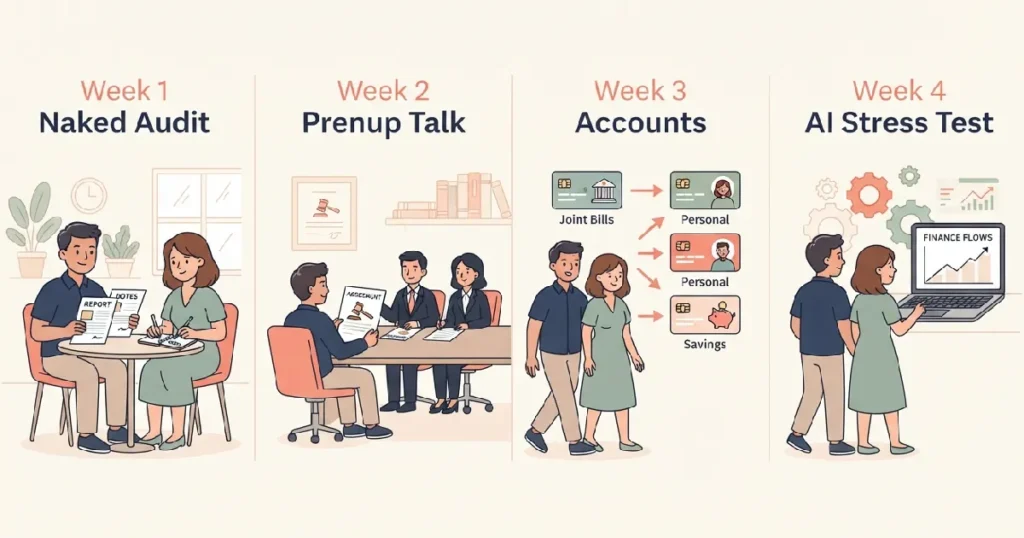
Week one: Run the Naked Financial Audit. Pull credit reports, list every liability, disclose side income and crypto holdings in writing.
Week two: Have the prenup conversation using the script above, and if it applies, book separate consultations with lawyers.
Week three: Set up the yours-mine-ours account structure and automate the transfers.
Week four: Sit down together and run the AI stress-test prompts, then talk through what surprised each of you.
A useful question to ask yourself before week one even starts: what am I more afraid of, an uncomfortable conversation now, or an uglier one three years from now? If fights about money already exist before the wedding, consider two sessions with a financial therapist or a certified financial planner who also works with couples. Treat old money wounds the same way you’d treat any other pattern worth addressing before you build a life on top of it.
The Conversation That Becomes the Marriage
Remember the termites. The damage was never really about the wood. It was about what stayed hidden while everything looked fine on the surface. The same is true for the couple who smiles through the credit card comment, the vague salary answer, the “we’ll figure it out later.”
You now have something you didn’t have at the start of this piece: a specific map instead of a vague fear. You know what to ask, what to disclose, what a fair prenup sounds like, and what your own money script has been quietly running in the background.
Talking about money before marriage was never really about the money. It was always a rehearsal for how you’ll handle every hard conversation for the next fifty years.
The couples who do this well don’t love each other less for asking the hard questions early. They love each other enough to ask.
My Closing Remarks
Here’s the part that surprises people: the couples I’ve watched thrive financially weren’t the ones with the most money. They were the ones willing to feel awkward for one evening instead of resentful for a decade. If you skip this conversation because it feels unromantic, you’re not protecting the relationship. You’re just postponing the fight and letting it grow interest.
More Related Stories for You
- If you want a broader list of the things to discuss before marriage beyond finances, that’s a natural next stop before your wedding date arrives.
About The Author