
 Sara Carmen
The most important conversation of your life should not happen after the ring is on your finger.
Key Points
- The best questions to ask before getting engaged are not about hypothetical “ideal” futures they are about how you and your partner actually function when life gets hard, messy, and unpredictable.
- Avoiding these conversations before an engagement does not protect your relationship; it just delays the moment when reality catches up to your assumptions.
- Couples who openly discuss finances, mental health, digital boundaries, and personal independence before marriage build relationships with fewer blind spots and stronger long-term bonds.
Contents
Table of Contents
You are sitting across from the person you love at dinner, and the thought crosses your mind for the hundredth time: Is this it? Are we really ready?
You feel it — that mix of deep love and quiet fear. Not fear of them, exactly. Fear of the unknown. Fear that there are things you have never talked about, truths you have never tested, and that one day the gap between who you think you married and who they actually are will widen into something you cannot cross.
That fear is not a red flag about your relationship. It is your instinct doing exactly what it is supposed to do.
But here is what that instinct is actually asking you to do: talk. Not about your dream wedding or your ideal house. About the real, sometimes uncomfortable, occasionally awkward truths that will define your actual marriage.
Why Most Pre-Engagement Advice Misses the Point
Most pre-engagement checklists feel like they were written for a 1950s sitcom. “Do you want children?” “Do you share the same religion?” Those questions still matter. But they do not account for the reality most couples live inside.
Modern relationships are navigated under pressures that did not exist a generation ago: social media boundaries, remote work blurring into personal time, student loan debt, the mental health crisis, and the very real question of whose Instagram story gets to feature your engagement photo before you have even told your parents.
Research from the Gottman Institute has consistently found that the quality of a couple’s conflict resolution skills, not the absence of conflict, predicts long-term relationship satisfaction. What you are really trying to assess before an engagement is not whether you agree on everything. It is whether you can navigate the things you do not.
Think of this process like a stress test for a bridge. You do not build a bridge and then pray it holds under pressure. You test its load capacity before you open it to traffic. These twelve questions are your load test.
The 12 Questions to Ask Before Getting Engaged
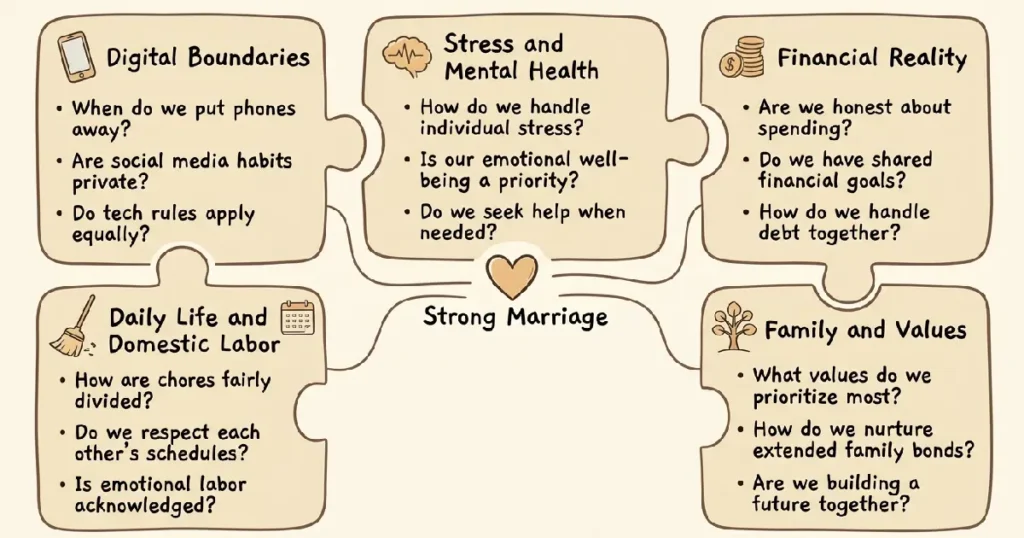
These are organized into five categories that reflect the real pressure points of modern marriages. None of them are designed to expose your partner as unworthy. All of them are designed to give you and your partner a clear, honest map of the road ahead.
Digital and Social Boundaries: The Category Most Couples Skip Entirely
1. What stays private and what gets posted on social media?
This might feel minor until it is not. The moment you post an engagement photo, a pregnancy announcement, or a casual couple photo, you are making a decision about shared identity one that your partner may not have agreed to.
Sit down and decide: Are you a “we post our milestones” couple or a “we keep our relationship offline” couple? What about future children? Do they get to be public figures before they can consent? There is no right answer. There is only your answer, and it needs to match.
2. Where is the line between privacy and secrecy in this relationship?
Phone passcodes. Location sharing. Close friendships with people your partner finds threatening. These are not just tech issues they are trust and intimacy issues wearing a digital costume.
Couples who never discuss this drift into resentment from opposite directions: one partner feeling surveilled, the other feeling shut out. Ask each other: What does privacy mean to you, and what would make you feel like something had crossed into secrecy?
3. How much screen time is too much when we are together?
Phubbing — the act of snubbing someone in favor of your phone has been linked in research to lower relationship satisfaction and higher feelings of exclusion. When your partner is scrolling through their feed while you are trying to connect, it does not just feel rude. It registers, neurologically, as rejection.
Talk about it now. Name specific situations: dinner, bedtime, weekends. Create a shared standard you both actually believe in.
Stress, Conflict, and Mental Health: The Section That Determines Everything
4. What does your worst 1% look like?
This is the question I have come to consider the most important one on this entire list. You have seen your partner at 70% and 80% stressed at work, irritable after a bad night. But have you seen them at rock bottom?
Do they shut down completely? Do they lash out and say things they later regret? Do they drink more, isolate, or spiral into catastrophic thinking? Understanding someone’s absolute worst behavior is not pessimism. It is preparation. And it is the difference between being shocked by your spouse during a crisis and being equipped to navigate one together.
5. How will we support each other through mental and physical health struggles?
According to a 2021 study published in the Journal of Marriage and Family, caretaking expectations are one of the leading unspoken sources of resentment in long-term marriages. Most people enter relationships assuming they will be cared for when they are sick or struggling but they never define what that care actually looks like.
Does support mean space or presence? Does it mean encouraging therapy or respecting the choice not to go? What about medication? Burnout? Chronic illness? These are not worst-case scenarios. For many couples, they are Tuesday.
6. Would you go to couples counseling if we hit a wall?
Here is a pattern interrupt for you: most couples wait until they are in crisis to seek therapy, which is roughly equivalent to waiting until your house is on fire to buy a smoke detector.
Normalize the conversation now. Couples therapy is not a last resort. It is maintenance. If your partner reacts to this question with defensiveness or dismissal, that reaction itself is useful data.
Modern Financial Reality: The Conversation That Most Couples Avoid Until It Explodes
7. What are your exact debts, credit scores, and hidden financial obligations?
Not your vague sense of each other’s financial situation. The actual numbers.
Student loans. Credit card balances. Money borrowed from family. A pattern of spending that has never been examined out loud. A credit score that would affect a joint mortgage application. These are not shameful secrets. They are facts and facts can be worked with.
Sharing your complete financial picture is one of the most intimate acts a couple can perform. It requires vulnerability, honesty, and trust. If you cannot do it before the engagement, you will be forced to do it under much worse conditions after.
8. If one of us loses a job or inflation squeezes us, what is our survival plan?
Financial stress is one of the top predictors of divorce. Not the stress itself the lack of a shared plan for handling it.
Ask each other: Are we willing to downgrade our lifestyle if we need to? Who handles the budget if things get tight? What are our non-negotiables, and what are we willing to sacrifice? The answer matters far less than the conversation.
Daily Life and Domestic Labor: The Category That Quietly Ruins Relationships
9. What is your exact definition of a fair division of household labor?
“We will split everything evenly” is not a plan. It is a wish.
A real plan names who manages grocery lists, who handles the deep clean, who schedules the doctor’s appointments, who remembers the birthday cards. Research from the University of Utah found that unequal distribution of invisible labor the planning and coordination work that happens before any task begins — is one of the most persistent sources of marital resentment, particularly for women in heterosexual relationships.
Do not leave this vague. Specificity is kindness.
10. How much alone time and independence do each of us need to stay happy?
Some people recharge by connecting. Others recharge by retreating. Neither style is wrong. But if one partner needs four solo evenings per week and the other reads alone time as abandonment, you are setting up a conflict that will repeat itself on an endless loop.
Talk about friendships, hobbies, solo travel, and the freedom to have a life that is not entirely merged with your spouse’s. A healthy marriage contains two whole people not two halves clinging together.
Family, Values, and Evolution: The Long Game
11. How will we maintain our partnership when family members try to get in the middle of it?
In my clinical experience, one of the most predictable sources of early marital strain is not in-law conflict itself — it is the couple’s inability to agree on a united response to it before it happens.
Talk now about what it means to put your partnership first. When your mother-in-law offers unsolicited parenting advice, who speaks? When a family member makes a passive remark about finances, does it stay between you two or get relitigated at the next holiday? Decide in advance. Protect the relationship as its own sovereign unit.
12. How will we handle the fact that we are both going to change?
This is the question almost no one asks and the one that quietly determines whether a marriage feels alive at 20 years or exhausted.
People change careers, political beliefs, spiritual convictions, body image, ambitions, and values. The person you marry at 28 will not be the same person at 48. Neither will you. The question is not whether you will change. It is whether you are both committed to knowing each other as you are, not as you were.
Couples who treat marriage as a static destination tend to feel betrayed by change. Couples who treat it as a living relationship — one that requires continuous recommitment tend to feel like partners in the deepest sense.
How to Actually Have These Conversations Without It Feeling Like a Deposition

You do not need to sit across from each other at a table with a printed checklist. In fact, please do not do that.
The Road Trip Method: Long drives are ideal for big conversations. There is no eye contact pressure. You are both facing forward. The motion of the car creates a natural rhythm. Pick one question per trip and let it breathe.
The “Worst Case” Scenario Game: Frame the harder questions as hypotheticals first. “If we were in a situation where one of us lost a job for a year, how do you imagine we would handle it?” is easier to enter than “What happens if you lose your job?”
The Check-In Ritual: Create a standing monthly conversation 20 minutes, no screens where you each share one thing you need more of and one thing you are grateful for. This builds the muscle for hard conversations before they become urgent.
The goal of all twelve questions is the same: not to find out if your partner is perfect, but to find out if the two of you are genuinely capable of building a life together imperfectly, honestly, and with your eyes open.
You Are Not Looking for Perfection. You Are Looking for Truth.
Remember the bridge metaphor. You are not trying to find a bridge that will never face weight. You are trying to build one strong enough to carry everything life will bring.
The couples who have the hardest pre-engagement conversations tend to build the steadiest marriages. Not because they resolved every tension. Because they learned, before the ring, that they could face hard things together without falling apart.
That is what you are actually testing. Not compatibility in the easy moments. Courage in the honest ones.
The ring can wait. The conversation cannot.
My Closing Remarks
Here is what I want to say to you directly, one human to another: I have watched people walk into marriages carrying questions they were too afraid to ask, hoping love would make the answers irrelevant. It does not. Love is not a substitute for honesty, it is actually built from it. The fear you feel about these twelve questions is not a sign that something is wrong. It is a sign that you care enough to get this right. Ask the hard things. Say the true things. The person worth marrying is the one who can sit with you inside that honesty and not flinch.
More Related Stories for You
- Struggling to open up during these conversations? You might want to read about why you always talk about yourself and how to break the pattern before it becomes a marital habit.
About The Author