
 Sara Carmen
The right question asked early can save you months of heartbreak and the wrong silence can cost you everything.
Key Points
- The questions to ask a new partner that matter most are not about facts they are about values, emotional patterns, and how someone handles friction.
- Asking the right questions early is not about rushing intimacy; it is about building it on something real.
- How your partner responds to these questions tells you as much as the answers themselves.
Contents
Table of Contents
You are two weeks into something that feels genuinely promising. The conversation flows easily, the attraction is real, and for the first time in a while, you are not overthinking every text. But somewhere beneath the excitement is a quieter question you are not sure how to ask out loud: Who is this person, really?
You do not want to interrogate them. You do not want to scare them off. But you also remember what happened the last time you let things unfold “naturally” for six months, only to discover you had completely different ideas about conflict, closeness, or commitment.
Here is the truth no one tells you at the start of something new: the best way to build genuine intimacy is not to wait and see. It is to ask better questions, sooner.
Why Early Conversations Shape Everything That Comes After
Most people treat the early weeks of dating as a performance. You show your best self, avoid the heavy topics, and hope the other person likes what they see. This is completely understandable. It is also a setup for a particular kind of disappointment.
Psychologist Arthur Aron’s research on intimacy most famously known for his work on the “36 questions” found that what accelerates closeness between two people is not shared time alone, but mutual vulnerability and escalating self-disclosure. In other words, the depth of what you share matters more than the length of time you have known each other.
Left unexamined, the early pattern of surface-level conversation doesn’t just delay connection. It can quietly become the architecture of a relationship where neither person ever feels truly known.
The questions that follow are not a script or a checklist. They are invitations carefully chosen to open a window into how someone actually thinks, feels, and moves through the world.
10 Questions to Ask a New Partner That Reveal the Real Person
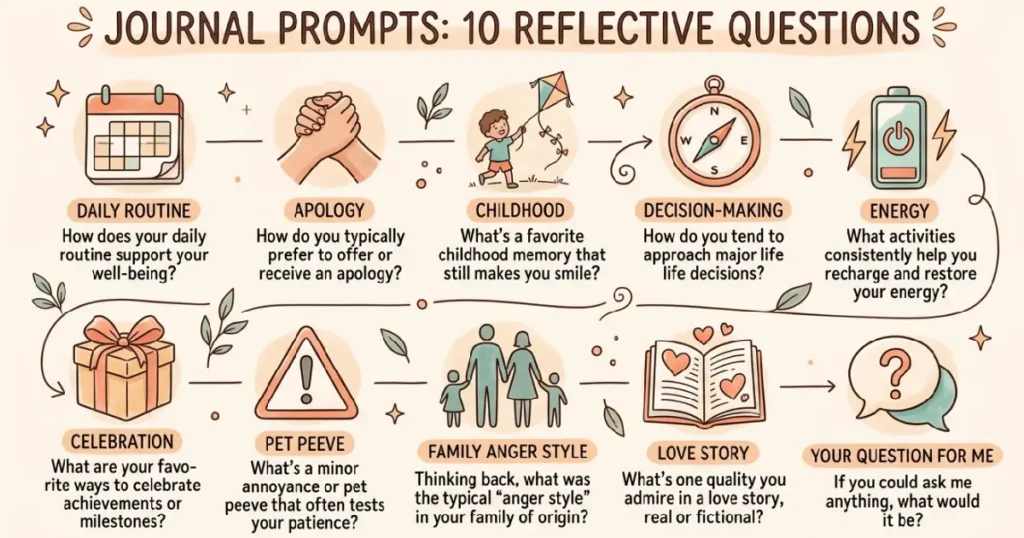
1. “What would you eliminate from your daily life forever if you could?”
This question sounds playful. It is actually precise.
When someone tells you what they would erase the morning commute, the obligation to respond to every message, the performance of being “fine” at work they are handing you a map of their daily stress. They are showing you what quietly drains them.
This matters because the things that drain your partner will eventually affect you. If they resent routine deeply, they may struggle with the ordinary rhythms of a shared life. If they hate performative socializing, large family gatherings might become a recurring tension. Listen not just for what they say, but for the emotion behind it.
2. “What’s the best apology you’ve ever received, and why did it feel genuine?”
This one is quietly one of the most revealing questions to ask a new partner, because it tells you exactly how they experience remorse.
Some people feel most apologized to when someone says the words clearly and means them. Others need to see a change in behavior before they believe the apology is real. Some want the other person to name what they did specifically; others just want to feel heard without an explanation.
Whatever they describe as the “best” apology they have ever received is, in effect, the apology they are hoping you will someday give them. Pay attention.
3. “What’s a silly childhood habit you secretly miss?”
Do not underestimate this question because it sounds light.
When someone lets themselves be a little ridiculous “I used to narrate my whole day like a nature documentary” or “I genuinely believed I could talk to animals” they are not just being funny. They are showing you that they feel safe enough to be unguarded around you. That is emotional security, and it is rare.
This question also opens a door to shared laughter, which research from the University of North Carolina links directly to relationship satisfaction. Couples who laugh together tend to report feeling more supported and more connected even during difficult periods.
4. “When you face a real dilemma, do you trust your head, your heart, or your gut first?”
Here is what you are actually asking: What is your relationship with uncertainty?
Someone who leads with logic may struggle when a situation cannot be solved, only survived. Someone who leads with emotion may find it hard to think clearly when feelings are running high. Someone who trusts their gut tends to be decisive, but may sometimes act before they have enough information.
There is no wrong answer. But knowing which one drives your partner helps you understand how they will behave in the moments that actually test a relationship job losses, health scares, major decisions.
Ask them also which approach they once regretted not following. The regret reveals more than the preference.
5. “After an exhausting week, what actually restores you?”
This is the question about personal space and it is one that couples avoid until it becomes a conflict.
Some people restore themselves through solitude: a quiet evening, a long run, hours with a book. Others need connection: friends, noise, laughter, being surrounded by people who care about them. Neither is wrong. But if you are someone who reaches toward your partner when you are depleted, and they are someone who needs to pull away to recover, that gap will show up every single week.
Knowing this early is not a warning sign. It is information. And information is what turns attraction into actual compatibility.
6. “How do you like to celebrate something that went well even something small?”
This question is about love languages in the context of success, not just struggle.
Some people want a heartfelt “I’m so proud of you.” Others want a concrete gesture a dinner, a small gift, something tangible that marks the moment. Others simply want someone present to share the feeling with, no words necessary.
But here is the insight most articles on this topic miss entirely: the way someone wants to be celebrated during good times mirrors what they need during hard ones. If they need presence when they are proud, they will need it even more when they are scared. If words matter when things go well, silence will sting when things fall apart.
7. “What small thing strangers do in public that instantly irritates you?”
This is the question that tells you where someone’s patience actually lives underneath the politeness.
Maybe it is people who talk loudly on the phone in quiet spaces. Maybe it is someone who does not hold the door. Maybe it is something so specific it surprises you. Whatever it is, you are getting a reading on their sensitivity, their expectations of others, and importantly how they respond when reality does not match what they think is reasonable.
A person who finds many small things intolerable in strangers is likely to bring that same sensitivity home. This is not necessarily a flaw. But it is worth knowing.
8. “Growing up, how did your family handle anger silence, arguments, or pretending it didn’t happen?”
This is the most clinically significant question on this list.
What psychologists call “family-of-origin patterns” — the emotional habits you absorb in childhood are among the strongest predictors of how people behave in adult relationships. Someone who grew up in a household where anger meant silence may shut down the moment a disagreement arises. Someone who grew up with raised voices may raise theirs before they even realize it. Someone who learned to pretend conflict didn’t happen may become a master of avoidance.
Think of this as emotional archaeology. You are not digging to judge them. You are digging to understand the ground you are both standing on.
9. “What book, movie, or song completely changed how you think about love?”
Consider this: the stories we find most moving are often the ones that confirmed what we already believed — or the ones that challenged it.
If they name a story about two people sacrificing everything for each other, they may carry a romantic ideal that is beautiful but also quite demanding. If they name something about love that survives imperfection, they may be more grounded in what a real relationship actually requires. If they struggle to answer this question at all, that is information too.
This question reveals the ceiling of their romantic expectations. It tells you what they are measuring love against.
10. “If you could ask me one question right now and guarantee I would answer honestly, what would it be?”
Save this one for last.
This question hands your partner the initiative and shows you exactly what is sitting at the front of their mind about you. It tells you what they are curious about, what they are a little nervous about, and what matters to them enough to actually ask.
It is also one of the most intimate things two people can do in conversation: give each other permission to be honest. That permission is where trust begins.
How to Ask These Questions Without It Feeling Like a Job Interview

The questions above only work if the context is right. Here is how to make them land.
Start with yourself. Before you ask any of these, offer your own answer first. This is called reciprocal disclosure — a well-documented mechanism for building trust. When you go first, you signal that this is a conversation, not an interrogation.
Pick one per occasion. You do not need to ask all ten in a single evening. One question woven naturally into a conversation is more powerful than ten questions fired in sequence. Think of it like seasoning food — a little changes everything. Too much overwhelms.
Listen past the answer. The goal is not to collect data. It is to understand the person in front of you. When they answer, stay with what they said. Ask a follow-up. Let the conversation breathe. The richest information often lives in the second layer — what they say after they think you have moved on.
Notice the non-answers too. If someone deflects a question with humor every time, or pivots away from anything emotionally direct, that pattern is itself an answer. You are not looking for perfection. You are looking for self-awareness and the willingness to be real with you.
The Connection That Comes After Courage
There is a moment in early relationships when most people choose safety over honesty. They give the pleasant answer instead of the true one. They wait to see what the other person believes before they say what they actually think.
I have seen this in clinical work for years: couples who spent months performing compatibility, then spent years navigating the distance they created by never being truly honest with each other.
The questions above are an act of courage. Not the dramatic kind the quiet, steady kind. The kind that says: I am interested enough in you to ask something real. I trust you enough to listen.
Asking the right questions early does not mean rushing love. It means taking it seriously.
Choose one question. Ask it this week. Then stay in the room for the answer.
The right person will not run from your curiosity. They will meet it.
My Closing Remarks:
I want to be honest with you about something I rarely say out loud: the hardest conversations I have ever witnessed are not the ones that happen during breakups. They are the ones that happen three years in, when someone quietly admits, “I wish I had known this about you sooner.” You already have the courage it takes to ask better questions otherwise you would not be reading this. What I am asking you to do is trust that courage a little earlier than feels comfortable. The person worth keeping will not flinch. They will lean in. And that moment that single moment of mutual honesty is where real love actually starts.
More Related Stories for You
- Struggling to talk about yourself without feeling like you are oversharing or shutting down? Read this: How to Stop Talking About Myself All the Time
About The Author