
 Sara Carmen
You’ve been told love is the main requirement for marriage. That’s the fairy tale. The real requirement is the ability to talk about real life without shutting down, blowing up, or “fine”-ing each other to death. If you’re searching for Questions to Ask Before Marriage, you’re not being dramatic. You’re being responsible. Because a wedding doesn’t fix unclear expectations, hidden debt, mismatched timelines, or unspoken fears. It just makes them harder to deal with.
And yes, you might be feeling anxious, awkward, or even guilty for “questioning” something that’s supposed to feel purely romantic. Good. That discomfort is information. Most couples don’t regret the questions they asked. They regret the conversations they avoided, especially about money. A 2024 Cornell report on research in the Journal of Consumer Psychology found that financial stress is linked to less financial communication, meaning the couples who most need the talk are often the least likely to have it. That’s how resentment grows in silence.
This guide gives you a clear framework, the exact prompts that reveal real compatibility, and a simple way to turn answers into agreements you can actually live by. You’ll also get a short true-to-life story (names changed), a comparison of self-guided talks vs. premarital counseling, and common mistakes that quietly wreck trust before the honeymoon ends.
Questions To Ask Before Marriage Redefined
Here’s the core idea: this isn’t a cute list for a date night. It’s a premarital decision framework that surfaces hidden assumptions (money scripts, family roles, conflict styles), separates “preferences” from deal-breakers, and helps you build a shared marriage operating system you can revisit after stress, kids, job changes, illness, or loss.
Contents
Table of Contents
Questions to ask before marriage are structured conversations that reveal values, expectations, deal-breakers, and perpetual issues early, so you can decide, design, and document how you’ll handle money, conflict, family, intimacy, and life goals as a team.
“Love isn’t enough when the numbers don’t add up.”
That’s not cynical. It’s protective. Love thrives when your daily system supports it.
What Is “Questions To Ask Before Marriage” Really?
Think of it as a compatibility plus capacity check across six domains:
- Core values, beliefs, and worldviews
- Conflict and repair (how you fight and how you come back)
- Money and risk (spending, saving, debt transparency)
- Family and boundaries (including in-laws and holidays)
- Intimacy and friendship (sex, affection, emotional safety)
- Roles and lifestyle design (division of labor, careers, chores)
It also includes the process: how you ask, how you listen, and how you handle differences without minimizing, moralizing, or trying to win.
The Science/Data: What Research And Experts Keep Pointing To
Financial stress doesn’t just strain budgets. It can reduce communication itself. Cornell summarized 2024 research showing that when people feel financially stressed, they may avoid talking about money with their partner, even though talking is exactly what helps. Reframing money conflict as “solvable as a team” increased willingness to communicate in the research discussed. See the Cornell write-up on the cost of silence in money conversations.
If you want the peer-reviewed source behind that reporting, the findings come from work published in the Journal of Consumer Psychology. You can read the journal page here: Journal of Consumer Psychology.
Also, many conflicts in marriage are not “one-and-done.” Relationship researchers often describe perpetual issues: recurring differences like spender vs saver, introvert vs extrovert, tidy vs messy. Your goal is not to erase them. It’s to manage them with respect and a plan.
The Six-Domain Question Map (So You Don’t Miss The Quiet Deal-Breakers)
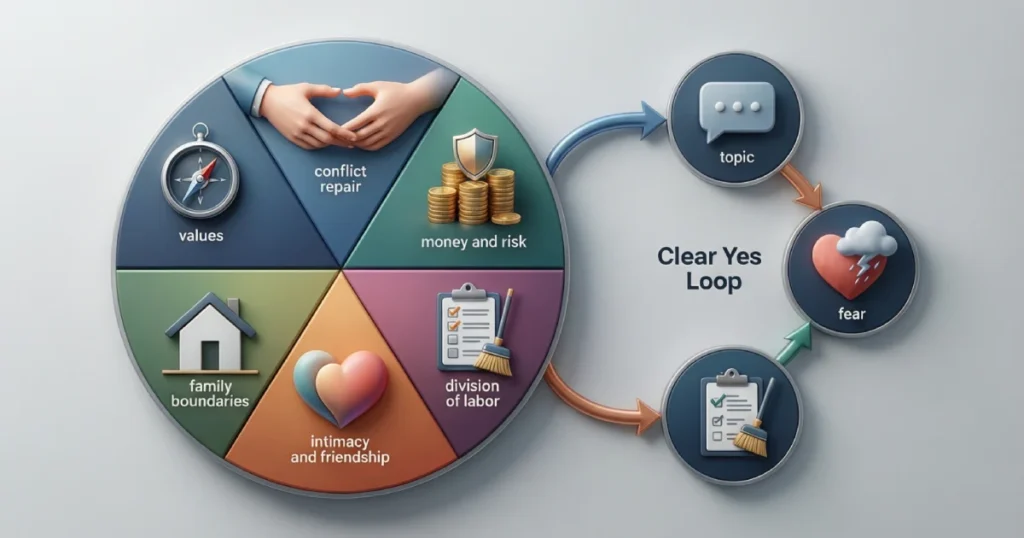
Use these prompts to get beyond vague answers:
- Money and risk: “What does money represent to you: freedom, safety, status, options?”
- Credit score and debt transparency: “If I pulled your credit report today, would anything surprise me?” (We’ll cover how to do this safely.)
- Family boundaries: “How involved do you expect our parents to be in decisions?”
- Division of labor: “What does ‘equal’ mean to you: same tasks, or same total effort?”
- Stress-reducing conversation / daily connection ritual: “What’s your ideal 10 minutes together on a normal weekday?”
- Intimacy: “What makes you feel wanted, and what shuts you down?”
9 Actionable Steps To Turn Premarital Questions Into Real Compatibility (Without Fighting)
These steps are designed to win you clarity, not just a pleasant talk. Each step includes a “Do This, Not That” so you know what to actually do tonight.
Step 1: Set The Container (Time, Rules, Goal)
- Do this: 45 to 60 minutes, phones away, one topic only, end with “What did we learn?”
- Not that: A 2-hour “everything conversation” that turns into a trial.
Mini-script: “Tonight is just money. We’re not solving it all, just mapping it.”
Step 2: Start With Meaning, Not Logistics
- Do this: Ask why it matters before how you’ll do it.
- Not that: Jumping to tactics (joint vs separate accounts) before values.
Two openers that work:
- “When you feel financially stressed, what do you fear most?” (This aligns with the communication barriers described in the Cornell report.)
- “What did you learn about money from your family?”
Step 3: Use The Big 6 Domains As Your Checklist
- Do this: Values, conflict, money, family, intimacy, roles.
- Not that: Only asking wedding-adjacent questions and calling it preparation.
Step 4: Upgrade From “What” To “When/Then”
- Do this: Ask scenario questions that reveal real behavior.
- Not that: Abstract questions that invite people-pleasing.
Examples:
- “When we disagree, do you want space first or resolution first?”
- “If one of us loses a job, what changes first: spending, savings, or lifestyle?”
Step 5: Name Perpetual Issues And Pick A Management Plan
- Do this: Identify the repeating difference and build a ritual around it.
- Not that: Trying to “win” the difference out of your partner.
Prompt: “What’s one difference between us you think will never fully change?”
Step 6: Ask The Hard Questions With A Soft Startup
- Do this: Direct plus kind: “I’m asking because I want us to be safe and honest.”
- Not that: Accusations or sarcasm.
Hard-question examples:
- “Have we ever hidden purchases, accounts, or debt?” (That’s financial infidelity, and it kills trust fast.)
- “What boundaries do we need with parents and in-laws?”
- “What makes sex feel safe and connected for you?”
Step 7: Turn Answers Into Agreements (The M.O.S. Doc)
Call it your Marriage Operating System (M.O.S.). It’s one page.
- Do this: Write 1 to 2 sentences per domain: “We agree to…” and “If we disagree, we will…”
- Not that: Assuming you’ll remember or that “we talked about it once.”
Examples:
- “If conflict escalates, we take a 20-minute break and return.”
- “Any purchase over $X requires a text and a yes.”
Step 8: Run A Stress Test Week (Behavior Beats Promises)

- Do this: One week of practice:
- one budget meeting
- one chores reset
- one conflict repair plan
- one intimacy check-in
- Not that: Waiting for marriage to discover friction.
Step 9: Know When To Bring In A Third Party
- Do this: Consider premarital counseling if you hit repeated shutdowns, looping fights, trauma triggers, or major value mismatches.
- Not that: Forcing “communication” that’s actually emotional gridlock.
Safety note: if there’s intimidation, threats, or coercive control, prioritize safety and professional help, not more questions.
The Simple Model: The Clear Yes Loop (3 Steps)
Use this when you feel stuck or vague:
- Name the topic: “Money. Not everything, just money.”
- Name the fear: “I’m scared of surprises and resentment.”
- Name the next action: “Let’s pull credit reports and set rules.”
This is how you get decisions instead of endless talks.
Comparison: “Do This, Not That” Conversation Upgrades
| Topic | Do This (High-Clarity) | Not That (High-Conflict Or Low-Info) | Outcome You Get |
|---|---|---|---|
| Money | Monthly “team vs problem” budget meeting; normalize stress | Surprise debt reveals; “we’ll figure it out” | Trust and fewer blowups |
| Conflict | Name patterns; take breaks; repair and return | “Always/never,” scorekeeping | Faster recovery |
| Family | Boundary plan for holidays and in-laws | Hoping families “just respect it” | Less resentment |
| Roles | Explicit division of labor; revisit quarterly | Unspoken gender-role assumptions | Less burnout |
| Intimacy | Talk preferences, safety, expectations | Treating sex as “should happen” | More closeness |
The Simplified True Story: The Turnaround
Meet “Maya” (name changed). It’s a Tuesday night, around 9:10 p.m. She’s sitting on the edge of the couch with a hoodie pulled over her hands, watching her fiancé “Jordan” tap his foot like he’s trying to shake off the whole topic. The TV is on, muted. That’s their habit when something feels heavy: create noise, pretend it’s casual.
Maya is excited to marry him. Also? She feels nauseous every time money comes up. Jordan isn’t reckless, but he avoids details. Maya fills the blanks with worst-case scenarios: secret debt, bad credit score, a future where she’s the only adult.
They tried online question lists. Jordan kept saying, “We’ll figure it out.” Maya heard “future surprise.” Jordan heard “interrogation.”
They changed one thing. They stopped asking for solutions first. Maya said, “When you feel financially stressed, what do you do: avoid, plan, or ask for help?” No numbers. No shame. Just the pattern. Jordan stared at the carpet, then admitted he avoids because he assumes conflict is inevitable. He grew up with loud money fights. He thinks silence is peace.
So they reframed it as “solvable as a team,” exactly like the Cornell reporting suggests helps people talk under stress. They scheduled a 30-minute monthly budget meeting, picked a $ threshold rule, and agreed to pull credit reports together using the FTC’s official guidance. Maya finally exhaled. The wedding felt lighter, not because life got perfect, but because secrecy got replaced with a system.
“A hard conversation now is cheaper than a divorce later.”
Not because divorce is the only outcome. Because clarity is always cheaper than confusion.
Comparative Analysis: Premarital Questions Vs. Premarital Counseling/Structured Programs
| Option | Pros | Cons | Time Required |
|---|---|---|---|
| Self-guided framework (this guide) | Fast, free, flexible; builds habits | Easy to stay vague; no facilitator | 2 to 6 hours over 2 to 3 weeks |
| Premarital counseling | Facilitated repair; better for stuck patterns | Cost and scheduling; depends on fit | Often 4 to 8 sessions |
| Financial consult (prenup, estate basics) | Clarity on assets, debts, “unknown unknowns” | Not a substitute for emotional work | 1 to 3 meetings |
| DIY tools only (spreadsheets, apps) | Great for tracking spending | Doesn’t address fear, control, or values | Ongoing |
A quick nudge: if money talks get heated, use evidence-based conflict skills. The American Psychological Association’s resources on managing conflict are a solid starting point for healthier communication patterns.
Common Mistakes And How To Avoid Them

Most couples don’t fail because they “didn’t love each other enough.” They fail because they practiced avoidance until it became a personality trait.
Mistake 1: You ask questions like a detective, not a teammate.
How to fix it, step-by-step:
- Lead with your intention: “I want us to feel safe and honest.”
- Ask one question. Then pause.
- Reflect back: “What I’m hearing is…”
Message you can send: “Can we do a 45-minute money talk this week? Not to fight. Just to map.”
Mistake 2: You skip debt transparency and call it “trust.”
How to fix it, step-by-step:
- Share numbers on the same day: income, debts, monthly bills.
- Pull credit reports together using the FTC’s free credit report steps.
- Agree on rules: spending thresholds, savings goals, and who pays what.
Message you can send: “I’m not judging. I just want no surprises. Let’s swap totals and make a plan.”
Mistake 3: You don’t define division of labor, so resentment fills the gap.
How to fix it, step-by-step:
- List every recurring task (laundry, dishes, meals, errands).
- Decide ownership: one person “owns” a task end-to-end.
- Revisit monthly for 10 minutes.
Message you can send: “I need our home to feel fair. Can we split tasks by ownership instead of ‘helping’?”
Quick Answers Before You Decide
Frequently Asked Questions (FAQs)
1) When should you start these conversations?
Start as soon as commitment becomes real. Engagement is ideal, but earlier is better. Choose one topic per week: money, conflict, kids, family boundaries, intimacy, roles. If you’re within 3 months of the wedding and still avoiding major topics, slow down and get support.
2) What if you disagree on something big like kids, religion, or money?
Separate values from logistics. Ask, “Why does this matter to you?” then test real scenarios: timelines, trade-offs, what changes in daily life. Some differences are manageable with agreements. Others are deal-breakers. If you keep looping or shutting down, premarital counseling can help.
3) Should you combine bank accounts before marriage?
There’s no one correct setup. What matters is transparency and shared goals. Many couples use a hybrid: joint account for bills and savings, separate accounts for personal spending. Agree on a budget meeting, spending thresholds, and what counts as “ours” versus “mine” to prevent resentment.
4) How do you bring up financial infidelity without accusing your partner?
Use a soft startup and make it mutual. Try: “I want a marriage with zero secrets. Have either of us ever hidden purchases, accounts, or debt? No punishment, just honesty and a plan.” Then set rules: shared visibility, spending limits, and regular check-ins to rebuild trust.
Conclusion
Marriage rewards preparation, not optimism. If you want the relationship to feel safe five years from now, you have to practice safety now: truth, transparency, and a plan for how you handle stress together. Money is the fastest place for “small” secrets to become big betrayals. Pulling credit reports, sharing debts, and setting spending rules is not unromantic. It’s grown-up love.
Here’s your one small task for tonight: set a 20-minute timer and ask, “When you’re stressed, do you want comfort, solutions, or space, and what does that look like?” Write one sentence you learned. Then schedule your first budget meeting. Put it on the calendar like it matters, because it does.
If you’re reading this and realizing you’ve avoided these talks for months, don’t panic. You’re not broken. You’re human. Avoidance is common, especially when you’re scared of conflict or rejection. But here’s the tough-love truth: clarity is kindness. Vagueness is a slow leak that ruins the house.
Reflection question: If nothing changed for the next 12 months, would you feel excited or trapped?
And yes, keep using Questions to Ask Before Marriage, but use them like a framework that ends in agreements, not like trivia you forget after dessert.
My Closing Remarks:
I’m going to say the part most people avoid: if you can’t talk about money, you’re not “chill.” You’re unsafe. I’ve seen too many couples treat debt transparency like a mood killer, then act shocked when financial infidelity blows up the marriage later. You don’t need perfect compatibility. You need honest data and repeatable habits. If this stings a little, good. That sting is your standards waking up. Use it.
More Related Stories For You
- If you want a broader checklist beyond finances, read things to discuss before marriage and use it to fill gaps in your Big 6 domains.
- If money is the main tension point, start here: talk about money before marriage for a deeper walkthrough of budgets, debt, and transparency.
- If fear is what keeps you avoiding these talks, you may relate to gamophobia meaning and how commitment anxiety can show up as procrastination.
About The Author