
 Sara Carmen
Why wanting forever and fearing it at the same time doesn’t make you broken. It makes you human.
Key Points
- The real gamophobia meaning goes far beyond “cold feet.” It’s a nervous system pattern, and it’s more common than most people admit.
- Five hidden symptoms, from panic at relationship milestones to serial dating, explain why you keep pulling away from people you genuinely want.
- Healing commitment fear is possible through small, structured trust-building steps, not one giant leap of faith.
Contents
Table of Contents
You’ve tried. You’ve really tried.
You’ve sat across from someone who checks every box, who calls when they say they will, who looks at you like you’re the answer to a question they didn’t even know they were asking. And somewhere around month six, something in your chest tightens.
You start finding reasons to leave. A tone of voice that suddenly irritates you. A future conversation that makes your skin crawl. You pull back before you even understand why.
Then you wonder if something is wrong with you.
There isn’t.
What you’re feeling has a name, and it’s more common than you think: gamophobia, the fear of marriage or long-term commitment. It isn’t about loving your partner too little. It’s about a nervous system that has learned, somewhere along the way, to treat closeness like danger.
That confusion, wanting forever while flinching at the thought of it, is not a contradiction. It’s a pattern. And patterns can change.
This guide breaks down the real gamophobia meaning, the five symptoms that quietly run your love life without your permission, and the specific steps that help you stop running from the relationships you actually want.
What Gamophobia Actually Means (And Why It’s Not Just “Cold Feet”)
Let’s start with the word itself.
Gamophobia comes from the Greek gamos, meaning marriage, and phobos, meaning fear. Put together, it describes an intense, persistent, and often irrational dread of marriage or lifelong commitment. Not mild hesitation. Not a passing wave of nerves before a wedding. A deep, physical aversion that shows up the moment a relationship starts asking for permanence.
Here’s an important distinction. Gamophobia is not a standalone diagnosis listed in the DSM-5, the manual clinicians use to diagnose mental health conditions. According to the Cleveland Clinic, it’s typically understood as a specific phobia or grouped under broader anxiety disorders, since the fear centers on a defined trigger, in this case, commitment, rather than existing as its own separate category.
That doesn’t make it any less real.
A 2023 study published in Evolutionary Psychological Science examined what actually keeps people single when they say they want a relationship. Researchers found that fear of commitment was one of the strongest predictors of involuntary singlehood, ranking above factors like a busy schedule or a lack of romantic opportunity. In plain terms, a lot of people aren’t single because they can’t find love. They’re single because part of them is quietly working to prevent it.
If you’ve ever ended a good relationship and couldn’t fully explain why afterward, this might be your answer. Not a lack of feeling. A fear response wearing the costume of a lack of feeling.
The Exit Door Reflex: Why Commitment Fear Feels Like Danger
Here’s a way to picture what’s actually happening inside you.
Imagine standing in a room you genuinely love. The furniture is right. The light comes in at the right angle. You feel at home in it. But your hand never leaves the doorknob behind you.
You’re not planning to leave. You just need to know that you can.
That’s the exit door reflex, and it’s the engine underneath most commitment fear. Your body isn’t rejecting the relationship. It’s protecting your ability to escape it, just in case love turns out to be the thing that hurts you again.
This reflex usually gets built early. Maybe you watched a marriage fall apart as a kid. Maybe an ex blindsided you right after you finally handed over your trust. Maybe you simply learned, however it happened, that closeness eventually costs you something.
In my practice, this pattern almost never shows up in people who are cold. It shows up in people who are deeply loving, deeply perceptive, and exhausted from a cycle they can’t seem to interrupt. The fear isn’t a missing capacity for love. It’s an overcorrected capacity for self-protection.
Once you can see the exit door reflex operating in your own life, something shifts. You stop asking “what’s wrong with me” and start asking a better question: what is this reflex actually protecting me from, and is that threat still real?
That question is where healing starts.
5 Symptoms of Gamophobia and How to Deal With Them
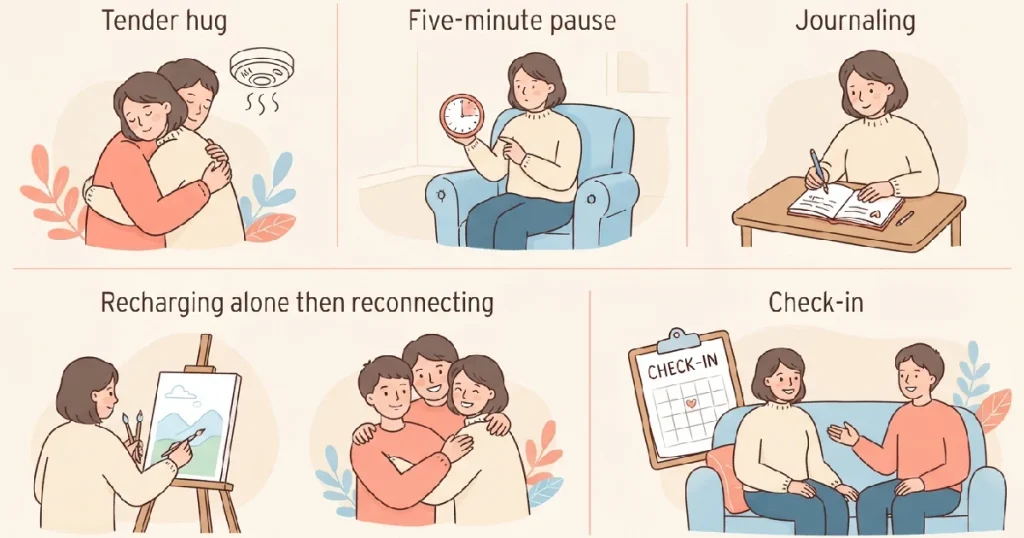
Commitment fear rarely announces itself directly. It hides inside behaviors that look like something else entirely, like pickiness, independence, or a commitment phobia label you’ve probably already slapped on yourself half-jokingly. Here’s what it actually looks like up close, and what to do about each version of it.
1. Severe Panic During Relationship Milestones
The symptom: Someone brings up moving in together or marriage, and your body reacts before your mind does. Racing heart. Shallow breathing. An overwhelming urge to end things immediately, even though nothing is actually wrong.
This is your nervous system reading “forever” as a threat it can’t outrun, a classic anxiety response where the mind treats an abstract future event with the same urgency as an immediate danger.
The solution: micro-commitments. Instead of facing the idea of forever, break commitment into pieces small enough to survive. Agree to a weekend trip before agreeing to a lease. Plan next month before you plan next year. Trust gets built in small deposits, not one enormous transfer.
2. Subconscious Relationship Self-Sabotage
The symptom: You start a fight over something that wouldn’t have bothered you last month. You zoom in on a partner’s minor flaw until it feels unbearable. You create just enough tension to put distance back between you.
This is self-sabotage in relationships, and it’s rarely random. It tends to surface right after intimacy deepens, working as an unconscious way to reclaim the emotional space that closeness took away.
The solution: trigger tracking. Keep a short journal for two weeks. Every time you feel the urge to pick a fight or fixate on a flaw, write down what happened right before that urge showed up. Most people find a pattern fast, usually tied to a moment of increased closeness, not an actual red flag.
3. The Hot and Cold Intimacy Cycle
The symptom: Alone, you crave deep romance and picture the whole future. The moment your partner actually shows up with real affection, you feel smothered, restricted, even trapped.
This push and pull often points to an avoidant attachment style, a way of relating shaped early in life that equates closeness with a loss of self.
But here’s what no one tells you: the trap isn’t the relationship. It’s the belief that closeness requires disappearing.
The solution: build what you might call an autonomy sandbox. Protect solo hobbies, solo friendships, and solo time on purpose, even inside a committed relationship. When your brain sees repeated proof that intimacy doesn’t erase your identity, the hot and cold cycle starts to lose its grip.
4. Serial Dating and Casual Hopping
The symptom: You keep things undefined on purpose. The moment a connection starts to feel exclusive or real, you end it, or quietly start looking elsewhere.
This pattern often gets mistaken for being “not ready” or “too picky,” when it’s really commitment fear doing exactly what it’s designed to do: exit before you can be left.
The solution: custom relationship mapping. Instead of measuring your relationship against a societal timeline, dating, then engaged, then married, sit down with a partner and define what safety actually looks like for both of you. Naming an honest, specific structure often feels far less threatening than an undefined “forever.”
5. Hypervigilance and the Perfectionism Trap
The symptom: No one is ever quite right. There’s always a flaw significant enough to justify walking away, a habit, a career choice, a laugh, something.
This is often a shield. Impossibly high standards protect you from ever having to test whether you can actually stay.
The solution: this layer usually benefits most from professional support. Cognitive Behavioral Therapy, a structured approach that helps you identify and challenge distorted thought patterns, is especially effective for unpacking where these standards came from and whether they’re protecting you or just isolating you.
Navigating a Relationship When Gamophobia Shows Up

If you’re the one carrying commitment fear, or you love someone who is, this part matters just as much as anything above.
Talk about the fear, not just the behavior. Instead of “I don’t know if I want this,” try “I want this, and it also terrifies me, and I need us to move at a pace where I can trust it’s safe.” That sentence tells the truth without handing your partner a rejection to carry.
Set boundary milestones together. Agree on regular check-ins, monthly is a good starting rhythm, where you both name how the pace feels. This replaces sudden ultimatums with an ongoing, shared conversation instead of a cliff edge.
Know when to bring in outside help. If the pattern keeps repeating despite honest effort, or self-sabotage is actively damaging a relationship you don’t want to lose, a licensed couples therapist or individual counselor trained in attachment work can move you past this faster than trial and error ever will. According to Verywell Mind, treatment for commitment fear often combines talk therapy with gradual exposure to the situations that trigger avoidance, giving the nervous system repeated proof that closeness is survivable.
Where to Start This Week: The 3-2-1 Commitment Practice
You don’t need to solve this by tomorrow. You need one place to start.
Consider trying what I call the 3-2-1 practice over the next seven days.
Three small joint decisions. Pick three low-stakes decisions to make together this week, like choosing a restaurant or planning Saturday. Practice letting someone else’s preference matter without it costing you anything.
Two protected solo hours. Block two hours this week for something that’s entirely yours, no partner, no explanation needed. Notice that having a relationship doesn’t erase this time. It coexists with it.
One honest sentence. Say one true thing to your partner, or to yourself in a journal if you’re not currently in a relationship, about what commitment actually scares you. Not the polished version. The real one.
A useful question to ask yourself afterward: did the world end when I let someone else in, even a little? For most people, the quiet answer is no.
The Door You No Longer Need to Hold
Remember that room you loved, the one where your hand never left the doorknob?
Healing gamophobia doesn’t mean you suddenly stop noticing the door. It means you learn, slowly, that you can let go of the handle and the room won’t disappear. You’re allowed to stay.
Gamophobia is a pattern, not a life sentence. Patterns respond to practice. Every small commitment you keep, every honest sentence you say out loud, every night you choose to stay instead of run, quietly rewires what your nervous system believes is possible.
You are not too much. You are a person who learned to protect yourself so well that you started protecting yourself from the very thing you want most.
That story can change starting today.
My Closing Remarks
I’ve sat with so many people who apologize for their fear of commitment like it’s a confession. It never is. In my experience, the people most afraid of commitment are usually the ones taking love the most seriously, which is exactly why the stakes feel so high. Give yourself the patience you’d give a good friend working through this. You’re not behind. You’re just finally paying attention.
More Related Stories for You
- Looking for more ways to build a relationship that actually lasts? Check out this good advice for a relationship for practical, everyday tools that help couples stay close instead of quietly drifting apart.
About The Author