
 Sara Carmen
The real answer isn’t a number on a calendar. It’s whether your relationship has survived the specific tests that actually predict a lasting marriage.
Key Points
- The honest answer to how long to date before marriage has less to do with counting months and more to do with surviving specific relationship “stress tests” together.
- Research shows couples who date at least three years before marriage cut their divorce risk by nearly half compared to those who rush down the aisle.
- Your age changes the math completely. Daters in their early 20s often need years longer than daters who meet later, once self-awareness has already settled in.
Contents
Table of Contents
We treat the relationship clock like a judge. Eighteen months feels respectable. Five years feels like a stall. Six months feels like a dare. Friends start asking when you will make it official. Family starts hinting. You start doing the math in the shower. The fear of rushing and the fear of wasting your best years sit in the same chair.
Someone might think a long relationship means they are being careful. But what they do not see is the quiet bargain underneath: stay pleasant, avoid the hard talk, and hope time will decide for them.
Someone might think a fast engagement means rare certainty. But what they do not see is limerence still running the show. Limerence is the brain’s early infatuation system. It floods you with focus, craving, and a glow that can make red flags look like personality.
Someone might think living together is already the test. But what they do not see is a carefully staged version of home. Separate finances. Soft conflict. A lease that either person can leave without a legal fight.
Here is the short answer most people want. Most couples need two to five years, and age changes that window. The number only works if you have lived through real pressure together. If you have not shared a home, a crisis, or a budget, you do not have a timeline. You have a highlight reel.
That is the Showroom Effect. Dating often happens under bright lights and good behavior. Marriage is the road. You cannot judge a car by the showroom floor.
What the Data Says About How Long to Date Before Marriage
You are not strange for wanting a number. The mind likes a finish line when the stakes feel this high.
Current U.S. trend data shows many couples now date for years before a ring, in part because people marry later and want more financial footing first. In the U.K., one widely shared snapshot put the average wait closer to 4.9 years together before marriage. Averages can calm you. They cannot choose for you.
A better number comes from risk, not fashion. Research tracked through Couples Analytics and the well-known Emory University work found that dating for three or more years was linked with a sharply lower chance of divorce, on the order of 50 percent in that sample. That does not mean three years is a spell. It means rushed vows often skip the part where the glow fades and character shows up.
The glow has a clock. Early love is driven by novelty, dopamine, and a narrowed gaze. For many people that honeymoon stretch thins out between six and twelve months. After that, attachment has to do the work attraction used to do. Attachment is the quieter bond that says, I can need you and still stay myself. Long-term relationship research maps how satisfaction and security shift once the first rush is gone. Marry before that shift and you may be promising yourself to a feeling, not a person.
Time is not a test. Pressure is.
Your Age Changes How Long to Date Before Marriage
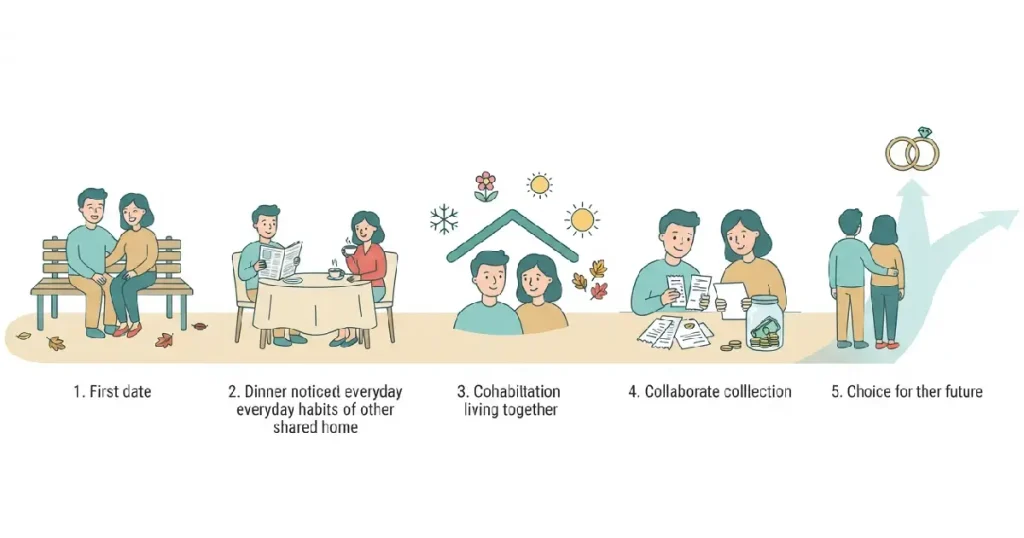
A timeline that protects a 23-year-old can stall a 34-year-old. The difference is not romance. It is how fast identity is still moving.
Dating in Your Early 20s Before Marriage
If you met in your early twenties, a three-to-five-year runway is often the safer bet. You are still becoming someone. Careers bend. Friend groups turn over. Values that felt fixed at 22 can look different at 26.
That is not immaturity. It is development. The person you are dating is changing too. A longer window lets you see whether you grow toward each other or simply grew up in the same apartment.
In my practice, the couples who get hurt here are rarely reckless. They are loyal. They confuse history with compatibility and stay because the relationship is the oldest adult thing they have.
Dating in Your 30s Before Getting Married
If you meet in your thirties, a year and a half to two years can be enough, as long as the stress tests are real. You usually know your money habits, your conflict style, and what you will not repeat from past relationships.
This is why the “we barely dated” panic does not always fit older couples. Self-awareness shortens the research phase. It does not remove it. You still need to see this specific person under strain, not just a more finished version of yourself.
The Age-Stage Matrix is simple. Younger love needs more seasons because the people are still under construction. Older love can move faster because the blueprints are already on the table.
Relationship Milestones Matter More Than Months
Relationship experts often argue that the better question is not how long you dated. It is what you have already survived together. Months are a container. Milestones are the contents.
One popular filter is the 3-6-9 rhythm. The first three months are chemistry and ease. By six months, patterns repeat: how they apologize, how they spend, how they speak about their family. By nine months, you are looking at the long game. Can you picture a boring Tuesday with this person and still want it?
There is also a tighter 3-3-3 check some daters use. Three dates to see basic respect. Three months to see consistency. Three seasons to see whether the bond holds when life is not entertaining.
Use those as lenses, not laws. The point is to stop confusing momentum with evidence.
The Four Seasons Cohabitation Rule
Living together for at least twelve months is the closest modern rehearsal most couples get. One season shows chores. Four seasons show illness, holidays, money crunches, family visits, and the version of you that exists when nobody is arriving for dinner.
This is where the Showroom Effect breaks. You see who loads the dishwasher after a fight. You see who goes silent when they are ashamed. You see whether “we share everything” still holds when the rent is late.
If you cannot share a home yet, that does not make you naive. It means you need a substitute lab. Marriage without any domestic data is a guess dressed up as faith.
The Underling Metric and High-Stress Travel
Watch how your partner treats people with less power. Servers. Retail staff. Drivers. Front-desk workers. This is the Underling Metric, and community wisdom keeps returning to it because it is hard to fake for long.
A person who is charming with you and sharp with a waiter is showing you their stress face. Marriage multiplies stress. You will meet that face at 11 p.m. over a broken plan, not over a tasting menu.
Then take the trip that can go wrong. A long road trip. A delayed flight. Lost bags. Bad directions. Navigation under fatigue is a cheap preview of marital problem-solving. You are not looking for perfect calm. You are looking for repair. Repair is the ability to come back toward each other after friction, not the absence of friction.
How to Test Compatibility Without Living Together

Plenty of couples cannot cohabitate first. Religion, culture, family, visas, or money can make a shared lease impossible. You still need a way to simulate the grind.
Think in terms of shared load, not shared address. Plan a week-long trip where one person handles logistics and the other handles the budget, then switch. Stay with family for more than a weekend. Cook through a sick day. Build a small joint travel fund and track every receipt.
That last piece matters. Talking about money is a quiz. Managing money is the exam. A Financial Fire Drill in year two can be as simple as running one shared category together: groceries, a trip, or a home project. You will learn fast whether one of you hides spending, scores points with gifts, or treats every purchase like a moral failing.
There is a second trap here that forums keep flagging. Couples buy a home to “take the next step” while delaying the legal step. That mixes an asset with a maybe. If the relationship ends, you may be untangling equity, debt, and occupancy with none of the clearer rules marriage provides. You can love someone deeply and still keep property and commitment on separate tracks until both of you are ready.
When You Are Wasting Time Before Marriage
Wasted time rarely looks dramatic. It looks like another pleasant year with no decision inside it.
The 1-Year Checkpoint for Marriage Timelines
By month twelve, have the Soft Timeline Talk. Not an ultimatum. A map.
A useful version sounds like this: “I am dating toward marriage. I do not need a ring this year. I do need to know if we are on the same road.” Then listen for specifics. A person who wants a future with you can usually name a window, a fear, or a milestone they still need. A person who only wants the present will keep the language foggy.
Most people in this spot do not realize how much resentment grows in silence. One of you may be counting toward a proposal. The other may think you both agreed to keep it light. That mismatch can steal years without a single blowup.
The 5-Year Threshold in Long-Term Dating
Past five years with no plan, the burden of proof shifts. Long love can be real. It can also be a holding pattern. Communities of people who feel stuck as the forever girlfriend or forever boyfriend say the same thing in different words. If the reasons for waiting never change, the wait is the answer.
Hidden doubt often wears the costume of “not yet.” Not yet until the job. Not yet until the family calms down. Not yet until they feel ready, with no picture of what ready looks like. After five years, “not yet” needs a date or a decision.
This is especially raw if you come from divorce. Caution is wise. Endless delay is not the same as wisdom. A high-stakes contract still needs a signing window.
Maya Thought More Time Would Make It Obvious
Maya was 31 and careful. Her parents’ split had taught her not to leap. She and Jordan were kind, funny, and proud of never fighting in public. They dated for four years. They split rent on weekends but kept separate apartments “just in case.” They talked about kids in the abstract and money not at all.
At year four she asked about a timeline. Jordan said he loved her and did not want to be rushed. Another year passed. The relationship stayed pleasant. It also stayed untested. The first real fight came over a joint lease they never signed. Maya realized she had been dating a well-lit version of the life she wanted. When they finally took a messy week-long drive to see his parents, the silence after small stresses told her more than the four soft years had. She did not need a villain. She needed weather. Once she had it, the choice got simple.
How to Build Your Own Marriage Timeline
One place to start is a Soft Timeline Checkpoint. Around the one-year mark, say out loud that you are dating for keeps and ask what “ready” means to both of you. Write down the answers. Vague answers are data.
Consider a Financial Fire Drill next. Pick one shared pot of money with a start date and an end date. Watch what happens when a surprise expense hits that pot. The goal is not perfect agreement. The goal is to see whether you can disagree without contempt.
A third move is the Road Trip Diagnostic. Take one trip with built-in friction: distance, tight connections, or family at the other end. Afterward, ask a clean question. Did we repair, or did we perform?
A fourth is the Four Seasons Test, with or without a lease. If you live together, give it a full year before you treat cohabitation as proof. If you cannot, stack the substitutes until you have seen illness, holidays, money stress, and boredom in the same bond.
Left unexamined, a pretty relationship can become a very expensive pause. You do not need panic. You need a lab.
The next time someone asks how long you have been together, try answering with what you have already tested. That shift alone changes the conversation from shame to strategy.
You walked in counting months. You can leave counting winters, budgets, repairs, and honest talks. That is more power than a borrowed average from someone else’s wedding.
Get the relationship out of the showroom.
Stop dating the highlight reel. Marry the person you have already survived.
My Closing Remarks
I have sat with people who married too fast and people who waited so long the tenderness went stale. The ache is similar. You want to be sure without becoming hard. If you grew up around broken vows, of course you want more proof. Wanting proof does not make you cold. It makes you awake. Give the bond real weather, then trust what you see. You are allowed to want a love that can survive an ordinary Tuesday.
If you are struggling with commitment fear, stalled timelines, or repeating relationship patterns, consider speaking with a licensed therapist.
More Related Stories for You
- If the timeline talk is already in motion and you are watching for weird signs he is going to propose, look at behavior under pressure, not just hints about rings.
About The Author