
 David Wall
The couples who stay close are not luckier. They are repeating a few small acts of safety that most people treat as optional.
Key Points
- You build healthy relationships in ordinary minutes, not anniversary weekends.
- Your partner’s nervous system is keeping score even when neither of you is talking.
- Managing the same old fight with care will do more for you than winning it.
Contents
Table of Contents
We spend years waiting for love to feel easy again. We tell ourselves the next vacation, the next long talk, the next quiet Sunday will bring us back. You know that ache. You still care. You still choose each other. And yet something between you has gone thin, like a song playing from another room.
Someone might think they have a communication problem because the same argument keeps returning. But what they don’t see is that the fight is not the failure. The failure is that neither of you feels safe enough to stay soft while you disagree.
Someone might think they are just tired at night, so the phones come out and the conversation dies. But what they don’t see is that each glance at a screen registers in their partner’s body as a small turn away.
Someone might think they need a new spark, a grand plan, a better version of themselves. But what they don’t see is that closeness is already trying to happen in the doorway, at the sink, in the six seconds before anyone speaks.
The short answer: You build healthy relationships the way you build strength. Not with one heroic effort, but with small reps that teach the body what to expect. Safety, attention, and repair are those reps. Repeat them and the bond thickens.
Here is the part most advice skips. Your brain does not measure love by how big a gesture was. It measures love by how reliably a person shows up. Attachment science, the study of how we seek closeness and comfort from the people who matter, shows that we are wired to look for proof of safety in tiny, repeated cues. A morning touch. A real hello. A repair after a sharp tone. These are not decorations on a healthy relationship. They are the structure.
Researchers sometimes call this security priming. In plain language, it means a simple reminder of a safe person can steady your inner world. A photo. A hand on your back. The sound of a familiar key in the door. Your body reads those cues and lowers its guard. That is why a six-second kiss can do more for trust in a relationship than a speech you both forget by Thursday.
Left alone, missed moments do not stay small. They quietly become the reason two people who still love each other start to feel like strangers.
Think of a healthy relationship like a campfire. You do not build it once and walk away. You feed it small pieces of wood through the day. The couples who last are not the ones who built the biggest fire on their wedding day. They are the ones who never stopped adding kindling.
1. Daily Rituals Quietly Build Healthy Relationships
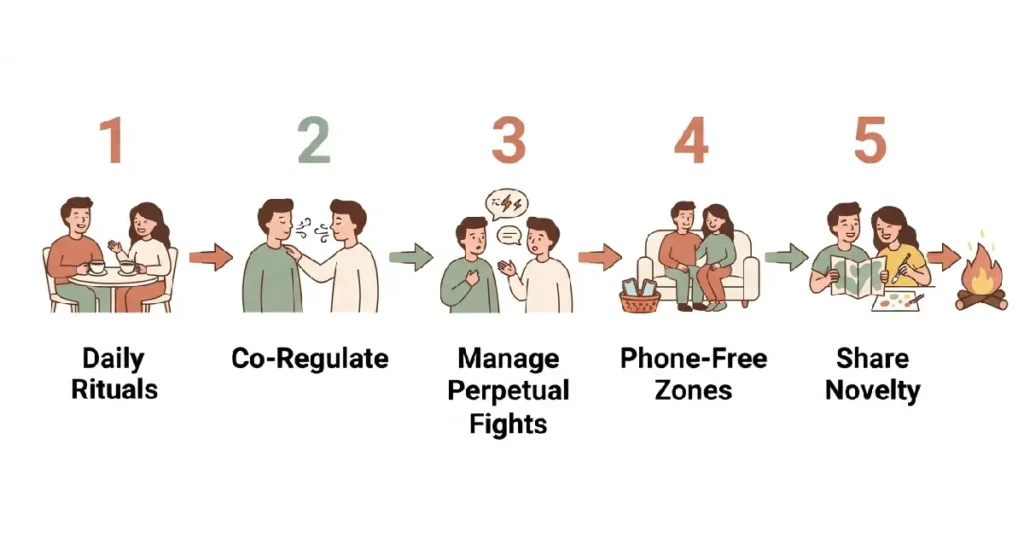
The claim is simple. Ordinary moments become bonding tools when you repeat them on purpose.
These rituals are a form of proximity-seeking, which means your attachment system is looking for closeness the way a body looks for warmth. You are not being needy when you want a real goodbye in the morning. You are doing what a bonded nervous system is built to do. Small, consistent contact has more staying power than rare grand gestures because the brain trusts what it can predict.
Maya and Jordan had been together seven years and living in the same apartment for four. From the outside they looked fine. Bills paid. Weekends planned. No screaming. Inside the apartment, though, they had become efficient. Jordan would walk in and go straight to the fridge. Maya would say “hey” without looking up from her laptop. They still loved each other. They just stopped arriving to each other. After a few months of that, even kind words started to sound thin. The first change that helped was almost embarrassingly small. For two weeks they agreed that whoever came home second would put their bag down, find the other person, and stay in a hug long enough to feel their breathing slow. Nothing dramatic. No speech. By the second week, Maya noticed her shoulders dropping before dinner. Jordan started talking about his day without being asked. The apartment did not get bigger. The people in it did.
What this means for you is that you do not need a new personality. You need a few cues your partner’s body can count on. A real greeting. Hands while the coffee brews. A goodbye that includes actual eyes. Those habits tell the attachment system, you are still my person.
2. Co-Regulation Strengthens Emotional Connection With Your Partner
You do not only calm yourself. In a close bond, you also calm each other. That process is called interpersonal co-regulation, or emotional co-regulation. It means one person’s steady presence helps the other person’s nervous system settle.
This is not rescuing. It is not fixing. It is sitting close enough, speaking slowly enough, and staying kind enough that your partner’s body gets the message: you are safe here. Higher success at this kind of support is tied to greater relationship satisfaction. Securely attached people often do this more easily because they can name a need without turning it into a crisis. But this is a skill, not a personality trait. You can learn it.
Most people in a tense moment try to win with words. Their partner does not need a better argument. They need a regulated person in the room. When your voice drops, when you stay, when you put a hand on their arm instead of building your case, you are practicing dyadic coping. That is the idea that stress is handled as a team, not as two separate projects. Your calm becomes usable to the person you love.
The next time your partner is flooded, try being the dimmer switch instead of the debate partner. Sit down. Slow your breath where they can see it. Ask one question and then wait. That pause is not passive. It is how emotional connection with your partner gets rebuilt in real time.
3. Relationship Communication Skills That Stop the Same Fight

You do not need to solve every disagreement to build healthy relationships. You need to stop treating every disagreement like a war that someone has to win.
Decades of work from John Gottman on solvable versus perpetual problems makes a distinction most couples never hear. Some problems can be settled. Who pays which bill. Who handles school pickup. Those deserve a plan. Other problems are perpetual. They grow out of temperament, history, and values. One of you is social and one of you is private. One of you is tidy and one of you can live with a sink full of dishes. Trying to erase those differences creates gridlock. Learning to talk about them with curiosity keeps the bond intact.
This is where many couples get stuck. They think repeating a fight means the relationship is broken. Repeating a fight often means you have found a perpetual problem and you are still trying to prosecute it. The healthier move is to stay interested in the need under the position. “I need the house calm” is different from “you are a slob.” “I need to feel chosen on weekends” is different from “you never want to go out.”
Approaches such as Emotionally Focused Therapy work on this same idea. They help you step out of the blame cycle and back into the attachment need underneath it. You fight for the relationship instead of against each other. Fondness can stay in the room even when agreement cannot.
That is not weakness. That is skill.
4. Phone Habits Quietly Damage Trust in a Relationship
Technology is not neutral in a partnership. Every time you reach for the screen instead of the person in front of you, their nervous system can read it as a miniature rejection. Researchers have a name for this: phubbing, or phone snubbing. It sounds cute. It does not feel cute when it happens every night on the couch.
This is not about manners. It is about safety. Face-to-face attention is one of the main ways adults still do attachment. When a phone becomes a third person at the table, quality time with partner stops being quality. It becomes shared isolation. Over time, that low-level stress makes people less generous, more watchful, and quicker to assume they do not matter.
The fix is specific. Create one or two phone-free zones and keep them. The bedroom is the most important because sleep and intimacy both need an unshared room. Meals are the second. Twenty undistracted minutes before bed will do more for relationship intimacy than a new streaming show you scroll through side by side. If you want the device in the evening, use it together. A game. A photo album. A plan for the weekend. Shared attention heals. Split attention slowly starves the bond.
5. Shared Novelty Rebuilds Relationship Intimacy

Routine keeps a household running. Too much routine makes two people feel like staff in the same office.
Novelty is not just entertainment. New shared experiences act as a buffer against outside stress and against the flatness that long-term love can slide into. Psychologist Arthur Aron’s work found that couples who did exciting, unfamiliar activities together felt more connected afterward. The point is not the activity. The point is that your brains encode each other as the source of aliveness again.
This can be small. A new walking route. A recipe neither of you has cooked. A class that makes you both beginners. Couples who keep adding new experiences give the relationship fresh memory to stand on. That matters when life gets heavy, because a bond with recent discovery in it is harder to reduce to logistics.
You are not trying to become a different couple. You are reminding your nervous systems that this person is still capable of surprising you.
Four Habits You Can Use This Week
One place to start is the Six-Second Reunion. When you come back together after work or even after a trip to the store, pause long enough to hug or kiss until your breathing matches. Six seconds is long enough for the body to notice. It is short enough that you will actually do it.
Consider the Weekly Emotional Check-In. Twenty minutes. Phones in another room. Each of you answers three things: what felt good between us, what felt off, and what I need this week. No fixing during the first telling. Just listening with your face, not your defense. Active listening here is simple. Eyes. A nod. A sentence that proves you heard the feeling, not just the facts.
A useful question to ask yourself during conflict is the Need Underneath question. “If this argument had a softer sentence, what would it be?” Then say that sentence out loud. “I miss you on weekends” will take you further than “you never make plans.”
The next time the evening starts to dissolve into screens, try the Phone Basket. One bowl by the door or on a shelf. Both phones go in from dinner until the check-in or until you go to bed. If that feels extreme, start with the first twenty minutes after you get home. Those twenty minutes are when bids for connection are easiest to miss and most important to catch. A bid is any small reach for attention, humor, or care. Turning toward it is how you build healthy relationships in the hours nobody photographs.
Maya and Jordan did not become a different couple. They became a more available version of the same one. The hug at the door. The phones in the kitchen drawer. The Sunday walk they had never taken because the old loop around the block felt good enough. The old fight about weekends still shows up. They just stopped needing it to end with a winner.
You already have the raw material. You have a person you keep choosing. What you may have been missing is a way to send that choice in a language the body believes.
Go back to that thin, faraway feeling from the start. The song in the other room. You do not need a louder life to bring it closer. You need a few faithful minutes that tell your partner, without a speech, I still turn toward you.
Add the kindling.
My Closing Remarks
I have sat with couples who could quote every communication rule and still feel unseen. The ones who turned toward each other did something humbler. They greeted each other like it mattered. They put the phone down before they felt like it. They let a perpetual fight stay unfinished without making it cruel. If you take one thing from me, take this. Love rarely dies in a single blow. It thins out in the minutes you keep treating as nothing. Those minutes are the whole relationship.
More Related Stories for You
- If the daily work of closeness has you wondering about the next chapter, read this next: when he wants to marry you but is scared
About The Author