
 David Wall
You’ve been lied to a little.
You were told that if you pick the right person and “communicate,” the rest will sort itself out. If that were true, you wouldn’t be searching for how to make your love last or asking yourself How to Make a Strong Relationship without feeling exhausted.
You love your partner.
But:
- The same arguments keep looping.
- You feel less “seen” than you used to.
- You might be doing all the emotional work and quietly resenting it.
You are not broken, and your relationship probably isn’t either. What you are running into is a skills and systems problem, not a lack-of-love problem.
Most couples are trying to build a long-term bond on vibes, chemistry, and half-remembered advice from social media. That is not enough. Relationships rarely fall apart from one huge betrayal. They wear down through a hundred tiny moments where:
- No one repairs after conflict
- Promises are made and dropped
- Phones get more attention than bids for connection
In this guide, you’ll get a clear system: steps, simple scripts, a comparison table, and a real story. My goal is simple: help you build safety, closeness, and momentum, even if things feel messy right now.
The Core Concept: How To Make A Strong Relationship Redefined
A strong relationship is not two people who never fight. It is emotional safety, dependable behavior, and fast repair when you mess up. You still have stress, busy seasons, and bad moods, but you carry them as a team instead of turning against each other.
Table of Contents
A strong relationship is built through consistent reliability, emotional responsiveness, and repair after conflict. Focus on daily “micro-moments” (turning toward bids), clear boundaries, and structured check-ins. Strong couples don’t avoid problems, they recover quickly and keep choosing each other.
Strong couples do three things very well:
- They keep promises, even small ones.
- They respond when the other reaches out.
- They repair quickly when conflict goes off the rails.
Daily rituals of connection hold all of this together. That might be a short morning check-in, a 10‑minute evening talk, or a nightly hug before sleep. Think of these as the “maintenance plan” for your bond.
What Is A Strong Relationship Really?
Let’s sharpen the definition:
- Strong = resilient. You can face money stress, health scares, or parenting chaos without sliding into contempt, control, or emotional shutdown.
- Strong = adaptable. Both of you keep growing. The bond stretches to fit new jobs, kids, grief, or aging parents instead of cracking under pressure.
- Strong = interdependent. You rely on each other, but you don’t erase yourselves. You still have your own hobbies, opinions, and friends.
In short: you are close, but not fused; committed, but not caged.
The Science And Data Behind Strong Relationships
Researchers do not just study feelings. They track relational behaviors that can actually be counted:
- Showing companionship and affection
- Fulfilling agreed-upon duties (like chores or shared tasks)
- Staying open instead of defensive
Recent work in journals such as Scientific Reports has tested couples on these behaviors and found that they line up closely with satisfaction and long-term commitment.
Another big theme in research is Perceived Partner Responsiveness (PPR). That is the felt sense of “you get me, you care about what I feel, and you respond.” Studies link PPR with better emotional health, stronger commitment, and even better sex. Feeling seen is not fluff; it predicts whether a relationship feels alive.
Good communication skills help you get there. Things like active listening, using “I” statements, clear boundaries, and real conflict resolution and repair are not therapist buzzwords. They are tools that help your nervous system relax enough to trust.
“Love is not proven by big speeches, but by how you treat each other on ordinary days.”
This matters because your brain tracks patterns, not promises. Small daily behavior teaches your body whether you are safe with someone.
9 Actionable Steps To Build A Relationship That Feels Safe, Close, And Fun Again
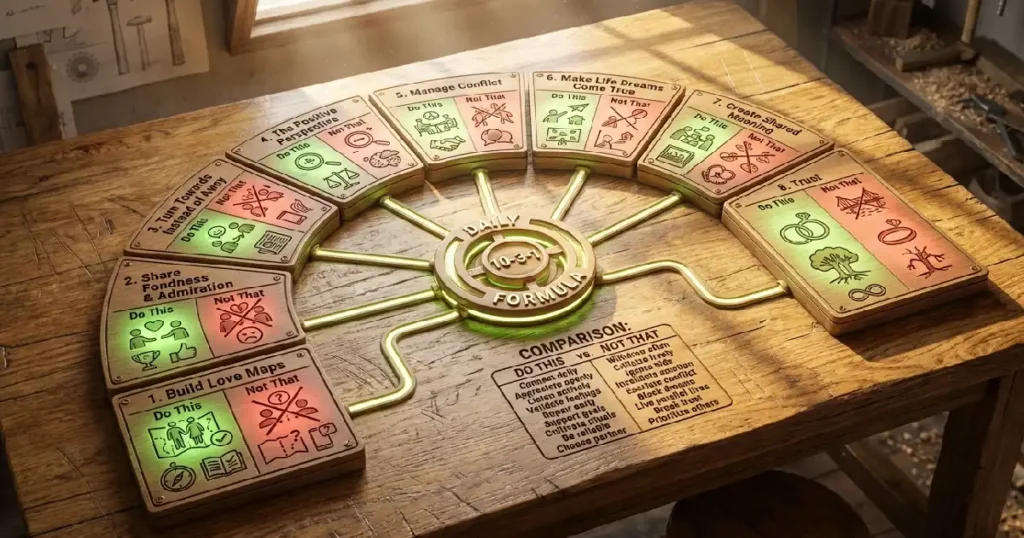
I want you to think about this section like a field guide. Use what fits today and come back for the rest later.
The Daily 10‑3‑1 Formula
Before we get into the nine steps, here is a simple model you can hold in your head:
- 10 minutes: one daily stress-reducing talk
- 3 bids: respond warmly to three small bids for attention
- 1 promise: keep one small promise every day
I will keep pointing back to this formula. It is small enough that real people can actually keep it going.
Step 1: Build “Reliability Credit” With Tiny Follow-Through
Do This:
Pick one repeatable promise you can keep every day:
- Text when you are running late
- Take out the trash without being asked
- Start the coffee in the morning
Not That:
Do not disappear for a week, then show up with flowers and a speech.
Why it works:
Trust grows from predictability, not dramatic apologies. Every kept promise is like adding a dollar to your shared trust account.
Step 2: Use A 10-Minute Daily Stress-Reducing Debrief
Do This:
- Take turns sharing “what was hard today.”
- The listener practices active listening:
- “What I hear you saying is…”
- “That would feel heavy to me too.”
No advice unless asked.
Not That:
Do not turn this into a problem-solving meeting or a chance to correct them.
This short talk teaches your bodies, “My partner is my safe place,” which is the core of emotional intimacy.
Step 3: Upgrade Communication Into A 3-Skill Stack
Do This: Use this simple script:
- Feeling: “I feel… (sad, scared, angry, lonely).”
- Meaning: “About… (the event), because it means… (I am not important, I am alone).”
- Request: “I need… (a hug, clearer plans, a check-in text).”
Example:
“I feel hurt about yesterday when you cancelled dinner. It means to me that I am last on your list. I need us to agree on changes earlier.”
Not That:
Skip “You always…” or “You never…” Those phrases tell the other person, “You are the problem,” and they shut down.
This is conflict resolution and repair in plain language.
Step 4: Master The 20-Minute Reset When Conflict Spikes
Do This:
- Say, “I am getting too heated. I care about this, so I need 20 minutes to calm down. Can we pick this up at 7:30?”
- Separate and do something that soothes your body: walk, stretch, breathe, music.
- Come back and pick one issue to discuss.
Not That:
- Do not storm out without a plan to return.
- Do not use breaks as punishment.
This reset lowers fight-or-flight so your brain can actually hear your partner again.
Step 5: Turn Toward Bids (The Hidden Glue Behavior)
Your partner says, “Look at this meme,” or “Guess what happened today,” or they sigh as they sit down. Those are bids for connection.
Do This:
- Pause the screen.
- Make eye contact.
- Give a short, warm response: “Tell me,” “That sounds rough,” “That is awesome.”
Not That:
- One-word replies
- Grunts
- Answering while scrolling
Research from the Gottman Institute shows couples who often turn toward bids stay together far more often than couples who ignore them. Small moments, huge impact.
Step 6: Create 3 Rituals Of Connection (Morning, Reunion, Night)
Do This: Pick three simple habits:
- Morning: a 30-second hug or “What are you facing today?”
- Reunion: a short check-in before anyone checks their phone
- Night: a “goodnight” touch and one thing you appreciated
Not That:
Waiting for vacations or big dates to feel close.
Rituals tell your nervous systems, “We are a team, every day,” which supports long-term connection.
Step 7: Set Boundaries That Protect The Relationship, Not Punish

Do This:
Use clear, calm language:
- “I am not able to talk about this while we are yelling. I will take a break and come back at 8.”
- “I am not okay with name-calling. If it starts, I will pause the conversation.”
Not That:
- Silent treatment
- Threats to leave to control the other person
- Demanding passwords in the name of “trust”
Public health guidance, such as from the CDC on healthy relationships, stresses respect, equality, and consent. Boundaries are about safety and respect, not power.
Step 8: Make Fairness Visible: Roles, Chores, And Mental Load
Most resentment is not about one dish or one bill. It is about carrying the mental list alone.
Do This:
Once a week, set a 15‑minute timer and ask three questions:
- What am I carrying that you do not see?
- What are you carrying that I do not see?
- What can we swap or adjust this week?
Write down who owns what.
Not That:
- Hoping they will “just know”
- Keeping score silently
Equal does not always mean 50/50, but it does mean visible and fair to both of you.
Step 9: Build Shared Meaning: The “Why” That Outlives Moods
Busy couples often live like roommates who share logistics. That kills long-term joy.
Do This:
Choose one shared project for the next 3–6 months:
- Training for a 5K
- Cooking through a new cookbook
- Saving for a trip
- Volunteering together
- A shared faith or growth practice
Not That:
Only talking about bills, kids, and schedules.
This shared meaning is the “story of us.” It makes stress feel like something you face together, not a storm you face alone.
Common Mistakes And How To Avoid Them
Let’s be blunt for a minute. Here are three common traps that quietly drain strong relationships, plus simple ways out.
Mistake 1: Turning Talks Into Trials
You bring up a problem. Your partner feels attacked. Suddenly you are arguing about “what really happened” instead of how you both feel.
Try this instead (step by step):
- Start with an “I” statement:
- “I feel hurt when plans change last minute, because it makes me feel unimportant.”
- Ask for their view:
- “Can you tell me how it looked from your side?”
- Pause and reflect back one thing they said before you respond:
- “So you felt rushed and forgot to text. That makes sense.”
You are no longer in a courtroom. You are two humans trying to understand each other.
Mistake 2: Calling It “Boundaries” When It’s Actually Control
Checking phones, demanding passwords, or cutting off friends is not about safety; it is about fear.
Healthier path:
- Name your own limit:
- “I can’t be in a relationship where we yell or threaten to leave during arguments.”
- State the behavior you will follow:
- “If that happens, I will pause the talk and come back after we both cool down.”
That is a real boundary: your line, your action, no threats.
Mistake 3: Pretending You Are Fine To Avoid Conflict
Silence feels easier in the moment, but it grows distance.
Try this message instead:
- “I don’t want to fight, but I also don’t want to quietly pull away. Can we set aside 15 minutes tonight to talk about this?”
You respect yourself, and you respect the relationship.
“Do This / Not That” At A Glance
| Relationship Area | Do This (High-Leverage) | Not That (Common Trap) | Why It Changes Outcomes |
|---|---|---|---|
| Conflict | Time-out + return plan | Escalate until someone “wins” | Lowers arousal and lets empathy come back |
| Communication | Validate, then problem-solve | Fix or defend immediately | Reduces defensiveness |
| Trust | Small consistent follow-through | Big apology, same behavior repeats | Builds reliability credit over time |
| Connection | Rituals + responding to bids | “We will connect when life calms down” | Prevents slow emotional drift |
| Boundaries | Clear limits + respect | Control or checking to soothe anxiety | Protects autonomy and emotional safety |
The Simplified True Story: The Turnaround

Maya and Jordan were the couple everyone thought was “fine.” No screaming matches, no dramatic breakups. Just distance.
Most nights around 9:30 pm, they sat on opposite ends of the couch, faces lit by separate screens. When Maya spoke, Jordan often answered with half a sentence while scrolling. She started doing all the planning, all the apologies, and then hating that about herself.
Their fights were rarely about big issues. They were about detergent, dinner, and forgotten errands. Jordan would forget to pick something up, Maya would snap, he would shut down. They promised to “communicate better,” which usually meant one of them delivering a long speech while the other waited to talk.
One night, after another icy argument, they tried something different: a 10‑minute stress-reducing debrief. No advice, no debate. Just listening.
They made three rules:
- Ten minutes, phone in another room.
- The listener had to mirror: “What I hear you saying is…”
- The speaker had to end with one clear request, not a character attack.
At first it felt awkward. Jordan kept wanting to fix things. Maya kept wanting to pile on old complaints. But they stayed with the structure.
Within two weeks, the tension softened. They argued less, not because problems vanished, but because they felt less alone. By week four, Jordan started initiating the talk: “Want our ten minutes?” Maya stopped testing him for attention, because she no longer needed proof.
Their relationship did not turn into a fairy tale. It became something much better: repairable.
“Strong couples are not the ones who never break; they are the ones who keep repairing.”
This matters because repair gives you hope. If you can fix it, you do not have to fear every bump.
Comparative Analysis: Strong Relationship Vs. Low-Conflict Relationship
Many people think “We barely argue” is the gold standard. It is not. Sometimes it simply means no one is telling the truth.
| Model | Pros | Cons | Time Required |
|---|---|---|---|
| Strong Relationship (Resilient + Repair-Focused) | High trust, faster repair, deeper intimacy, flexible under stress | Needs practice, honest talks can feel uncomfortable | 10–20 minutes a day + short weekly check-in |
| “Low-Conflict” Relationship (Avoidance Peace) | Fewer open fights in the short term | Emotional distance, unmet needs, surprise breakups | Low daily time, high long-term cost |
| “High-Intensity” Relationship (All Chemistry) | Big passion, excitement | Volatile, hot-cold pattern, trust erosion | Time varies, often crisis-driven |
Real strength is not the absence of conflict.
Real strength is the presence of repair and reliability.
If you are willing to have hard conversations kindly, keep small promises, and practice emotional self-soothing, you can shift from “low-conflict and numb” to “honest and alive.”
Frequently Asked Questions
Frequently Asked Questions (FAQs)
1) What Makes A Relationship Strong, Really?
A strong relationship is less about constant happiness and more about emotional safety, reliability, and repair. You feel respected, you can be honest without walking on eggshells, and you trust your partner’s intentions. Strong couples still disagree, but they recover faster and keep choosing teamwork instead of trying to win against each other.
2) How Can I Improve My Relationship Without My Partner Changing First?
Start with what you fully control: your daily behavior. Keep one small promise every day and try a 10‑minute check-in where you listen, mirror, and validate before solving anything. This often lowers defensiveness and invites your partner to soften. You are not doing all the work; you are changing the pattern.
3) How Do You Rebuild Trust After Repeated Disappointments?
Trust is rebuilt through predictable follow-through, not perfect speeches. Pick a few clear commitments together, write them down, and review them weekly. When one is missed, talk about it and repair quickly instead of hiding. Over time, your nervous system learns, “They are honest and consistent, even when it is uncomfortable.” That is how trust regrows.
4) What Are Healthy Boundaries In A Strong Relationship?
Healthy boundaries protect respect, safety, and individuality. They sound like, “I am willing to talk when we are both calm,” or “I am not okay with insults.” They are about your behavior, not controlling your partner. Strong boundaries reduce resentment because expectations are clear and conflict does not turn into emotional harm.
5) When Should Couples Consider Therapy Or Outside Help?
Consider therapy when you keep having the same fight, feel stuck or unsafe, or notice patterns of control, contempt, or repeated broken trust. Therapy is not a “last hope”; it is a structured way to learn skills and get a neutral view. If there is emotional or physical harm, reach out for safety support as soon as possible.
For more on healthy partnership patterns, see the American Psychological Association’s relationship resources and this Mayo Clinic guide on relationships and communication.
Final Takeaway
If you are still reading, I know something about you: you care enough to do the work. And maybe you are a little scared that you waited too long. Here is the good news: relationships are systems, and systems can change.
You do not have to fix everything this week. Start with one piece:
- One daily promise you keep
- One 10‑minute stress debrief
- One ritual of connection you do no matter what
That is it. Three small moves that begin to rewrite the story you live inside together.
Tonight, try this exact line:
“What felt heavy today, and do you want comfort or solutions from me?”
Then give only what they asked for, for ten minutes. No fixing. Just presence.
If you keep showing up like that, day after day, you are no longer guessing at How to Make a Strong Relationship. You are building it in real time.
And if you feel tired or discouraged, please hear this: you are allowed to want more than “not terrible.”
Reflection question:
What is one behavior you are willing to practice for the next seven days that would make your partner feel more seen?
My Closing Remarks:
Let me be direct with you. Most people treat relationships like a gamble: hope, wish, repeat. You just did something different. You studied the game. You saw where you contribute to the mess and where you can change it. That is rare. I have watched people rebuild trust and closeness from very dark places using the exact tools you just read. So take one step today. Do not wait for the “right moment.” This is it.
More Related Stories For You
- If you are planning a future together, it helps to agree on the big topics early. You can start with these things to discuss before marriage.
- If jealousy has been quietly poisoning your connection, this guide on jealousy issues before marriage will help you tell the difference between intuition and insecurity.
- And if you are craving deeper closeness, this article on how to build emotional intimacy can support you as you add more honesty, curiosity, and warmth to your daily life together.
About The Author