
 Sara Carmen
Your urge to post may not mean you lack boundaries; it may mean your nervous system is asking strangers to calm fears your relationship has not yet learned to hold.
Key Points
- Wanting to Keep Your Relationship Private can clash with anxious attachment, online validation, and the quick relief of being seen.
- Oversharing is often a control strategy: you post the relationship story first so silence, doubt, or conflict cannot define it.
- Stronger social media boundaries help you move intimacy back where it belongs: between you and your partner.
Contents
Table of Contents
Your oversharing may not be a failure of boundaries. It may be a nervous system strategy. You can want a private love and still feel your hand reach for the phone when a text feels distant, a date feels perfect, or a small fight leaves you shaky. The post becomes proof. The likes become a lullaby.
Someone might think you posted the soft-launch photo because you wanted attention. But what they do not see is the tiny panic under it: the fear that if no one sees the relationship, it might not be real enough.
Someone might think your long caption about “choosing love through hard seasons” is brave. But what they do not see is the argument that happened the night before, the apology that still feels unfinished, and the hope that public praise will make private pain feel less embarrassing.
Someone might think tagging your partner in every story is just affection. But what they do not see is the way you check whether they reposted it, how long they took, and what it means if they did not.
This pattern has a name in relationship research: relationship visibility, which means making your relationship a central part of how others see you online. In work summarized by the Society for Personality and Social Psychology on relationship visibility, people with higher attachment anxiety wanted their relationships to be more visible, especially when they felt unsure about their partner’s feelings.
That does not mean every couple post is insecure. It means your urge to post has a story behind it.
And the story is usually deeper than “I need to stop being online so much.”
The Intimacy Paradox: Wanting to Keep Your Relationship Private While Posting Love Online
You may crave the “private but not secret” relationship. You want the quiet Sunday mornings, the inside jokes, the soft life without a public scoreboard. You do not want strangers, old classmates, exes, or distant relatives tracking every mood shift in your relationship.
Then something happens.
Your partner takes a little longer to reply. A friend asks if you two are still good. You see another woman post flowers, a ring, a vacation, or a caption that seems effortless. Suddenly, privacy feels less like peace and more like disappearance.
This is the intimacy paradox: you want closeness that does not need an audience, but your nervous system has learned to use the audience as proof of closeness.
A useful term here is external regulation. It means using something outside yourself to calm an internal emotional state. Healthy external regulation can look like calling a trusted friend, asking your partner for reassurance, or taking a walk. But social media offers a faster version: post, refresh, receive proof that people see you, want you, envy you, or approve of you.
The problem is that fast relief can become expensive later.
You do not just share the relationship. You train your brain to need spectators before the relationship feels secure.
Privacy is not secrecy. Secrecy hides truth. Privacy protects tenderness. If your partner refuses to acknowledge you at all, flirts publicly while calling you “private,” or keeps you hidden to avoid accountability, that is not healthy privacy. But if you are both known, chosen, and committed, keeping intimate details offline can be an act of care.
The difference matters.
Inside the Anxious Attachment Loop: How Online Validation Feels Like Relationship Security
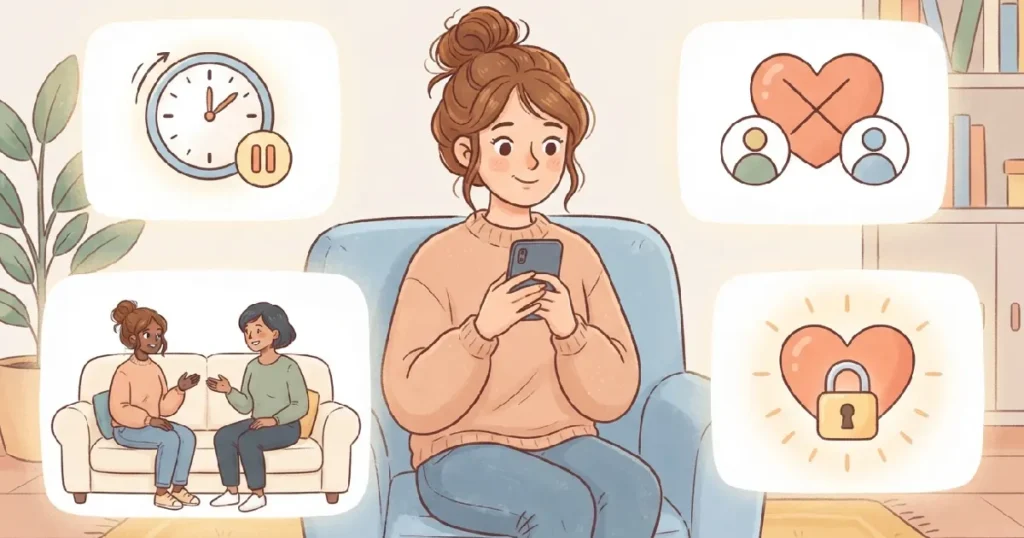
Anxious attachment is a relationship pattern where closeness feels deeply desired but also uncertain. You may fear abandonment, read small changes as signs of rejection, or need frequent reassurance to feel safe. It is not a character flaw. It is a protective pattern that often forms when love has felt inconsistent.
When anxious attachment meets social media, a loop can form:
You feel unsure.
You post.
People respond.
You feel calmer.
The calm fades.
You need to post again.
That is not weakness. That is wiring.
Dopamine plays a role here. Dopamine is a brain chemical involved in motivation, reward, and wanting. It is not just the “pleasure chemical.” It helps your brain chase what might feel rewarding next. A neuroimaging study on what the brain “Likes” found that giving and receiving social media likes involved brain areas tied to reward, including the striatum, a region that helps your brain register reward and anticipation.
So if keeping your relationship private suddenly feels boring, flat, or strangely unsafe, you may not be missing love. You may be missing the reward loop.
This is why slow dating and offline intimacy can feel surprisingly uncomfortable at first. A quieter relationship gives you fewer digital hits. No constant story replies. No public comments. No “you two are goals.” No visible scoreboard.
If you confuse digital quiet with emotional absence, you may start posting to create noise again.
Maya, 29, loved the idea of a private relationship with Jordan. She told friends she wanted something mature and peaceful. But whenever Jordan seemed tired or less affectionate, she posted a photo of them with a caption about loyalty, growth, and “real love.” If he reposted it, she felt calm for a few hours. If he did not, she spiraled. In therapy, she realized she was not posting to celebrate Jordan. She was posting to measure whether she still mattered. When she began asking him directly for reassurance before posting, the urge softened. Their relationship did not become hidden. It became less managed by an audience.
Most people in this pattern do not realize they are seeking safety. You may call it sharing. Your body may be using it as checking.
That distinction changes everything.
Curated Vulnerability: When Relationship Privacy Becomes a Control Shield
Curated vulnerability is when you share something emotionally real, but in a polished way that lets you control how others receive it. It is vulnerability with lighting, edits, and a caption. It can look honest, but it may protect you from the harder kind of honesty.
The harder kind happens offline.
It is saying, “I felt scared when you pulled away last night.”
It is asking, “Can we talk about what happened without blaming each other?”
It is admitting, “I wanted to post that because I needed proof we were okay.”
Online, you can edit the tone. You can delete a comment. You can choose the photo where you look unbothered. You can turn pain into a lesson before you have actually processed it.
Real intimacy does not let you control the camera angle.
This is where oversharing can become a control shield. You post the anniversary before anyone can ask why you have seemed distant. You post the flowers before anyone can suspect the apology behind them. You post a vague quote about disrespect because saying the sentence directly to your partner feels too risky.
A study of oversharing on social media found that anxiety, attention-seeking, and problematic social media use were linked with higher levels of online oversharing among adolescents. You are not an adolescent, and one study does not explain every adult relationship. Still, the emotional mechanism may feel familiar: when anxiety rises, the urge to disclose can rise with it.
Sometimes the post is not communication. It is pressure.
This can show up as sadfishing, which means sharing emotional distress online in a way that seeks sympathy, concern, or a reaction. You may not mean to manipulate anyone. You may simply feel alone. But if your partner learns about your hurt through your public post before they hear it from you, trust can crack.
There is also toxic self-disclosure, a plain-language term for sharing private information at a depth or frequency that damages safety, dignity, or consent. It can include screenshots of fights, hints about sexual issues, family conflict, private gifts, location details, or “lessons” that expose your partner without naming them.
A relationship under constant posting can become a glass terrarium: visible from every angle, arranged beautifully, and too dry for anything tender to grow.
The least obvious part is this: oversharing is not always about revealing too much. Sometimes it is about relocating where the relationship is regulated. The emotional center moves from the room you share to the audience watching it.
Once that happens, your partner is no longer only your partner. They become material for public reassurance.
That is a lonely trade.
The Digital Vulnerability Hangover: Rebuilding Social Media Boundaries in Relationships

You know the vulnerability hangover. It is the tight chest after you post too much. It is checking who watched. It is rereading your caption and wondering if you sounded needy, dramatic, fake, or exposed. It is the sudden wish to disappear after wanting so badly to be seen.
A vulnerability hangover is the emotional regret that follows overexposure. It does not mean you did something unforgivable. It means your boundary system woke up after the post went live.
Healthy self-disclosure brings people closer. Oversharing often makes you feel briefly connected, then strangely alone. That is because an audience can react to your relationship, but it cannot repair it.
There is another cost: your partner may begin to feel watched rather than loved.
Pew Research Center’s Dating and Relationships in the Digital Age found that 51% of partnered U.S. adults said their partner was at least sometimes distracted by their phone during conversations. Among social media users under 30, 48% said these platforms were at least somewhat important for showing how much they care about their partner.
That tension is real. Your phone can help you express love, but it can also pull you out of the moment where love is actually happening.
Researchers call one version of this phubbing, which means phone-snubbing: ignoring someone in front of you because your attention is on your phone. A University of Connecticut report on phone use and relationship satisfaction described findings that phubbing was linked with feeling deprived of affection, which was linked with lower relationship satisfaction.
That matters because oversharing does not only happen after the moment. It can steal the moment while it is still alive.
You are at dinner, and instead of letting joy land in your body, you start framing the shot. You are on a walk, and instead of noticing how your partner’s hand feels in yours, you think about the caption. You receive a sweet message, and instead of letting it be yours, you screenshot it.
Little by little, the relationship becomes less of an experience and more of an exhibit.
A useful check is simple:
- Would this moment still matter if no one saw it?
- Am I posting to celebrate, prove, punish, or pressure?
- Did my partner consent to this detail being shared?
- Do I feel closer to my partner after posting, or only calmer online?
- Am I using my followers as a substitute for one honest conversation?
These questions are not meant to shame you. They are meant to return your power to you.
How to Stop Oversharing and Keep Your Relationship Private Offline
One place to start is The Ten-Minute Privacy Pause. Before you post anything emotional about your relationship, wait ten minutes and ask, “What am I hoping this post will do for me?” If the answer is proof, pressure, revenge, or reassurance, the post is probably carrying a job it cannot handle. For example, instead of posting a vague quote after a fight, save it to drafts and breathe until your body is calm enough to speak clearly.
Consider The Owner Question. Ask, “Does this detail belong only to me, or does it belong to both of us?” Your feelings are yours. Your partner’s texts, face, body, trauma, family story, apology, and private habits are shared territory. A photo of your coffee on a date may be yours to share. A screenshot of their apology is not.
Try First Share Offline. When you want to post something tender, anxious, or charged, share it with the right person first. That might sound like, “I felt really happy tonight and wanted to post, but I also want to just tell you first.” Or, “I feel tempted to make a story because I’m anxious. Can I ask for reassurance directly?” This turns online validation back into real connection.
Create a Private-but-Not-Secret Agreement. Together, sort content into green, yellow, and red zones. Green might include casual photos, public events, or a birthday post. Yellow might include vacations, milestones, or couple updates that need consent. Red might include fights, screenshots, sexual details, locations, family issues, and anything shared during a vulnerable moment. The point is not control. The point is respect.
The next time your hand reaches for your phone after a beautiful moment or a painful one, treat that urge as information. It is telling you something needs care.
Maybe you need reassurance.
Maybe you need repair.
Maybe you need to feel chosen.
Maybe you need to let joy stay private long enough to become real inside you.
You do not have to erase your relationship from the internet to keep your relationship private. You only have to stop asking the internet to hold what belongs between two people.
Your love does not need to live inside a glass terrarium. It needs air, shade, privacy, and time.
Let love breathe.
My Closing Remarks
Here is the bold truth: if your relationship only feels secure after an audience claps for it, the audience has become part of the relationship. I have watched kind, intelligent people confuse exposure with closeness because privacy felt like being erased. It is not. Privacy is where desire, repair, and trust grow without performing. The internet can witness your joy, but it cannot hold your bond. That work belongs to the two of you.
More Related Stories for You
- If online secrecy has made you question your partner’s loyalty, read this guide on a cheating husband.
About The Author