
 David Wall
The good life is not a finish line you cross. It is a house you can actually live in.
Key Points
- What is success in life is not a checklist of money, titles, and status. It is a daily match between your values and how you spend your hours.
- Traditional winning often costs more in health, time, and connection than it returns in fulfillment. That is a poor Life ROI.
- The metrics that matter most are quiet: time you control, people who stay when status drops, and a nervous system that can rest.
Contents
Table of Contents
We were handed a map that looked finished. Degree. Job. Promotion. House. Then the feeling of having made it. We followed that map with real effort and real sacrifice. For a lot of us the feeling never arrived.
You did the work. You checked the boxes. And still there is a hollow quiet that no raise quite fills. That is not proof that you are ungrateful. It is proof that the map was incomplete.
Here is the short answer. Success in life is not a title or a salary. It is the daily match between how you spend your hours and what you actually value. When your time, your relationships, and your peace line up, you stop chasing a feeling you already have.
Someone might think a corner office means they won. But what they don’t see is the 11 p.m. Slack messages and a marriage running on leftover energy.
Someone might think a high salary is the proof. But what they don’t see is Sunday-night dread and a body that never fully comes down.
Someone might think stepping off the ladder means they gave up. But what they don’t see is the nerve it takes to define a life on their own terms.
Left unexamined, this pattern does more than drain your joy. It can cost you years and people you cannot buy back.
Why Traditional Success Fails to Deliver Happiness
Psychologists have a name for the letdown you feel after you “arrive.” It is called the arrival fallacy. That is the belief that reaching a big goal will create lasting happiness. The promotion. The house. The number in the bank. Your brain treats that moment as the finish line. Then Monday comes. The feeling fades. You set a bigger target.
This happens because of hedonic adaptation. In plain language, your mind gets used to good things fast. The new salary becomes normal. The title becomes expected. The house becomes a list of repairs. You are not broken for adapting. Your nervous system is built to notice change, not to stay thrilled by the same reward.
Most people in this situation do not realize they were trained to confuse human worth with economic output. In the US and UK that training starts early. Be productive. Be impressive. Be busy. Rest looks like laziness. A full calendar looks like value. So you keep performing. And you keep waiting for the performance to turn into peace.
It does not.
The Illusion of the Corporate and Material Checklist
The old sequence still runs in the background of a lot of smart lives. Degree, then job, then marriage, then house, then “we made it.” Those milestones can be meaningful. They are not a personality. They are not a nervous system. They are not a substitute for a life you can inhabit.
Burnout is often the bill for treating that checklist as a moral test. You can hit every marker and still feel like a guest in your own days. That gap has a name in research too. Affective forecasting error is the tendency to mispredict how much a future event will change how you feel. You overestimate the joy of the win. You underestimate how quickly ordinary life returns.
You are not failing at success. You may be succeeding at the wrong scoreboard.
The High Cost of Winning
Forums and late-night conversations are full of people who “won” and then took inventory. Health gone. Youth spent in rooms with bad lighting. A partner who became a roommate. Kids who know your calendar better than your face.
This is where a Life ROI calculation belongs. ROI means return on investment. A Life ROI asks a harder question than “Did I get the outcome?” It asks “What did this goal cost my body, my sleep, my closest people, and my sense of self, and was the return worth that price?”
A goal is not successful if you paid more in stress than it gave back in meaning. A title is not a victory if it required you to abandon the only relationships that would still be there if the title vanished.
That is not soft thinking. That is accurate accounting.
The Answer Most People Miss: Redefining True Success
The answer most people miss is this. What is success in life is not a static destination. It is an ongoing metric of freedom, connection, and inner quiet. Your outer life has to match your inner values. When it does not, no amount of applause will fix the mismatch.
In psychology this inner match is close to eudaimonic well-being. That is well-being built from meaning, growth, and living in line with your values. It is different from hedonic well-being, which is the chase of pleasure, comfort, and status hits. Hedonic hits fade. Eudaimonic alignment holds.
Self-determination theory, developed by Edward Deci and Richard Ryan, names three psychological needs that keep a life feeling like it belongs to you. Autonomy is having a real say over your time and choices. Competence is using your skills in ways that matter to you. Relatedness is being known and valued by people who are not impressed by your LinkedIn. When those three are starved, a high salary can still feel like a golden cage.
You have been decorating the outside of a house you barely live in.
Time Sovereignty Over Financial Capital
Money buys options. It does not automatically buy a life. The modern luxury that intentional people are quietly chasing is time sovereignty. That means real control over your calendar. Who gets your hours. When you rest. When you are reachable. When you are not.
Trading 80-hour weeks for nicer objects is a worse deal than it looks on social media. You spend your prime energy to purchase a version of rest you are too depleted to enjoy. The true elite in this new math are not the people who never stop. They are the people who can stop without their identity collapsing.
Financial capital is a tool. Time is the currency you actually live in. If your money grows while your hours disappear, you are rich on paper and poor in the only resource that does not refund.
The Power of Deep Relational Safety Nets
Professional status is a spotlight. It is bright. It moves. When the project ends or the company changes, the light goes with it. A relational safety net is different. It is who remains in your corner when the transactional parts of life drop away. Money. Rank. Usefulness.
Long-term data is blunt on this point. Fulfillment is rooted in social connection far more than in wealth or IQ. Data published by the World Economic Forum on the Harvard Happiness Study shows that supportive relationships are the single strongest predictor of lifelong health and joy. Not the resume. Not the house. The quality of your bonds.
That finding should rearrange your week. If connection is the strongest predictor, then the meeting you never miss and the friend you keep postponing are not equal investments. One of them is decorating the house. The other is living in it.
The Unquantifiable Silent Metrics of Success in Life
Some of the most honest measures of a good life will never show up on a dashboard. Call them silent metrics.
How deeply you sleep at night.
Whether your daily routine requires pretense.
Whether you can smile without hunting for a reason.
The respect that lingers after you leave a room, not the fear.
The absence of a constant inner courtroom.
These are not poetic extras. They are signals from your autonomic nervous system. If your body cannot downshift, your life is running at a cost your mind has learned to call “normal.” Deep rest is not laziness. It is evidence that your inner threat system is not stuck in the on position.
Maya Had Everything on Paper
Maya was 39, a vice president, and the person her family pointed to when they talked about “making it.” She had the salary, the renovated kitchen, the passport stamps. In my practice she sat very still and said she felt like she was watching her life through glass.
She was not depressed in the way people expect. She was empty in a more specific way. Every win had been spent in advance. The next goal was already waiting. Her marriage had become logistics. Her sleep was thin. She could not remember the last weekday she had not performed competence.
We did not start with a vision board. We started with a Life ROI. What had the last promotion cost. Twelve pounds. A friendship she let die. A jaw that clicked from clenching. When she saw the receipt, she stopped calling the emptiness “ingratitude.” She started calling it information.
Six months later her title had not changed. Her evenings had. She protected two dinners a week like client meetings. She stopped answering email in bed. She told one true thing to a friend instead of a highlight reel. The house she had been decorating started to have a kitchen she actually stood in.
That is not a fairy tale. It is what happens when you stop confusing the photograph of a life with the pulse of one.
What the Research Shows: Where Humans Find Actual Meaning
When tens of thousands of people are asked openly what makes life feel worth living, career advancement does not win. Across major economies, people rank family, physical health, and personal freedom above material well-being alone. An extensive global survey by the Pew Research Center on Meaning in Life found that these core human elements are cited as far greater sources of satisfaction than status markers by themselves.
That does not mean work is meaningless. Work can feed competence and even relatedness. It means work is a chapter, not the book. If your entire self-worth sits inside a role, a slow season at the office will feel like a character assassination. It is not. It is a season.
Most high achievers never learned that distinction. You were praised for output. So output became identity. When output dips, identity shakes. That shake is painful. It is also a chance to put your worth back where it belongs: in the person who remains when the metrics go quiet.
Actionable Solutions to Shift Your Life Metric Today

Knowing this is not the same as living it. One place to start is with small, named practices that move your scoreboard.
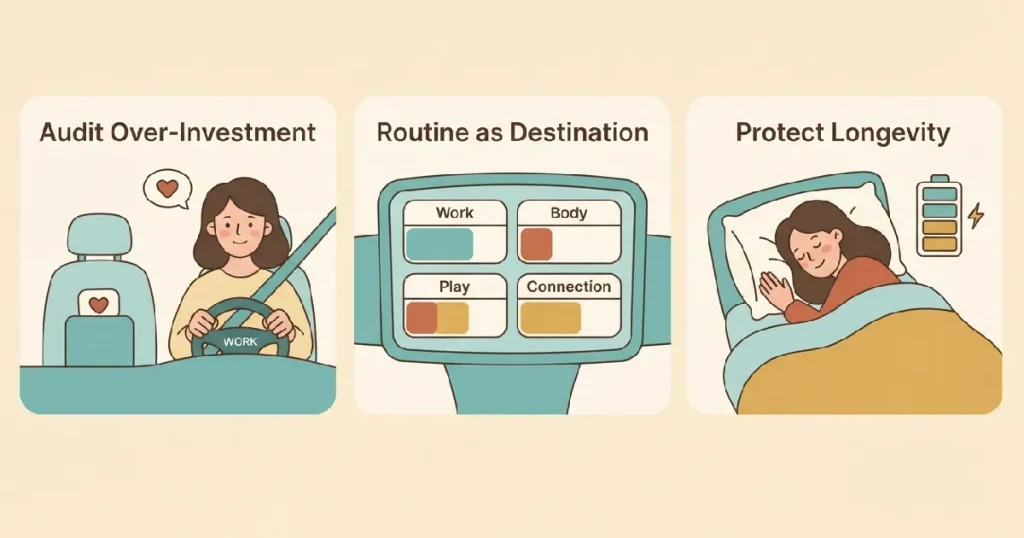
1. Audit Your Emotional Over-Investment
Intense career emotion is not always maturity. Sometimes it is a sign that your self-worth is over-tied to a single arena. A useful question to ask yourself is: “If this project failed and my closest people still loved me, would I still be okay?” If the honest answer is no, the job is driving and you are in the passenger seat.
The practice is simple. When a work slight or a win floods your body, pause long enough to name the feeling. Ambition. Shame. Hunger for credit. Fear of being ordinary. Listen to it. Then do not hand it the steering wheel. You can care about excellence without letting a quarterly review become a verdict on your existence.
The next time you catch yourself obsessing over credit, try this sentence: “This matters. It is not the whole of me.” Repeat it until your shoulders drop a centimeter.
2. Reframe Your Daily Routine as the Destination
Success is not a celebration you schedule after you survive your weeks. If your ordinary Tuesday requires an escape to be tolerable, the life is the problem, not your willpower.
Consider building a Life Balance Dashboard. Keep it simple. Four columns you check weekly: money and work, body, play, and connection. If three columns are empty and one is overflowing, you do not have a discipline issue. You have a design issue.
To help you structure those changes, a visual planning framework can keep personal milestones from getting crowded out by professional ones. Many people use structured resources such as the HubSpot Goal Setting Templates to put health, relationships, and work on the same page so the quiet goals stop losing to the loud ones.
A routine that is a celebration in itself does not mean every hour is bliss. It means you can smile at some point in an ordinary day without hunting for a reason. That is a silent metric. Treat it like one.
3. Prioritize Your Physical and Mental Longevity
A functioning body is not a lifestyle accessory. It is the only asset you cannot repurchase in original condition. Sleep, movement, and stress recovery are not the prize you earn after success. They are the ground success stands on.
Stress management is a competitive advantage because a flooded nervous system makes poor long-term choices. It grabs the short hit. It neglects the people who matter. It calls depletion “dedication.”
If you want numbers rather than vibes, track whether strain is outrunning recovery. Platforms like the WHOOP Performance Optimization Site exist to show whether your body is keeping up with the life you are asking it to run. You do not need a gadget to start. You need one non-negotiable: a bedtime you defend as fiercely as a board meeting.
Building a Life That Feels Good on the Inside
The final shift is almost embarrassingly simple. Success is when your external lifestyle matches your internal values. If you value presence and your calendar forbids it, you will feel poor no matter what you earn. If you value kindness and your workplace rewards only sharpness, the win will taste like metal.
You may be climbing a ladder that is leaning against the wrong wall. The courageous move is not to climb faster. It is to look at the wall.
For a longer view of how lives actually turn out, the qualitative records on the Harvard Study of Adult Development Site follow people across entire lifespans. The through-line is not who collected the most. It is who stayed connected, who could adapt, and who did not wait until the end to live inside their own days.
You now have a new way to read the emptiness. It is not a character flaw. It is a signal that the house is decorated and still unlived in. This week, pick one hour and inhabit it on purpose. No performance. No proof. Just a room in your own life with the lights on.
Build a life you do not need to escape.
My closing remarks
I have sat with enough high-functioning, secretly exhausted people to know this ache is not rare and it is not shameful. I have felt a version of it myself after seasons when my work looked full and my inner world felt rented out. The turning point was never a bigger goal. It was telling the truth about the price. If you are tired of winning in public and bracing in private, you are not behind. You are awake. That wakefulness is a beginning, not a verdict.
More Related Stories for You
- If the part of this that landed hardest was the people who remain when status falls away, you may also want good advice for a relationship that protects connection instead of treating it as leftover time.
About The Author