
 David Wall
Success is not a prize you chase. It is the shadow that follows you once you stop performing and start becoming.
Key Points
- What does it take to be successful is no longer talent, long hours, or a polished degree. It is adaptability, emotional control, and messy execution.
- Most people stall because they aim at the scoreboard. Lasting progress comes from building capability that money and titles cannot fake.
- The climb will cost you comfort, some friendships, and the old story you tell about yourself. That cost is the filter.
Contents
Table of Contents
We were sold a clean formula. Get the credential. Stay late. Follow the rules. Wait your turn. Then we watched people who ignored half of that script walk past us while we kept doing everything “right.”
The quiet answer is this: what does it take to be successful is not a louder grind. Success is a lagging indicator, a trailing result of how fast you can relearn, how well you can regulate your inner weather, and how completely you own your outcomes when no rescue is coming.
Someone might think the person who got promoted simply worked harder. But what they don’t see is the private decision to drop a skill that used to define them and rebuild before the market forced the issue.
Someone might think the freelancer who looks “lucky” has better connections. But what they don’t see is a year of unglamorous output, ignored group chats, and a refusal to wait until confidence arrived.
Someone might think you are failing because you lack talent. But what they don’t see is that talent without agility now expires the way unused software does. Quietly. Then all at once.
This pattern exists because the human brain loves certainty. Psychologists call this cognitive closure, the hunger for a finished answer so you can stop feeling the ache of not knowing. A degree, a title, a 5-year plan all soothe that hunger. They just no longer buy safety. Research on emotional intelligence, the ability to notice, name, and repair your own emotional state, shows that self-regulation tracks with higher pay and longer satisfaction at work far more reliably than raw intellect. That is why the old formula feels personal when it breaks. It was never only a career plan. It was a sedative.
Left unexamined, this gap does not just stall a promotion. It can become the story you tell about your worth.
Here is the reframe that changes the rest of this piece. Stop treating success as a destination you can aim at. Treat it as a side effect. You do not become successful by staring at success. You become the kind of person whose work, judgment, and stamina make success hard to avoid.
The 7 Brutal Truths of Modern Success
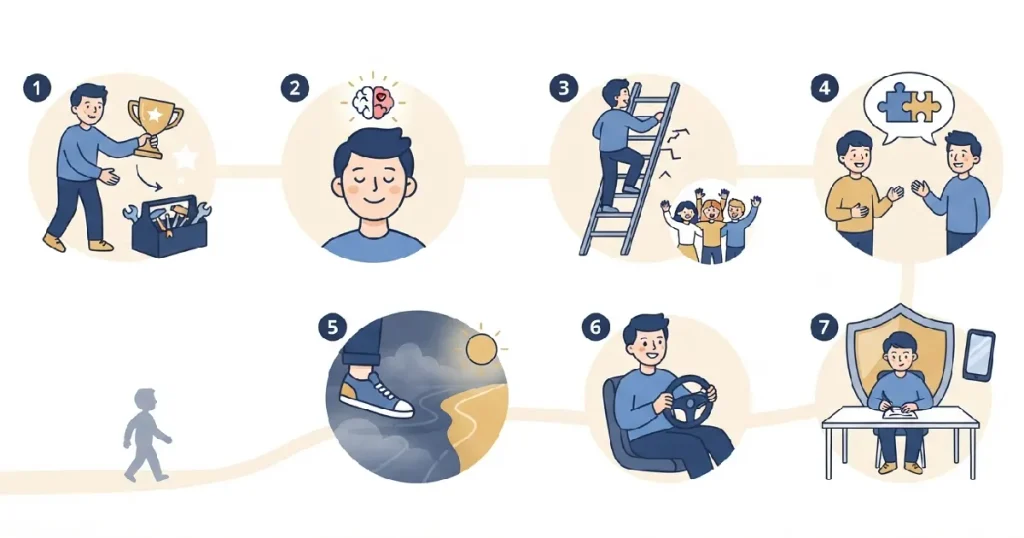
Talent Fades. Adaptability Is What It Takes to Be Successful
Relying on a fixed gift or a once-hot skill set is how capable people become outdated while still feeling busy.
Generative tools have flattened baseline competence. Writing a clean brief, coding a standard function, building a slide deck, summarizing a report: these used to mark you as sharp. Now they mark you as replaceable. A Forbes analysis of the new AI career divide describes the split already forming between people who still execute tasks and people who move into judgment, oversight, and original direction. The first group gets cheaper every quarter. The second group sets the terms.
The people pulling ahead are not lifelong masters of one static tool. They are meta-learners. That means they treat learning itself as the skill. They can re-skill on an 18-month cycle without making it a personality crisis.
If your identity is welded to “I am the Excel person” or “I am the writer,” you will defend the old self instead of updating it. The so-what is simple. Audit one skill you are proud of and ask whether the market still pays a premium for it, or only for the thinking around it.
Emotional Mastery Sets the Ceiling on Your Income
High intelligence gets you into the room. Emotional control decides how long you stay and what you earn while you are there.
A body of work indexed through the National Library of Medicine on emotional intelligence links emotional repair, self-awareness, and regulation to stronger salary outcomes and lasting job satisfaction. In plain language, the person who can cool their nervous system after a public slight makes cleaner decisions than the person who is still arguing in their head at 11 p.m.
Top performers treat outrage as a tax on attention. They do not feed workplace theater or online friction. They protect cognitive bandwidth, the limited mental energy you spend on focus, memory, and choice. Spend it on drama and you have less left for the work that compounds.
Most people in this situation do not realize they are leaking their best hours into emotional residue. If you want scale, start treating composure as a professional asset, not a personality trait you either have or lack.
The Climb Will Alienate People You Still Love
Raising your professional tier changes how your current circle sees you. That is not a side note. It is one of the costs almost no one warns you about.
When you break mediocrity, the first resistance often comes from the people closest to you. A joke about you “changing.” A sigh when you skip the usual Friday. A parent who liked you more when you were easier to understand. This is the knife ladder. Every rung up can cut, and the people below often see the blood before they see the height.
Seasoned professionals who remake their careers have to rebuild informal networks on purpose. Harvard Business Review’s work on career shifts and fractional leadership points to a practical move: you do not just change jobs. You change presence. You set new authority boundaries. You stop asking the old room for permission to become someone it cannot recognize.
This is lonely. It is also common, understandable, and not proof that you have become cold. You can keep love without keeping the old ceiling.
Human-Centric Skills Are Your Only Real Moat
Any process that can be written as a checklist will be automated. Your safety net lives in traits a model cannot copy at full fidelity: judgment, taste, cultural literacy, and the ability to sit with another human’s fear without flinching.
As data processing gets cheap, the World Economic Forum’s view of career success keeps returning to the same cluster: leadership, storytelling, and empathy rise in value. Machines can draft. They cannot yet hold a room, read a silence, or decide which risk is worth your name.
High earners keep repeating a blunt communication filter from the real world: W.I.I.F.M. What’s in it for me, from the other person’s side. Stop trying to sound clever. Translate every pitch, update, and ask into the pain you remove. “Here is my process” is noise. “Here is the delay I will kill for you” is money.
If you cannot say whose problem you solve in one sentence, you do not have a career strategy. You have a hobby with a job title.
Clarity Follows Action. It Never Arrives First
Waiting for perfect confidence or a flawless plan is socially acceptable procrastination. It looks responsible. It is usually fear in a nicer outfit.
Modern markets move too fast for a five-year blueprint that never leaves the notebook. Messy execution beats clean planning because the world talks back. A live customer, a live manager, a live failed launch gives you empirical data, meaning evidence from contact with reality, that a theory cannot match.
Confidence is not the fuel. It is the exhaust. You act while your hands shake, then the shaking has somewhere to go. Public mistakes are tuition. Hide them and you pay twice: once in delay, again in self-doubt.
The next time you catch yourself researching one more week, shrink the move until it is almost embarrassing, then make it before noon.
Radical Responsibility Is Not Optional Anymore
The economy may not be your fault. Navigating it is still your job.
No company, platform, or government is assigned to preserve your long-term security. That sentence can feel harsh. It is also the end of a certain kind of waiting. High performers, even when they hold traditional roles, start thinking like independent businesses. They keep a living portfolio. They keep relationships outside one org chart. They keep a skill that would still sell if the badge disappeared on a Friday.
This is not bitterness. It is locus of control, the psychological term for where you place the steering wheel. People with an internal locus still feel the storm. They just stop arguing with the weather and start building a better boat.
If your plan requires someone else to stay loyal, kind, or solvent, you do not have a plan. You have a hope.
Sustainable Boundaries Beat Volatile Hustle
A 100-hour week can look like devotion. It often produces worse judgment, thinner patience, and a body that starts collecting the bill.
Longevity needs a system, not a mood. One useful practice is strategic under-commitment: a planned refusal that protects the work that actually moves the needle. Guidance on realistic goal setting keeps returning to this point. Goals that ignore your real capacity are not ambitious. They are a setup for self-contempt.
Attention is the scarce resource now. Rigid offline blocks, a true zero-screen morning, a deep-work hour the phone cannot enter: these are not lifestyle flourishes. They are how you keep a mind that can still make an original call.
Hustle without recovery is just a slower way to become average again.
The Night Marcus Stopped Performing Success
Marcus was 34, a project lead in a mid-size firm, the one friends called “the responsible one.” He had the degree, the certifications, the 7 a.m. gym slot. On paper he was doing everything the old formula asked. In private he refreshed job boards the way some people check the weather, hoping the sky would change without him having to.
His breaking point was small. A junior colleague used a new tool to finish in two hours what had taken Marcus two days, then asked, without malice, if he wanted the template. That night he sat in his car and felt something close to grief. Not for the job. For the identity.
He did three unglamorous things. He told two friends he would miss the usual Thursday drinks for a season. He built a public sample of work that solved one ugly problem his industry complained about but never fixed. He practiced saying no to a standing meeting that existed only so people could look busy. Six months later he was not famous. He was harder to replace. The shadow had started to follow him because he had finally turned toward the light of skill instead of the scoreboard.
That is the mechanism. You do not climb by announcing the climb. You climb by becoming inconvenient to ignore.
What to Do With These Truths This Week

Knowing what does it take to be successful means nothing if it stays as a feeling. One place to start is a short, named practice you can finish in days, not quarters.
The Capability Audit. Write down three skills you are known for. Next to each, mark whether the market pays for the task or for the judgment around the task. If two of the three are pure tasks, pick one adjacent skill and schedule four ugly hours of practice before the week ends. Example: if you are “the report person,” spend those hours learning to present the decision the report should force.
The W.I.I.F.M. Rewrite. Take the last email or pitch you sent. Delete the part that makes you sound impressive. Rewrite it so the first line names the other person’s pain and the second line names the relief. “I have 10 years of experience” becomes “You are losing a week every month to handoffs. I will cut that to two days.”
The Single Refusal. Choose one commitment this month that flatters your image and starves your real work. Decline it in one clean sentence. No essay. No apology tour. Then put the recovered hours on the one output that would still matter if your title vanished.
The Action-First Loop. Pick a move you have been researching. Shrink it until it can be done in 45 minutes. Ship it. Then write three lines: what happened, what you learned, what you will try next. Clarity is a receipt, not a prerequisite.
A useful question to ask yourself tonight: am I building a self that success would have to follow, or am I decorating the old self and calling it a plan?
You Already Have More Than the Formula Gave You
Remember the formula we opened with. Degree. Hours. Rules. A seat that was supposed to arrive if you behaved. You can put that script down now without calling yourself a failure. You were never broken. You were over-indexed on a map that stopped matching the ground.
What you have now is a different instrument. You can tell the difference between motion and progress. You can treat composure as capital. You can let a few rooms misunderstand you while you build in the rooms that matter. You can move before you feel ready and let the work teach you the rest.
Success will not send a calendar invite. It will show up the way a shadow does, after you stop chasing it and start walking toward the work that makes you difficult to replace.
Build the person. Let the shadow catch up.
My Closing Remarks
I have sat with enough driven people to know the worst part is not the missed promotion. It is the private shame of having done everything you were told and still feeling behind. I know that ache because I have felt the version of it that comes after a “safe” path stops being safe. If you are tired, you are not weak. You are waking up. Take two of these truths, test them against one real week, and notice what happens when you stop performing the climb and start doing the work the climb was always made of. You are allowed to outgrow the formula. You are allowed to begin again without announcing it.
More Related Stories for You
- If the people closest to you are struggling to understand the person you are becoming, start here: good advice for a relationship.
About The Author