
 Nicole Adkins
True emotional stability is not the absence of feeling. It is the skill of turning the volume of a feeling up or down without losing yourself.
Key Points
- Emotional stability is a volume knob you learn to operate, not a personality trait you either have or lack.
- Suppressing stress to look composed creates emotional debt, and your body always collects the interest.
- You can build a calmer inner life by training your nervous system first, then diversifying the places you draw support from.
Contents
Table of Contents
We keep waiting for life to settle down before we allow ourselves to feel steady. The inbox never empties. Someone always needs one more thing. Money pressure sits in the background like a low hum. We treat calm as a prize we will earn once the noise finally stops.
You already know the noise is not stopping.
Someone might think you are the most composed person in every room. They see the clean emails, the even voice, the way you hold a family together. What they do not see is the hour later, when the door closes and the feeling you postponed finally arrives like a delayed train.
Someone might think you have grown thicker skin. What they do not see is that you did not grow thicker. You just learned to hold the feeling underwater until you are alone.
Someone might think emotional stability means becoming less yourself. What they do not see is the quiet fear underneath that effort: if you stop gripping so hard, everything might fall apart.
Here is the short answer. Emotional stability is the ability to keep your inner volume usable when outer life is loud. You do not get there by becoming numb. You get there by building a body-first reset, a clearer mind, and a support structure that does not collapse if one person or one job fails.
Understanding Emotional Debt: Why Suppressing Stress Fails
Most of us were taught that a stable person looks unbothered. So we practiced looking unbothered. We called it resilience. Often it was just delay.
Healthy regulation means you feel the signal, choose a response, and then complete the feeling later in a safer place. Bottling is different. Bottling is refusing the signal altogether so you can keep performing. A published model on affect regulation from the National Institutes of Health treats stability as a living mix of stress, coping, and recovery, not as a frozen face.
Think of suppression like a credit card. You swipe it during the meeting, the argument, the hospital call. You get through the moment. That part can be wise. The problem starts when you never pay the balance. The feeling does not vanish. It accrues interest as tight shoulders, broken sleep, sudden irritability, or a panic wave that seems to come from nowhere.
Token Calmness Is Not Emotional Stability
Token calmness is the performance of peace. Deep regulation is the restoration of it.
You can look composed and still be internally flooded. Your heart rate stays high. Your jaw stays locked. Your mind keeps replaying the scene. That is not emotional stability. That is a body still running a threat program with the sound muted.
Left unpaid, emotional debt does not stay polite. It starts collecting from your health, your closest relationships, and the small daily patience you need to stay kind.
The Delayed Emotion Phenomenon After You Stay Strong
This is one of the most common patterns I see, and it is widely misunderstood.
You handle the hard conversation without raising your voice. You stay useful in the crisis. Hours later, folding laundry or sitting in the car, a wave of rage or grief or dread hits you so hard it feels like a second event. You then judge yourself for “falling apart after it was already over.”
You did not fall apart. Your nervous system waited until the social threat dropped before it released what it had been holding. That delay is a feature of high-functioning people, not a failure of character.
When the delayed wave arrives, do not argue with it. Name it as payment coming due. Give it a container: ten minutes of writing, a walk, a shower, a voice note to yourself. The goal is not to stay composed forever. The goal is to stop leaving the charge unpaid.
The Hidden Biology Behind Emotional Stability
You cannot think your way into a stable mood if your body is already sounding an alarm. This is the part most advice skips, and it is the part that changes everything.
Your amygdala is the brain’s smoke detector. When blood sugar crashes, sleep fragments, or your gut is inflamed, that detector becomes jumpy. A short email can feel like an attack. A delayed text can feel like abandonment. The trigger looks emotional. The fuel is often physical.
Blood Sugar, Sleep, and Gut Health Shape Your Emotional Stability
Skip lunch, live on caffeine, and sleep five broken hours, then notice how thin your patience becomes. That is not a moral collapse. That is a body with fewer resources for self-control.
Sleep architecture matters here. Deep sleep and REM sleep are the hours when your brain files stress and resets emotional charge. Cut those stages short and yesterday’s irritation arrives tomorrow already half-lit.
Gut health plays a quieter role. The gut and brain talk constantly through chemical messengers. When digestion is off, many people feel more anxious, more reactive, and less able to come down after a spike. You do not need a perfect routine. You do need fewer days where your body is running on fumes.
Heart Rate Variability and Mental Elasticity
Heart rate variability, or HRV, is the tiny change in time between heartbeats. Higher HRV usually means your autonomic nervous system, the automatic system that runs fight, flight, and rest, can shift gears. Lower HRV often means you get stuck in high alert.
This is why two people can face the same rude comment and only one of them stays internally wrecked for hours. Flexibility is not only a mindset. It is a body skill. Research on cognitive reappraisal and autonomic regulation in Frontiers in Psychology points to the same idea: the thinking brain can help, but only when the body’s alarm system is not already in full takeover.
Somatic Tools That Restore Emotional Stability Fast
When adrenaline spikes, the prefrontal cortex, the planning part of your brain, loses the microphone. That is why “just think differently” fails in the exact moment you need it. You have to come in through the body, from the bottom up.
A scoping review of body-oriented therapy shows why physical tracking can lower trauma-style responses. You are not being dramatic when words stop working. You are being biological.
Bottom-Up Regulation Stops a Panic Loop
Try one of these when the inner volume slams to maximum.
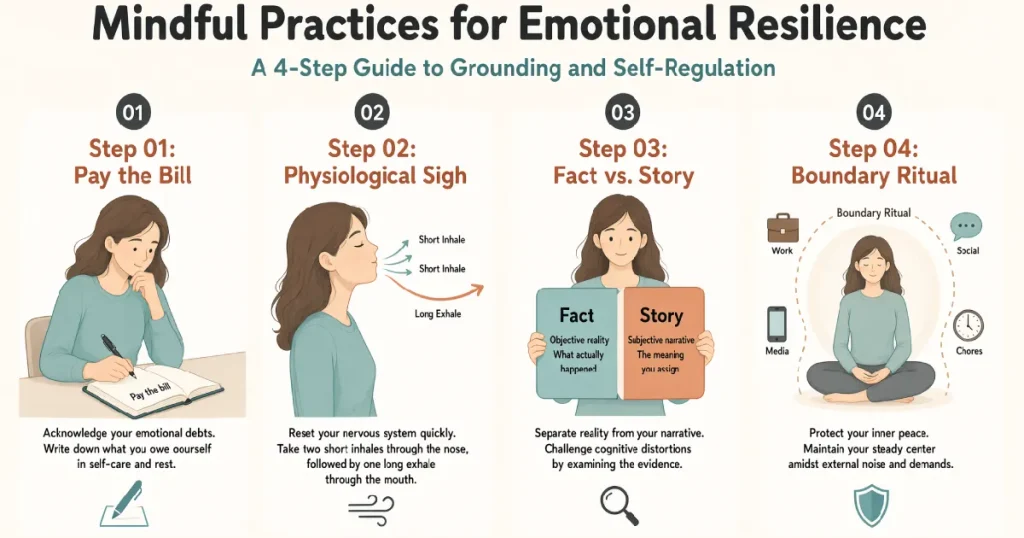
The physiological sigh. Take two short inhales through the nose, then one long, slow exhale through the mouth. Repeat two or three times. This is one of the fastest ways to signal safety to the vagus nerve, the long nerve that helps your body switch from panic toward calm.
Localized cold. Splash cold water on your face or hold a cold pack against your cheeks and the sides of your neck for 20 to 30 seconds. This can trigger the mammalian dive reflex, a built-in braking system that slows heart rate.
Sensory eye resets. Let your eyes slowly scan the edges of the room. Name five colors. This pulls attention out of the mental loop and back into present space. Work on bottom-up sensory tracking keeps confirming that the body can lead the mind back when the mind cannot lead itself.
A Three-Step Everyday Grounding Routine
You do not need a long practice. You need a repeatable one.
- Feet first. Press both feet into the floor and notice heel, arch, and toes. Stay there for four breaths.
- Spine second. Roll your shoulders once, then sit or stand a half-inch taller. Anxiety lives up in the head. Height and breath start moving energy downward.
- Name the room. Quietly say three objects you can see and one sound you can hear. Physical grounding strategies work because they interrupt dissociation, that foggy sense of floating above your own life, and return you to the present.
Do this before you try to solve the problem. Solve after your volume knob is back in your hand.
How Elena Stopped Paying Interest on Every Hard Day
Elena, 38, managed a team and helped care for her mother after a fall. At work she was the person who never flinched. In the parking garage she would sit with both hands on the wheel and feel a heat in her chest that had no words. She thought this meant she was secretly unstable.
She was not unstable. She was overdrawn.
We started with the body, not the story. Physiological sighs after hard calls. A real lunch. A lights-out time that was boring and non-negotiable. Then she added a nightly thought download: facts on the left, stories on the right. “Mom needs more help” was a fact. “I am failing everyone” was a story. The delayed wave still came. It just stopped owning the whole night.
Within weeks she was not calmer because life had improved. Life had not improved. She had stopped confusing composure with health.
Cognitive Engineering: Diversify Your Emotional Stability

Once the body is less hijacked, your thinking can do real work. This is where many people accidentally make themselves fragile again.
The Danger of a Single Emotional Anchor
If one partner, one friend, or one job title is the only place you feel okay, you do not have stability. You have a single point of failure.
This is not an argument against love. It is an argument against concentration risk. When all of your worth, soothing, and identity sit in one relationship, any conflict feels like annihilation. The same thing happens when your whole self-respect lives inside a job title. One bad review and your inner world caves in.
Build a small portfolio instead. One person for practical help. One for honest talk. One activity that restores you without requiring anyone else’s mood. One private ritual that belongs only to you. If one area goes chaotic, the whole structure still stands.
Separate Facts From Stories With Thought Downloads
Mental loops feel true because they are loud, not because they are accurate.
When your mind starts circling, write every thought without editing. Then mark each line as a Fact or a Story. A fact can be photographed or verified. A story is the meaning you added. “He left the dishes” is a fact. “He does not respect me” may be a story worth checking, but it is still a story until you test it.
This is not positive thinking. It is radical truthfulness. Sugarcoating a broken dynamic to keep a false peace is another form of debt. Facing the blunt truth may hurt for a few days. Lying to yourself to look stable costs you years.
Pair this with implementation intentions, a simple if-then plan that runs before emotion hijacks you. “If my boss uses that tone, then I will unclench my jaw, feel my feet, and ask one clarifying question.” “If I feel the delayed wave at 9 p.m., then I will write for ten minutes before I text anyone.” You are not waiting to become a calmer person. You are installing a calmer sequence.
The Social Politics Around Emotional Stability
The phrase itself is not neutral. It gets used as a compliment and as a weapon.
Gender Bias Still Distorts Who Gets Called Stable
Valid anger in a woman is still too often labeled unstable, dramatic, or “too much.” The same intensity in a man is frequently recast as passion, leadership, or drive. If you have spent years shrinking your reactions to avoid that label, your problem may not be excess emotion. It may be chronic self-erasure dressed up as maturity.
Emotional stability does not mean making other people comfortable. It means you can feel a full feeling and still choose a clean action. Boundary-setting can look intense to someone who benefited from your silence. That intensity is not proof you are unwell.
Radical Truthfulness Protects Long-Term Peace
A false calm that depends on denial is not peace. It is a temporary truce with reality.
If a relationship is one-sided, say so to yourself first. If a job is draining the life out of you, stop calling it “just a busy season” when it has been three years. Truth creates short pain and long stability. Self-deception creates short relief and long confusion.
That’s not weakness. That’s wiring meeting honesty.
What to Practice This Week
You do not need a new personality. You need a few named moves.
Pay the bill the same day. After any hard event, schedule a 10-minute discharge. Write, walk, cry, or shake out your hands. Do not wait until the weekend. Interest accumulates overnight.
Install one if-then plan. Choose your most common trigger and write a single sentence: If X happens, then I will do Y. Put it in your notes app. Read it once each morning for seven days.
Run a support audit. List the people and places that currently hold your emotional weight. If one name appears in every column, that is your warning light. Add one more source of steadiness this month, even a small one: a class, a sibling check-in, a solo Saturday ritual.
A useful question to ask yourself tonight is simple. Where am I still swiping the card and pretending the balance is zero?
The next time life gets loud, you do not have to become smaller. You can reach for the volume knob.
You were never meant to feel nothing. You were meant to feel fully and still remain yourself.
My Closing Remarks
I have sat with enough exhausted, high-functioning people to know this pattern from the inside, not only from the chair across the room. I used to treat my own composure like a professional credential. It looked impressive. It cost me sleep, patience, and a kind of private aliveness I did not notice was missing until it started to return. If you are the reliable one, you may need this more than anyone. Stability is not the reward for being low-maintenance. It is the daily act of coming back to yourself after the world has pulled you thin.
More Related Stories for You
- If part of your calm has been tied too tightly to one relationship, it may help to look again at the qualities of a good partner and notice whether support in your life actually flows both ways.
About The Author