


I see you. You are exhausted, aren’t you? You spend your days analyzing every text message, scanning rooms for tension, and trying to control outcomes that are completely out of your hands. You probably wonder, How Do You Treat a Neurotic Disorder when it feels like your own brain is actively working against you? For decades, the medical field handed people like you a generic depression pill, told you to do some deep breathing, and sent you on your way.
It was insulting, and honestly, it rarely worked.
But things have completely changed. We no longer look at intense emotional sensitivity as a broken mind. We look at it as a highly tuned nervous system that simply lacks a mute button. You do not have a character flaw. You are experiencing a high-resolution perception of threat, and your biological hardware is struggling to process the noise.
What is the current medical consensus on finding relief?
Treating a highly sensitive personality in the modern era requires a precision-based biological protocol rather than traditional talk therapy alone. The most effective treatment includes pharmacogenomic testing to find bio-compatible medications, using rapid-acting modulators to stop negative cognitive loops, practicing interoceptive recalibration, stabilizing the metabolic gut-brain axis, and implementing automated boundary scripts to preserve your mental energy.
Here is the truth. Standard advice to just relax fails because you cannot use your conscious mind to fix an unconscious physical reaction. You cannot think your way out of a hyperactive amygdala any more than you can think your way out of a fever.
As a therapist who has sat across from hundreds of high-achieving, totally burned-out individuals, I am going to walk you through exactly what works today. We are going to move away from old stigmas and dive into the biological, data-driven tools that can finally give you some peace.
The Core Concept: Redefining Emotional Stability Vulnerability
We need to start by changing our vocabulary. The medical community has largely moved away from the outdated, heavily stigmatized term of neurosis. Instead, we now look at Emotional Stability Vulnerability.
Table of Contents
What does this actually mean for you?
It means your tendency to experience negative emotions (like fear, anger, and shame) is just a biological hardware setting. It is a stable part of who you are. This trait only becomes a clinical problem when your recovery mechanisms fail. Biologically, this happens because there is a weak connection between your amygdala (the fire alarm in your brain) and your prefrontal cortex (the calm, rational CEO of your brain).
In a perfectly balanced nervous system, your prefrontal cortex looks at a mildly stressful email and tells your amygdala to stand down. In your brain, that connection is a bit noisy. Your alarm keeps ringing long after the fire is out. We call this concept Inertia.
“The way you think determines the way you feel.” – Aaron T. Beck.
Aaron Beck gave us the foundation of cognitive therapy. When you learn to catch your racing thoughts, you actually stop the physical panic before it starts.
You also have to understand the physical cost of all this worry. There is a concept called Allostatic Overload. This is the cumulative physiological wear and tear on your body resulting from chronic adaptation to stressors. When you are constantly on edge, your blood pressure spikes, your cortisol rhythms get entirely out of whack, and inflammatory markers in your blood shoot up. Your emotional pain is causing literal, physical damage to your cells. You can read more about how chronic stress impacts the body through resources provided by the National Institute of Mental Health (NIMH).
The Real Cost of Doing Nothing (A Quick Story)

Meet Sarah. She is a 34-year-old software architect living in San Diego, and she was absolutely exhausted. It was usually 2:15 AM on a Tuesday when her mind would hit maximum overdrive. I vividly remember her sitting on my beige office couch, obsessively twisting her silver wedding band around her index finger, a nervous habit she barely realized she had. She lived in an exhausting state of analysis paralysis.
Her late nights were spent pacing the hardwood floors, drinking lukewarm chamomile tea while mentally autopsying every single Slack message she had sent that day. She was constantly searching for hidden slights, perceived failures, or tiny mistakes. Her stomach was perpetually in knots, a heavy, tight feeling just below her ribs. She suffered from chronic insomnia and what we used to call a nervous gut. Her previous doctors had tried prescribing standard daily pills. Those medications only left her feeling numb, physically heavy, and completely disconnected from the joy in her life.
She genuinely felt broken. But Sarah was not broken at all. Her nervous system was simply highly tuned, acting like a loud fire alarm with no mute button. When we finally updated her treatment plan, everything shifted. We ran a genetic test and discovered her body metabolized standard drugs way too fast. By switching to a precision protocol, her life changed. The time she spent trapped in a negative spiral dropped from three miserable days to just twenty minutes.
How Do You Treat a Neurotic Disorder (The 5-Step Protocol)
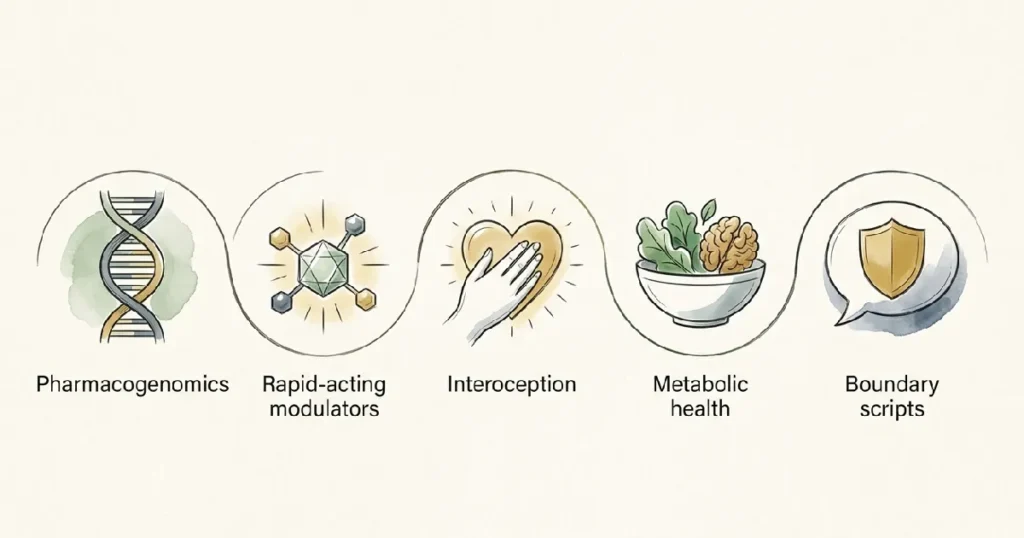
If you are tired of generic advice like taking a warm bath or doing yoga, this section is for you. Here is the modern, step-by-step protocol we use to lower your baseline reactivity without completely changing your personality.
Step 1: Conduct a Pharmacogenomic Baseline Audit
For decades, psychiatry relied on a deeply frustrating trial-and-error method. Doctors would hand you a standard SSRI (a common antidepressant), tell you to wait six weeks, and hope for the best. If it caused massive weight gain or ruined your sex drive, they would just switch you to another pill and start the clock over.
We do not do that anymore.
- Do This: Request genetic testing (pharmacogenomics) from your provider before starting any new psychiatric medication regimen. A simple cheek swab will reveal exactly how your specific liver enzymes process different drugs.
- Not That: Do not accept blind trial-and-error prescribing.
- Why It Works: Over thirty percent of patients simply do not respond to traditional pills due to genetic variants in an enzyme called CYP2D6. By checking your genes first, we end the guesswork. We can find a medication that fits your unique biological makeup, reducing the chance of emotional blunting.
Step 2: Utilize Rapid-Acting Modulators
The era of waiting months to feel better is ending. We are now seeing the rise of Neuroplasticity-Inducing Psychoplastogens. These are advanced molecules that help your brain quickly rewire itself.
- Do This: Talk to a specialized psychiatrist about rapid-acting glutamate modulators. Treatments like MM120 (a highly controlled, safe clinical tool) or newer nasal sprays like Fasedienol are designed to stop anxiety loops in their tracks. You can track the progress of these massive clinical advancements through databases like ClinicalTrials.
- Not That: Do not assume a daily pill is your only option.
- Why It Works: These new treatments do not just tweak your serotonin. They promote actual neurogenesis (the growth of new brain pathways). They reset the default mode network in your brain, offering relief in a matter of hours or days, not weeks.
Step 3: Master Interoceptive Recalibration Training
Here is a wild fact about highly sensitive people. You probably suffer from interoceptive inference errors. This means you feel everything happening inside your body (a racing heart, a flutter in your stomach), but your brain completely over-reacts to those sensations. You misinterpret a simple adrenaline spike from drinking too much coffee as a sign of impending doom.
- Do This: Practice the RAIN method to label your physical sensations.
- Recognize what is happening in your body.
- Allow the feeling to exist without fighting it.
- Investigate it with curiosity (say to yourself, “My chest is tight, but I am safe”).
- Nurture yourself with self-compassion.
- Not That: Do not use pure distraction or doom-scrolling as your main coping mechanism.
- Why It Works: Building your Interoceptive Accuracy trains your prefrontal cortex to stop hitting the panic button every time your stomach drops. The Psychology Today Interoception Guide breaks down exactly how physical awareness changes brain chemistry.
Step 4: Stabilize the Metabolic Gut-Brain Axis
Your brain is a massive energy hog. If your blood sugar is constantly crashing, your mood will crash right along with it. We call this Metabolic Psychiatry.
- Do This: Adopt an anti-inflammatory diet and ask your doctor to run an HbA1c test to check your blood sugar history. Focus heavily on getting enough magnesium, zinc, and Omega-3 fatty acids.
- Not That: Do not ignore your diet when treating your mental health. A sugar crash triggers the exact same physiological response as a panic attack.
- Why It Works: The bacteria in your gut produce over ninety percent of your body’s serotonin. Insulin resistance and systemic bodily inflammation are primary drivers of emotional volatility. By healing your gut, you calm your brain. The experts at Harvard Medical School have extensively documented how digestive health dictates emotional stability.
“There is no health without mental health; the brain is a biological organ.” – Dr. Thomas Insel.
Dr. Insel completely changed how we view emotional distress. You cannot separate your racing mind from the physical inflammation happening in your gut.
Step 5: Automate Interpersonal Boundaries with Precision Scripts
If you are neurotic, social interaction probably feels like walking through a minefield. You are terrified of making people mad, so you constantly people-please. This trauma response is called fawning, and it drains every ounce of your energy.
- Do This: Use pre-written boundary scripts. Automating your responses removes the emotional friction of saying no.
- Not That: Do not wait until you are completely burned out to set a boundary.
Try using these specific text messages this week:
- For the demanding boss: “I would be happy to help with that project. To ensure the absolute best quality of my current work, which tasks should I reprioritize to make room for this new assignment?”
- For the draining family member: “I am really not comfortable discussing that topic today. Let’s talk about something else, or I will need to step away from the conversation for a bit to recharge.”
- For the exhausting friend: “Thank you so much for thinking of me! I just do not have the social capacity for plans this weekend, but I hope you have an amazing time.”
By using these scripts, you preserve your Window of Tolerance. You stop bleeding energy on people who do not deserve it.
Comparative Analysis: Traditional Therapy vs. The Transdiagnostic Unified Protocol
In the past, therapy was heavily siloed. If you had generalized anxiety, you got one type of therapy. If you had obsessive-compulsive traits, you got another.
Today, the gold standard is the Transdiagnostic Unified Protocol Therapists now understand that all these different diagnoses share the exact same root cause: emotional avoidance. The Unified Protocol teaches you emotional flexibility. You learn to stop fighting your negative feelings and start moving with them. This approach is heavily backed by the American Psychological Association (APA), showing that when you treat the root cause of avoidance, all the other symptoms naturally fade away.
Common Mistakes and How to Avoid Them

Even with the best intentions, people often sabotage their own recovery. Here are four massive mistakes I see my clients make every single day, and exactly how you can fix them.
1. Relying Solely on Unsupervised AI Therapy Bots
We live in an incredibly digital world, and it is tempting to just vent to an artificial intelligence chatbot when you are feeling panicked at midnight.
- The Mistake: Treating a large language model like it is a licensed mental health professional.
- How to Fix It: Bots hallucinate medical facts. They cannot read your body language, and they will completely miss the signs of a true crisis. You should absolutely use AI to brainstorm ideas or summarize your messy journal entries. However, you must always take those summaries to a real, licensed human being to build your actual treatment plan.
2. Ignoring the “Inertia Factor” in Recovery
People constantly judge their healing by the number of panic attacks they have. If they have a bad day, they assume all their progress is gone.
- The Mistake: Expecting your emotional spikes to disappear completely.
- How to Fix It: Success is not about stopping the spike. Success is lowering your recovery time. When you get triggered, use a simple two-minute labeling script. Say out loud, “I am experiencing a massive cortisol surge. My body is safe right now. This feeling will completely pass in fifteen minutes.” Track how fast you bounce back, not how often you fall down.
3. “Ritual Stacking” to the Point of Burnout
Wellness culture is incredibly toxic for highly sensitive people. You see an influencer online, and suddenly you are taking ice baths, swallowing fifteen different supplements, meditating for an hour, and tracking your sleep cycles with three different devices.
- The Mistake: Trying to do everything at once, which is just perfectionism in disguise.
- How to Fix It: Stop exhausting yourself. Limit your healing to exactly two things. Pick one biological habit (like eating a high-protein breakfast to stabilize your blood sugar) and pick one psychological habit (like using boundary scripts at work). Do only those two things for ninety days before you try adding anything else to your plate.
4. Mistaking “Nocebo” Responses for Real Side Effects
Highly anxious individuals have incredibly powerful minds. If you read the side effects label on a bottle of aspirin, you will probably start feeling nauseous within ten minutes. This is called the Nocebo Effect.
- The Mistake: Expecting a new treatment to fail just because the old ones did.
- How to Fix It: Your brain will physically manifest the pain it expects to feel. Before you start a new medication or therapy, you have to consciously break the loop. Write this down and stick it on your mirror: “My previous bad experiences do not predict how my body will react to this completely new biological pathway.”
Frequently Asked Questions
What is the best way to explain my neuroticism to a partner?
You should use a clear calibration script to explain your biological reactions. Tell them your brain has a highly sensitive alarm system that sometimes goes off when there is no actual danger. Explain that you do not need them to fix the problem. You just need them to acknowledge it and give you twenty minutes to recalibrate.
Can a neurotic disorder lead to actual physical health problems?
Yes, chronic emotional instability absolutely increases your physical stress levels, which doctors call your allostatic load. This constant state of physiological wear and tear is heavily linked to cardiac issues, immune system dysfunction, and irritable bowel syndrome. Treating your highly reactive personality traits acts as powerful preventive medicine for your entire body and long-term health.
Is the new MM120 treatment safe for severe anxiety?
Pharmaceutical-grade MM120 is administered in highly controlled, non-hallucinogenic doses by trained professionals. Clinical trials consistently show it is incredibly safe. It provides massive symptom relief for up to twelve weeks following just a single dose. It works rapidly by effectively resetting the default mode network of the brain, breaking negative cognitive loops without daily medication.
How exactly does metabolic psychiatry help with personality issues?
This medical approach focuses entirely on treating the brain as an energy-intensive organ. By carefully managing your insulin sensitivity and providing essential micronutrients like magnesium and B-vitamins, doctors can significantly reduce neural irritability. Stabilizing your blood sugar directly stops the massive mood swings and emotional volatility that make highly sensitive personality traits feel impossible to manage.
What should I do if an AI chatbot gives medical advice?
You must always verify any artificial intelligence suggestions with a licensed human professional. Health technology experts list the misuse of automated therapy bots as a massive hazard to patient safety. You can use these bots for brainstorming or summarizing your daily journal entries, but never use them for official diagnosis or long-term behavioral treatment planning.
Final Takeaway
You do not need to wake up tomorrow and be a completely different person. The goal here is not to completely erase the parts of you that care deeply, plan carefully, and notice the small details. Those traits are actually beautiful. The goal is simply to build a stronger container for your intense energy.
Start small. This coming Monday morning, when you feel that familiar rush of panic hitting your chest over an email or a meeting, just pause. Do one single interoceptive audit. Label the feeling in your body objectively. Say, “My throat feels tight,” instead of, “My life is falling apart.” Then, fire off one of your automated boundary scripts to protect your peace. True transformation is built entirely on these tiny, data-driven micro-wins. Over time, these small actions literally rewire the physical hardware of your brain, giving you the quiet, stable life you have always wanted.
My Closing Remarks
We spend so much time pathologizing our deepest feelings, begging doctors to numb our beautiful, messy human reactions. Stop fighting your own biology. Your intense sensitivity is not a curse, a character flaw, or a lifelong prison sentence. It is simply a highly sensitive biological instrument that you never learned how to tune. I suffered for years before I realized my emotional intensity was my greatest asset. Demand better care, refuse the standard numbing pills, and finally step into the vibrant, stable life you actually deserve.
More Related Stories for You
- Understand why you feel things so deeply by exploring these high-order personality dimensions.
- Learn why we sometimes try to numb them through substance use when our nervous system gets overwhelmed.
- See how these intense neurotic traits actually show up in your daily routines and relationships.