
 Nicole Adkins
The signs look like anxiety, but the real story is about a nervous system trying to keep you safe.
Key Points
- What is a neurotic person like in love is not chaos. It is a nervous system that notices threat before anyone else does.
- The same sensitivity that fuels overthinking can also make you the most loyal, attentive partner in the room.
- Lasting connection is built with structure, co-regulation, and tools that calm the body, not with unlimited reassurance.
Contents
Table of Contents
We know that pause. The one that happens after a message is marked read and the reply does not come. Most of us fill the silence with a story. For some of us, that story arrives faster, louder, and with a body that treats the delay like danger.
Someone might think you are being dramatic when you ask if everything is okay for the second time in an hour. But what they do not see is the way your chest tightens before you even type the words.
Someone might think your partner is needy when they reread a short text looking for a hidden meaning. But what they do not see is a nervous system doing its job too well.
Someone might think real love should feel easy. But what they do not see is that ease and depth are not the same thing.
A neurotic person in love notices tone, delayed replies, and distance faster than most. They seek reassurance to quiet an internal alarm. This is a personality trait, not a flaw. With the right tools, they become some of the most loyal partners you will ever know.
Left unexamined, this pattern does not just strain a relationship. It can quietly become the reason it ends. The good news is that the pattern is understandable, common, and far more workable than the word “neurotic” has ever made it sound.
What a Neurotic Person Actually Means in Psychology
In casual conversation, “neurotic” lands like an insult. Unstable. Dramatic. Too much. In psychology, it means something far more precise and far less cruel.
Neuroticism is one of the Big Five personality traits, the same research model that includes openness, conscientiousness, extraversion, and agreeableness. It describes how strongly you feel negative emotions such as anxiety, guilt, or sadness, and how quickly your body registers a possible threat.
Everyone sits somewhere on this spectrum. A person high in neuroticism is not broken. They are more emotionally reactive. They pick up subtle shifts in tone and mood. They are more likely to read ambiguity as a warning. Verywell Mind’s overview of neuroticism makes this distinction clear: it is a trait, not a diagnosis, and not a character defect.
You can be high in neuroticism and still be kind, reliable, funny, and deeply capable of love. The trait names your emotional volume. It does not name your worth.
Most people in this situation do not realize that. They just keep calling themselves “too much” and hoping the next partner will finally prove them wrong.
7 Signs of What a Neurotic Person Is Like in Love
When this trait walks into a relationship, it does not look like a textbook. It looks like Tuesday night.
1. A frequent need for reassurance. You ask “Do you still love me?” or “Are we okay?” more often than a calmer partner expects. The question is not a test. It is an attempt to turn the alarm off.
2. Hypervigilance to tone and micro-expressions. A slightly flatter voice. A shorter reply. A face that looks tired instead of warm. You notice it first, and your body decides it means something is wrong.
3. Protest behavior when you feel disconnected. This can look like withdrawing, over-texting, or starting a fight just to feel close again. The goal is not conflict. The goal is contact.
4. Jealousy rooted in fear, not distrust. The fear is rarely “you will cheat.” It is “you will leave, and I will not see it coming.”
5. Overthinking after minor conflict. A small disagreement plays on a loop for hours. You search for the hidden meaning, the sentence that proved you are too much, the moment things quietly changed.
6. Deep empathy and loyalty once you feel safe. When the alarm is quiet, you remember the details. You show up. You notice when your partner is hurting before they have found the words.
7. Digital anxiety spirals. A delayed reply or a read receipt with no response can set off a reaction that looks out of proportion from the outside. Inside, it feels like falling.
You are not the only one who has refreshed a message thread looking for proof you are still wanted. That habit has a name, a cycle, and a better way through it.
The Reassurance Trap: Why a Neurotic Person Needs Constant Validation
Psychologist Thomas Joiner’s work on excessive reassurance-seeking describes a loop that many couples know by heart. Anxiety triggers a request for comfort. Comfort brings brief relief. The underlying fear returns, often stronger, and another request follows.
The more reassurance you get, the more your brain treats reassurance as the only proof of safety. The more you ask, the more a patient partner starts to feel drained. Nobody is the villain in this cycle. The design of the cycle is the problem.
Unlimited access to “Are we okay?” does not heal the fear. It feeds it. The fix is not to withhold comfort. The fix is to structure it, which you will see later as the Timed Reassurance Rule.
Digital Triggers: Read Receipts, Delayed Texts, and Spiraling Thoughts
Modern phones gave neurotic patterns a new stage. Read receipts. The “typing…” bubble that appears and dies. A partner active on social media while your message sits unanswered. These are not small details to a sensitive nervous system. They are incomplete data, and incomplete data feels like danger.
Maya, 34, used to watch that bubble vanish and feel her stomach drop. She would tell herself not to text again. Twenty minutes later she would send, “Did I do something wrong?” Her partner Daniel was often in a meeting, or driving, or simply thinking. By the time he replied, Maya had already written a full story in which he was pulling away. She was not trying to punish him. She was trying to survive a silence her body had coded as abandonment.
This is where anxiety-related patterns described by the National Institute of Mental Health overlap with everyday relationship life. The fear is real in the body even when the facts are kind. Maya and Daniel later agreed on a response window. The spiral still visited. It stopped running the house.
The Hidden Strength of a Neurotic Partner

Most conversations about neuroticism stop at the hard parts. That is a half-truth, and half-truths make people ashamed of the very quality that also makes them devoted.
Higher neuroticism has been linked with greater emotional attunement. You notice the shift in someone’s eyes. You hear the tightness in a “I’m fine.” You remember the anniversary, the hard week at work, the thing they said they were afraid to want. Think of it as an early warning system for the relationship. The same sensitivity that causes overthinking also means you often catch a real problem before anyone else does.
Here is the metaphor I want you to keep.
A neurotic nervous system is a smoke alarm that goes off when toast burns. The sound is real. The emergency often is not. You still have to live with the noise until you learn how to reset it. But that same alarm will also wake you when there is actual smoke. Dismiss the person, and you lose the detector. Teach the detector a new setting, and you keep the protection without the nightly panic.
When a neurotic person feels safe, they are frequently the most attentive, loyal, and emotionally present partner in the relationship. Not despite the sensitivity. Because of it.
That’s not drama. That’s wiring.
Why Neurotic Love Happens: The Nervous System Science
This is the part most advice skips, and it is the part that makes the behavior make sense.
According to polyvagal theory, developed by Dr. Stephen Porges, your autonomic nervous system constantly scans for cues of safety or threat. That scanning is called neuroception. It happens below conscious thought. You do not decide to feel unsafe. Your body decides first, then your mind writes a story to match the feeling.
In someone high in neuroticism, that scanner is simply more sensitive and quicker to fire. A flat tone. A slower reply. A change in posture. These can register as danger before the thinking brain catches up. Harvard Health’s work on chronic stress and the threat response helps explain why “nothing is wrong, I promise” so often fails in the moment. The ears hear the words. The body has not received the all-clear.
This is also where neuroticism and anxious attachment get tangled. They often travel together, but they are not the same thing. Anxious attachment is a learned pattern about how safe it feels to depend on a specific person. Neuroticism is a broader personality trait that shapes how strongly you feel fear, guilt, and sadness across your life, not only in romance. That is why attachment work alone sometimes is not enough. You may also need tools that calm the body, not only the bond.
Once you see the mechanism, the shame starts to loosen. You are not choosing to ruin a good night. You are living in a body that sounds the alarm early.
Can a Neurotic Person Build a Lasting, Secure Relationship?
Yes. And the conditions are more ordinary than people fear.
It usually takes three things. Self-awareness, so you can name the pattern instead of acting it out. A partner who can stay steady without becoming defensive. And in many cases, support that matches the actual problem, such as Emotionally Focused Therapy for attachment wounds or a body-based approach like Somatic Experiencing for nervous system flooding.
There is also room for real change at the trait level. Research by Roberts and colleagues, published in Psychological Bulletin, found that personality traits, including neuroticism, can shift in meaningful ways across adulthood. Therapy, mindfulness practiced over months, and stable relationships are among the forces that help the volume come down. This is not a life sentence. It is a pattern that can soften.
In my practice, this pattern reverses when couples stop treating sensitivity as the enemy and start treating it as information.
You do not have to become a different person to be easy to love. You have to become a better-equipped version of the person you already are.
How to Support a Neurotic Partner Without Losing Yourself
Co-regulation is the idea that one calm nervous system can help settle another. It has become a core idea in modern couples work because patience, by itself, runs out. The Gottman Institute’s writing on emotional communication keeps returning to this truth: tone, timing, and small signals of safety often matter more than the perfect speech.
A few practices make this concrete.
Use a steady voice even when you are tired. Tone is processed faster than language. Offer brief physical contact when words are bouncing off, a hand on the back or a short hold, so the body gets the message the sentence cannot deliver yet. Name your state out loud before the gap fills with fear: “I am not upset. I am just tired.” Agree on scheduled check-ins during hard weeks instead of leaving reassurance open-ended.
This is not a job offer to become someone’s full-time calm. It is a set of small, repeatable signals that lower how often the alarm goes off, and how long it lasts when it does.
If you are the partner doing the supporting, your limits belong in the plan. Love that has no edges turns into resentment, and resentment is a poorer gift than an honest boundary.
Managing Your Own Neurotic Tendencies in Love

If you recognized yourself in Maya, or in the seven signs, the goal is not to sand down your sensitivity. The goal is to give it better tools.
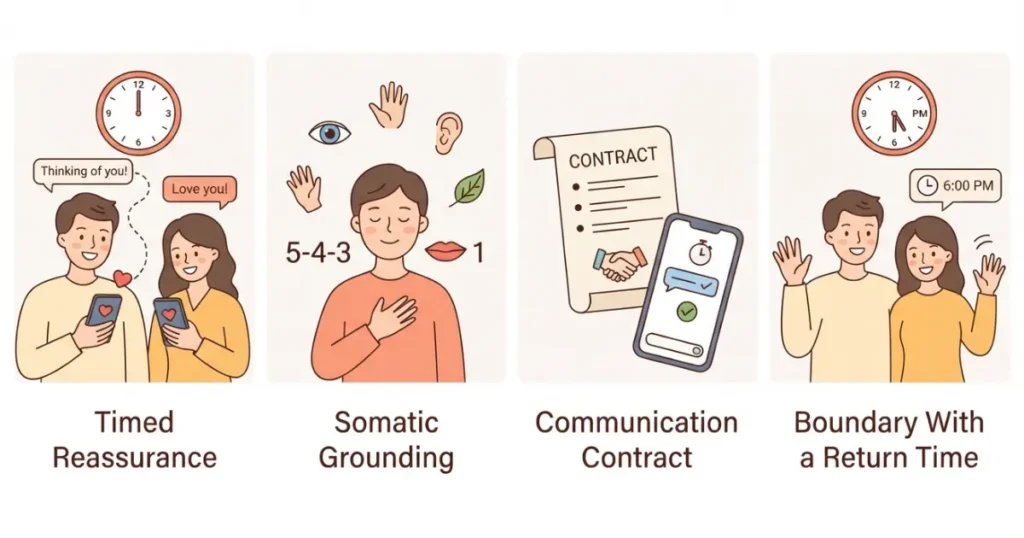
The Timed Reassurance Rule. Instead of asking whenever the fear spikes, agree on structured check-ins. A midday text at a set time. A short evening recap. Predictable contact interrupts the loop Joiner described, because the brain starts to trust the schedule instead of hunting for proof.
Somatic grounding before the debate. When you are flooded, logic will not land. Try the 5-4-3-2-1 sensory reset: name five things you see, four you can touch, three you hear, two you smell, one you taste. Or place a hand on your chest and feel one full breath land. Calm the body first. Then talk.
Thought-record journaling. Before you reach out for reassurance, write the fear down. What am I afraid this means? What evidence supports it? What evidence does not? You can still ask for comfort after. You will ask from a clearer place.
A digital communication contract. Agree on a real response window. “I will reply within a few hours unless it is urgent” removes the story your nervous system writes in the blank space. Ambiguity is fuel. Clarity is a firebreak.
Sustained mindfulness will not make you unrecognizable. Over months, it has been tied to measurable drops in trait neuroticism. Think of it as lowering the smoke alarm’s sensitivity by a few degrees, not ripping it out of the ceiling.
A useful question to ask yourself the next time the spiral starts: “Is this smoke, or is this toast?”
Setting Boundaries With a Neurotic Person You Love
Compassion fatigue is real. If you love someone with high neuroticism, the third check-in of the night can leave you emptied, even when you still care. That exhaustion is not proof that you are selfish. It is proof that unlimited emotional labor has a cost.
The boundary that works is the one that includes reassurance rather than erasing it.
Try this script: “I love you, and I need an hour alone right now. I will check in with you at 6 p.m.”
That single sentence does two jobs. It protects your bandwidth. It also answers the fear of disappearance that silence alone can trigger. You are not choosing between kindness and self-respect. You are putting them in the same sentence.
If you are the neurotic partner hearing a boundary, notice the urge to treat space as rejection. Space with a return time is not abandonment. It is a promise with a clock. Let the clock do some of the work your anxiety wants your partner to do.
Loving a neurotic person, or being one, does not require fixing anyone. It requires treating sensitivity as a system you can work with. Structure, self-awareness, and steady co-regulation turn that system from a nightly emergency into a form of loyalty most people spend years hoping to find.
You still know that pause after the read receipt. You still feel it. The difference is that you now have a name for the alarm, a way to reset it, and a relationship that does not have to burn down every time the toast does.
You were never too much. You were missing the manual.
My Closing Remarks
I have sat with people who whispered they were too much for anyone to stay. I have sat with the partners who loved them and felt emptied by the third check-in of the night. Both were telling the truth. What changed things was never more love. It was structure. Your nervous system is allowed to be loud. Your relationship is allowed to have rules. Those two facts can live in the same house. They have to.
More Related Stories for You
- If delayed replies and online visibility keep lighting that alarm, read more about how social media affects relationships and the quiet ways a feed can turn a small silence into a full story.
About The Author