

The internet handed you a Greek letter and called it a self. Your real personality was never that still.
Key Points
- Popular female personality types are social media costumes, not clinical categories, and wearing them too long creates real burnout.
- Sigma, Alpha, and Dark Feminine labels often hide attachment patterns, workplace masking, or undiagnosed neurodivergence.
- Fluid female personality types describe you more honestly because your traits already change between work, home, and love.
Contents
Table of Contents
We have been sorting women into types as if one word could hold a whole life. Sigma. Alpha. Dark Feminine. Omega. We pin the word on and wait to feel finished. You know that small rush when a caption seems to explain every tense meeting, every cold date, every night you chose silence over a crowded room.
Female personality types online are not science. They are shortcuts for burnout, attachment wounds, and sometimes traits that deserve a clinical look. The type that truly describes you is the one that shifts when your context shifts. Fluidity is not confusion. It is psychological health.
Someone might think a Sigma female is simply born independent. But what they don’t see is a woman who learned that asking for help came with a price, then wrapped that lesson in a Greek letter so the loneliness would look like power.
Someone might think Dark Feminine energy is just a style of makeup, posture, and expensive quiet. But what they don’t see is a nervous system that got tired of being available and built distance so nobody could take the last of her.
Someone might think she is fake because she leads like an Alpha at 10 a.m. and wants to be held at 10 p.m. But what they don’t see is a normal adult doing what personality research has shown for years. Behavior bends toward the room you are standing in.
This pattern has a name in psychology: identity foreclosure. That is what happens when you lock onto a self before you have tested enough versions of yourself to know which parts are chosen and which parts were just nearby. A short video offers a finished identity. A tired brain accepts the offer.
According to the American Psychological Association, the trait model with real empirical support is the Big Five, sometimes called OCEAN. That stands for Openness, Conscientiousness, Extraversion, Agreeableness, and Neuroticism. There is no peer-reviewed female dominance ladder made of Greek letters. Those categories work more like horoscopes with better lighting.
Left unexamined, this pattern does more than waste an afternoon on a quiz. It can quietly become the reason you feel ashamed of ordinary needs. And shame is a terrible architect of a life.
The Greek Alphabet Trap Inside Female Personality Types
The Greek-letter hierarchy was borrowed from wolf-pack myths and old pickup culture, then rebuilt for women. Alpha means dominant and ambitious. Sigma means independent and hard to reach. Beta means agreeable and supportive. Gamma means creative and off-script. Delta means hardworking and overlooked. Omega means withdrawn and done with the climb.
If one of those words fit, that does not make you gullible. It makes you human. Your brain likes clean stories. A single label reduces the noise of a complicated week into something you can post, date with, or hide behind.
The trouble starts when a social shorthand gets treated like a diagnosis. Workplace friction, dating patterns, and social exhaustion are real. A Greek letter cannot explain them. It can only rename them. When you use the rename as the answer, you stop looking for the cause.
Personality psychologists talk about traits and states. A trait is a durable tendency, like being generally conscientious. A state is how that tendency shows up today, under this boss, after this little sleep, in this relationship. Online female personality types collapse those two things into a costume and then tell you not to take it off.
Dark Feminine Energy Is Armor, Not a Personality Type
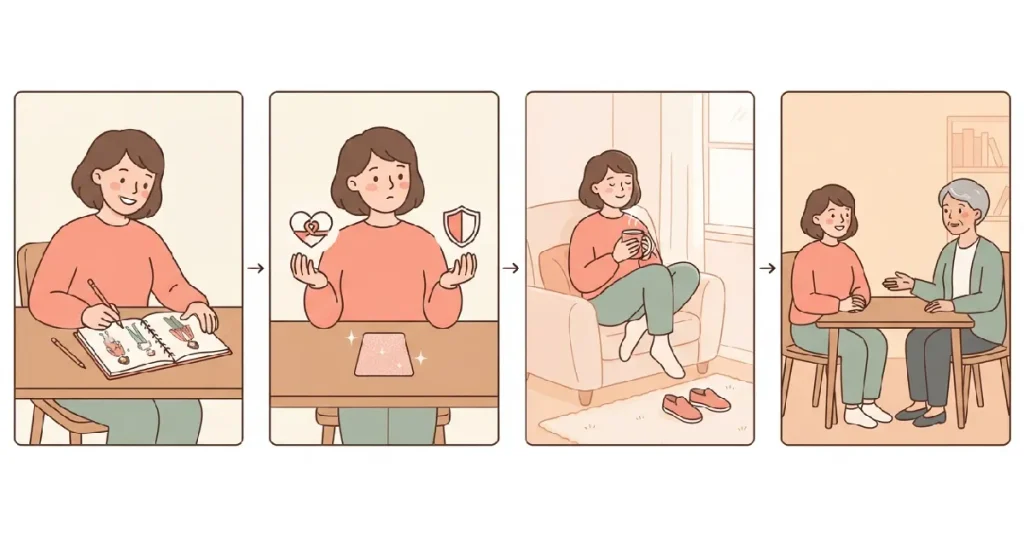
Dark Feminine content sells boundary, sensuality, and emotional distance. Light Feminine content sells softness, warmth, and a slower pulse. Both can look like fashion. Both are often recovery strategies.
For many women, Dark Feminine branding is psychological armor. After burnout, betrayal, or being talked over in a meeting, cold elegance feels safer than openness. Light Feminine content often rises in the same women later, when the armor gets heavy and the body starts asking for rest.
Aesthetics can be useful. A red lip can help you walk into a room you used to shrink in. A soft morning can help you come down from a week of overfunctioning. The problem is not the look. The problem is mistaking the look for a personality type you now have to maintain.
Internet female personality types work like a rented costume. The first night it feels like a revelation. By week three the seams are cutting into your shoulders, and you start blaming your body instead of the outfit.
MBTI Personality Types and the INTJ Woman Problem
Myers-Briggs never left. It just moved into the same conversation as Sigma and Dark Feminine. Analytical types, especially INTJ and INFJ women, report a specific kind of friction. The same cognitive style that gets a man called strategic can get a woman called cold, intense, or hard to manage.
The Myers-Briggs Foundation has long noted that certain introverted thinking profiles are less common among women. Rarity plus a gendered script creates a double bind. You are asked to be warm enough to be likable and sharp enough to be taken seriously, often in the same hour.
That bind is not a flaw in your female personality types. It is a mismatch between how your mind works and what the room expects femininity to sound like. If you have spent years sanding down your directness so nobody calls you difficult, of course a “rare type” label feels like home. It gives your difference a name that sounds like a gift instead of a problem.
Micro-Archetypes Hidden in Everyday Female Personality Types
Beyond Greek letters, a quieter taxonomy has taken hold. The Caretaker carries everyone else’s mood. The Perfectionist outruns anxiety with achievement. Panda Girl wants low light, soft clothes, and as little performance as possible.
These micro-archetypes work as emotional shorthand. They let you signal a complex inner state without writing an essay. They also map, with uncomfortable accuracy, onto attachment patterns. Attachment style is the learned way you reach for closeness or protect yourself from it.
The Caretaker often tracks with anxious attachment, the habit of managing other people so you will not be left. Panda Girl often tracks with avoidant withdrawal or with simple burnout recovery. The Perfectionist can be either, plus a nervous system that treats rest like danger.
The label is the costume. The attachment pattern is the seam.
Self-Boxification Fatigue and Fixed Female Personality Types

Across comment threads, a pattern keeps repeating. Women describe shame after failing to stay on-brand. Not Sigma enough. Too soft for Dark Feminine. Too ambitious for Light Feminine. Too needy for Omega. The shame is the point, even when nobody uses that word.
This deserves a name: Self-Boxification Fatigue. It is the exhaustion of performing a personality label instead of living a life. It happens because internet archetypes are sold as identities to achieve, not patterns to notice.
Maya, 34, a marketing director, found Sigma content after a bruising breakup. The videos told her that needing people was a Beta habit. She stopped texting friends first. She called her Sunday loneliness “high-value solitude.” At work she became sharper, cooler, harder to read. Then her sister had a baby and Maya wanted to sit on that couch and be ordinary and close. The wanting felt like a fall from rank. She almost canceled the visit to protect the brand.
In session language, Maya was not becoming more herself. She was using impression management, the effort to control how others see you, as a substitute for grief. When she tracked her “modes” for two weeks without grading them, the Sigma pose showed up after conflict. The Caretaker showed up with family. The Perfectionist showed up before presentations. None of those modes was fake. The lie was that only one of them was allowed to count.
The type was never you.
Most people in this situation do not realize that the fatigue is information. It means the box is too small for a life that has more than one room.
What Psychologists See Behind Female Personality Types
Here is the gap most personality quizzes will never mention. Research collected through the National Institutes of Health has shown for years that ADHD and autism in women are underdiagnosed. Traits like hyperfocus, social withdrawal, emotional intensity, and uneven social energy get recoded online as Sigma, Omega, or Gamma personality traits.
That recoding has a cost. A woman who keeps seeing herself in Omega withdrawal may be managing autistic burnout, the crash that follows too much social performance. A woman who loves Sigma hyperfocus and detachment may be living with ADHD-related hyperfixation. Treating those patterns as a fixed female personality type can delay support for years.
Masking makes this harder to spot. Masking is the learned effort to hide or reshape your natural responses so you appear easier, smoother, or more professional. Many women already mask at work because the room still rewards a narrow version of competence. Then they come home and drop the act so hard they look like a different person. That is not a dual personality. That is a nervous system clocking out.
If an archetype description fits you intensely, repeatedly, and around focus, sensory overload, or social exhaustion, that is worth a conversation with a clinician. A quiz cannot give you that conversation. It can only give you a prettier name for the strain.
Fluid Female Personality Types: The Frame That Fits Real Life
Pew Research Center data on younger generations keeps pointing in the same direction. Many people already prefer a self that changes with context over a self that stays loyal to one badge. That preference is not flakiness. It is closer to psychological flexibility, the skill of staying in contact with the present moment and choosing behavior based on your values instead of a rigid rule.
Fluid female personality types treat archetypes as temporary outfits. Sigma independence during a career pivot. Caretaker warmth inside a family week. Perfectionist drive on a deadline. Dark Feminine steel after a boundary gets crossed. Light Feminine softness when your body is done performing.
You are not inconsistent because Monday and Sunday do not match. You are adaptive. The healthiest personality is not the most dramatic type. It is the one that can change rooms without calling itself a fraud.
The Collaboration Model for Female Personality Types
Ranking women from Alpha to Omega trains you to compete with people who could have been relief. In teams, that ranking is especially useless. A detail-minded Delta and a big-picture Sigma are not rivals. They cover different parts of the same problem.
The Collaboration Model maps complementary strengths instead of a ladder. Who steadies the room? Who spots the risk? Who starts the hard conversation? Who recovers the group after conflict? Those questions build better work and better friendships than any hierarchy of female personality types.
Attachment Styles Beat Any Personality Test for Women

For dating and close relationships, community wisdom and clinical practice keep landing in the same place. Your attachment style and your non-negotiable values predict friction better than any Greek-letter match chart. Secure, anxious, avoidant, and disorganized are not aesthetic brands. They are maps of what you do when closeness gets risky.
A structured attachment-style assessment will not make you a type. It will show you the move you make under stress. That is far more useful than learning whether a Sigma should date an Alpha.
How to Work With Fluid Female Personality Types
One place to start is the Mode Map. For seven days, jot down the “type” you appeared to be in three settings: work, home, and one relationship. Do not grade the entries. Just notice the weather. Maya wrote “Sigma after the budget meeting, Caretaker on the phone with Mom, Panda Girl by 9 p.m.” Seeing the rotation on paper turned shame into data.
Consider the Attachment Swap. The next time you reach for a personality quiz, take an attachment measure instead. Then ask a gentler question. “When I feel unsure, do I chase, disappear, or freeze?” That question will tell you more about love than any female personality types chart.
A useful practice after a high-mask day is an Authenticity Window. Give yourself 20 to 40 minutes with no audience. No improving your face. No optimizing your rest. Sit, walk, or eat something warm. Neurodivergent women especially need this decompression on purpose, not as a collapse they apologize for later.
If the same “type” keeps taking over your life, try the Clinical Checkpoint. Chronic Omega withdrawal, Sigma hyperfocus that wrecks sleep, or Caretaker overfunctioning that you cannot stop may be more than an aesthetic. Bring those patterns to a licensed clinician and ask about ADHD, autism, anxiety, or depression. You are not dramatic for wanting a real explanation.
The next time a video tells you who you are, try this line in your head: “That is one mode I can borrow. It is not a sentence.”
You came here looking for the female personality type that powerfully describes you. You may have hoped the answer would be clean. Sigma. Dark Feminine. INTJ. Something you could keep.
Look back at that first click of recognition, the caption that felt like relief. The relief was real. The cage was optional. You can keep the language as a shorthand and still refuse to live inside it. The costume can go back to the shop. Your shoulders already know this.
A personality that cannot change rooms is not a personality. It is a cage with good branding.
You were never meant to be a type. You were meant to be true in more than one room.
My Closing Remarks
I have watched brilliant women shrink themselves to stay on-brand for a label a stranger invented between ads. I have also watched the moment a woman puts the costume down and her voice comes back into her body. That moment is quiet. It is not cinematic. It is a text sent first, a need said out loud, a Sunday spent unimpressive and alive. If a Greek letter has been running your choices, this is your permission slip. Return it. You do not owe the internet a finished self.
More Related Stories for You
- If your “type” has been covering anxiety you can no longer outrun with aesthetics, these mindfulness exercises for anxiety can help you come back into your actual body instead of a brand.