
 Sara Carmen
Why the calmest, most uneventful Tuesday with your partner might be the clearest proof that you are finally safe.
Key Points
- Learning what a healthy relationship looks like starts with noticing what’s missing, like fear and guesswork, not just what’s present.
- These 15 real signs trade fireworks for something sturdier: consistency, repair, and ordinary emotional safety you can count on.
- If quiet, steady love feels confusing right now, that reaction says more about your past than about your current partner.
Contents
Table of Contents
We’ve all absorbed the same script about love. Someone chases someone through the rain. A grand gesture fixes everything overnight. The chemistry feels instant and a little unstable, and somehow that instability gets marketed to us as passion.
So when your relationship feels steady instead of stormy, part of you starts keeping score against a movie that was never real to begin with.
Someone might think you’re settling because there’s no chaos to chase anymore. But what they don’t see is the quiet check-in text every afternoon, just because.
Someone might think a fight that ends in five calm minutes means neither of you cared enough to fight harder. But what they don’t see is that neither of you needed to win.
Someone might think boredom is the beginning of the end. But what they don’t see is that boredom, in this context, is your body finally exhaling after years of holding its breath.
If you grew up watching two people love each other through slammed doors and silent treatments, safety can feel unfamiliar. It can even feel suspicious. That confusion is common, and it doesn’t mean something is wrong with you.
What a Healthy Relationship Actually Feels Like in Your Body
A healthy relationship looks like consistency, ordinary tenderness, and the absence of fear, not a nonstop parade of romantic highs. It’s the relief of exhaling around someone instead of bracing for impact. Research on attachment consistently shows that felt safety, not excitement, predicts whether love actually lasts.
The Psychology Behind Feeling Safe in a Relationship
Psychologists use a term for what happens inside a secure partnership: co-regulation. It means your partner’s calm presence actually helps settle your own nervous system, the network that controls your fight-or-flight response. When you’re anxious and they respond with steadiness instead of matching your panic, your body slowly learns this person is not a threat.
This matters because your body has been quietly asking one question since childhood: is this person safe? Attachment theory, first developed by psychologist John Bowlby and expanded by later researchers like Sue Johnson, explains that humans are wired to seek a secure base, someone we can return to and feel steadied by. Walden University’s relationship framework backs this up, noting that mutual respect and consistency, not intensity, form the actual backbone of relationships that last.
Beyond safety, there’s a second driver of satisfaction: feeling known. Not just adored, known. People who feel genuinely understood, quirks and all, tend to report higher relationship satisfaction over the long run than those who simply feel showered with compliments.
Healthy couples also shift their language without noticing it. Instead of “you always” or “I need,” they start saying “we.” Not in a way that swallows either person’s identity, but in a way that adds a shared layer on top of two whole people who still exist separately. That shift sounds small. It changes almost everything.
15 Real Signs of a Healthy Relationship You Can Actually Recognize
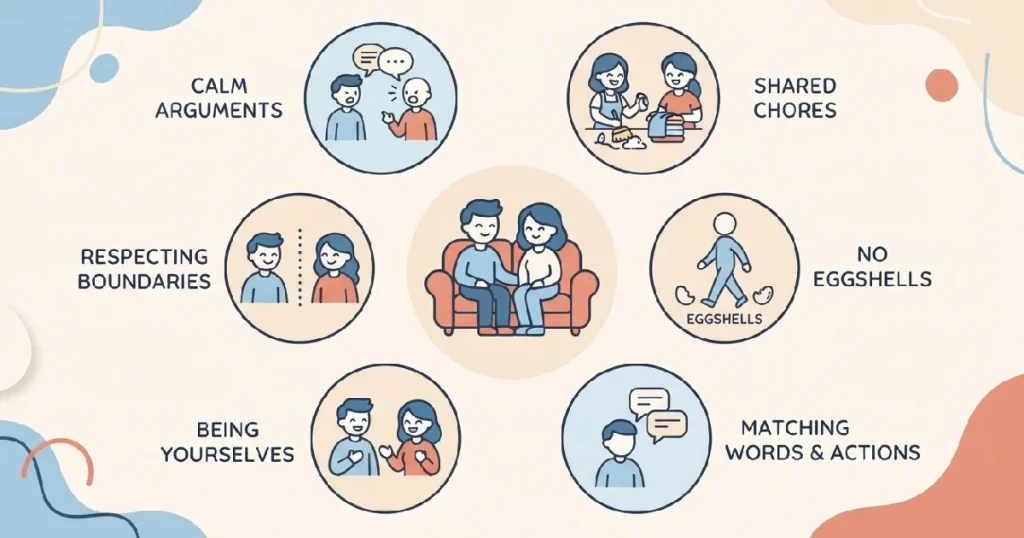
1. No “Eggshell Walking”
You can share a bad mood, an unpopular opinion, or an honest mistake without bracing for an explosion or a freeze-out.
Example: You come home drained and admit you just need quiet time. Your partner doesn’t take it personally. They simply give you the space you asked for.
This is emotional safety in its most basic form, and it’s the floor everything else on this list is built on.
2. The Relationship Feels “Calm and Boring” in the Best Way
If your nervous system is used to chaos, calm can feel like a red flag. It isn’t.
Example: A Friday night spent reading on the same couch, barely talking, still feels satisfying instead of tense or lonely.
Steady love isn’t dull love. It’s love with the adrenaline finally turned down.
3. Arguments Are “Us vs. the Problem”
Disagreements happen without name-calling, insults, or dragging up old wounds to win a point.
Example: Instead of yelling about dirty dishes, one of you says, “I’m overwhelmed by the house right now, can we split this differently?” and the other actually works with you.
Healthy couples fight the issue, never each other.
4. Your Partner Notices Things Before You Ask
Researcher John Gottman calls these small moments “bids for connection,” the tiny attempts we make to get noticed by someone we love.
Example: Your partner sees you’re almost out of your favorite coffee and grabs it on the way home, no request required.
Turning toward these small bids, instead of ignoring them, is one of the strongest predictors of lasting connection that Gottman’s research has identified.
5. You Keep Your Own Identity Intact
Distinct hobbies, friendships, and personal goals survive the relationship instead of dissolving into it.
Example: Your partner spends a weekend away with friends, and you enjoy your own quiet weekend without either of you sending anxious check-in texts every hour.
The Johns Hopkins University green flag guidelines specifically point to respect for outside friendships as one of the clearest markers of a healthy dynamic, and for good reason. Losing yourself is not the same thing as loving someone.
6. You Can Be Unfiltered and Still Feel Loved
The messy, unglamorous parts of you don’t need to be hidden or performed around.
Example: You get hit with a stomach bug, say so plainly, and your partner brings you water without flinching or making it weird.
7. Their Words and Actions Always Match
There’s no guessing game, no delayed replies used as a power move, no testing your loyalty on purpose.
Example: You know they love you because what they do lines up with what they say, day after day, without contradiction.
That consistency is what quiets relational anxiety instead of feeding it.
But here’s what no one tells you.
Calm isn’t the absence of feeling. It’s the presence of a functioning alarm system that’s finally allowed to rest. A chaotic relationship works like a smoke alarm that never stops chirping. You get so used to the noise that real silence starts to feel wrong, even threatening. A healthy relationship simply changes the batteries. The chirping stops, and for a while, that stillness feels almost suspicious. It isn’t. It’s just quiet.
8. Chores, Money, and Emotional Labor Are Actually Shared
Both people show up to manage life, without one partner playing manager or being cast as “the nag.”
Example: You sit down together and look at your shared budget in plain, calm detail, instead of hiding purchases or dreading the conversation.
The Johns Hopkins research mentioned earlier also flags equal effort around daily responsibilities as a marker of respect, not just logistics.
9. Your “No” Is Respected, Not Punished
Boundaries don’t disappear once you fall in love. In a healthy relationship, they’re welcomed as protection for the bond itself.
Example: Your partner says they don’t have the bandwidth for a heavy conversation tonight, and you agree to pick it back up tomorrow instead of pushing.
10. Everyday Chores Turn Into Connection
The boring, repetitive tasks of daily life feel easier and even a little sweet when done side by side.
Example: Doing the dishes together after dinner becomes a small, teasing ritual you both quietly look forward to.
11. You Assume Good Intentions First
A concept researchers call negative sentiment override happens when you start interpreting everything your partner does through a negative lens, even neutral or well-meaning actions. Healthy couples resist that pull.
Example: They forget to text back during a busy afternoon, and your first thought is “they got slammed at work,” not “they’re pulling away.”
12. You Can Be Vulnerable Without Bracing for Judgment
Deep fears, financial stress, or shame from your past can be spoken out loud and met with care instead of dismissal.
Example: You share a painful memory from childhood, and your partner listens fully and holds you instead of telling you to get over it.
13. Apologies Come With Real Change
A “sorry” that isn’t backed by different behavior is just a pause button, not a repair. Psychological research on long-term compatibility consistently finds that the quality of a couple’s repair attempts, not the absence of conflict, is what actually predicts whether a relationship survives.
Example: Your partner apologizes for snapping during a stressful week, then visibly works on managing their stress differently the next time things get hectic.
14. There’s Nothing to Hide
No secret accounts, no hidden messages, no small lies told just to dodge criticism.
Example: You’d leave your phone unlocked on the counter without a second thought, not because you’re being tested, but because there’s genuinely nothing to find.
15. You Genuinely Just Like Each Other
Underneath the romance, you’re actual friends who enjoy each other’s company and sense of humor.
Example: Even after years together, you still look forward to hearing the front door open just to see their face and hear about their day.
Rebuilding Trust in a Healthy Relationship After a Chaotic Past

If you grew up in a house where love came with conditions or unpredictable moods, calm can feel strangely uncomfortable at first. That discomfort has a name in psychology: it’s your baseline recalibrating, and recalibration is rarely instant.
Learning to accept safety is an active process. It often means catching yourself when you want to pick a fight just to feel something familiar, or when you assume good treatment must be temporary.
A healthy relationship is not a perfect one. Stress still happens. What actually keeps a bond safe is the capacity to repair after a rupture, not the absence of rupture in the first place.
Harvard Health’s relationship guidance points out that unbalanced, draining relationships slowly erode mental well-being over time, while responsive, empathetic listening actively restores it. Most people in this situation don’t realize how much energy chronic tension has been quietly draining until it finally stops.
Maya’s Story: Learning to Trust the Quiet
Maya spent three years bracing for arguments that never came in her new relationship, and the stillness genuinely unsettled her. She’d pick small fights just to see if her partner, Daniel, would leave the way her father used to. He never did. He’d just ask, calmly, what was really going on underneath the fight. Six months in, Maya finally admitted the quiet was starting to feel less like danger and more like home. She hadn’t been settling. She’d just never been safe enough before to notice the difference.
What to Try This Week to Build a Healthier Relationship
One place to start is a Weekly Weather Check, a two-minute conversation where you each name how connected you’ve felt on a scale from one to ten, no defending required, just information.
Consider trying the 24-Hour Repair Rule as well. If a disagreement leaves either of you feeling off, agree that one of you will circle back within a day, even briefly, instead of letting resentment quietly compound.
A useful question to ask yourself is this: when was the last time I mistook peace for a lack of love? Sitting with that answer honestly tends to reveal more than any checklist ever could.
You might also keep a small Green Flag Journal, jotting down one ordinary moment each week where you felt genuinely safe, seen, or cared for. Patterns become obvious once they’re written down instead of just felt.
Bringing It Back to That Quiet Tuesday
Remember that movie script we started with, the one with the rainstorm and the chase and the fireworks? Real love was never actually written that way. It was written in the ordinary Tuesday, the one where nothing dramatic happened and you still felt completely at ease.
You now know what that ease is actually built from: safety, consistency, and repair, not intensity.
The smoke alarm has finally stopped chirping. That silence isn’t empty. It’s the sound of being safe.
My Closing Remarks
I’ve sat across from so many people who apologized for their relationship being “too easy,” as if ease were something to defend. It never is. In my practice, the couples who last aren’t the ones without conflict, they’re the ones who keep choosing repair over pride. If your relationship feels quiet right now, let it. Quiet was never the absence of love. It was love, finally allowed to rest.
More Related Stories for You
- For more grounded, practical guidance on strengthening your connection day to day, check out this good advice for a relationship.
About The Author