
 Sara Carmen
Why the same dinner-and-a-movie date keeps failing you, and 19 real ways couples are fixing it this week.
Key Points Box
- Your brain gets used to pleasure fast, which is why even couple activities you once loved start feeling flat.
- These 19 couple activities are pulled from real relationships, not a marketing team’s idea of “romantic.”
- Novelty isn’t a luxury for your relationship. It’s a psychological requirement for keeping the spark alive.
Contents
Table of Contents
We all know the drill. Work ends, dinner gets ordered, a show gets picked, and by 9 p.m. you’re both staring at a screen instead of at each other. It feels comfortable. It also feels a little dead inside, and neither of you wants to say it out loud.
You’ve noticed it too. The conversation over takeout has started sounding like a status update instead of a connection. You laugh at the same three jokes. You’ve watched everything worth watching, and somehow you still can’t remember the last time you felt genuinely surprised by your partner.
Someone on the outside might think your relationship is fine. You go out, you split the bill, you post the occasional photo. But what they don’t see is the quiet boredom sitting at the bottom of it, the sense that you’re both just going through motions you stopped choosing a long time ago.
You’re not broken, and neither is your relationship. You’re just stuck in a loop that was never designed to hold your attention forever.
Why Dinner and a Movie Stopped Working on You
Here’s the part that might surprise you: it’s not that dinner and a movie is a bad date. It’s that your brain was never built to stay excited about the same experience indefinitely.
Psychologists call this hedonic adaptation, which is a fancy way of describing something you already know intuitively. The first time you did something enjoyable with your partner, it lit you up. The fiftieth time, your nervous system barely registers it. Your brain adjusts its baseline for pleasure, so the same activity has to work harder and harder to produce the same feeling it once did.
This isn’t a character flaw. It’s wiring.
Your relationship isn’t failing because the routine went stale. The routine went stale because that’s what routines do, biologically, to every human brain that has ever existed.
There’s a second piece to this, and it’s the one most couples never hear about. A well-known 2000 study by relationship researcher Arthur Aron and his colleagues, published in the Journal of Personality and Social Psychology, found that couples who did new, mildly challenging activities together, rather than familiar, comfortable ones, reported noticeably higher relationship satisfaction afterward. The researchers connected this to what’s called self-expansion theory, the idea that people are drawn to relationships that help them grow, learn, and become a slightly different version of themselves. When your partner becomes the person who introduces new experiences into your life, your brain files them under “exciting” again, even after years together.
This is also why shared screen time isn’t automatically the villain. Large, shared entertainment moments, like couples tuning into a global event such as The Game Awards 2021, can still create genuine connection when the attention is joint and active rather than two people silently scrolling in parallel. Coverage from BBC News on that same event noted how shared audience moments, reacting together in real time, are part of what makes an experience memorable rather than forgettable. The problem was never the screen. It’s passive consumption versus active participation.
In my practice, I’ve noticed the couples who describe themselves as “bored” almost never mean they’ve fallen out of love. They mean they’ve run out of novelty, and they don’t know that novelty is something you can manufacture on purpose.
19 Inspiring and Creative Couple Activities to Break the Rut
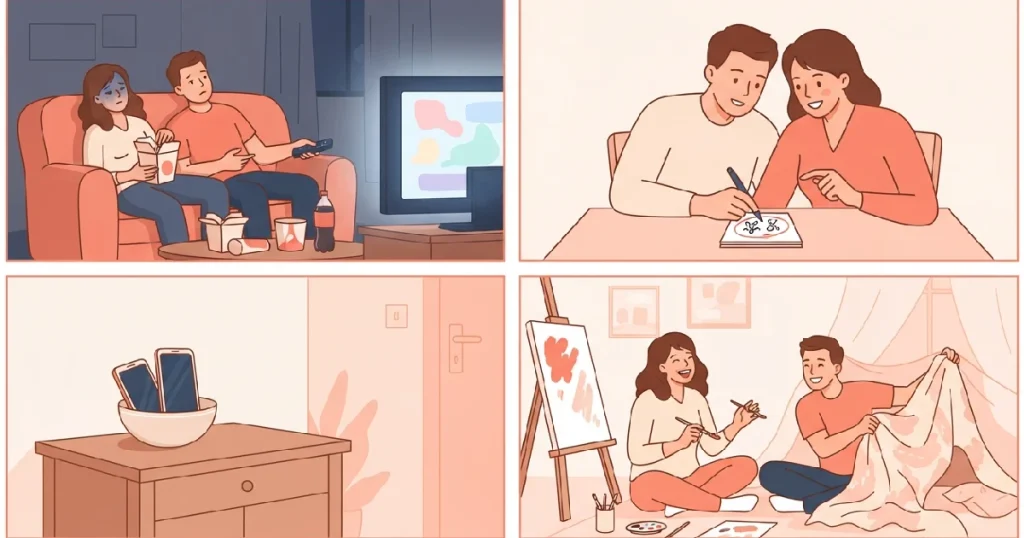
Think of your relationship right now like a treadmill. You’re both moving. You’re both putting in effort. But you’re not actually going anywhere new, and that’s exactly why it feels exhausting instead of energizing. These couple activities exist to get you off the treadmill and back onto open ground.
At-Home and Creative Bonding
These require almost no money and work well for couples craving connection without leaving the couch entirely.
- Canvas Swap Painting Night: Grab two cheap canvases, follow along with a Bob Ross video, then swap canvases halfway through and finish each other’s work.
- Themed Cookbook Roulette: Pick up a secondhand cookbook, choose the most intimidating recipe inside, and cook it together with music playing.
- “Sexy Jenga” Game: Write playful or deep questions on Jenga blocks. Whatever block you pull, you answer.
- Drunk Scrabble Challenge: Play normal Scrabble, but add a rule where a wrongly challenged word means a sip of your drink.
- Read-Aloud Book Club: Choose a short story collection and take turns reading chapters out loud on the couch.
- Audiobook Craft Sessions: Start a thriller audiobook while working on a large jigsaw puzzle together.
- The “No-Screen” Blanket Fort: Build a living room fort, light it with string lights, and talk with your phones somewhere else entirely.
Give yourself permission for these to go badly. The burned recipe and the lopsided painting aren’t failures, they’re the whole point.
Outdoor and Adventurous Outings
Fresh air changes the conversation, literally and biologically.
- Thrift Shop Costume Date: Give each other a small budget to pick an outfit, then wear it out for drinks.
- Guinness World Record Attempt: Search the record database for something quirky and try to beat it at home.
- Childhood Place Tour: Drive each other through your old neighborhoods, stopping to tell the stories behind them.
- No-Service Wilderness Hike: Find a trail with zero cell signal, so nature and each other are the only options.
- Ghost Tour Sightseeing: Book a local ghost walk or true-crime tour and see your own city like a tourist.
- Geocaching Scavenger Hunt: Download a geocaching app and spend a Saturday hunting hidden containers in local parks.
- Airport People-Watching: Sit in a terminal and invent elaborate backstories for strangers rolling by with suitcases.
Playful and Competitive Escapes
A little rivalry does something your nervous system actually craves.
- Improv and Acting Workshops: Drop into a local beginner improv class and laugh through the awkward parts together.
- Target Sports Date: Try axe throwing, archery, or a batting cage instead of another restaurant reservation.
- Goodwill Scavenger Hunt: Race to find the weirdest toy, the ugliest shirt, or the oldest item on the shelves.
- Nostalgic Skee-Ball and Arcades: Spend the night at a retro arcade playing purely for tickets and bragging rights.
- Bar Trivia Night Showdown: Team up at a local pub quiz and turn your combined knowledge into friendly warfare against strangers.
Here’s the part almost no one explains about competition between partners. Mild, low-stakes rivalry triggers a small dopamine response, the same neurochemical involved in motivation and reward. It’s not about winning. It’s about your brain briefly treating your partner as a source of excitement again instead of a source of familiarity.
One Couple’s Turning Point
Maya and Devon had been together six years and could barely remember their last real conversation over dinner. Every Friday looked the same: takeout containers, a show neither of them cared about, phones within reach. Maya suggested axe throwing on a whim, mostly out of desperation. Devon lost every round and refused to let it go. They spent the drive home laughing about his terrible aim instead of scrolling in silence. Nothing about their relationship had changed structurally. What changed was that, for two hours, they had both been fully present in the same moment, competing, teasing, actually looking at each other. That’s the shift these couple activities are built to create.
8 Unique Seasonal Couple Activities

These come from couples across the US and UK who noticed something specific: certain seasons practically hand you a built-in excuse for novelty.
Spring and Summer
- Kayak Sunset Picnic: Tie two kayaks together on a calm lake at dusk and share a picnic while the sun goes down.
- Plant Nursery “His and Hers” Date: Spend an afternoon at a greenhouse picking custom plants for each other to keep alive.
- Renaissance Faire First-Date Style: Dress up, eat a ridiculous turkey leg, and watch jousting like it’s your first date all over again.
- Late-Night Stargazing: Set up blankets in a truck bed or open field outside the city and watch for shooting stars.
Autumn and Winter
- Pumpkin Carving and Roasted Seeds: Hold a carving competition, then roast the seeds together with custom spices.
- The “YouTube Fireplace” Present Wrap: Play a crackling fireplace video, add winter music and a cheese board, and wrap gifts together.
- Call-In-Sick Winter Takeout Day: Pick one freezing day to skip responsibilities entirely and stay in bed with food and movies.
- Gingerbread House Architecture Battle: Skip the kit. Buy raw graham crackers and candy, then see whose house survives the night.
Now What: Turning This List Into an Actual Habit
Reading a list of couple activities feels good for about ten minutes. Turning one into a weekly rhythm is what actually rebuilds a relationship.
One place to start is what I call the Rotation Rule. Pick three activities from this list right now, one from each category, and put them on the calendar for the next three weeks. This removes the mental tax of deciding “what do we even want to do” every single Friday, which is often the real reason couples default back to dinner and a screen.
Consider asking each other a simple question before you commit: “Which of these would make us laugh at ourselves?” Activities with a built-in chance of looking silly, like the gingerbread battle or the thrift store costume date, tend to produce the fastest reconnection because they lower your guard.
The next time boredom shows up on a Tuesday night, try naming it out loud instead of silently enduring it. Something as simple as “I think we’re in a rut” opens a door that months of quiet frustration never will. Most couples don’t realize their partner is often just as bored and just as relieved to hear someone else say it first.
Left unexamined, this kind of low-grade boredom doesn’t just make weeknights dull. Over years, it can quietly become the distance that ends relationships that were never actually broken, just unattended.
Breaking the Routine for Good
You don’t need a bigger budget or a better relationship to feel this shift. You need a Tuesday night and a willingness to look a little foolish in front of the one person who already knows you completely.
That treadmill feeling, moving without going anywhere, isn’t permanent. It only holds as much power as your routine gives it.
Pick one activity from this list before the weekend arrives. Not the perfect one. Just one.
Connection was never about finding the right date. It was always about choosing to create something new together.
My Closing Remarks
I’ve watched couples spend hundreds of dollars trying to fix boredom with bigger dinners and fancier plans, when what actually worked was a five-dollar thrift store shirt contest that made them laugh until they cried. Your relationship doesn’t need more spending. It needs more surprising itself. Start smaller than you think you should, and let the silliness do the work you’ve been overthinking for months.
More Related Stories for You
- Curious what it means when your partner starts noticing you again during these dates? Here’s what it really means when a guy calls you beautiful and why that shift often shows up right after couples break out of a routine.
About The Author