
 Sara Carmen
The friction that ends cross-cultural marriages rarely looks like conflict. It looks like silence.
Key Points
- Cultural differences in marriage rarely explode into one big fight. They wear love down quietly, one unspoken assumption at a time.
- Understanding the hidden rules your partner grew up with is the fastest way to stop mistaking culture for a lack of love.
- Couples who name these 12 patterns early can turn cultural friction into their marriage’s greatest source of strength.
Contents
Table of Contents
Most marriages that quietly fall apart don’t end with one dramatic betrayal. We like to believe love dies in a single loud moment: an affair, a screaming match, a slammed door. For couples navigating cultural differences in marriage, the real story is usually much quieter than that.
You’ve felt it, maybe without ever finding the words. The small sting when your partner doesn’t call their mother before making a decision that affects you both. The confusion when affection feels rationed. The loneliness of loving someone whose inner rulebook you still can’t quite read, even after years of marriage.
Here’s the short answer, before we go further. Cultural differences in marriage don’t destroy love because two people disagree. They destroy love because both partners are following invisible rules neither of them ever agreed to out loud, and each one mistakes the other’s rule-following for a lack of care.
Why Cultural Friction Feels So Lonely in Intercultural Relationships
Picture your mind as an operating system, installed slowly over eighteen or twenty years by your family, your language, your holidays, and a thousand small examples you watched growing up. Your partner has their own operating system too, quietly running a completely different set of rules underneath the surface.
You aren’t incompatible. You’re running different software, and nobody ever handed either of you the manual.
This is why cultural friction feels so isolating. Most arguments come from something you can name, like money or chores. Cultural friction hides inside assumptions so deep that neither partner realizes they’re assumptions at all.
A widely cited multi-country analysis on individualism and collectivism found that these two orientations shape what people actually require to feel satisfied in marriage, from how much independence they expect to how involved extended family should be in daily decisions. If you grew up believing your parents have a permanent seat at your marital table, and your spouse grew up believing marriage means building a completely separate life, neither of you is wrong. You’re simply working from two different definitions of the word family.
If you’ve searched relationship forums late at night wondering whether your marriage is unusually broken, it isn’t. Thousands of intercultural couples describe this exact ache: deep love, paired with a persistent, low-grade exhaustion neither person can fully explain. That combination has a name. Psychologists sometimes describe it as anxious-ambivalent strain, a mix of wanting closeness and quietly fearing you’ll never fully get it. It’s common, and it’s very solvable.
Left unexamined, this quiet friction doesn’t just create distance. According to a Psychology Today analysis on intercultural marriage, these unions can carry a distinct vulnerability, not because the love is weaker, but because couples often skip the step of turning unspoken rules into shared ones. Naming the specific differences is where that starts to change.
12 Cultural Differences That Silently Destroy Marital Love
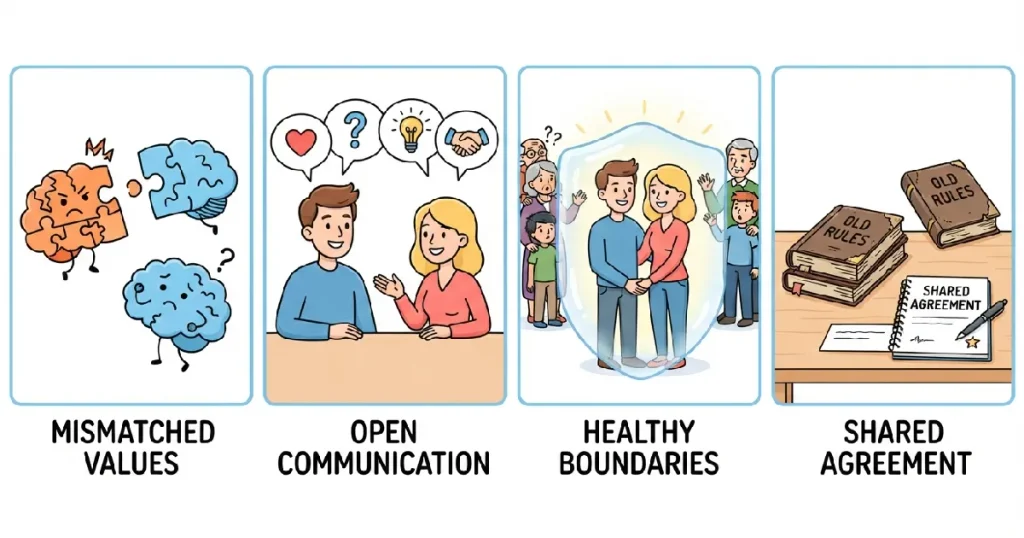
Each of these patterns follows the same quiet arc: a clash neither partner named, a slow cost that built without anyone noticing, and a fix that works once the pattern finally has a name.
1. High-Context vs. Low-Context Communication in Marriage
The clash: One of you expects needs to be read between the lines. The other needs things said plainly, out loud, in full sentences.
The quiet cost: The direct partner starts to look blunt or even harsh. The indirect partner quietly stacks up resentment over needs that were never spoken, only implied.
The fix: Try a weekly check-in where the direct partner asks one specific question, like “What do you need from me this week?” The indirect partner practices answering plainly instead of softening it into a hint.
2. Individualism vs. Collectivist In-Law Dynamics in Marriage
The clash: You see your marriage as its own unit, making its own calls. Your partner sees parents as permanent co-decision makers, woven into every major choice.
The quiet cost: The Western-leaning spouse starts to feel like the third priority in their own household. The collectivist spouse feels torn between two loyalties at once.
The fix: Set a private rule that major decisions get finalized between the two of you first, even if the conversation with extended family happens afterward. A recent review in the Journal of Cross-Cultural Psychology found this exact kind of boundary is one of the strongest predictors of satisfaction in individualist-collectivist pairings.
3. Public and Private Displays of Intimacy Across Cultures
The clash: One of you shows love through touch, a hand on the back, a kiss hello at a party. The other grew up seeing public affection as exposing, even disrespectful.
The quiet cost: The touch-oriented partner starts to feel physically starved of warmth. The reserved partner feels watched and overexposed.
The fix: Build a private language of affection instead of a public one. A specific hand squeeze during dinner. A look across a crowded room. Small, coded signals give you both what you need without either of you performing for an audience.
4. Financial Collectivism vs. Financial Autonomy in Marriage
The clash: Sending money home every month feels like basic duty to one of you. It feels like an unexpected leak in the budget to the other.
The quiet cost: Trust erodes quietly around money, already one of the most common sources of marital conflict.
The fix: Set up a three-pot system: one joint account for shared bills, one individual account each partner controls freely, and one capped, agreed-upon family support line. Nobody gets blindsided by a transfer they didn’t know was coming.
5. Egalitarian Roles vs. Traditional Domestic Hierarchies in Marriage
The clash: One of you expects a fully equal partnership at home. The other carries a deeply internalized, often unconscious script about which chores and decisions belong to which gender.
The quiet cost: Resentment builds fast here, faster than almost anywhere else, because it shows up in small tasks every single day.
The fix: Run an honest household audit. List every task. Assign it by actual schedule and skill, not by who “should” do it. This one change resolves more marital arguments than most couples expect.
6. Language Barriers and the Slow Loss of Wit in Marriage
The clash: Speaking your second language, even fluently, strips away quick wordplay, sarcasm, and the emotional shortcuts that make you feel truly known.
The quiet cost: Over time, the native speaker starts assuming their partner lacks depth or humor, when really, they’re just working in translation.
The fix: Slow down on purpose. Learn five slang phrases from your partner’s first language. Ask them to explain a joke that didn’t land. This single habit builds more closeness than most couples realize.
Here’s what almost nobody tells couples going through this: the fight was never really about the chore, the money, or the missed hug.
Dr. John Gottman’s research on “bids for connection,” small attempts one partner makes to get attention, affection, or support, found that couples who consistently miss each other’s bids drift apart even without ever having a major fight. In cross-cultural marriages, the bid usually lands just fine. It’s the language around it that gets lost.
Your partner texting their mother before texting you isn’t a rejection of you. It’s their bid for connection, just filtered through a different operating system. Once you see it that way, the sting changes shape. It stops feeling like proof you’re unloved and starts feeling like a translation problem you can actually solve.
7. High Emotional Expressiveness vs. Stoic Self-Censorship in Marriage
The clash: One of you processes emotion out loud, immediately, sometimes loudly. The other was raised to internalize distress to protect group harmony.
The quiet cost: The expressive partner starts to look explosive or dramatic. The reserved partner gets labeled cold, even when they’re quietly overwhelmed inside.
The fix: Use a shared written check-in once a week, just a few sentences each. Writing removes the pressure of an immediate reaction and gives the quieter partner room to say what’s actually true.
8. Multi-Generational Living Expectations in Marriage
The clash: In one culture, aging parents moving in permanently is simply what family does. In another, an independent household is a non-negotiable boundary.
The quiet cost: Privacy disappears. Ordinary romantic connection, the kind that needs unguarded time and space, quietly starves under constant supervision.
The fix: If a shared household is required, build in hard spatial boundaries, like a separate suite, along with clear rules about who has a say in parenting and money. Structure protects the marriage even when the living arrangement itself can’t change.
9. Divergent Child-Rearing and Discipline Philosophies in Marriage
The clash: High-pressure academic expectations and strict discipline collide with a more permissive, child-led approach to development.
The quiet cost: Parents start undermining each other in front of the kids, which teaches children to play one parent against the other.
The fix: Have the disagreement privately, every time, and present a united front in public no matter what. Children need consistency far more than either parent needs to win the argument.
10. Cultural Assimilation Guilt Inside Marriage
The clash: One partner assimilates fully into a Western lifestyle for years, then suddenly pulls back, flooded with guilt about losing their heritage.
The quiet cost: The local spouse feels blindsided by a shift they never saw coming and don’t fully understand.
The fix: Build heritage into the calendar on purpose, not as a crisis response. Regular visits home, traditional meals, holidays observed every year. Guilt has less room to grow when identity is already being honored consistently.
11. Diverging Conceptions of Time and Punctuality in Marriage
The clash: One of you treats the clock as sacred. The other grew up in a culture where events start when people arrive, not when a clock says so.
The quiet cost: Constant arguments over lateness quietly build a false story that one partner simply doesn’t respect the other’s time.
The fix: Set different rules for different stakes. Hard deadlines for flights and job interviews. Flexible windows for casual dinners and family gatherings. One rule doesn’t have to fit every situation.
12. Hidden Religious and Spiritual Undercurrents in Marriage
The clash: A secular or minority-faith partner runs into the quiet, foundational pull of a dominant religion, especially around births, deaths, and major milestones.
The quiet cost: Philosophical gaps that felt manageable during dating suddenly feel enormous once children, funerals, or holidays are on the table.
The fix: Map out how you’ll handle major life transitions before you’re standing in the middle of one. Mutual respect works. Quiet pressure to convert the other person doesn’t.
When “You Don’t Care About My Family” Really Meant Something Else

Priya grew up in a British Asian household where checking in with parents before big decisions was simply how love worked. Tom grew up ten miles away, in a family where marriage meant the couple decided things privately, then told everyone else afterward.
For the first two years of marriage, every visit to Priya’s parents turned into a quiet argument in the car. Tom felt like an afterthought in his own marriage. Priya felt torn in half, guilty no matter what she chose.
Neither of them was wrong about what love should look like. They were simply using two different manuals, and nobody had ever asked them to compare notes.
Once they named the pattern out loud, they built one new rule: big decisions get discussed between the two of them first, privately, before either family weighs in. The arguments in the car stopped almost immediately. What changed wasn’t the culture. It was the clarity.
Moving Forward: How to Build Your Own Third Culture in Marriage
Here’s the reframe that changes everything: you don’t have to pick a winner between two cultures. You get to build a third one.
Couples across relationship forums describe this same move, often without knowing there’s research behind it. They stop trying to force one partner’s rulebook onto the marriage and start writing a new one together, borrowed from both backgrounds, owned by neither alone.
Research from the National Institutes of Health supports this instinct. Studies on mutual acculturation, meaning both partners intentionally adapt toward each other rather than one partner assimilating alone, link this approach to significantly higher marital satisfaction over time. Intentionality is the active ingredient. Couples who leave it to chance drift apart. Couples who build it on purpose tend to thrive.
There’s a strong case that intercultural couples end up with an advantage most same-background couples never develop. You’re forced to communicate explicitly from day one, because you can’t assume your partner shares your unspoken rules. That skill, saying the quiet thing out loud, is exactly what predicts long-term stability in any marriage, cross-cultural or not.
Where to Start This Week With Cultural Differences in Marriage
You don’t need to overhaul your entire marriage overnight. Small, specific changes move faster than most couples expect.
The Assumption Audit. Sit down separately and each write five things you quietly assumed marriage would look like, based on how you grew up. Compare lists together. Most couples find two or three assumptions neither of you ever said out loud before.
The Bid Translator. The next time your partner does something that stings, pause before reacting. Ask yourself what bid for connection might be underneath it, a phone call to a parent, a request for modesty, a need for structure. Naming the bid usually softens the sting.
The 7-7-7 Check-In. Borrowed from a modern marriage framework, this means one date night every seven days, one weekend away every seven weeks, and one longer trip every seven months, all protected from extended family and household obligations. Cultural friction tends to shrink when the relationship itself gets consistent, undiluted attention.
A question worth sitting with this week: which of these 12 differences has been quietly running your marriage without either of you ever naming it out loud?
Conclusion: Protecting Cultural Differences in Marriage From Quiet Erosion
Love doesn’t usually die from the differences themselves. It dies from leaving them unspoken for too long.
You aren’t running incompatible software. You’re running two systems that were never properly introduced to each other, until now.
Every one of the 12 patterns above stops being dangerous the moment you name it together, out loud. That’s the whole shift. Not less culture. More clarity.
The couples who make it aren’t the ones without differences. They’re the ones who stopped guessing and started asking.
My Closing Remarks
In eight years of clinical work, the couples who struggle most with cultural differences in marriage are rarely the ones who differ the most. They’re the ones who stopped talking about it, quietly assuming love should sort itself out. It doesn’t, and it isn’t supposed to. The couples I’ve watched build the strongest marriages are the ones who asked the awkward questions early, about money, parents, time, and touch, cultural gap and all.
More Related Stories for You
- If you want good advice for a relationship that goes beyond cultural friction, start there next.
About The Author